






Wanxiang Blockchain Annual Review: From NFT to Innovation Field (Application)


Original Source: Wanxiang Blockchain Chief Economist Office
2022 is coming to an end, and we will look back at the ups and downs of the industry this year. Whether it is technological breakthroughs, application innovations, or the rise and fall of ecology, they have all become historical footnotes in the development of the industry. As in previous years, Wanxiang Blockchain launched a series of important annual review articles at the end of the year: "Public Chain Technology", "Application" and "Regulation", in order to record the epitome of the current industry development. The following is the annual review series - "Application".
Related reading: "Wanxiang Annual Review|Technology: Efforts to Break Through the Impossible Triangle of the Public Chain》
In 2020, the blockchain will start exploration in the financial field around Ethereum, and open up a decentralized financial DeFi 1.0 ecosystem, including over-collateralized lending, AMM, income aggregation assets, synthetic assets, derivatives, and algorithmic stablecoins, etc. The financial model shows a high degree of combination; in addition, with the continuous improvement of infrastructure, NFT has once again entered people's field of vision, and applications including game props and collectibles have become popular in the market. After entering 2021, in addition to witnessing the large-scale application of blockchain technology in the financial field, it has also begun to emerge in the field of entertainment and social networking. First of all, in the financial field, the application ecology is showing a trend of expanding from Ethereum to other public chains; in addition, these new financial applications have accumulated a number of successful algorithm models after about a year and a half of market testing. There have been several innovative breakthroughs (such as liquidity mining, AMM-based perpetual contracts, etc.), and some DeFi 2.0 projects that optimize the liquidity of locked assets and the efficiency of capital use have gradually emerged; finally, in terms of market growth, Grayscale Allocation of alternative assets for institutional investors, such as trusts and Bitcoin ETFs and other financial products have attracted a large number of institutional investors under the influence of the mainstream economic downturn. Blockchain applications in the field of entertainment and social networking present a variety of experiments in full bloom, which is attractive to a wider user group.
After two years of technological iteration and application innovation precipitation in 2020 and 2021, the development of the blockchain industry in 2022 also presents a different scene. Below we first analyze the development of blockchain in the financial and NFT fields, and summarize the progress and innovation in 2022 based on the market application development in the past two years. Secondly, sort out the situation of blockchain application breaking circles in fields other than finance and NFT.
The financial field of blockchain industry application
In 2022, the innovation and development of blockchain in the financial field will slow down as a whole. According to DeFiLlama data, on December 27, 2021, the total locked-up volume (TVL) of various blockchain platforms participating in financial applications reached a record high ($314.83 billion), and then gradually fell back in 2022 and fell to early 2021 level (as shown in Figure 1). Especially after the collapse of Luna and UST in May 2022, the locked-up amount of funds in the market fell precipitously. In addition, after the bankruptcy of the FTX exchange occurred in November 2022, regulators in various jurisdictions attached great importance to it.
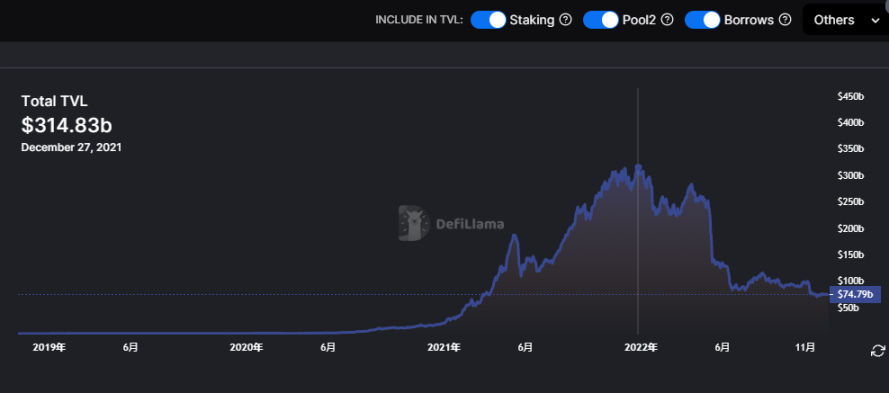
Figure 1: Total locked positions in the DeFi market
The NFT field of blockchain industry application
According to NFTScan data, as of December 14, 2022, the annual transaction frequency of NFT on Ethereum reached 28,628,998 times, and the number of active wallet addresses was about 33,865,590, which was significantly higher than that in 2020 and 2020. 2021. The NFT market was also affected by the crash of Luna and UST in May. The transaction frequency and the number of active wallet addresses reached a historical low on May 12 (transaction frequency was 20,983, and the number of active addresses was 32,076), but returned to normal values in the following week. And reached the highest value of the year on June 2 (transaction frequency 161,074, number of active addresses 163,614), and then began to fall back to the transaction level in early 2021.
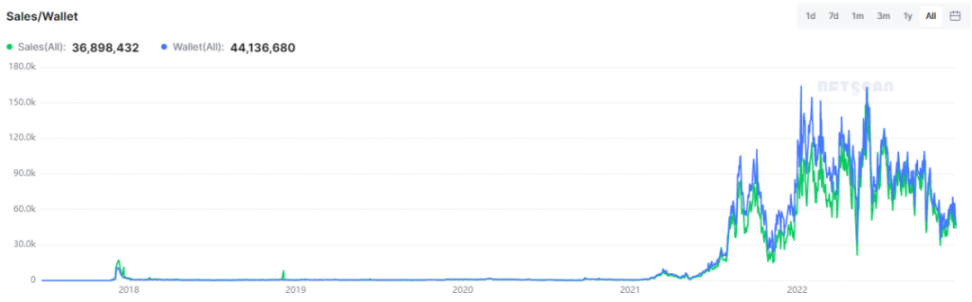
Figure 2: NFT market transaction frequency and number of active addresses
In terms of NFT specific tracks, according to the Nansen NFT index (as shown in Figure 3), the specific performance can be summarized as follows: First, in the first quarter of 2022, due to the positive impact of the Metaverse and Web 3.0 concepts, including land, real estate The 20 metaverse NFT aggregate indexes related to , avatar, assets and public utilities were significantly stronger than other indexes, and began to weaken significantly in the second quarter. The second is the 20 art NFT collection indexes, which remain stable throughout the year. Although the transaction volume is at the end of the NFT track in Q1 of 2022, it maintains a stable transaction volume in the next three quarters. Among them, Q4 can be in the leading position, not Because there are explosive products on the art NFT track, but when the development of other NFT tracks is weak, art NFT still maintains a stable transaction volume. Finally, there is the Gaming NFT track, which includes 50 NFT collections such as Play-to-earn, role-playing and DeFi-related games. It can be seen that, except for the influence of move-to-earn games such as StepN in Q1, several other The quarter was significantly below the market average.
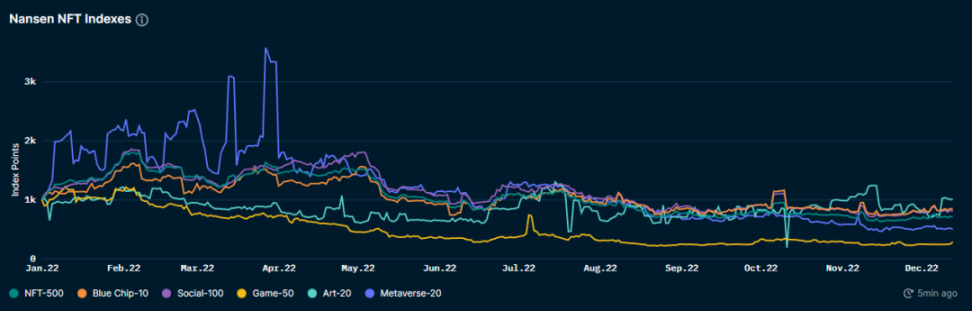
Figure 3: Nansen NFT Index
In the development of NFT market applications, three problems will be exposed in 2022. The first is the liquidity problem. Take CryptoPunks, which ranks first in market value, as an example. The data on December 14, 2022 shows that a total of 10,000 NFTs are held by 3,665 individuals, with a floor price of 64.5 ETH and a market value of 757,333 ETH. The daily transaction volume is less than 10, which means that a large amount of funds are locked in the project and cannot be used; the second is the non-homogeneous nature of NFT, and it is difficult for buyers and sellers to form a consensus on the rarity, so it is difficult to complete price matching 1. Due to the lack of a price discovery mechanism, many NFTs have a problem of price but no market; the third is that due to the limited practical application scenarios of NFT, the market is full of speculation, which is not conducive to the sustainable development of the market. Based on the above three problems, the market in 2022 will propose three types of financial solutions based on NFT liquidity and price discovery mechanisms, namely: NFT liquidity pool agreement, NFT fragmentation agreement and NFT lending agreement.
NFT Liquidity Pool Protocol
Typical examples of NFT liquidity pool protocols are NFTX and NFT20. They essentially build a liquidity pool of NFT/FT, using a fixed number of FT to represent the price of a single NFT. That is, the user deposits NFT into the adapted liquidity pool, and the smart contract will mint FT in proportion to the price and distribute it to the user's address. The above process means that the user gives up the ownership of NFT, and the NFT deposited in the liquidity pool can also be exchanged by other users with a specified amount of FT. In addition, the protocol allows users to combine the above steps, and can directly use one NFT to exchange another NFT of the same series. For FT minted through the liquidity pool, users can mortgage to a third-party AMM to establish a "FT/mainstream FT" liquidity pool for this FT, and earn governance tokens or transaction fee sharing from it; users can also sell directly on the AMM Cash out FT. The liquidity pool agreement solves the NFT market problem to a certain extent, but its shortcomings are also obvious. The NFT liquidity pool agreement averages the price of the NFT input, resulting in arbitrage opportunities, and makes the assets in the liquidity pool tend to the NFT series. floor price. Therefore, this type of agreement is suitable for NFT series with the same or close prices.
NFT Fragmentation Protocol
The NFT liquidity pool agreement cannot retain the rights and interests of NFT holders, which cannot meet the needs of NFT Holder. The NFT fragmentation protocol provides differentiated functionality in this regard. Fragmentation protocols, such as Niftex, Unicly, and Fractional, are simpler in principle, allowing NFT holders to mortgage NFTs to obtain tradable fragmented FTs, and sell some FTs to other investors through the AMM trading market to obtain mainstream FTs. In this process, the NFT is locked in the smart contract, and the ownership is still returned to the original holder. This design, on the one hand, meets the long-term investment or collection needs of NFT Holder, and can also unlock the liquidity of high-value assets; Offers are made, thereby facilitating the price discovery process for NFTs. A major flaw of fragmented NFTs is the All-or-Nothing problem. When Alice mortgages the NFT to the smart contract and fragments it, although the nominal ownership of the NFT still belongs to Alice, if the private key corresponding to part of the FT held by Bob is lost or unwilling to sell, Alice may never be able to redeem the mortgage It becomes very tasteless to own some fragmented tokens. In order to solve this kind of problem, for example, the buyout auction method has become an important direction to solve the reconstruction problem after fragmentation. There are many proposals on the buyout auction, which are all fragmented FT holders reach a consensus through a buyout auction mechanism, and redeem the fragmented FT at a consensus price.
NFT lending agreement
Lending is a common financial tool to unlock non-homogeneous assets. In the NFT market, lending agreements around NFT have also emerged. For example, NFTfi provides a simple lending model: NFT holders can establish a loan contract with a counterparty, mortgage NFT, and obtain wETH or DAI from the lender. The borrower can redeem the NFT if he repays the principal and interest before the contract expiration date, and the lender can terminate the contract and obtain the NFT in the mortgage pool if the contract is not fulfilled. The premise of this model is that a potential investor of an NFT can be found and is willing to accept NFT as compensation in case of default.
In addition to the above three types of liquidity agreements, the Paradigm research team has proposed some innovative solutions for NFT liquidity issues. Among them, RICKS (Recurrently Issued Collectively Kept Shards) is a game process that splits the one-time buyout auction game process into multiple auctions, and introduces randomness in the stage of claiming NFT. This design reduces the size of a single on-chain transaction, and uses a martingale algorithm to more fairly distribute the probability of fragmented holders claiming a complete NFT. The martingale protocol can also be used to obtain the desired liquidity for NFT holders. The proportion of martingale tokens owned by the holder is equal to the probability that he can redeem NFT in the future, which is considered a fair trading mechanism. The floor price perpetual contract provides NFT investors with a financial tool for risk hedging or leveraged investment.
Innovative fields and concepts of blockchain industry applications
Any industry is looking for ways and means to break the circle, and the same is true for the blockchain application industry. Only after breaking the circle can it find its own correct development model. From the expansion of blockchain applications in the financial field in 2020 to the rise of entertainment and social applications in 2021, blockchain applications have been exploring and trying to break the circle. So what new breakthroughs will be made in 2022?
Metaverse
To break the circle of blockchain applications, we must first mention the Metaverse. Since November 2021, forces from all walks of life have paid unprecedented attention to the concept of the Metaverse. Technology giants regard the Metaverse as a new growth point and the next strategically significant competitive field, and strive to invest in important resources for the layout of related industries. Bit Universe Raceway. On the other hand, the governments of many countries have also stepped down to participate, actively releasing favorable industrial policies, and accelerating the construction of their own Metaverse market through government-enterprise cooperation, in order to occupy a dominant position in the new international division of labor system that may be brought about during the development of the Metaverse. .
From the perspective of market application development, the Metaverse is still in the conceptual exploration stage, and there are many different opinions on the shape and evolution path of the Metaverse. Metaverse projects related to the blockchain are mainly concentrated in the field of games, such as The Sandbox, Axie Infinity, Decentraland, etc., and their economic mechanism is mainly based on the transaction and circulation of assets. NFT used and traded, including virtual plots, characters, weapons and equipment, scene decorations, domain names, etc. From the end of 2021 to the Q2 period of 2022, there will be a wave of Metaverse in this market, but from the end of April 2022, the trading volume of Metaverse NFT assets will gradually weaken (as shown in Figure 4).
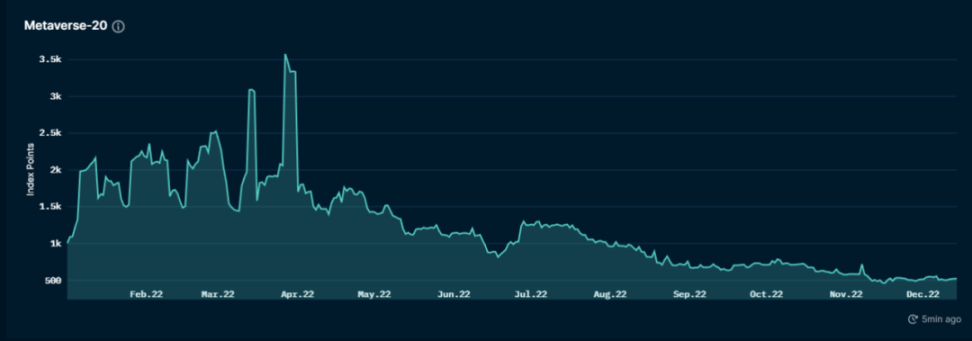
Figure 4: Nansen Metaverse NFT Index
Games are only a sub-track of the Metaverse. If you go out of the field of games and look at the entire industry of the Metaverse, compared with Web 2.0, the innovation of the Metaverse is mainly reflected in four aspects: First, the high degree of integration of the bit world and the atomic world ; Second, let bits have value directly; third, programmable value; fourth, distributed architecture and spontaneous order. In general, the metaverse has a structure of "underlying architecture and inner core".
1. High integration of bit world and atomic world
The world of bits and the world of atoms are becoming highly integrated from 6 levels. First, information infrastructure. The bit world runs on a series of information infrastructure provided by the atomic world, such as computing, storage, network bandwidth, etc. These information infrastructures have certain physical forms. Second, as a mirror image of the atomic world, the bit world records the people, things, and happenings in the atomic world. The most watched development in this regard is the Digital Twin (Digital Twin). Third, use FT (Fungible Token, homogeneous token) and NFT to represent the value of the atomic world, that is, to establish a mapping relationship between the scarce FT and NFT in the bit world and the scarce products in the atomic world. Fourth, operate the value of the atomic world from the bit world. Fifth, products that integrate the value of the bit world and the atomic world. Various human-computer interaction technologies, such as AR/VR glasses, belong to layers. They provide an interface from the world of atoms to the world of bits. Sixth, the same participants, a common economy. A large amount of human activities, time, and attention have migrated from the atomic world to the bit world. The degree of interconnection between the two worlds has continued to deepen, and the value circulation has gradually merged into one, becoming a common economy.
2. Make bits directly valuable
How is value realized in the metaverse? Value comes not only from the world of atoms, but also from the world of bits. Value is everywhere, but the most important thing is tradable value, that is, value that can participate in economic activities. The premise of tradable value is scarcity, that is, not everyone who wants it can get it, so a resource allocation mechanism is needed. Different from the atomic world, the products of the bit world are not limited by natural factor endowments or production functions, and are not subject to the discussion of the law of conservation of energy and matter. Theoretically, the boundaries of the bit world are determined by human imagination, and there are infinite possibilities that will expand forever. Products in the atomic world are generally worn out and depreciated, but products in the bit world are almost never lost. Products in the atom world are difficult to copy, but products in the bit world are easy to copy. In this case, how to make bits scarce? There are currently three main methods. First, information non-proliferation technology, represented by information hiding technology ("digital watermark") and digital rights management (Digital Rights Management, abbreviated as DRM). Second, privacy computing technologies represented by secure multi-party computing technology (Multi-party Computation, abbreviated as MPC), homomorphic encryption, etc., make data "available but not visible". Third, blockchain technology, embodied in homogeneous and non-homogeneous Tokens (ie FT and NFT). The characteristics of the blockchain that cannot be tampered with, cannot be "double spent", and transactions can be audited make digital symbols such as homogeneous and non-homogeneous Tokens scarce.
3. Programmable value
Programmable Value will be an important concept in the Metaverse. Programmable value is a product of economic and technological development, and its driving force is the need for human beings to dispose of their own property rights anytime, anywhere, and at will—especially in an intelligent way. Under different economic and technical conditions, the implementation of programmable value is very different, but the value carrier is mainly divided into the following five categories: first, currency; second, asset; third, identity; fourth, authority; Five, social relations. The discussion of these five types of value carriers is aimed at both the atomic world and the bit world. The identity, authority and social relationship of the bit world will receive more and more attention. Different from the traditional value settlement system, programming logic is introduced through the application programming interface. This process is inseparable from the review, certification and execution of the centralized organization. In the Metaverse value settlement system, the value carrier and programming logic can be integrated into one, It embodies "code is value", and describes rich and diverse value characteristics and transaction mechanisms through code. Under the support of the metaverse value settlement system, new property rights and transaction mechanisms will emerge: First, property rights and transactions in Bitworld itself have diversity and multi-dimensionality. For example, from Professionally Generated Content (PGC for short), to User-generated Content (UGC for short) and AI-generated Content (AIGC for short). For another example, some games adopt the "Play to Earn" method, rewarding users' use and feedback as the basis for system upgrades and improvements. Second, the new features of atomic world property rights integrated into the bit world. The transaction does not have to be buyout and sellout, and only part of the property rights can be transferred. For example, in the art market, through NFT, smart contracts automatically distribute transaction income, allowing copyright owners to have long-term passive income. This transaction method cannot be realized without the integration of the atomic world and the bit world. Third, programmability brings fine-grained permission control, which corresponds to a series of protocols that complement each other and can be combined. Fourth, property rights and transaction mechanisms are diversified, and the corresponding forms of financial activities will also be diversified.
4. Distributed Architecture and Spontaneous Order
From an economic point of view, the metaverse has a structure of "underlying structure + inner core" (Figure 5):
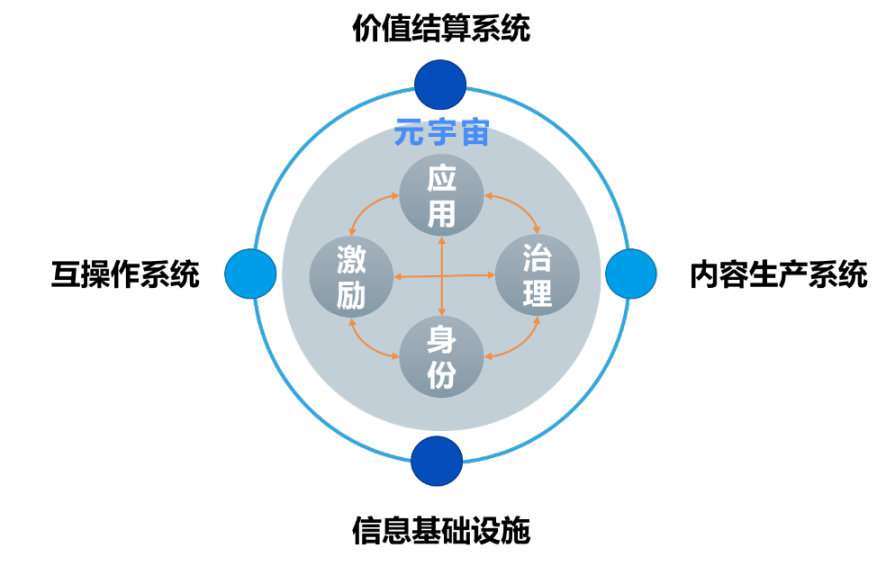
Figure 5: The "underlying structure + inner core" of Metaverse
The underlying architecture of the Metaverse is divided into four parts: First, computing, storage, bandwidth, AR/VR and other information infrastructures form the base of the digital world. Second, content production systems represented by game engines and AIGC (Artificial Intelligence Generated Content), etc. reflect the reproduction logic of the digital world. Third, the interoperability system, that is, a series of infrastructures that facilitate the switching and interaction of users, information, and value between the physical world and the information world, represented by digital identities and digital avatars. Fourth, the value settlement system, represented by digital assets. On top of these 4 parts of the underlying architecture, the metaverse includes 4 inner cores, namely identity, application, incentive and governance.
Economic activities in the Metaverse will present the following three characteristics. First, the rise of individual autonomy and the empowerment of programmability. Creator economy and influence economy are reorganizing the interaction methods and benefit distribution among creators, distribution platforms and users. The general trend is that the status of distribution platforms is declining. Second, the self-organizing power of markets and communities will surpass centralized corporate organizations. Third, even if there are some centralized nodes in the metaverse, economic activities will generally follow the principle of distributed business.
Web 3
Web 3, also known as Web 3.0, is used to describe the vision for the next generation of the World Wide Web. The concept of Web 3 is slightly later than the concept of Metaverse, and it became popular in the blockchain field in the fourth quarter of 2021, and has been gradually cited in comparison with the concept of Metaverse. The Web3 concept and the Metaverse concept look forward to the development direction of the next generation of human social collaboration networks from different starting points. In the past, there have been three main perspectives describing Web3. The first perspective evolved from the Semantic Web proposed by World Wide Web inventor Tim Berners-Lee in 1999 to a description of a new generation of networks that process information intelligently and protect user privacy; the second perspective is based on the public chain foundation facilities, emphasizing the anti-censorship and user ownership of the network during the information transmission process; the third perspective is close to the vision of the metaverse, describing the next-generation network as a space network that integrates digital information and the physical world.
After a year of development and exploration, the Web 3 track applications have gradually enriched, forming multiple tracks including creator economic platforms, games, storage, metaverse, IoT, DAO tools, identity, and privacy.
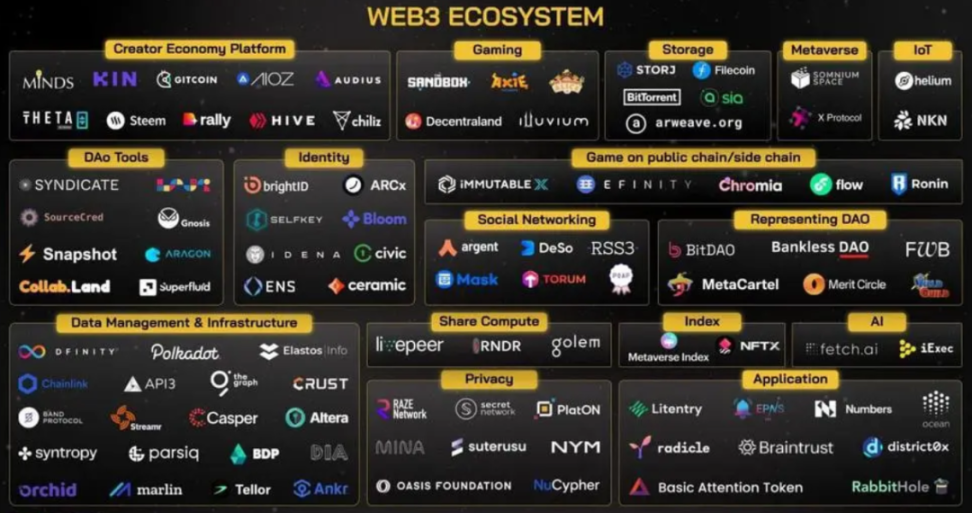
Figure 6 Ecological panorama of public chain Web 3
Let's take DAO, identity, carbon emission reduction, and IoT as examples to introduce the development status of several sub-tracks.
1. DAO
DAO broke the circle almost at the same time as Metaverse and Web3, and the two words spread rapidly on the Internet. According to Google Trends data, Decentralized Autonomous Organization has become a hot word in the industry since 2021 and reached its peak in January 2022. Among them, Denmark, China and Singapore are the top three countries in terms of search popularity.
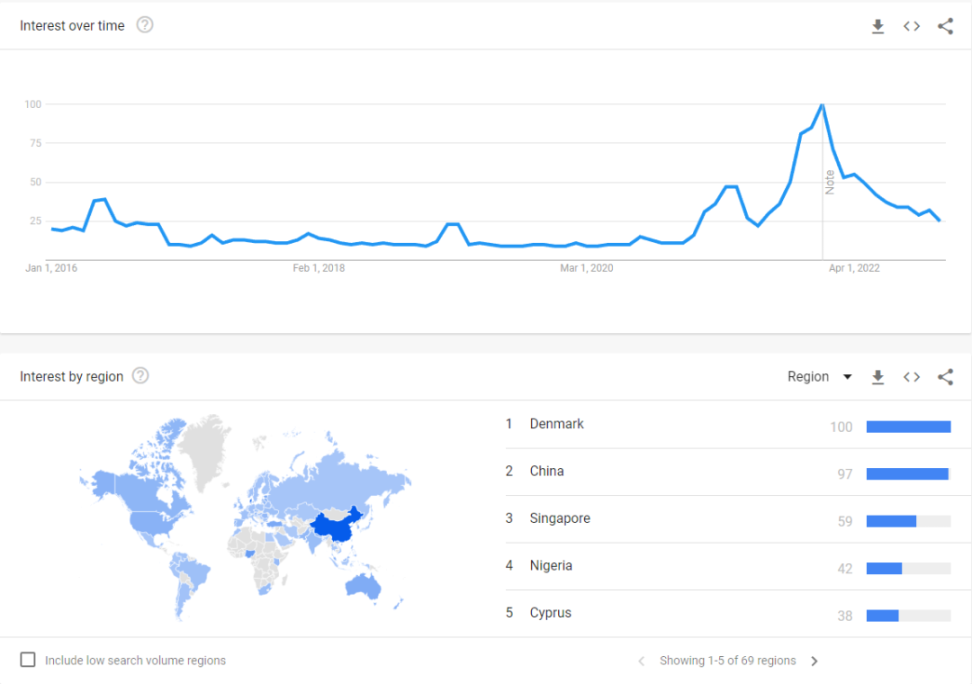
Figure 7: "Distributed Autonomous Organization" search popularity statistics
According to DeepDAO data, as of December 15, 2022, there are 10,621 DAOs in the market, and DeepDAO has tracked the data of 2,299 DAOs. Let’s look at the development of DAO in 2022 from the four indicators of total funds, scale of governance tokens, DAO voting and proposal activity, and distribution of governance token holders (as shown in Figure 7). The first is the total amount of funds. The scale of governance tokens in the entire market is about 9.6 billion U.S. dollars, of which, the number of circulating governance tokens is about 7.1 billion U.S. dollars, and the number of locked tokens is about 2.6 billion U.S. dollars. The second is the scale of DAO governance tokens. The data shows that there are only 15 DAOs with a total scale of more than 100 million US dollars, accounting for 0.7%. There are 124 DAOs. Then, from the perspective of voting and proposals, the number of governance token holders in the market is about 51 million, of which only one-third of the holders will participate in governance voting and proposals. The last is the distribution of governance token holders. There are 60 projects with more than 10,000 holders, accounting for 0.5% of the 2,299 DAOs; 131 DAOs with 1,000 to 10,000 holders, accounting for 1.2% ; There are 195 DAOs with 100 to 1,000 holders, accounting for 1.7%. In addition, according to the market value of governance tokens, the top five DAOs are Uniswap, BitDAO, ENS, Genosis and OlypusDAO.
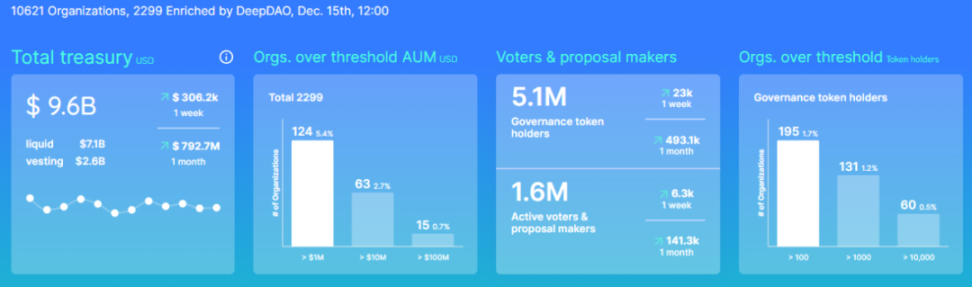
Figure 8: DAO organization statistics in 2022
In the development of 2022, DAO application scenarios will gradually enrich, which can be divided into protocol, investment, social, collection, game, etc. In particular, various DAO tools have become popular in the market, which can help the community quickly build application platforms such as task release, salary calculation, rule setting, fund management, dispute resolution, data analysis, voting management, and media communities. These tools effectively lower the threshold for the establishment of DAO, allowing promoters to complete token issuance, distribution, community discussion and voting management on the same platform, and DAO gradually forms a modular structure.
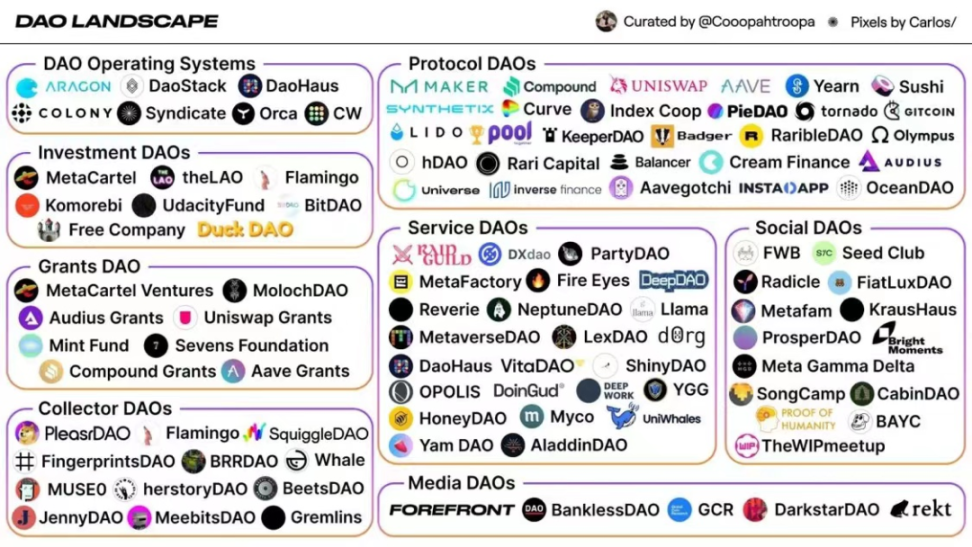
Figure 9: DAO panorama ecological map
In addition to content and application innovation, DAO gradually presents a multi-layer structure. Under the unified DAO, several new DAOs are hatched with specific themes or content, which are called SubDAO. SubDAO and DAO belong to an affiliation relationship, and new organizations are hatched from within DAO, but they can develop independently, making community development more scalable and flexible.
Although DAO in 2022 presents innovative development in various forms. In pure on-chain governance projects, a set of distributed autonomous management methods has been formed before the concept of DAO is proposed. After the concept of DAO was put forward, the market has gradually formed a set of methodology, which can form and manage DAO more effectively. However, some projects try to apply DAO to off-chain governance, and there are various obstacles in the actual implementation. In the future, it is still necessary to continue trial and error in development and find the application boundary and development logic of DAO.
2. Distributed digital identity
When DID is mentioned in the industry, the first thing that comes to mind is the distributed digital identifier (Decentralized Identifiers) proposed by W 3 C, which uses a string of characters to represent the unique identity of people, machines, things, etc., which solves the problems of identity data privacy and identity certification . However, with the iteration and development of Web 3 applications, the DID we mentioned now has another meaning, that is, distributed digital identity (Decentralized Identity), which is used as a general term for identity representation in the digital world. Data management (usually the original data on the chain, or record off-chain data to the chain through the oracle machine), the representation method of identity (domain name, wallet, virtual digital person, etc.) and identity data application protocol. It can be simply understood that distributed identity identifiers belong to distributed digital identities. Like domain names and wallets, DID proposed by W 3 C belongs to a category of identity representation methods.
From the collection, processing, and application of identity data, distributed digital identities have formed a huge ecosystem in just two or three years, and the identity track presented in 2022 has a clear division of labor.
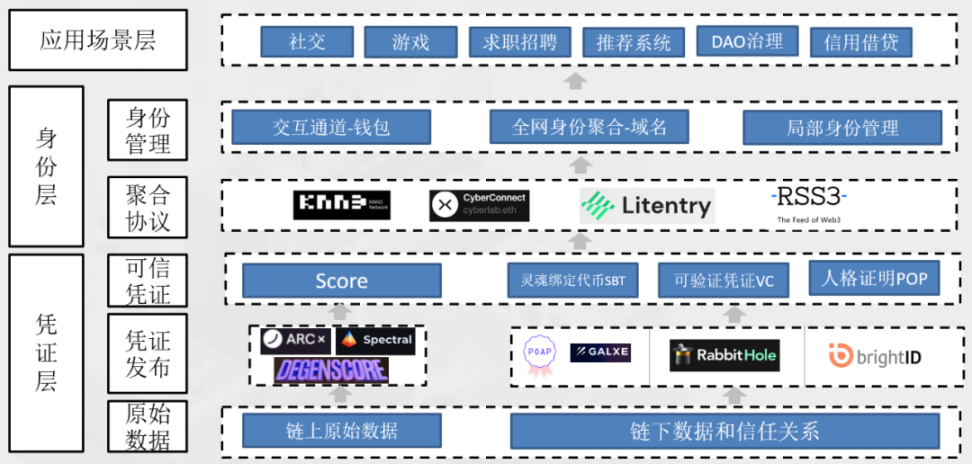
Figure 10: Distributed Digital Identity Architecture
(1) Credential layer
The credential layer is mainly responsible for credible verification of off-chain data, and at the same time aggregates the original data on the chain to form credible and convenient verification and display credentials. There are usually three forms of vouchers, namely non-homogeneous token NFT, verifiable voucher VC and credit score Score. From data classification, vouchers are divided into two types: variable data vouchers and immutable data vouchers.
① Variable data certificate
Like Ant Credit, different project parties will use different credit scoring models to score user interaction data on the chain. The user's on-chain behavior data has been changing over time, so the credit score will also change, so it is called a variable data certificate. Industry representative projects include ARCx, Spectral, etc.
② Immutable data certificate
There are three ways of immutable data certificate digital representation of legal trust and community trust: soul binding token SBT, verifiable certificate VC and personality proof POP.
(2) Identity layer
The voucher layer realizes the standardized display of variable data vouchers and immutable data vouchers through NFT, SCORE or VC. Although the credential data is stored on the chain, it is not collected under one identity. It is still necessary to view the data stored on the chain through the channels provided by the project party. An important purpose of the identity layer is to aggregate fragmented data on multiple chains from the user dimension, allowing users to control and manage data more conveniently and efficiently. The identity layer mainly includes two technologies: aggregation management and identity management.
① Aggregation management
The aggregation management protocol "binds" and "connects" raw data and various credentials on different chains and contracts. Provide a data standard, data storage infrastructure and recommended index system for identity data on the chain, and provide a common data layer for Dapp. Representative projects currently on the market include CyberConnect, Litentry, KNN 3 Network and RSS3, as well as game identity aggregation Loots, etc.
② Identity management
Identity management is committed to enabling users to achieve personal cross-chain data management through an identity. Currently divided into three tracks and one potential track. They are: wallet, domain name, partial identity management and virtual digital person.
After two years of exploration, the prototype of the distributed digital identity value chain has basically taken shape, and its characteristics can be described as: First, the distributed digital identity is divided into three layers: credential layer, identity layer and distributed application layer; Second, the construction of the distributed digital identity value chain is built around the financial market on the chain to solve problems such as sybil attacks and user portraits on the chain.
Since the concept of distributed digital identity was proposed shortly and the ecological development is still in its infancy, there are still many problems to be solved, including: first, identity data is expanded from the financial market to other fields on the chain; The authenticity verification mechanism urgently needs to be innovated, which can allow more types of reliable data to be uploaded to the chain; thirdly, the innovation of the variable data credential scoring model and the different calculation methods of the trust score will attract different chain institutions to use according to their own needs . In an open and public data market, the scoring model will be the direction of continuous competition in the future; fourth, the representation method and content innovation of immutable data certificates, the concept of SBT was proposed only half a year ago, and the existing SBT solutions are all Badges, whether it will expand to more types in the future is worth looking forward to; fifth, verifiable credentials are a key technology for accepting legal trust, and if properly applied, verifiable credentials will facilitate the expansion of identity data; sixth, identity management competitions The homogenization competition of Dao is serious, and more innovative solutions are needed. The core logic is to reduce the entry cost of new users; seventh, the current distributed applications mainly focus on social networking, games, DAO governance, lending and other fields, and the depth is insufficient , the rise of these applications can bring more user traffic and data on the chain, and the emergence of explosive Dapps is urgently needed in the future.
3. Carbon emission reduction
The low-carbon economy has become the consensus of all countries. However, due to the weak development of the market economy, the spread of the new crown epidemic, and the instability of the international form, the advancement of the low-carbon economy has been very slow. How to motivate all participants to join the low-carbon economy? Economic construction has become a development bottleneck. Based on this problem, a group of blockchain project parties tried to tokenize carbon credits and place them in the open market for transactions. Such projects will attract market attention in early 2022. Compared with the high threshold characteristics of carbon emissions trading in the mainstream market, various types of tokenized carbon credits can be split, traded, and transferred, and can be applied to carbon offsets in various scenarios, as well as flexible Let all kinds of participants join the carbon trading market. The project party cleverly combined innovations such as public chain Token, NFT and DeFi with the carbon market, which enhanced the richness and playability of carbon trading products.
The carbon market is divided into a mandatory emission reduction carbon market and a voluntary emission reduction carbon market. The mandatory emission reduction carbon market is mainly based on the quota system management of key emission enterprises by regulatory agencies. According to the enterprise emission plan, enterprises are encouraged to sell the excess allowances on the market. Similarly, enterprises with insufficient allowances can also buy carbon emission rights in the market and use them for year-end carbon emission settlement. The voluntary emission reduction carbon market is where the government encourages various emission reduction projects (forest carbon sequestration, clean energy, methane utilization, biomass energy combustion) to have their emission reduction effects quantified and verified by standard institutions (such as Verra, Gold Standard, etc.) , and in the form of carbon credits registered in the voluntary greenhouse gas emission reduction trading registration system of various countries or institutions, the registered carbon credits can be freely traded within the system. Public chain projects generally propose various solutions around the voluntary emission reduction carbon market. The common practice is as follows: first, the centralized system under the chain will be anchored to issue the NFT on the chain, and the NFT records the source of the carbon credits under the chain, so as to avoid False minting or double spend issues. Since the number of carbon credits anchored by NFT is fixed and cannot be differentiated, it does not affect market transactions and circulation. Therefore, in order to solve the NFT liquidity problem, the project party usually combines the NFT fragmentation method to mint various project tokens, which is convenient for users or investors to participate in the carbon market by holding tokens. But we have to pay attention to a problem. If the market directly trades the fragmented Token, this may cause the price of Token to deviate significantly from the value of the traditional carbon credit market, resulting in the instability of the agreement. Therefore, in order to avoid this problem, the fragmented Token is generally not directly traded, but the value of the fragmented Token is anchored to the price of carbon credits in the traditional market, and a new token is minted based on the fragmented Token. Tokens can be traded. When the price of new Token deviates from the traditional market price, the price can be stabilized through the algorithm mechanism of issuing or burning new Token. In addition, it can also be integrated into the loan or pledge method in DeFi to increase the types of investment products for carbon credits and increase market playability.
Representative projects on the market, such as KlimaDAO, mint NFT based on carbon credits in the Verra database, then fragment NFT into BCT, and then mint Klima Token based on BCT. Klima Token can be circulated, pledged, traded and invested in the market. Other projects such as FlowCarbon, which has attracted the attention of many well-known investment institutions, and Moss.Earth and its circulation token MCO 2 initiated based on the carbon credits of the Amazon rainforest, in addition, the BetaCarbon project promoted by Australia is also advancing rapidly . Whether in the traditional market or on the public chain, carbon trading is an emerging market. Currently, projects including KlimaDAO and other projects have exposed many shortcomings in their operation, such as the feasibility of adjusting the price stability of Token through algorithms, and the application scenarios of Token Insufficient circulation leads to excessive circulation, and the high return rewards of Staking make the project fall into the Ponzi trap. In the future, it is necessary to popularize Token application scenarios and design a more reasonable economic mechanism to deal with the above problems.
4.PoPW
In addition to the carbon trading market, another breaking field of the public chain in 2022 must belong to the physical proof of work. Just in April this year, Tushar Jain, the managing partner of Multicoin Capital, published an article titled "Proof of Physical Work", which aroused market discussions on the concept of Proof of Physical Work (PoPW for short). Proof of Physical Workload PoPW refers to a protocol that connects the digital world and the physical world. It applies the encryption economy and incentive mechanism to various activity organizations in the physical world, and allows more people to become one in a distributed and trustless way. or several common goals, and after the goal is achieved, follow the principle that the more you contribute, the more you get, and the benefits are automatically distributed through smart contracts. The constituent elements of the PoPW protocol generally include six (as shown in Figure 10), namely: physical hardware, contributors, consensus agreement, Token, incentive mechanism and DAO community.
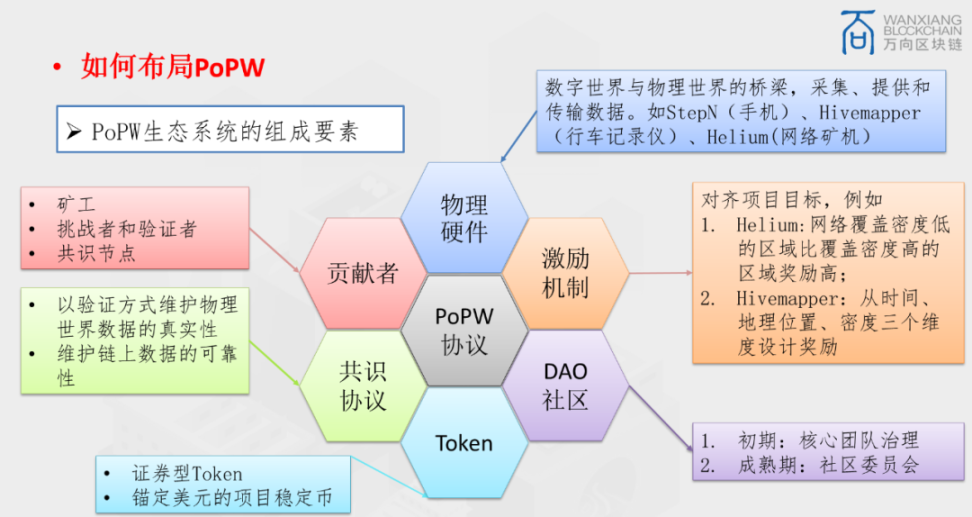
Figure 11: Six components of the PoPW protocol
Original link


