Intensive reading and analysis of V God's new book "Proof of Stake" (6)



Book chapterBook chapter
The first part of the book - pre-mining
abstract
abstract
During the development of blockchain technology, a "chimney-like" island phenomenon has been formed. This is because different teams hold different perspectives and have different areas of expertise. Including the topic of whether all chains will be unified in the future or multi-chain coexistence, as well as different views on the consensus mechanisms of POW, POS, and DPOS, as well as the direction of expansion and so on. The views of V God and others are listed in detail below.
The idea of hyperconsolidation and winner-take-all is completely wrong for the most part, fragmentation isn't that bad, and it's inevitable. Rather, it's the only way the space can reasonably thrive.
The reason for fragmentation and "chimney-like" development is that all parties hold different opinions and philosophical ideas, and cannot seek common ground while reserving differences.
Different projects should focus on different goals.
But there are plenty of opportunities to reduce duplication of effort and create more collaboration. Different products should exist in a more modular way, where they only exist in one or two layers of the cryptocurrency ecosystem and provide a common interface that allows any mechanism on any other layer to work with them.
Translator's point of view
Translator's point of view
The topic of whether the future will be unified by ten thousand chains or coexistence of multiple chains, as well as some other different propositions, from 2014 to 2022, there is still no completely unified understanding in the entire ecology. These topics may gradually become dominant with some successes and failures, but the mentality and environment of tolerance and acceptance of different opinions are the soil for a hundred flowers to flourish. The “one-X-to-rule-them-all” atmosphere is not conducive to lasting innovation.
The data chimney phenomenon also exists in traditional Internet and ERP products. Almost most enterprises have gone through this stage in the process of growth and improvement of informatization capabilities, and finally achieve integration through centralized management and control paths such as unified standards and unified architecture. , thus creating greater value. Although there are differences between the centralized method and the decentralized method, the realization of value through joint efforts requires a correct strategy and a reliable driving force behind it. Both models are initiated by centralized leaders, one is promoted through organizational management and other methods, and the other needs to be promoted through DAO culture and community.
In game theory and economics, it is widely accepted that different ways of cooperating lead to different outcomes, and that individuals can act in one of two ways, mutually "cooperating" or "defecting" with each other. Everyone is better off if everyone cooperates, but everyone is better off defecting no matter what others do. As a result the story happens and everyone ends up betraying so people's individual rationality leads to the worst collective outcome. The most common example is the famous prisoner's dilemma game. Since many readers may have already seen the Prisoner's Dilemma, for added interest, I propose Eliezer Yudkowsky's even crazier version of the game:
Brief translation of the content (the order has been adjusted, and the content has been deleted)
A common question many people have about the concept of a DAO (Decentralized Autonomous Organization) in the crypto 2.0 space is: what are the benefits of a DAO? If an organization's management and operations are tied to fixed code on a public blockchain, what are the fundamental advantages over the traditional route? What are the advantages of blockchain contracts over ordinary shareholder agreements? Especially even if transparent governance and guaranteed non-evil governance are supported, individual organizations open core source code and weaken themselves, and competitors can see their plans while competing behind closed doors. What is their motivation for doing so?
There are many ways to answer this question. Specifically for nonprofits that have a clear commitment to philanthropy, they lack personal incentives but work to improve the world without receiving monetary gain themselves. For a private company, if everyone else can bring their own information and intelligence into the computation, other things being equal, the governance algorithm will work better based on the information theory argument, because according to the established In fact, by increasing the amount of data compared to adjusting the algorithm, the effect can be greatly improved. In this article, however, we will take a different, but more specific, route to analysis.
What is hyperrationality?
In game theory and economics, it is widely accepted that different ways of cooperating lead to different outcomes, and that individuals can act in one of two ways, mutually "cooperating" or "defecting" with each other. Everyone is better off if everyone cooperates, but everyone is better off defecting no matter what others do. As a result the story happens and everyone ends up betraying so people's individual rationality leads to the worst collective outcome. The most common example is the famous prisoner's dilemma game. Since many readers may have already seen the Prisoner's Dilemma, for added interest, I propose Eliezer Yudkowsky's even crazier version of the game:
Of course in many situations, people sometimes act ethically and cooperate even when it is detrimental to their personal situation. But why do they do it? We were created by evolution, and evolution is usually a rather selfish optimizer. There are many explanations, one we will focus on is the concept of hyperrationality.
From a pragmatic and moral point of view, our choice to betray is justified, and a paper clip in another universe cannot possibly be worth a billion lives. From an AI perspective, betrayal would result in an extra paper clip whose code assigns exactly zero value to a human life. Therefore, it will betray. However, this leads to results that are obviously worse for both parties than the benefits of human and artificial intelligence cooperation. However, if the artificial intelligence is to cooperate, we can save more lives by defecting, and the same is true for artificial intelligence. In the real world, many small-scale two-party prisoner's dilemmas are resolved through trade mechanisms and legal systems that enforce contracts and laws, in which case if there exists a God with absolute power over both universes, but only Concerned about keeping a priority agreement, humans and AI can enter into cooperative agreements and ask God to prevent both parties from betraying at the same time. When there is no ability to pre-contract, the law punishes unilateral treachery.
Of course in many situations, people sometimes act ethically and cooperate even when it is detrimental to their personal situation. But why do they do it? We were created by evolution, and evolution is usually a rather selfish optimizer. There are many explanations, one we will focus on is the concept of hyperrationality.
The following explanation of virtue, provided by David Friedman:
The following explanation of virtue, provided by David Friedman:
There are two observations about humans. The first is that there is a substantial connection between what is happening inside and outside their heads. Through facial expressions, body posture and various other signs, we can understand at least part of our friends' thoughts and emotions; the second is that our intelligence is limited, and we cannot consider all options in the time to make a decision. In computing terms, we are machines of limited computing power operating in real time. Suppose I want people to believe that I have certain characteristics, that I am honest, kind, and helpful to my friends. If I actually had these traits, it would be easy to project them, and I would just do and say what seemed natural and pay less attention to how I appeared to outside observers. They would observe my words, actions, facial expressions and draw reasonably accurate conclusions. However, suppose I don't have these characteristics. I'm (for example) dishonest. I generally act honestly because it is usually in my interest to act honestly, but I am always willing to make an exception if I can benefit from it. Now, in many practical decisions, I have to do double counting. First, I have to decide how to act, for example, whether this is a good opportunity to steal without getting caught. Second, I have to decide how I'm going to think and act, what look will be on my face, will I be happy or sad, if I'm really who I'm pretending to be. If you need your computer to do twice as many calculations, it will be slower. The same is true for humans. Most of us are not very good liars. If this argument is correct, it means that if I was really honest (and kind and...), I would probably be better off with less material conditions, e.g., have a higher income, And not that I'm just pretending to be, simply because real virtue speaks louder than pretended virtue. So, if I'm a narrowly selfish person, I might try to make myself a better person, more virtuous in those ways that other people value, for purely selfish reasons. The final stage of the debate is the observation that we can be better, by ourselves, by our parents, and maybe even by our genes. People can and do try to train themselves to develop good habits, including habits of automatically telling the truth, not stealing, and being kind to friends. With enough training, these habits become taste, and doing "bad" things makes one uncomfortable, even if no one is watching, so one doesn't do them. After a while, a person doesn't even have to decide not to. You could describe this process as synthetic conscience. Essentially, it's hard to convincingly pretend to be virtuous while being greedy as long as you can get away with it, so it makes more sense for you to actually be virtuous. Much ancient philosophy followed similar reasoning, viewing virtue as a cultivated habit. David Friedman just does us the usual service of economists and translates intuition into a more analyzable formalism. Now, let's push this experience a step further. In short, the key point here is that humans are public agents, and every second we act, we basically indirectly expose parts of our source code. If we really intend to act nice we act one way, if we just pretend to be nice but actually intend to act immediately when our friend is vulnerable we act differently when others usually Will take note of this. This seems to be a disadvantage. However, it allows a kind of cooperation not possible with the simple game-theoretic agents described above. Suppose two agents, A and B, both have the ability to "read" whether the other is "good" with some degree of accuracy, and are playing a symmetric prisoner's dilemma.
1. Try to determine if the other person is benign.
1. Try to determine if the other person is benign.
2. The other party is virtuous and cooperates.
As unnatural as this tactic may seem, human culture has some ingrained enforcement mechanisms, especially in relation to untrustworthy agents who work hard to make themselves less readable, see the common adage that you should never People who don't drink should be trusted. Of course, there is a class of people who can convincingly pretend to be friendly but actually plan betrayal every moment, and these are called sociopaths, and they can be the main flaw in this system that humans have built.
Both parties will cooperate and get greater rewards. If a good person comes into contact with a non-good person, the good person will betray. In all cases, therefore, the virtuous agent earns at least as much as, but often better, than the unethical agent. This is the nature of hyperrationality.
As unnatural as this tactic may seem, human culture has some ingrained enforcement mechanisms, especially in relation to untrustworthy agents who work hard to make themselves less readable, see the common adage that you should never People who don't drink should be trusted. Of course, there is a class of people who can convincingly pretend to be friendly but actually plan betrayal every moment, and these are called sociopaths, and they can be the main flaw in this system that humans have built.
This kind of hyperrational cooperation can be said to be an important cornerstone of human cooperation in the past 10,000 years, even though these simple market incentives may lead to defection, but people can also be honest with each other. However, perhaps a by-product of modern large centralized organizations giving people the ability to read minds and effectively deceive others makes this kind of cooperation more difficult. Most people in modern civilization reap the benefits, but they indirectly fund some people in some 3rd world countries dumping toxic waste into rivers to make cheaper products. Yet, we don't even realize that we are indirectly involved in this betrayal, that the company does the dirty work for us. The market is so powerful that it can even arbitrage our own morality, handing over the dirtiest and most unsavory tasks to those willing to sell their consciences at the lowest cost, and effectively keeping them hidden. Companies can have their marketing department create a smiling face as their public image, and have a completely different department sweet-talk potential customers. This second department may not even know that the department producing the product is more immoral and less beautiful than them.
This kind of hyperrational cooperation can be said to be an important cornerstone of human cooperation in the past 10,000 years, even though these simple market incentives may lead to defection, but people can also be honest with each other. However, perhaps a by-product of modern large centralized organizations giving people the ability to read minds and effectively deceive others makes this kind of cooperation more difficult. Most people in modern civilization reap the benefits, but they indirectly fund some people in some 3rd world countries dumping toxic waste into rivers to make cheaper products. Yet, we don't even realize that we are indirectly involved in this betrayal, that the company does the dirty work for us. The market is so powerful that it can even arbitrage our own morality, handing over the dirtiest and most unsavory tasks to those willing to sell their consciences at the lowest cost, and effectively keeping them hidden. Companies can have their marketing department create a smiling face as their public image, and have a completely different department sweet-talk potential customers. This second department may not even know that the department producing the product is more immoral and less beautiful than them.
. . . and DAOs
Arguably, a greater degree of transparency offers a solution. Individuals are moderately open, and the current centralized organization is less open. Organizations that continuously and randomly release information to the left, right, and center of the world are more likely to be open than individuals. Imagine a world where if you even started thinking about how to cheat on your friend, business partner or spouse, there was a 1% chance that the left side of your hippocampus would rebel and send a full transcript of your thoughts to your intended victim in exchange for $7,500 in rewards, it's like a governance dashboard for open organizations.
This is essentially a restatement of the founding ideology behind WikiLeaks, which has been superficially furthered recently by the emergence of a motivated WikiLeaks alternative, slur.io. However, the founding of WikiLeaks was murky, and the murkiness of centralized organizations will remain. Perhaps incentives, coupled with similar predictive mechanisms for people to profit from employer misconduct, will open the floodgates for greater transparency, but in the meantime we can go a different route: provide a way for organizations themselves to voluntarily and thoroughly , open, hyper-rational to an unprecedented degree.
. . . and DAOs
DAOs as a concept are unique in that their governance algorithms are not only public, but in fact fully public. That is to say, even in a transparent centralized organization, outsiders can only roughly understand the temperament of the organization, but with DAO, outsiders can actually see the entire source code of the organization. Right now, they can't see the "source code" of the people behind the DAO, but there are ways to write the source code of the DAO so that no matter who the participants are, it's heavily oriented towards a specific goal. A futarchy organization that maximizes average human lifespan will be very different from a futarchy organization that maximizes paperclip production, even if the exact same people are running it. So not only does the organization make it clear to everyone else when everyone starts to cheat, but even the "mind" of the organization cannot possibly cheat.
Now, what would hyperrational cooperation using DAOs look like? First of all, we need to see some real cases of DAO: gambling, stable currency, decentralized file storage, one ID data provision per person, SchellingCoin, etc. However, we can call these DAOs "Type I DAOs": they have some internal state, but basically no self-governance. They can do almost nothing but tune some of their parameters to maximize some utility metric via PID controllers, simulated annealing, or other simple optimization algorithms. So they are hyper-rational in a very small sense, but they are also rather limited and stupid because they can only be updated by external factors which are not hyper-rational.
What is Futarchy?
What market failure problems that conventional cooperation cannot solve can be solved by ultra-rational cooperation? Unfortunately, issues of public affairs may be outside the scope; none of the mechanisms described here address large-scale multiparty incentives. In this model, organizations make themselves decentralized and public in order to make others trust them more, so organizations that fail to do so are excluded from the economic benefits of this "circle of trust". For public goods, the root of the problem is that no one can be excluded from benefiting, so the strategy fails. But anything that has to do with information asymmetry falls within that spectrum, and it's a wide range indeed, and as society becomes more complex, deception in many ways will become easier and more Difficult to regulate or even understand, the modern financial system is just one example. Perhaps the real promise (if there is one) of DAOs is to help in this regard.
background supplement
What is Futarchy?
Futarchy is a form of government proposed by economist Robin Hanson in which elected officials determine measures of national well-being and prediction markets are used to determine which policies will produce most positive effect. It was named the buzzword of 2008 by The New York Times. The idea of futarchy was later introduced in the context of blockchain and DAO, bringing it closer to an actual implementation. The theory advocates "vote on value, but bet on beliefs (vote on value, but bet on beliefs)". It contains two meanings: one is that individuals decide whether the country implements a certain policy through shares, which is transformed into voting on metrics. The most appropriate and optimal metric policy is then selected by the prediction market. In other words, prediction markets create a barometer of government effectiveness. Another layer is that in Futarchy governance, participants can profit from it if they win, and lose money if they make mistakes. In essence, "Speaking with money, words have no basis." This requires participants to focus more on the proposal itself, collecting and researching more in-depth information rather than irrelevant social activities.
However, since Futarchy was proposed, its participation has been questioned. Prediction markets are zero-sum games. Participants need to pay other costs besides predicting votes, which is unreasonable for participants. The end result is low engagement, insufficient market depth, and the inability of experts and analyst firms to fully profit from the process of gathering information. In addition, due to the complexity of value and the slowness of policies, Futarchy has not been successfully applied in any government, and it has not even been truly realized in corporate governance.
The envisioned architecture of Ethereum in 2014
In December 2014, Vitalik made the vision for the next 1-5 years and the network layered architecture
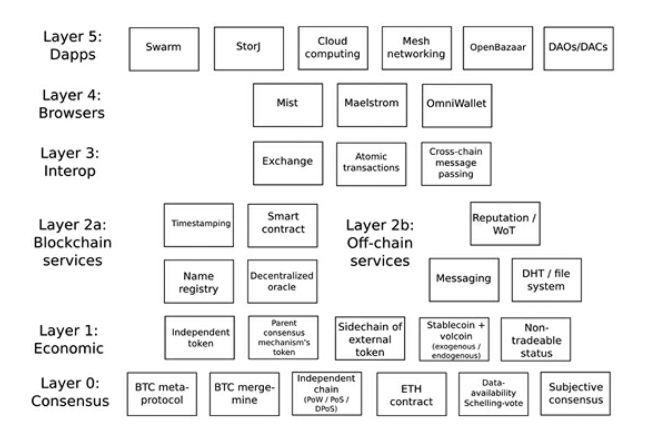
Consensus mechanism layer: Ethereum blockchain, data availability, Shelling voting (maybe to Ethereum 2.0)
Economic layer: Ether (a separate token), research proposals for stablecoins
Blockchain Service Layer: Domain Name
Off-chain service layer: Whisper (message), trusted web page (in progress)
Interop layer: BTC to Ethereum bridge (in progress)
Browser: Mist