Changpeng Zhao's 15 Principles


This article comes fromBinance, the original author: CZ_Binance
Odaily Translator |
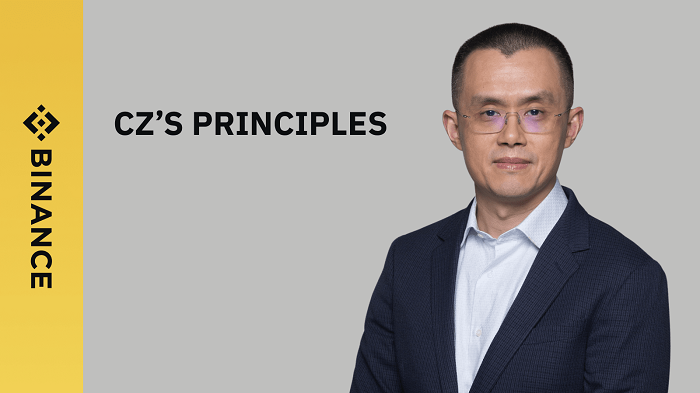
Binance CEO Changpeng Zhao released some of the principles he followed. He said that not all principles are right or wrong, most of them are just his personal way of doing things. Next, let us look at Changpeng Zhao's 15 personal principles.
secondary title
1. General principles
1.1 Fairness
This is a broad principle that covers many areas of life, from personal relationships, work colleagues to business transactions, and I do believe in treating others fairly. Don't take advantage of others, and don't let others take advantage of you.
1.2. Establish long-term, win-win relationship or transaction
Success is built on a long-term basis, and to maintain healthy long-term relationships, it is imperative to build and engage in long-term win-win relationships. For a transaction to make sense, it must benefit both parties. Always ask what the other side gets in return, one-sided deals don't last, you always need to find new (weak) partners to work with. I am against short-term profits, which often have negative long-term effects and distract yourself from the long-term, with a high hidden opportunity cost. Focus on longer-term, greater victories.
1.3 Avoiding "Bad" Relationships
Unethical/toxic people, people who don't share your values or mission, and people who waste a lot of your time. Let them go, remove them from your life.
1.4 Ethics
Never cross a moral line. When dealing with users, always do the right thing, not the easiest thing.
1.5 focus
Success doesn't come from how many things you do, but from how well you perform at a very few chosen things. Focus allows you to work hard and remove distractions from your life. For me, I don't have many hobbies. I exercise 30 minutes a day, and I don't have much material possessions to maintain, time is expensive after all.
1.6 Stay Positive
1.8 Continuous Learning
secondary title
Understanding how the world works is obviously important if one hopes to achieve any level of success. Don't hold a black and white attitude, the world is diverse, and many people's views on the world are too simplistic.
secondary title
3. Framework for decision-making
Making good decisions is a skill that can be practiced, and I go through this mental decision-making framework, whether it's a quick decision or a well-thought-out one.
3.1 First principles
If the decision touches on one of the core principles, follow those principles, simple. Otherwise, pass the decision frame.
3.2 Small and big
The first thing to determine is the scale or impact of the decision.
Small decisions (like where to eat, or a small investment), make it quickly or delegate it, and move on.
Big decisions (such as big sponsorships, investments, etc.), collect data, discuss in a group, and then sleep for 24 hours.
3.3 Reversible and permanent
Some decisions are reversible, such as developing new product features. You can stop at any time and work on something else, or close it when you're done. There will be some sunk costs in time and effort, but it's finite.
Some decisions are not easily reversed, such as large upfront payments for sponsorship deals, team integrations, large company acquisitions, etc.
3.4 Do I have expertise?
If it's something I'm familiar with, or have background information like technology, product, then I can make a decision faster. In areas where I don't know much, like marketing, I either delegate or involve other experts, or make decisions more carefully.
3.5 Sufficient information
In conclusion: It is usually much better to make a decision and execute it than not to make a decision.
secondary title
4. Team and organization
4.1 The team is stronger than the self
Performing well alone on an underperforming team rarely leads to personally satisfying results.
4.2 Shuffle often
Don't let the organization become stale.
4.3 Internal competition is good
There will always be competition (external), some internal competition is good, just on a professional level.
4.4. Lawful chaos is a structure
This explanation is somewhat counterintuitive. Chaos and thorough structure are two extremes. Organizations with too tight a structure will lack innovation, and the encrypted world is ever-changing. We need to find a balance between chaos and order.
4.5 Frequent team building of local teams
Once a month should be the goal, due to scheduling etc it actually usually ends up being every 2 months.
4.6 Give Feedback
Whenever and wherever I provide direct feedback in one-on-one discussions or in large groups.
4.7 Not so much verbal praise
If you do a good job, you may hear people say "well done, well done, etc", but I don't have that much (praise). Conversely, when you do something bad, if I see it, you're likely to hear criticism.
4.8 Reporting Up and Rumors
Reporting up is part of normal business and there is a right and wrong way.
The rumor is that when you complain to me about someone, you don't tell the other person about it. Rumors suck, and I don't deal with rumors.
The right way is when you book a three-way meeting with me, the person you want to complain about, so I can hear both sides.
I believe in the "bottom up" principle. In my experience, high performers love working with high performers. When a high-performance team works together, the work itself can be addictive. When you don't play well in your mix, everything is destroyed. Get the bottom ones out.
secondary title
5. Recruitment
Hire the best people, always.
5.1 Enthusiasm
Passion is one of the most important factors I look for.
5.2 Hire people who are "hungry"
5.3 Doers and talkers
Hire doers who express themselves, not talkers who do nothing.
5.4 Targeted employment
Every newcomer must have clear responsibilities.
5.5 Don't hire people who care about titles
5.7 Once you have doubts about the candidate, please do not hire
secondary title
6. Leadership style
6.1 Don't try to motivate people who are not self-motivated
6.2 Don't Micromanage
6.4 Work hard, uphold our values and lead by example
secondary title
7. Goals, OKRs/KPIs
My biggest problems with goals are: 1. Goals are never accurate nor scientific. In the crypto industry, market conditions change too quickly. 2. Goals take too much time (costly) to discuss.
secondary title
8. Commercial transactions
8.1 Keep transactions simple and don't introduce too many variables
8.2 Say no early
Too many people waste too much time on useless "partnership" discussions, and when your head space is spent on these useless discussions, you're not thinking about useful partnerships.
8.3 No exclusivity
Don't sign an exclusive contract. Don't lock yourself in. Don't expect others to be locked in.
8.4 There must be a termination clause
There is always a termination clause in the contract.
8.6 Treat all customers equally
secondary title
9. Passive BD, go for the low-hanging fruit
But I will not spend too much time chasing giants and big companies and teaching them what Crypto is.
secondary title
10. Work style - don't waste time
Time is a more limited resource than money, don't waste it. When you start valuing your time, the money will come.
The most effective tool for saving time is saying "no."
secondary title
11. Communication
11.1 Be concise and direct
Always be clear about your intention or goal, be clear about what you want.
11.2 Communication records should be concise
For me, I don't want to see more:
3-5 takeaways from a 15 minute meeting
30-60 minute group meetings correspond to half-page to one-page minutes
5 pages (maximum) for MBR or QBR (Quarter Business Review)
No fancy PowerPoints.
11.3 Use the most efficient method/tool possible
11.4 Stay away from the chain of communication and talk directly to the source
11.5 Synchronization or work coordination using IM
11.6 Use one message to say something instead of sending multiple messages
11.7 Do not argue online
11.9 Asking questions in context
secondary title
12. Meetings
12.1. Keep it short
Meetings should be as short as possible, 5 minutes is best.
12.2 Start meetings on time
12.3 Going straight to the topic
12.4 Do not discuss issues with more than 10 people
12.5 Block people who don't speak
12.6 Write down the main points before the meeting
12.8 Don't spend time "introducing" meetings, stay productive, I'm not here to be friends, I'm here to get things done
secondary title
13. Products and Delivery
13.1. Focus only on scalable products
Having users is key. Everything else is less important. Without users there is no value. Be kind to them.
secondary title
14. PR
14.1 Do not make large-scale publicity when the product is just launched
14.2 Do not sign memoranda of understanding or letters of intent
14.3 PR cannot be delayed, release it in time when it is ready
14.5 Rapid Response to Negative News
secondary title
15. Rest, stay calm and relax
15.1 sleep
I recommend finding your own sleeping pattern that will give you the most energy. For me, I sleep 5-6 hours at night and then usually take a 30-45 minute nap in the afternoon.
15.2 Keep Calm
15.3. Relaxation and fun
I'm as calm as most people, I exercise a little every day, and I play some sports. I like to snowboard and watch some movies (usually after being recommended). When I visit a new city, I do tours and relax with friends, dinner, drinks, etc.
I don't like luxuries, cars, jewelry, etc., although my lifestyle is probably overvalued by most people. I travel a lot and stay in nice hotels. I get invited to fancy parties (actually I usually don't like those).