






The next stop of Solana ecological oracle machine Pyth Network


This article comes fromMedium, Odaily translator | Moni
, Odaily translator | Moni
As a Solana ecological oracle service provider, Pyth Network's goal is actually very simple (but equally ambitious), namely: to make the price of every asset on every chain easily available. In pursuing this goal, the Python Network hopes to empower data owners and users in new ways.
secondary title
The development status of Python Network
Up to now, Pyth Network has been able to support more than 80 price feed data sources from more than 70 first-class data providers, covering the fields of traditional finance and decentralized finance. It can be said that it has made great progress in a short period of time. Plus, the Pyth Network has surpassed $5 billion in lockup and 550,000 client downloads - it's safe to say that developers love what the Pyth Network has to offer, and you can now see many #PoweredByPyth apps, For example: Solend, Mango Markets, Friktion, Zeta Markets, Drift, Backpack, Jet, etc., and institutions like QCP and Geneva Trading are also using the oracle data service of Pyth Network.
It feels like the Python Network has climbed a mountain in the past year, but that doesn't mean the journey is about to end. As the next chapter unfolds, there will be higher mountains to climb in the future, and the Pythian community will increasingly participate in network operations.
secondary title
The next development plan of Pyth Network
The next step of Pyth Network mainly involves three aspects:
1. Promote cross-chain data services
Pyth Network is exploring cross-chain data services, in fact, to most people who understand this protocol, this direction of development is not surprising, because the protocol contributors have set their sights on the cross-chain future from the beginning.
At this stage, Pyth Network is mainly running on the BNB Chain mainnet, but it will support almost all Layer 1 and Layer 2 in the future, including: Ethereum, Polygon, Injective, NEAR, Avalanche, Fantom, Algorand, Arbitrum, Optimism, Aptos, Sui, etc. .
Not only that, but many blockchain builders have always wanted to cooperate with Pyth Network, such as Venus on BNB Chain. In addition, with the support of DeFi composability, Pyth Network also provides services for Ethereum’s Ribbon Finance and Hashflow on the Solana chain , which is expected to soon use Pyth oracle data services on Ethereum, Arbitrum, Optimism, Polygon, Avalanche, and BNB Chain. It can be said that developers widely appreciate the granularity, security, high speed, variety and reliability of Python data.

Likewise, Pyth Network is currently one of the preferred DeFi oracle service providers on the Solana blockchain. Developers on the Solana chain choose Pyth data because Pyth Network's oracle solution can access more institutional-level data from first-party data sources, and then more actively participate in price discovery.
Not only that, but no other oracle solution updates as frequently as Pyth Network, protects users with confidence intervals, and supports higher standards of oracle reliability, transparency, and data legality. Thanks to the above advantages, Pyth Network has now occupied more than 90% of Solana's on-chain oracle addressable market (Total Value Secured or TVS) share.
2. Cross-chain through Wormhole: How does it work?
Pyth Network currently handles cross-chain data through Wormhole, and publishers can send their pricing data as transactions to the Pyth chain program, which is also part of Pyth Network's regular operations.
To send its data to other blockchains, the Pyth Network uses the Wormhole universal messaging protocol, based on which potential data users on the chain can request Pyth price data through Wormhole, as long as it is a blockchain supported by Wormhole. As required by the protocol, Wormhole will certify price data from Pyth and relay (or "transmit") those prices to Pyth contracts deployed on the user's local on-chain. In other words, as long as it is a blockchain supported by Wormhole, any protocol on the chain can request quotation data from the Pyth contract according to the frequency it needs.
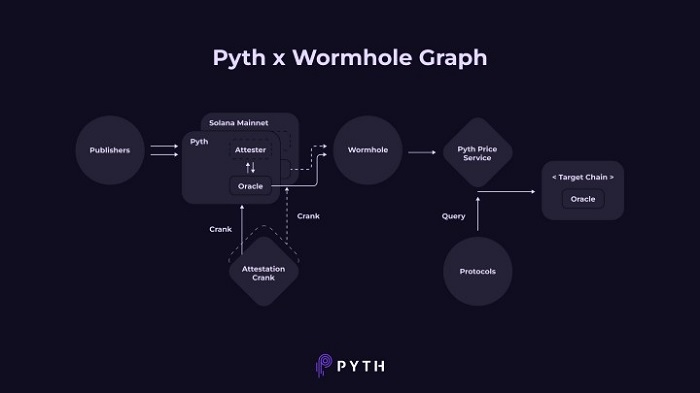
Pyth can provide price data on demand. This design allows users to send transaction requests only when they need it, which can greatly reduce costs. Not only that, but this design allows users of Python data to benefit from each other's requests, since price data requested by one protocol is updated and available to everyone else on the chain.
This "publisher network" design pattern of Python (where data providers are data owners or creators) gives users access to the latest, most timely data and feeds it into data as an oracle. In addition, Pyth's price aggregation algorithm and Pyth-Wormhole proof process can also maintain low latency and provide users with a seamless oracle data service experience.
3. Improve the network
On the other hand, Pyth Network has also made significant progress in providing valuable financial market data to the public. The initial version of the protocol was released on the Solana chain, mainly for users to publish US stocks, foreign exchange, precious metals, and of course "sub-second "Cryptocurrency price data.


