






Arthur Hayes: Post-Ethereum Merger Review, Supply, and the Fed


Original author:Arthur Hayes, 100x Co-Founder
Original compilation: Wu Zhuocheng,first level title
CZ: Binance Chain, US Government: Ethereum Network
Do you believe in decentralized and/or censorship resistant web? I expect that most Satoshi believers (who are probably most of my readers) will answer yes.
To this I say: absolutely impossible. Many people may be enthusiastic about buying, holding and using BNB, ETH and/or other dApps, tokens, but most of them don't actually care about the ideology behind these technologies.
BSC is not decentralized and has never claimed to be, but that hasn’t stopped the explosion of on-chain activity, nor has it had any impact on the attractiveness of BNB, the fifth largest token by market capitalization .
As of September 21st, Lido Finance, Coinbase, and Kraken collectively control over 50% of all ETH staked on the Beacon Chain. This means they are the most powerful validators, and essentially they can decide which transactions are processed. What do these three centralized entities have in common? They are all US companies or DAOs invested by US venture capitalists.
Six of Lido Finance's eight investors are U.S.-based venture capital firms or own vehicles in the Americas, according to Crunchbase.
This concentration of network power in the hands of centralized entities (which, I should remind you, are subject to US laws and regulations) does not exist under proof-of-work systems. However, network users voluntarily chose to transition to proof-of-stake and stake their ETH, thereby choosing to accept this centralization and potential future censorship. The US government is not coercing anyone here.
Does anyone really care? No. I'm sure Vitalik would argue that there are safeguards in place to help ensure decentralization - such as the way validators are penalized for censoring transactions. It's a nice idea, but let's stress test it.
The game theory behind how to incentivize validators to reach consensus becomes trickier after the proof-of-stake "upgrade". I went back and forth with Jonathan Bier, head of research at BitMEX, about the different penalties potential bad actors could face looking to censor transactions, and I quickly realized that things were a bit off. In a nutshell, the penalty system works like this:
There is a way to slowly lose ETH if less than 33% of the network refuses to validate blocks. Slowly losing ETH means validators are penalized for reducing their stake on nodes. If the stake falls below 16 ETH, the validator will be removed from the network. Since you cannot unstake the ETH, this capital becomes dead capital.
If more than 33% of the network refuses to validate a block, there is a quick way to lose ETH. Penalties get worse exponentially so quickly that dissenting validators are quickly below the 16 ETH threshold and kicked off the network.
Here's a hypothesis test of your ideological commitment - given the above, if the centralized bignodes of the Ethereum network changed the rules to mitigate penalties, would you support them, or would you support resistance to blind compliance with censorship?
We already saw a similar ideological test in 2016, when "The DAO" locked up a large portion of all ETH, at a time when nearly everyone defaulted to forking the protocol so people could get their money back, rather than being loyal to Ethereum's so-called "code is law" ethos.
This rather serious breach of Ethereum's "code is law" ethos didn't even dampen the fervor of its supporters, and had little negative impact on the network in the long run. ETH, the token that powers the network, has maintained its throne as the second largest token by market capitalization without much challenge, while Ethereum remains the most used blockchain network in existence (with nearly as much Bitcoin's daily 4 times the trading volume).
In all fairness, there are still plenty of very successful dApps leveraging the network that seek to break censorship in areas such as finance. However, as dApps scale and become important financial players in the global ecosystem, their success will likely threaten entrenched interests if the network does not place a high priority on censorship resistance or decentralization. Fang will have countless levers to whittle them down to a minimum.
The pseudo-decentralization endured by users of two of the most valuable "decentralized" internet computers (BSC and Ethereum) is in part a reflection of the ideological sacrifices people currently make every day when using the major Web2 platforms . The cost of using these platforms is not high: you either give your data to the US (Facebook, Google, Amazon, Microsoft, Apple, etc.) or China (Tencent, Baidu, Weibo, Alibaba, Huawei, ByteDance, etc.) ). But even after waking up to this dire reality, the vast majority of humanity continues to voluntarily surrender their data sovereignty to governments in exchange for the ability to entertain, socialize, and communicate online.
Early investors in US and Chinese Web2 giants created generational fortunes, and the same is true for ETH holders. ETH as a financial asset — fully tethered to the U.S.-dominated financial system and under the guise of “decentralization” — can still do extremely well in the near future. The question I want to address is whether truly decentralized financial and social dApps can exist at scale (i.e., have hundreds of millions of users), given the above. I don't know the answer to this question, but when it matters to the market, I wish I had used institutional investors as exit liquidity so I could fully immerse myself in a real Satoshi world.
As I've said in various interviews, I think the only thing that matters in the short term (i.e. the next three to six months) is how ETH issuance per block goes down under the new Proof-of-Stake model. In the days following the merger, the emission rate of ETH dropped from an average of +13,000 ETH to -100 ETH per day.
The price of ETH continued to rise as USD liquidity deteriorated, but gave time to changes in supply and demand dynamics to permeate. Check back in a few months and I suspect you'll find that the drastic reduction in supply has created a strong and rising floor for prices.
I previously wrote that I purchased a $3,000 ETH/USD December 2022 strike call option. I worry that I may not have enough time to invest in these options. Take a look at the table below.
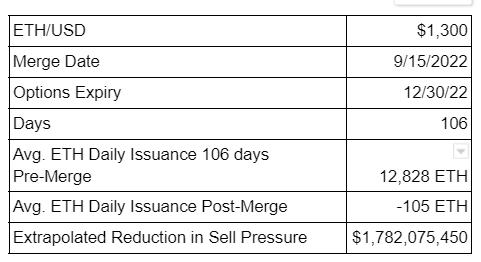
ETH net issuance = ETH issuance - [(ETH gas usage average / 10⁹ ) * ETH transactions].
first level title
do not follow the organization
"A bull market can only start when institutions come back" is a common argument I've seen a lot lately. The reality is that institutions are beta chasing muppets, they buy at the top and sell at the bottom due to their compensation incentives. Institutional money managers and trustees get paid by accumulating large assets and collecting management fees.
Many of these hard workers are Muppets because that's what they're paid to do. But when it comes to managing their own money, many recognize the value of crypto assets and flock to them. As a trustee, you care about bonuses. But as the head of a household, you care more about compound returns.
All that said, those who predict that institutional investor money will lead the next bull market aren't talking about those investors' individual portfolios.
In any environment, the primary goal of any organism is to survive, and money managers are no exception. In their working lives, trustees hope to make it through the year for their next bonus. This means they will only buy cryptocurrencies if they are safe to do so. Safety is found when the price has already risen from the bottom several times. When the market goes lower and they lose investors' money, at least they can justifiably say they bought when everyone else was.
first level title
exacting relevance
Isn’t it sad that Bitcoin has become a high-powered indicator of dollar liquidity? Isn’t it a frustration that crypto assets are moving in lockstep with the Nasdaq 100 index, which is made up of big US technology companies? I would have thought crypto assets were supposed to be the people's money, negatively correlated with the TradFi system.
first level title
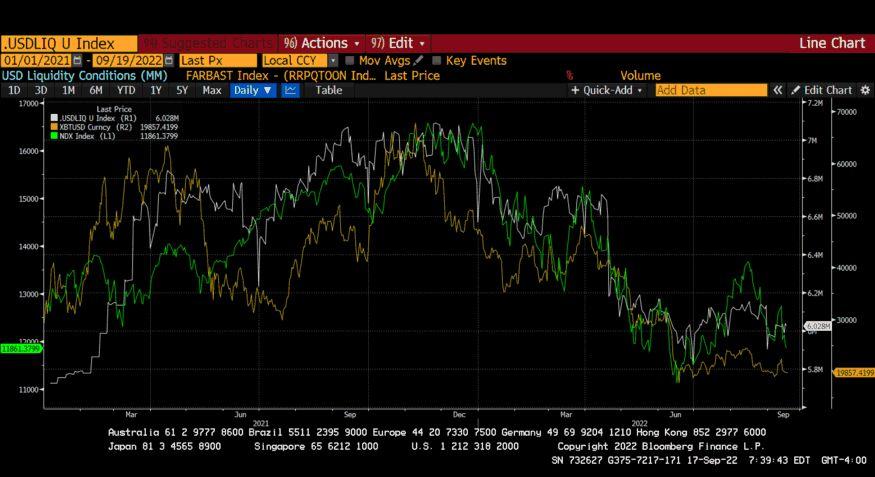
Bitcoin Price = USD Liquidity + Technology
The dollar's liquidity position will do what it can, which is the price driver that most people focus on. But censorship-resistant technology doesn't get enough trust. It will continue to be distrusted until those attributes are proven valuable.
These technical properties are impossible to know a priori, mainly due to the way we think about the future, we tend to predict the future with reference to the recent past. For most of humanity living in economically advanced countries, recent history from a financial services perspective has been"correct", fiat currency and the financial system that comes with it are valid.
As I pointed out in my recent article "For War", recent history has been one of economic peace between two major blocs (US/EU and Eurasia/Russia/China). If your passport is Russian, your dollars, euros, pounds, etc. are no longer yours. Russia now allows only rubles, gold or"friendly"The country's currency to buy fuel. The global financial and energy systems are being balkanized, which will lead to hyperinflation. In this case, a global currency run and owned by humans has infinite value. At this time, Bitcoin technology will show its true value and support the right side of the above value proposition.
first level title
increase
While the U.S. Dollar Liquidity Index does a good job of explaining Bitcoin’s recent movements, it has little predictive power. If we want to predict what might happen to the price of Bitcoin in the future, we care about the liquidity situation today relative to the recent situation.
As always, forecasting is an art, not a science. With curve fitting, I made assumptions about time. In this case, I want a less volatile increment, but also move quickly to account for the rapidly changing nature of Bitcoin. I determined a 3 month index. The components of the index are updated weekly (Fed Balance Sheet and Treasury General Accounts) and daily on weekdays (Reverse Repo Swaps and Standing Repo Facility Balances). There are typically 252 trading days in a US year, so if I want a 3 month impulse, that's 63 trading days.
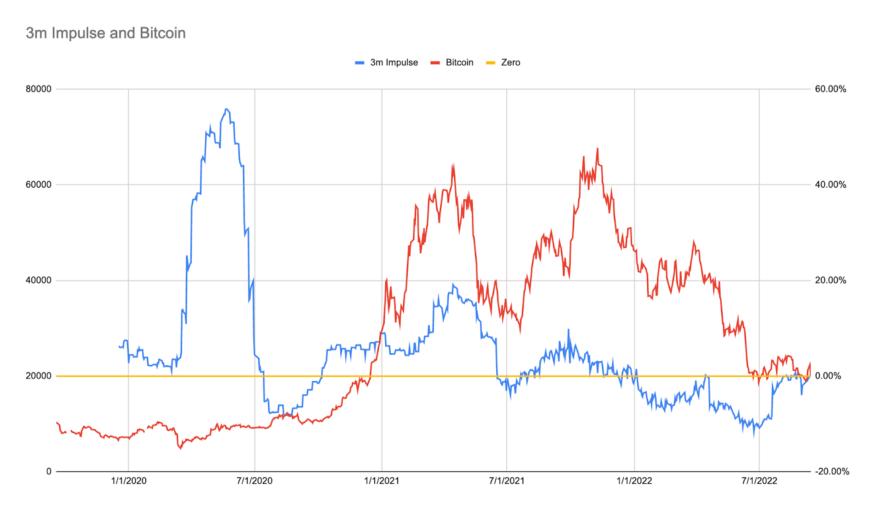
Simple, if the delta is positive, I'm long Bitcoin, if the delta is negative, I'm short or short Bitcoin.
This simple statement does not do much good for a trader. As traders, we care about inflection points. In November 2021, the delta is positive -- that is, dollar liquidity has increased compared to the previous three months -- but it is the top of the market. If the delta is rising but the rate of rise is slowing, we want to exit long positions and possibly go short. If impulse is declining but the rate of decline is decelerating, we want to exit short positions and possibly go long.
The current situation is choppy. From November 2021 to July 2022, USD liquidity conditions tighten significantly. The chart clearly shows the drop of $3 million, and the corresponding drop in the price of Bitcoin. In recent weeks, the urge has been cut to around 0%.
From a dollar liquidity standpoint, the remainder of the year saw the Fed commit to reducing the size of its balance sheet, with the U.S. Treasury issuing large amounts of debt to finance the government. Both actions remove liquidity from the system. That should lead to a lower pulse and send Bitcoin down to test its June low of $17,500.
The mitigating factor is that all this tightening of liquidity will disrupt financial markets in the US and the world. A highly leveraged dollar-based global economy cannot survive current levels of activity with significantly reduced dollar liquidity. My guess is that there is something wrong with how the US Treasury market works. The Federal Reserve, the Treasury Department, domestic banks and large foreign holders such as Japan and China are all selling bonds. Who is going to buy all these bonds at yields well below the government's inflation target? If the Fed and Treasury want to ensure that the U.S. Treasury market, the most important to the global financial system, remains intact, they may have to abandon plans to significantly remove dollars from the system. Politics is a passive activity, so we may have to see the US Treasury market crash before it changes direction.
There are rumors that the "strengthening the dollar" policy being pursued by the Fed and Treasury could be reversed during the G20 battle in Bali on November 15-16. The EU as an anti-Russia/China spearhead cannot survive a stronger dollar as they now have to import more LNG tankers. This event is also after the US mid-term elections, so the political will to "fight" inflation may decline faster than TerraUSD.
The Fed has not changed their quantitative tightening or short-term interest rate policies as I have suggested in the past few articles. However, I never said that I believed the Fed would make adjustments before the midterm elections.
When we look at the volatility of the USD Liquidity Index and its increment, the bitcoin price that bulls should worry about is $17,500. The most likely course of action is to retest that low. Whether this line can be held depends entirely on the incremental trajectory of the US dollar liquidity index.
On ETH, we are only a week away from the merger. It appears that the network is functioning normally, which is fine. Technology is hard, and it seems like congratulations to the Ethereum core developers for this incredible feat. As expected, the amount of ETH decreased by almost 13,000 per day.
Since I wrote two bullish articles on ETH, the price has capitulated. I still believe that the structural reduction in ETH supply will definitely lead to outperform Bitcoin - but if the Fed and Treasury continue their USD liquidity reduction plan, I am not confident that ETH will reach five digits by the end of the year. To my chagrin, my December options expire worthless.
Having said that, am I lightening my portfolio with ETH and ERC-20 altcoins? Absolutely not! Since I hold stock, I don't have to worry about time and cost. Obviously, there is an opportunity cost in short-term US Treasuries compared to holding fiat currency, but I have allocated a portion of my overall portfolio to it. I also go long interest rates through a range of exotic derivatives. In crypto markets, the wait is worth the wait, and I'm structured to be patient.


