






Vitalik: Talking about ENS domain name ownership in detail, should there be recurring fees based on demand?


Original title: "Should there be demand-based recurring fees on ENS domains?》
Original Author: Vitalik
Compilation of the original text: Guo Qianwen, Chain Catcher
Compilation of the original text: Guo Qianwen, Chain Catcher
ENS domain names are very cheap these days. It only costs $5 per year to register and maintain a five-letter domain name. If you look at it from the perspective of a single person registering a single domain name, this price is very reasonable, but when you cut in from the global perspective, everything is very different. In the early days of ENS development, people could register all 8,938 five-letter words in the "Spelling Word List" (which contains various uncommon words), prepay their ownership for a hundred years, and only need two Lamborghinis in total. In fact, as many people have said: almost all five-letter domain names are already taken, and many people are occupying this position waiting for a high-priced buyer. Just glance at OpenSea and you'll see that 40% of those domains are either up for sale or have already been sold.The question is, is this really the best way to distribute domain names? By selling domain names at a low price, ENS DAO obviously can obtain less income, which will limit its ability to improve the ecosystem. The current status quo is also detrimental to fairness: being able to buy all domain names at a low price is a good thing in 2017, and it is acceptable in 2020, but it will seriously affect the operation of the ecosystem in 2050. Buying a five-letter domain name actually requires 0.1 to500 ETH
Is there a better way to assign domain ownership? Could it bring more revenue to the ENS DAO, ensuring that domain names are available to those who make the most of them, while preserving the value of ENS - trusted neutrality and the guarantee of long-term ownership?
secondary title
Question 1: Is there a fundamental compromise between property rights and justice?
Suppose there are N "high-value names" (such as five-letter words in a spelling dictionary, or any similar category). Assume that every year, users grab k names, among which p names are snatched away by people who are extremely stubborn and will not give up (p can be very small, as long as it is greater than 0). Then, after Nk∗p years, no one can get high-value names anymore.
It's a two-line mathematical theorem that doesn't require much explanation. But it reveals a key truth: the timeless allocation of finite resources undermines long-term fairness. This situation also occurs on the land issue, which is why there have been many land reforms in history, and it is also an important reason why many advanced people advocate land taxation. The same is true for domain names, although early .com holders brought in .io, .me, .network and many other domains in abundance, briefly mitigating the problem with this "forced dilution".
The ENS has documented its commitment not to add new top-level domains to avoid polluting the global namespace and undermining its eventual integration with the mainstream DNS, so this dilution is not considered.
At the very least, recurring fees mean that no one can accidentally lock a domain name forever by forgetting or being careless. But that may not be enough. You could still pay $500 to lock an ENS domain name for a full century, and there are bound to be some domain types that are in high demand, so the price will be more than that.
secondary title
Problem Two: Speculators Are Not Creating Efficient Markets
If we admit that there is a problem with the first-come, first-served model of low flat rates, the usual counterargument is: yes, many names will be bought by speculators, but speculation happens naturally and is a good thing. It's a free market mechanism where speculators who really want to maximize their profits are incentivized to resell domain names in such a way that the people who can best use them get them, and their excess returns are just for the payment for such services.
But it turns out that there has been academic research on the issue, and that, in fact, the profit-maximizing auctioneer is not maximizing social welfare! To quote Myerson from 1981:
"The seller announces that the reserve price is 50, which means that it bears the risk (1/2n) that the item cannot be sold, even if some bidders are willing to pay a price higher than t0; but the seller also increases its expected income, Because he can demand a higher price when the item is sold.
Therefore, optimal auctions may not be ex post efficient. To get a clearer idea of why this happens, consider the example in the previous paragraph, the case of n=1. Ex post effectively requires that the bidder always gets the item as long as his value estimate is positive. But then the bidder will never get any recognition beyond the infinitesimal value estimate, since any positive bid will win the item... In fact, the seller's best strategy is to refuse to sell the item for less than 50. "
Therefore, it is not true that "speculators capture a large portion of domain name distribution revenue as compensation for ensuring the efficient operation of the market". On the contrary, speculators can easily make the market worse than the well-designed mechanisms in the agreement that can encourage domain names to be sold directly at fair prices.
first level title
Why support stricter property rights: Stable domain name ownership can have positive externalities
For a long time, people have realized that excessively strict property rights of non-homogeneous assets will bring about monopoly problems. The Harberger tax was originally designed to solve this problem in a market-based way: it required each owner of an asset to set a price at which they were willing to sell it to someone else, and pay an annual fee based on that price. For example, 0.5% of the sales price is charged annually. Then the holder will be incentivized to keep the asset in a purchaseable state at a reasonable price, and the "lazy" holder who refuses to sell will lose money every year, and hoarding assets without using them is economically impossible in many cases OK.
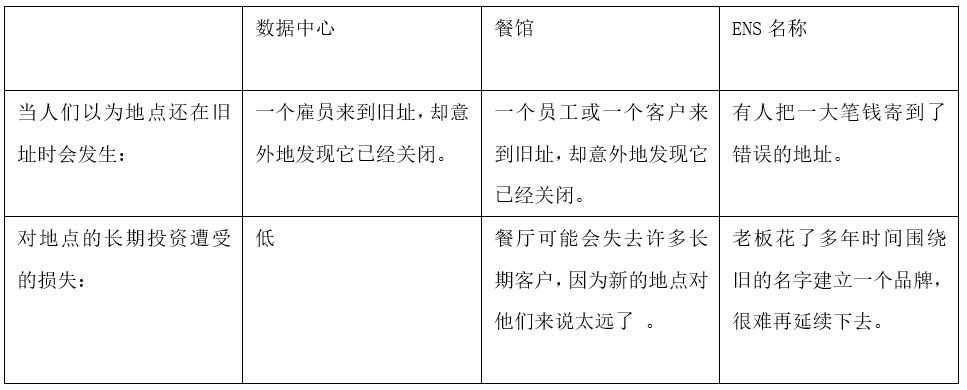
But the risk of being forced to sell something at any time carries enormous economic and psychological costs, which is why advocates of the Harberger tax have generally focused on industrial property applications because of their more sophisticated market players. Where do domain names fit on this spectrum? Let's consider the cost of "moving" a business in three different cases: data centers, restaurants, and ENS names.Therefore, a Harberger tax on domain names is not a good idea.
secondary title
Alternative Solution 1: Demand-Based Recurring Pricing
There is currently a recurring fee for maintaining ownership of ENS domain names. For most domain names, this is just a low fee of $5 per year. The only exceptions are four-letter domain names ($160 per year) and three-letter domain names ($640 per year). But what if, instead of doing this, we let the actual level of demand for domain names in the market determine the price?
This, unlike the Harberger tax, does not require a specific price to make the domain immediately available for sale. Instead, the initiative in the pricing process will rest with the bidders. Anyone can bid on a specific domain name, and if they keep their bids open long enough (say 4 weeks), the domain's valuation will rise to that level. The annual fee for the domain name will be proportional to the valuation (for example, it may be set at 0.5% of the valuation). If no one bids, the fee may decrease at a constant rate.
When bidders send their bid amounts into a smart contract for bidding, asset owners have two options: they can accept the bid, or they can decline, which means potentially starting to pay higher prices. If bidders bid more than the domain name is actually worth, the owner can sell it to them, costing the bidder dearly.This property is important because it means that making domain holders "unlucky" is risky and expensive, and may even end up benefiting the original victims.
This provides more stability than the Harberger tax and is more suitable for newbies. Domain owners don't need to constantly worry about whether they've set their price too low. Instead, they can sit back and pay an annual fee. If someone makes a bid, they can make a decision within 4 weeks to either sell the domain name or hold on to it and accept a higher fee. But even then, this probably doesn't provide enough stability. To go further, we need a compromise.
secondary title
Alternative 2: Demand-Based Capped Recurring Pricing
We can modify the above scheme to provide stronger guarantees for domain name holders. Specifically, we can try to provide the following properties.Strong time-limited ownership guarantees:
For any fixed number of years, it is always possible to calculate a fixed amount that you can pay upfront to unconditionally guarantee ownership for at least that number of years.
In the language of mathematics, there must be some function y=f(n), and if you pay y dollars (or ETH), you get a hard guarantee that no matter what happens, you will hold the domain name for at least n years. It may also depend on other factors, such as what happened to the domain name previously, as long as these factors are known at the time of the registration or domain extension transaction. Note that the highest annual fee after n years will be the derivative f'(n).
The new price after the bid will be capped at an implied maximum annual fee. For example, f(n)=1/2*n2, so f'(n)=n, you get a bid of $5 after 7 years, the annual fee will rise to $5, but if you get A $10 bid, and the annual fee will only rise to $7. n resets if no bid raises the fee to the maximum value for a certain amount of time (e.g. a full year). If someone bids and is rejected, n is reset.
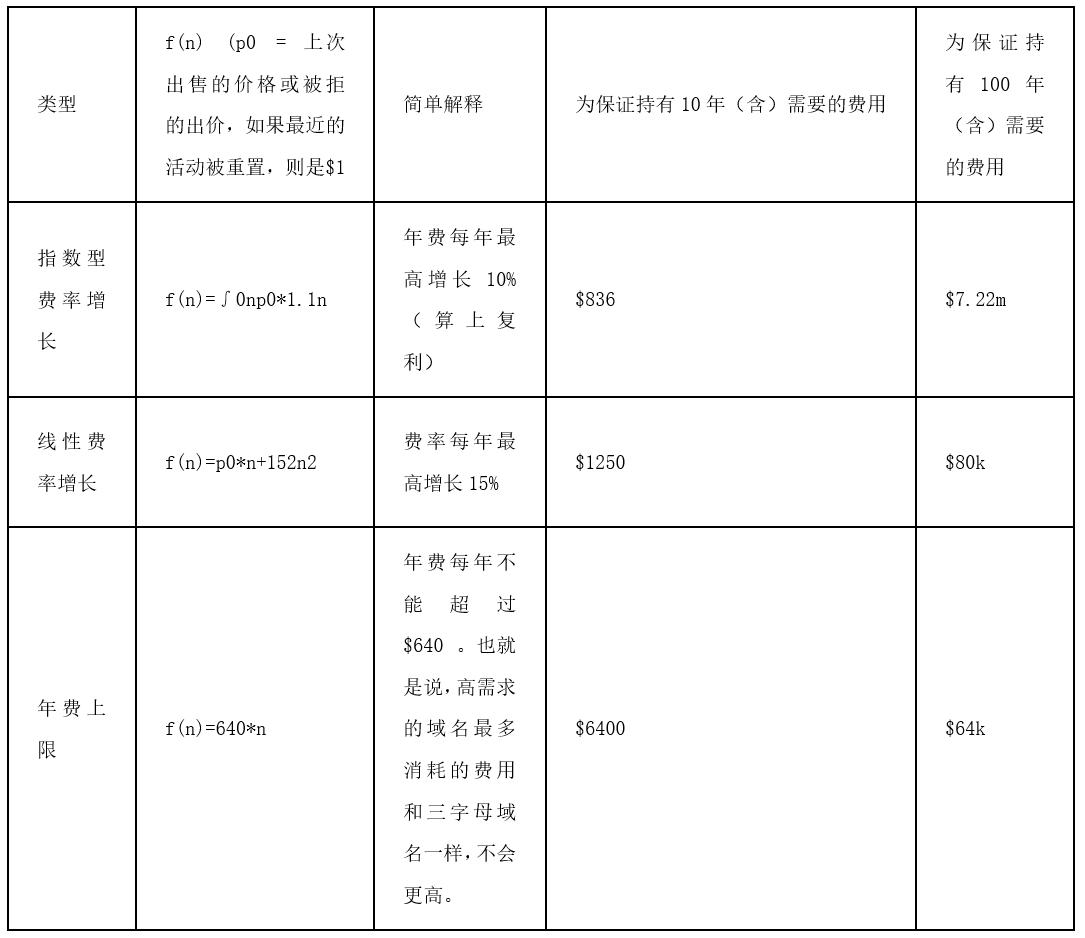
Of course, we have a very subjective criterion that f(n) must be "reasonable". We can suggest a compromise by experimenting with different function shapes:
Please note that the amounts in the table are only the theoretical maximum amount required to guarantee holding the domain name for that year. In practice, almost none of the domain name bidders are willing to pay a high price, so almost all domain name holders will end up paying far less than the highest price.One of the fascinating things about "capped annual fees" is that some versions of it are strictly more favorable to existing domain name holders than the status quo.
In particular, we could imagine a system where domains not being bid on pay no annual fee, and bids can raise the annual fee up to a cap of $5 per year.Demand from outside bids clearly provides some signal of the domain name's value (ie, the extent to which the owner spends maintaining control over it to the exclusion of others).
So, whatever your opinion on the level of expense required to maintain a domain name, you should choose some cost parameters based on your needs.
first level title
summary
summary
Weakening property norms and increasing fees is psychologically unpalatable for many. This is the case even if there are clear economic benefits to these fees, even if you could convert the fee income into UBI and show mathematically that most people will gain a net financial benefit from your proposal. It's hard to add congestion charges in cities, even when people know full well that the only options are to pay for congestion in dollars, or to drive painfully slow in traffic, for wasted time and mentally weakened Health pays the congestion charge. Although a land value tax is in many respects one of the most effective and harmless taxes, it has been difficult to adopt. It seems to me that Unstoppable Domains' public and proud claim of "never charge for renewals" is very short-sighted, but it clearly has at least some effect. So why do I think it is possible for us to add fees and conditions to domain ownership?
The cryptocurrency space will not solve the deep political-psychological challenges facing humanity — humanity has failed for centuries. But we don't have to solve the problem, and I see two possible answers that may bring hope of success from a practical point of view:
The first is democratic legitimacy: coming up with a real enough compromise that enough people are happy, and maybe even some existing name holders (not just potential name holders) are better off than they are now.
For example, we can implement a demand-based annual fee capped at $640 per year for domains up to 8 letters in length, $5 per year for longer domains, and if no one bids, the domain name holder pays nothing. With such a suggestion, many ordinary users will save a fortune.
The second is market legitimacy: there is no need to subvert people's expectations of an existing system to gain legitimacy, rather, a new system (or subsystem) is created.
In traditional DNS, this can be done simply by creating a new TLD, which will be just as convenient as the existing TLD. In ENS, there is an explicit idea of sticking to .eth only to avoid conflicts with the existing domain name system. And using existing subdomains is not entirely feasible: foo.bar.eth is much worse than foo.eth. A possible middle path is for ENS DAO to hand over single-letter domain names entirely to projects that run trusted neutral marketplaces for their subdomains, as long as they give at least 50% of their revenue to ENS DAO.
For example, perhaps x.eth could apply one of my proposed pricing schemes to its subdomains, and t.eth could implement some mechanism giving the ENS DAO the power to forcefully transfer subdomains for anti-fraud and trademark purposes. If it's going to be some kind of replacement for foo.eth, foo.x.eth is just barely good.
If there is no way to change ENS' domain pricing, then a market-based approach should be strongly considered, explicitly encouraging markets with different rules in subdomains.
For me, the cryptocurrency space is more than just currency, and I admit that my interest in ENS does not revolve around the concept of ownership of its domain name, which is similar to property rights, unconditional and infinitely strict. Rather, I am more interested in this space in terms of trusted neutrality, and property rights that are well protected, especially against political censorship and arbitrary and targeted intervention by the powerful. Nonetheless, a high degree of ownership security is important to the functioning of the Domain Name System.
The above mixed proposal is my attempt to maintain completely credible neutrality, continue to provide a high degree of ownership security, and at the same time increase the cost of domain name occupancy, bring more income to ENS DAO, and enable it to Work on an important public good so that those who can't get the domain name they want have the opportunity to get one.


