






How to choose high-quality projects? One article compares various NFT fund indexes


In recent years, the application of NFT in games, art and other fields has made it a bridge between the virtual world and the real world, attracting the attention of more and more investors outside the encryption circle. But for new entrants, the NFT market is first of all very complicated. According to NFTScan data, as of September 12, there were a total of 96.68 million NFT assets and 130,000 NFT contracts in the market.
It’s safe to say that the trick to picking the best NFT projects requires experience, often after a few failures. The question is, if you are not an NFT expert, how is it possible to pick a high-quality item from the dazzling collection? This is exactly why index funds were born.
Why do you need NFT index funds?
The mechanism of the NFT index fund is created by emulating the mechanism of the index fund in traditional finance. Index funds refer to fund products that use a specific index as the target and construct a portfolio with all or part of the constituent stocks of the index. At present, the mainstream benchmark indexes on the market include the Shanghai and Shenzhen 300 Index, the S&P 500 Index, and the Nasdaq 100 Index. Index funds have the characteristics of diversifying risks, reducing operating costs, and reducing portfolio transaction volume.
From historical data, index funds have always been used as a tool for hedging market risks, and are considered to be one of the best financial tools, which can obtain stable and continuous returns, and these returns usually increase year by year.
Applying the basic principles in the traditional financial market to the NFT field and creating an NFT index fund is the only way to meet the needs of investors, because the NFT market faces the same contradiction as traditional finance: on the one hand, invest in as many different projects as possible It is the best choice, but on the other hand, it means that you need a huge amount of money to invest, which increases the financial burden of investors.
In this case, NFT index funds are very good products for people with limited purchasing power. By purchasing the tokens of an NFT index fund, people can obtain the overall benefits brought by the different NFTs covered by the index at a relatively low cost, and hedge risks through diversification. Judging from the current market price, NFT index funds have lowered the threshold for investing in NFT asset portfolios to around $10.
Some basic methods for judging the quality of NFT index funds
For ordinary users or users who are new to NFT, judging the quality of index funds is less difficult than screening different NFTs one by one in the entire NFT market. Here are some simple ways to judge the value of an index fund:
Look at the team's work goals and results. If the team behind the project is exaggerating results, trying to mislead first-time investors, or if its roadmap is just copy-pasted from another popular project, then that's a red flag.
Look at the importance of the index community. The community must be deeply involved in the project, and all major decisions are made jointly by the community. For example, JPG NFT Index will invite users of the index community to decide the weight of different NFT series in the index fund.
Look at the selection of index funds. They must be unique, visually stunning art that will attract potential buyers, or something that will reinforce the popularity, that is, the NFT with viral effect.
See the principle/methodology followed when selecting NFT for the index fund token. NFT series eligible for inclusion must meet certain qualitative criteria, including but not limited to the following:
Trading volume in the NFT trading market
Price performance after initial listing
Appeal among community members
Visibility inside and outside the NFT ecosystem
project maturity
Each index fund has its own set of principles/methodology for screening NFTs to ensure that the index is worth investing in. The principles of different index funds focus on different directions. Some focus on the popularity and spread speed of NFT, some focus on the ranking of NFT, and some are divided by fields, such as game NFT, social NFT, art NFT and Metaverse NFT.
Index funds generally avoid certain bad NFTs. For example, certain NFT series perform poorly in terms of effective casting and redemption, and are generally abandoned by index funds. The characteristics of this type of NFT include: low supply, low listing/supply ratio, and NFTs with floor prices in the mainstream market Can't transfer online, and so on.
In addition, the Nansen index is a good reference index, but the index currently only provides analysis tools, and there is no corresponding Token for investors to purchase. Nansen NFT Index, applying various index investment principles, analyzes and presents different NFT market segments, and helps investors discover investment opportunities, so as to choose a reasonable NFT portfolio for themselves. In particular, the Nansen NFT-500 (tracking the prices of the top 500 NFTs) was created against the S&P 500.
It is worth noting that investing in index funds will also be exposed to various risks in the encryption market and the NFT market, such as risks in smart contracts and custody, but if you are not an expert in the NFT field, choosing an index fund is better than doing it yourself Choose an NFT that can earn income.
Different NFT Index Funds in the Market
Now there are many NFT index funds on the market, there are two main types:
One is the index fund on the NFT Defi platform (such as NFTX)—that is, the vault tokens corresponding to different NFT series, such as PUNK corresponding to cryptopunks and MASK corresponding to Hashmasks. Users can choose different NFTs in this index fund to make portfolio.
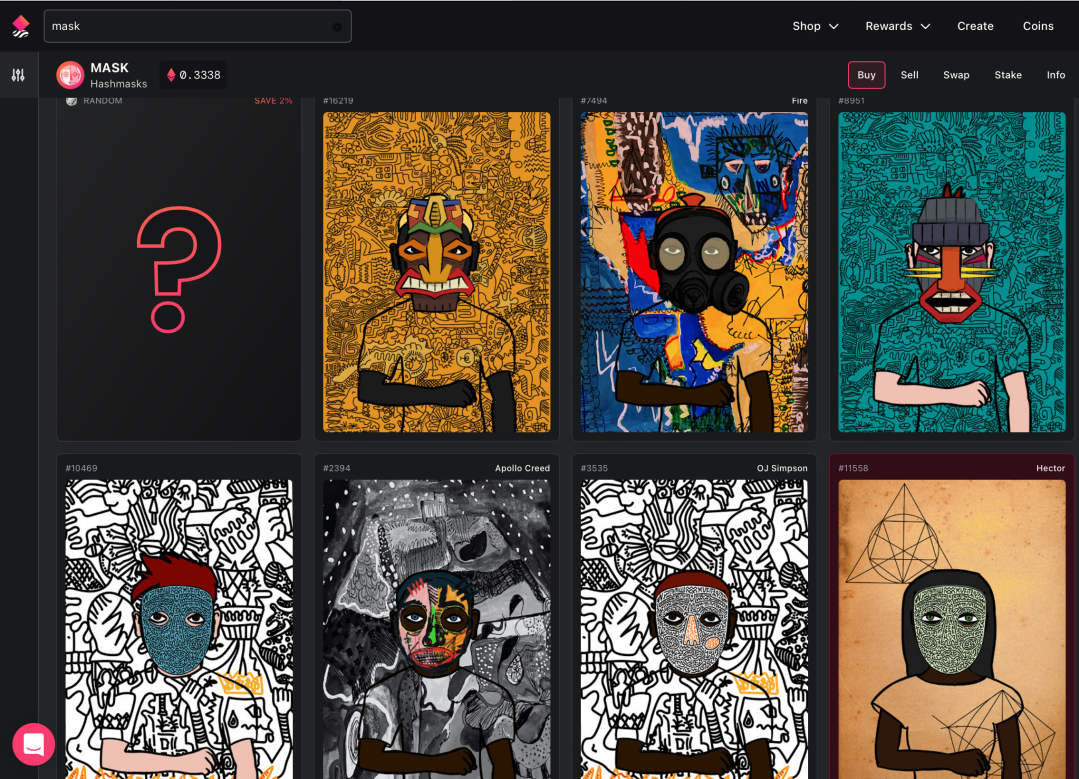
The other type is fragmented index funds, such as JPG NFT Index. Purchasing the tokens corresponding to the fund is equivalent to directly investing in the fragments of different series of NFTs contained in it, without having to choose by yourself.
Examples of NFT Defi platform and fragmented NFT index:
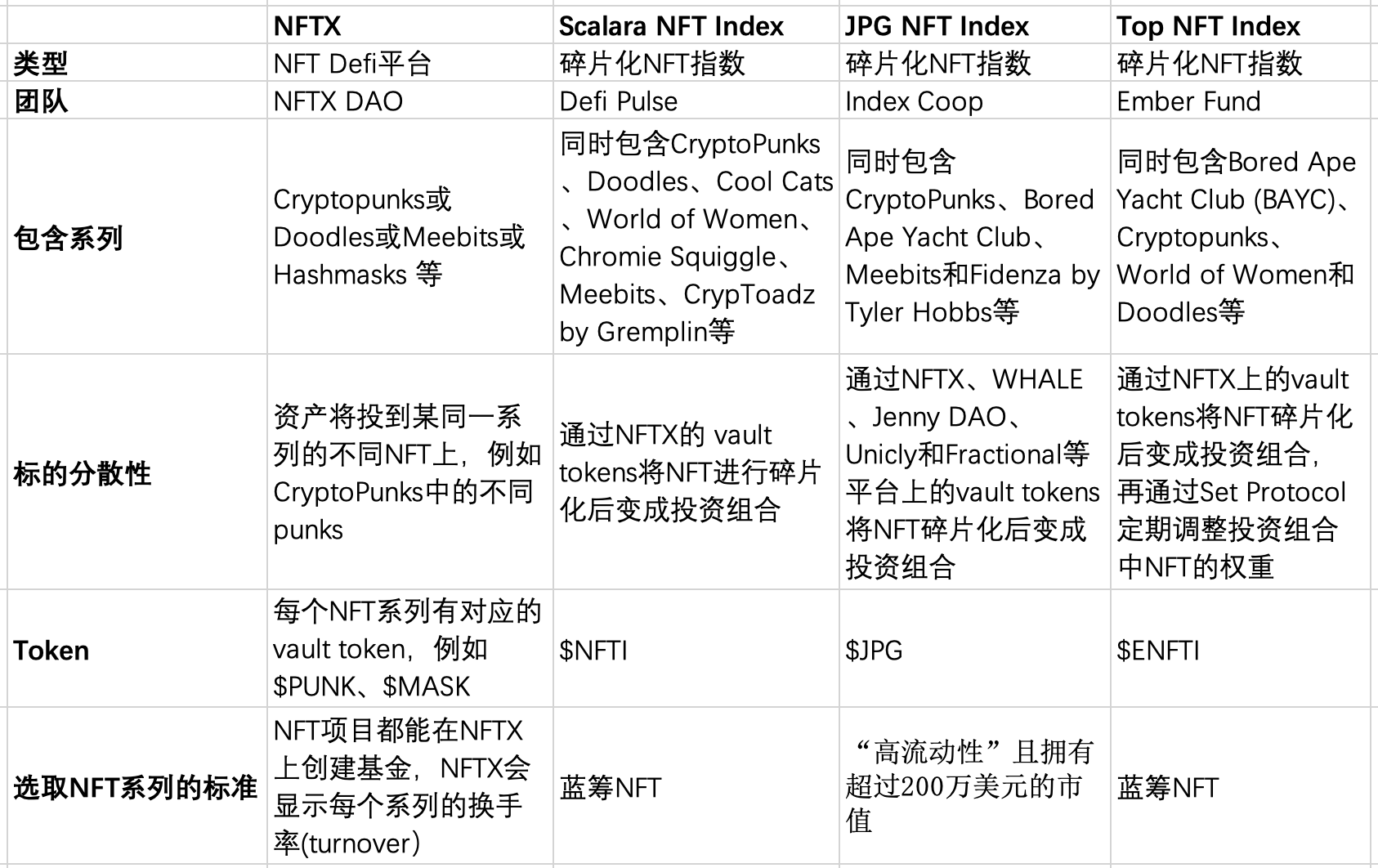
The JPG NFT Index, Scalara NFT Index and Top NFT Index in the above chart are all based on tracking the floor price of premium NFT series. As of the end of August, their prices have fallen by about 60% relative to their historical highs. If you refer to the Nansen NFT-500 index (the official website shows that it has fallen by about 68%), the performance of these index funds is very average, because it is only better than the Nansen index a little.
In addition, the Ember Fund Top NFT Index does not indicate whether these fragmented NFTs for users come from Ember Fund's own inventory or the inventory of other Defi projects. In its promotion, it is mentioned that the ROI that users can obtain may reach 76.16%, and there is currently no available data website to confirm how likely this data is to be realized.


