






Conversation with Vitalik: PoW will eventually turn to PoS, and token-driven governance is a backward model


Original title: "Interview: Vitalik Buterin, creator of Ethereum》
Original Author: Noah Smith, Noahpinion
Original compilation: Biscuit, chain catcher
Original compilation: Biscuit, chain catcher
Vitalik Buterin is one of the most well-known and well-loved figures in the crypto world, and Ethereum, which he co-founded with Gavin Wood, has become a leader in the entire Web3 world. What's clear is that he's a smart, friendly guy who just wants to create cool stuff, not fool anyone. In addition to being one of the voices of cryptocurrency, Vitalik also has an interesting Twitter account and a blog where he often expresses great depth and original opinions on various crypto topics.
As we speak, Ethereum, which powers most smart contracts in the crypto world, is undergoing an epochal transformation. In a process called The Merge, scheduled to be completed within two weeks, ethereum is switching the way it verifies transactions from proof-of-work (PoW) to proof-of-stake (PoS). This will allow the network to significantly reduce energy use and carbon emissions.
In the interview that follows, Vitalik and I discuss proof-of-work vs. proof-of-stake, the recent crypto market crash, cryptocurrency security, decentralized governance, "cyber-states," and more.
Vitalik:Noah Smith: I think we should start with some current events. Almost all cryptocurrencies have crashed in recent months. Why do you think this is happening? How will this affect the future of the blockchain ecosystem?
I'm actually surprised that the "crash" event happened so late. Typically, crypto bubbles last about 6-9 months after a bull market top, followed by a rapid decline. This time the bull market has lasted for nearly a year and a half, and people seem to have developed a mentality that high prices for cryptocurrencies are the new normal.
All along, I've known that the bull market will eventually end and we'll experience a dip, but I just don't know when. It currently feels like people don’t understand the cyclical dynamics of cryptocurrencies well enough. When the price goes up, a lot of people say it's the new paradigm and the future, and when the price goes down, people say it's doomed and fundamentally flawed.I do think the price drop helped "reveal" some of the problems that were there to begin with.
Unsustainable business models tend to succeed in boom times, because everything is going up, so is the amount of money people have at their disposal, so the model can be temporarily propped up by the constant influx of new dollars.
During a crash, as we saw with Terra, this model no longer works. This is most prevalent in extreme situations like high leverage and Ponzi schemes (crypto gamers in 2017 will remember "BIT-CONNE-EEE-ECT!!!"), but also in more subtle ways, like during bull markets Developing a new protocol needs to consider how easy it is to maintain high yields. When the price plummets, it is often difficult for newly established teams to sustain financially. Apart from my usual advice that people should remember the history of crypto and take a long view on this thing, there is nothing I can do to fight these cycles.
Editor's note: BIT-CONNE-EEE-ECT refers to the sudden announcement in January 2018 that BitConnect, a bitcoin investment and lending platform, would shut down its lending and exchange services. At its peak, BitConnect had a market capitalization of over $2.6 billion, guaranteeing investors a total monthly return of up to 40%.
Vitalik:Noah Smith: Makes sense. Now please talk a little more about the financial aspect. For Bitcoin — the most widely held and traded cryptocurrency — we’ve seen this pattern repeat with fairly regular bubbles and busts, but each boom has a lower percentage return than the previous one. To me, this looks like a curve - as more and more people hold cryptocurrencies, new users get less and less financial gain. Have we reached a stage where Bitcoin adoption is saturated and returns drop to gold levels?In my opinion, in the medium term of the future, cryptocurrencies will stabilize and be only as volatile as gold or the stock market. The main question is at what level will the price of the cryptocurrency stabilize? In my opinion, a lot of the early volatility has to do with the uncertainty of cryptocurrencies: in 2011, when Bitcoin fell from $31 to $2 in six months, people suspected that Bitcoin was just a fad, and then Crash forever. In 2014, this uncertainty is less than before, but it is still there. Then after 2017,
The question of uncertainty shifts to the fact that cryptocurrencies can rise to higher prices, but only if they gain the required mainstream-approved legitimacy.
Even though we've come a long way, this is still roughly where we'll be in 2022. These existential problems will become more and more apparent over time. If in 2040, cryptocurrency has steadily entered several market segments: it has replaced gold as a store of value share, it has become a kind of "financial Linux", ubiquitous and always available.
If alternative financial products become a really important target for cryptocurrencies, but not to completely replace mainstream financial products, then the chances of it disappearing or completely taking over the world in 2042 will be much smaller, and individual events have a very small impact on this possibility. Small.
Some deadheads believe that the price of cryptocurrencies is stuck in a finite range (between zero and all the wealth in the world) and that cryptocurrencies can only remain highly volatile within that range for so long until they repeatedly buy high and buy low Selling becomes an arbitrage strategy that is mathematically almost certain to win.
Vitalik:Noah Smith: Furthermore, estimates of Bitcoin’s energy use show that the energy consumption of the network is closely related to Bitcoin’s price. This is not the case for stocks, houses or gold - none of these assets require increased energy use to support higher prices. In the long run, this seems to represent a force that will weigh on the price of Bitcoin, doesn't it?
I generally view the question of how Bitcoin's demand and supply curves interact, and how supply arises, as two separate issues. Difficulty adjustments ensure that the number of bitcoins mined is fixed on a schedule: currently 6.25 BTC every 10 minutes, starting around 2024 to drop to 3.125 every 10 minutes, and so on. This timeline applies regardless of hashrate or price. Therefore, from an economic point of view, it does not matter that the protocol hands these tokens to miners or core developers. That's why I don't buy into the mentality that miners somehow "back" the value of Bitcoin.
A consensus system that consumes a lot of electricity is not only harmful to the environment, but also requires the issuance of hundreds of thousands of BTC or ETH every year. Of course, eventually the circulation will decrease to close to zero, at which point this will cease to be a problem, but then Bitcoin will face another problem: how to ensure the security of the network...
These security motivations are also a very important driver of Ethereum's move to Proof of Stake.
Vitalik:Efficiency and security are not independent concerns. The central question is: how much security does each dollar you spend each year buy? If the security of a system is too low, you can use more cryptocurrency as an incentive to increase security. At this point, you have gained security by sacrificing efficiency. I am hereThis articleThis article
Dive into some of the economic reasons why Proof-of-Stake can be roughly 20x more secure for the same cost. Basically, being a Proof of Work miner has moderate ongoing costs and entry costs, but being a Proof of Stake validator has low ongoing costs but high entry costs.It turns out thatA network is only as secure as the cost of entry
, because that's what the attacker has to pay. Therefore, the consensus system of the network should have low ongoing cost and high entry cost, which is what PoS is good at. Also, there is a difference in how the two restore the network after an attack: in PoW, the network can only be restored by changing the PoW algorithm, but throwing away all existing mining hardware. However in PoS, the network can own the protocol and give away only the attacker's assets, so the attacker pays a lot, but the ecosystem recovers quickly.In the case of Bitcoin, I am concerned for two reasons. First, in the long run, Bitcoin's security will come entirely from fees, and the network has not managed to achieve the required level of fee income, so it's hard to be a potentially multi-trillion dollar system. Bitcoin fees are around $300,000 per day and haven't really grown that much in the past five years. Ethereum is much more successful in this regard becauseEthereum is more designed to support user usage and build an application ecosystem.
Second, Proof-of-Work offers far less security per dollar of transaction fees than Proof-of-Stake, and Bitcoin's migration from Proof-of-Work does not appear to be feasible. If the Bitcoin network reaches $5 trillion in the future, but only $5 billion is needed to attack the blockchain, what will users think? Of course, if Bitcoin does come under attack, I hope they will show a willingness to at least move to hybrid proof-of-stake, but I expect it will be a painful switch.
Vitalik:Noah Smith: Anyway, your argument about the per-dollar security that proof-of-stake provides makes a lot of sense. Bitcoin's high energy costs are actually security costs. But let's talk about why Bitcoin proponents are reluctant to accept any alternatives to PoW. Does the proof-of-stake idea allow large stakeholders to modify the network protocol to their own advantage and rob users of fees? Proof of Work has created a large class of miners, is there an incentive to protect their ongoing income going forward? Even though these miner revenues represent a holding cost for users.
There is some debate about proof of stake. The most powerful one, in my opinion, is the "Costless Simulation" problem. The idea is that in a proof-of-stake network, an attacker can contact token stakers from years ago, buy their old private keys for a very low price (since those tokens have already been transferred), and use those addresses to create a different The chain will fork the main chain. During the post-fork vacuum period, the chain's historical data looks valid. A node that only knows the protocol rules and connects to the network from scratch will not be able to tell the difference between the real chain and the simulated chain provided by the attacker. In PoW, however, creating such a simulated blockchain requires redoing an equivalent amount of proof-of-work.
Editor's Note: The PoW mechanism follows that the longest chain is the correct blockchain, and attackers need to consume a lot of computing power to forge the longest blockchain. The PoS verifier does not need to do a lot of calculations, but only needs to take out the transaction from the transaction pool, pack it into a block, and finally broadcast it. Therefore, there is no cost to forge a chain as long as the main chain under the POS mechanism.In the PoS mechanism, this problem will be solved by adding a weak subjectivity: nodes need to connect to the network occasionally (for example, once a month), and nodes syncing for the first time may need to ask some sources they trust ( does not necessarily require centralization) to transmit the correct blockchain version.
Stakers must lock up their tokens for this amount of time, and if someone sees a staker supporting two conflicting chains, they can send a transaction to "slash" them, burning most or all of their tokens assets. In the model, this all makes perfect sense. But PoW proponents are uncomfortable with weak subjectivity; they prefer a pure approach where validators only need protocol rules.
In fact, I don't think purism really works in practice. In any case, validators need trusted sources to provide protocol rules, especially given that validators get software updates to improve efficiency or occasionally fix bugs. And I don't think the attack that purists fear will happen in reality: you have to convince a large group of people that the most recent block hash is wrong, and that some other hash is wrong, and no one but the attacker can tell whether correct. Once you start digging into the details, it doesn't seem feasible.There have also been attempts to claim that PoS allows large stakeholders to control the protocol, but I think this argument is completely false.They mistakenly think that PoW and PoS are governance mechanisms, when in fact they are consensus mechanisms.
All they do is help the network agree in the right direction. Blocks that violate the rules of the protocol (for example, a block trying to get more reward tokens than the rules of the protocol) will not be accepted by the network, no matter how many miners or stakers support it. Governance is a completely separate process that involves users discussing aspects of the BIP and EIP, as well as calls from all core developers and coordination efforts of other official bodies, and suggesting improvements. Interestingly, Bitcoin holders (who tend to be the most supportive of PoW) should understand this well, because the Bitcoin civil war in 2017 is a good example of the powerlessness of miners in the governance process. It's exactly the same in PoS; stakers just enforce the rules and help package transactions.
Compiler's Note: The Bitcoin civil war refers to the split in the Bitcoin community on the issue of block size in 2017, and then another public chain, Bitcoin Cash, was forked (its token is BCC, which was later renamed BCH).
One possible argument is that PoS has greater centralization pressures than PoW, either because the nature of digital stake makes it easier to centralize, or because the PoW mechanism involves interested parties leveraging local influence to secure cheap electricity. These are definitely things that worry me, although I think people overstate the problem. Especially at present, the Ethereum Proof of Stake has not yet opened the function for pledgers to withdraw ETH. If stakers participate in the pledge in the fund pool, they can sell their shares to others if they want to get their funds back at some point, so the fund pool provides a huge competitive advantage in obtaining liquidity. However, this will no longer apply when deposits are enabled next year.
Another problem with staking right now is that stakers cannot easily switch pools (or switch to solo staking), also due to the lack of withdrawal capabilities, but next year they will be able to. As for miner decentralization, I'm just not sure that these highly decentralized small scale mining pools are important enough. Mining is a highly industrialized activity, and large farms outside the US (i.e. ~35% of global hashrate) appear to have close ties to governments, so PoW censorship resistance is highly contingent in the future. The early era of highly democratized proof-of-work was a wonderful thing and greatly helped make cryptocurrency ownership more equal, but it is unsustainable and will be phased out.
Vitalik:Noah Smith: Let's really talk about governance. Governance has always seemed to me the most promising and interesting thing about blockchain technology — a way to sidestep cumbersome business processes and create fluid, ad-hoc economic cooperation, especially in the realm of cross-border cooperation. I'm a big fan of the sci-fi "Rainbow's End" where most of the economy is based on this kind of cooperation. But so far, there seem to be a lot of problems with the way people are doing this - in fact, you've written a lot in your blog criticizing blockchain governance systems that try to remove all human judgment and trust. Can you briefly describe your views on how blockchain governance should work?
One reason blockchains are interesting is that they share many properties with many things we're already familiar with, but aren't exactly like any of them. Like a company, a blockchain offers tokens that can be bought, and holders hope it goes up. But unlike a corporation, a blockchain is more like a state, not relying on external authorities to resolve internal disputes. Instead, the blockchain is a "judge" that can adjudicate its own problems; you could even say that it is trying to become a "sovereign state" (of course, the blockchain is not really independent of the existing nation-state infrastructure. But in fact , and most nation-states have not achieved true independence).
As democracies aspire to, blockchains are highly open and transparent, and anyone can verify that rules are being followed. Blockchains have often spawned something akin to religion, inspiring a persistent and devout zeal among followers, but their economic components are far more complex than religions usually do. A blockchain is like an open source software project, with egalitarian ideals and, more importantly, the freedom to fork: if the "official" version of the protocol goes astray and violates what some parts of the community consider core values, the community can build around Fork their own ideas, and then they can compete with the original agreement for legitimacy.
But a blockchain is not the same as an open-source software project: in a blockchain, billions of dollars of capital are at risk, and the cost of a fork going wrong is much higher. Just as some people believe that the scale of DeFi prevents Ethereum from having an Ethereum Classic fork, if the cost of the fork is too high, its role in governance is more like a nuclear deterrent than a conventional weapon.All of this means that the blockchain is a powerful infrastructure that can be used to host the governance logic of other applications, but the blockchain itself is also a complex thing that requires a new and different form of governance.
We’ve seen various forms of “constitutional crises” in both Bitcoin and Ethereum, most notably the Ethereum DAO fork and the Bitcoin block size debate. In both cases, both parties had strong and differing beliefs about the values that the protocol should embody, which was ultimately resolved by a fork. Interestingly, both Bitcoin and Ethereum eschew formal governance: there is no specific individual or council or voting mechanism for deciding which protocols become formally legal. There were calls from the core devs, but even then the rules were not clearly defined, and for anything truly controversial, the core devs often took a step back and listened to the community.Of course, people often come out and say that this "anarchist" design looks ugly and needs to be replaced with a more "proper" formal system. But they almost never succeed. It seems to me that there is actually a lot of wisdom in our current "unstructured government". In particular, it captures well the idea thati.e. a relatively small core development team should be able to independently make detailed technical decisions that don't really affect the core vision
, but operating certain things in depth requires high philosophical theory, such as saving a hard fork event, or switching to proof of stake.Application governance on the blockchain is a different challenge.There is also disagreement about how "forkable" an application is:
Is it like E Noah Smith, if governance fails, the community can fork with different rules and convince all infrastructure to migrate to the new rules. And the stablecoin DAI relies on reserve assets like ETH, so you can't safely fork DAI without forking other underlying assets. It gives you additional support if the application is forkable, and you can take advantage of it (like Hive does). If the application is not forkable, then you do need some fully formal governance that can be trusted.I have long believedThe current popular way of token-driven governance (governance done by votes of token holders) is really not applicable, we need to move to something better, especially something less "financialized".Token-driven governance naturally favors the wealthy, and there are many ways to break the system in the long run. at melast year's posts
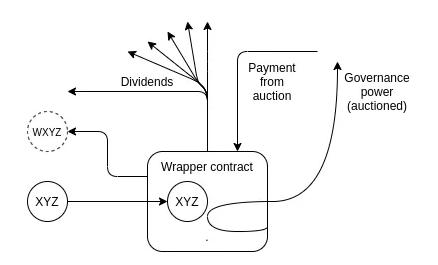
In, I describe a smart contract that automatically accepts bribes for token holders to vote in a specific way from the highest bidder in a very user-friendly way:
This turns every governance decision into an auction, leading to only the wealthiest participants having any say, a community chasing soulless profit maximization, and at worst, this leads to rapid extraction of community wealth and then The project quickly collapsed.I think the best alternative to token holder governance is some kind of multi-stakeholder governance that tries to formally represent stakeholders, not just tokens.
Optimism is doing this with the concept of "citizenship", which is intended to be assigned to contributors and ecosystem participants, and specifically states that this authority is not transferable. But we're still in the early stages of figuring out how this kind of thing works.
Vitalik:Noah Smith: Let’s talk a little more about the alternative forms of human organization that blockchain might enable. I really liked your in-depth commentary on Balaji Srinivasan's state of the web. Are there any valid attempts so far to create "cyber-states" with encryption as an integral part?The reason I don't think this concept has really been implemented so far is thatThere is a fundamental difference between a blockchain ecosystem and a full-fledged cyber nation
. The blockchain ecosystem survives economically by convincing a lot of people to participate. You only need a few core developers, and even they don't necessarily have to make great personal sacrifices, to live in a "normal" real-world city and look like any other job. But the cyber nation is something much deeper. Requiring people to venture out and move to a specific place, probably not a regular one, comes with significant disadvantages that can only be overcome by virtues created by the community itself.I thinkEncrypted narratives are deeply penetrated by "morality"
, They were the core of the ecosystem in 2009-2014, when people did not know whether encryption as an industry could survive, ordinary encryption users had almost no offline encryption social circle, and even legal issues were still uncertain. Encryption, as a continuation of a grand Internet liberal movement, is almost considered the spiritual successor of PGP, BitTorrent, Tor, Assange, Snowden, etc. These strong ideals act as the glue of thought and morality, allowing People make great sacrifices and risks for space.
More recently, the industry has matured, and with that maturity comes a degree of dilution of morally relevant condemnation. This dilution favors mainstream adoption of cryptocurrencies, and in fact, newer blockchain projects often downplay this weirdness and aim for mass adoption. NFTs are extending the appeal of cryptocurrencies beyond their original users.But at this point,This growth method also makes the existing blockchain too "skinny" to form a good network state.Ethereum has so many different user communities, many of which are deeply divided (for example, there are definitelydebates, not to mention international disagreements). There is a strong consensus mechanism for defending the integrity and operations of the network, as we have recently seen the community unite around preventing on-chain censorship, but not yet united enough to form a nation.
also,also,Attempts by the offline crypto community have also been poor so far.
The problem I see is basically that they all use some form of "low taxes" as a promotional tagline, and while low taxes are a tempting benefit from a personal standpoint, if your goal is to attract really interesting people. And low tax slogans form communities that are really boring and crappy. Network effects are about quality, not just quantity. I think the "cyber nation" has a lot of needs for a brick-and-mortar community oriented toward certain values, and needs to provide a channel to express those values constructively, not just through zero-sum games or twitter wars. The combination of the cost of living and the needs of offline communities, and not just the theoretical despotism of many other large countries. But none of the projects I've seen so far have done well.Much of this answer is about culture. Whether we have on-chain land registries, smart contract titles or other minor things. I think"Network Nation" should try to think very differently from what we are used to.
For example, I would try to downplay the idea of absolute ownership of specific land, houses, and apartments, and emphasize the economic coherence of communities through things like "crypto cities." I think innovations like this have more long-term value, and that alone isn't enough to attract people in the short-term. In the beginning, this concept combined with cryptocurrency and blockchain technology was mainly symbolic, and it will evolve into something more practical over time.
Vitalik:Noah Smith: One more question: In that article, you disagree with Balaji's description of the importance of authoritarian leaders to the "cyber nation." Do you feel that your role as the founder and "spiritual backbone" of Ethereum is overemphasized by the media and crypto enthusiasts?From the very beginning, I very much hope that:My influence can slowly dissipate as Ethereum develops.
Many amazing works have already appeared on Ethereum. In fact, I think that's been happening for the past two years. In 2015, I basically did 80% of my research on Ethereum, and I even did a lot of Python coding. As of 2017, I'm doing much less coding, maybe 70% of my research. In 2020, I'm probably only doing a third of my research and coding very little, but I'm still doing most of the "advanced theory".
But in the past two years, others have begun to come up with high-level theories. We have a lot of great new Ethereum influencers like Polynya who has been doing a lot of thought leadership around layer 2 scalability. The Flashbots team has been responsible for leading the entire MEV research field. People like Barry Whitehat and Brian Gu have taken on the mantle of zero-knowledge proof technology, while Justin and Dankrad, who were originally hired as researchers, are increasingly showing thought-leadership qualities.
This is all a good thing! I don't think the public perception has fully shifted yet, but I hope over time people will start to understand that.
Vitalik:Noah Smith: Okay, this is my last question, are there any recent projects that excite you?
I'd say it's not any one project that excites me the most, but the way the entire ecosystem of many interesting ideas fit together. On a technical level this is true, Ethereum is about to merge, and major improvements in blockchain scalability, usability, and privacy are all coming soon after. The same is true at the level of social and political ideas, with many ideas maturing around decentralized organisations, radical economic and democratic mechanisms, internet communities, and more.
On the cutting edge of science far from encryption, the advancements in biotechnology and artificial intelligence are astounding. Some people may say that this may be a bit exaggerated. We're starting to understand what politics and technology will look like in the 21st century, and how every part of what we're working on will fit into that scenario.


