






IOSG Ventures: Is the NFTFi Summer led by Sudoswap coming?


Author: Bryan
Original source: IOSG Ventures
Original source: IOSG Ventures
This article will discuss the NFT-FI direction aroundDerivativesas well asDerivativesSome interesting subdivision tracks/protocols, as well as current bottlenecks and possible future developments.
NFT AMM
The application scenarios of NFT AMM are mainly divided into blue-chip NFT and long-tail NFT. For blue-chip NFTs, one step before entering the AMM is to fragment them first.
NFTx
arbitragearbitrageInvestors can buy a complete NFT fragment from amm and redeem the NFT from the vault, and then sell it in the secondary trading market to achieve risk-free arbitrage.
Sudoswap
Because the entire NFT is directly traded, its positioning is closer to the secondary market such as opensea and superRare. The difference is that it can provide instant liquidity that is not available in the secondary market. Through the linear/exponential bonding curve setting (more curves will be introduced in the future to match different trading needs) to ensure that traders can know the established trading profits, and Have an instant trading experience. The pricing methods of the same NFT series are different, and risk-free arbitrage within the agreement can be achieved. The current traction is pretty good, the platform has reached 100,000 NFT transaction volume, and TVL shows a good upward trend. A concern is mainly UX, because it is permissionless. At present, the same NFT series can have as many as 200+ pools, and the depth of each pool is different, and some depths are only single digits. Such liquidity dispersion may hinder this A possible bottleneck for the further development of the protocol. In addition, most of the NFTs traded on the platform are long-tail assets, and the penetration rate of series with high entry barriers such as blue chips is low.
Comments:
We believe that the main application scenario of the nft fragmentation protocol is in the blue-chip nft with a high floor price, which reduces the user entry threshold and improves liquidity through fragmentation. For the long-tail non-blue-chip NFT, its floor price is relatively lower, and there is no need for further fragmentation, and it can be traded directly.Although the transaction mode of both is AMM, the target NFT is not the same.
Is Constant product Amm an appropriate transaction model?Constant product (x*y=k) is a common model in erc-20 swap (Uniswap, Bancor), but the uncompensated loss of LP is proportional to the volatility of the assets that provide liquidity, that is to say, asset price fluctuations The larger the value, the higher the IL of LP. For fragmented nft, its price volatility is directly proportional to spot nft, so for LP, its IL is also a big risk exposure. (nftx has designed a new staking mode that reduces IL in this scenario—inventory staking, but it does not essentially improve the problem of still existing IL). Currently, the most mainstream innovations in the market are bonding curves like sudoswap, which ensures that price fluctuations in the same pool are independent of the number of NFTs in the pool, and fixes price slippage to promote a better trading experience.
The author's personal point of view is that AMM is one of the ways to improve liquidity/capital efficiency (mainly to promote the price discovery of NFT near the floor price), but AMM is not a suitable trading model.
NFT as collateral lending
In addition to directly trading NFTs, lending agreements using NFTs as collateral is also one of the means to promote NFT liquidity.NFT lending is mainly divided into two models: P2P/P2pool.P2P is the so-called peer-to-peer transaction, one borrower for one lender. The mode of P2Pool is that multiple lenders provide assets, not for a single borrower.
P2P: A distinctive gameplay in P2P lending
Flowty:
The lending agreement on the flow chain mainly focuses on the pfp NFT collateral that is different from other chains, mainly including NBA Top Shot and Ballerz. The co-founders are all early participants in nba top shot, and the platform is also more focused on sports Loan project of NFT-like drama track. One difference lies in its collateral—the brand effectiveness/events of nba top shot itself. For example, nba top shot regularly holds challenges. Participants can use their NFT portfolio to participate in challenges and get rewards. Flowty can help participants unlock additional funds At the same time, go to buy the required NFT. At the same time, there are a series of third-party platform references on the flow chain, such as the ranking system Moment RANKS just mentioned, and other analytical platforms such as Own the Moment (including historical sales data, price forecasts, trends), etc. , to help the lender to better judge whether to provide loans to the borrower. In general, there are many ways to play but the scalability is limited, and the ceiling depends on the flow/nba top shot ecology.
NFTfi:
The ancestor of NFT P2P lending is also the platform with the highest depth of NFT P2P lending and the best user experience in the pfp series currently on the market. In April of this year, the open loan position reached 2k+, far exceeding other similar competing products. Some interesting findings: High-value NFTs, such as BAYC/Punk, generally have a longer duration - ranging from 30/90 days. The LTV of these high-value NFT series is also relatively high - (past month: BAYC-77%, Punk-53%, MAYC-58%, the collateral price is calculated according to the average transaction price in the past 30 days). For the LTV of general pawn shop 25-30%, it can be concluded that the barrier power of blue-chip Nft in the lending market is still relatively high. What is more friendly to the lender is that the loan history of the borrower will be displayed (such as the amount lent out, and whether there has been a default record, etc.), and other reference data include the floor price of the NFT series and the NFT by upshot/NFTBank The value estimates given are the basis to help the lender make reasonable judgments.
Some comments generated when exploring the P2P lending model:
P2P basic terms mode:The standard LTV of ntf P2P lending is close to the pawn shop in real life, fluctuating between [25-50%]. And the longer the Duration, the higher the risk of lender, soShort term + low LTVIt is a more suitable choice for NFT P2P.
There are two interesting findings:
a. In general, the default rate is low, about 10% in quantity. There are also tiered differences in default rates among blue-chip NFTs. For example, bayc, punk, and mayc, which have the highest loan volume, have default ratios of about 1%, 3%, and 5% respectively. And blue chips with large price fluctuations, such as azuki, have a default rate of 30%. But this explains more,For blue-chip Nft lending, borrower is more about holding than defaulting (i.e. using the platform to cash out).
b. The two data of APY and duration can also explain the difference in value retention between different blue-chip NFT series in the eyes of lender. For example, the apr of punk is lower than that of other NFTs (14% on average, around 10% even in the recent period with severe fluctuations, while relatively speaking, the apy of BAYC has reached 40%), and the duration utilized (real repayment time / regulation repayment time), indicating that punk's lender and borrower have a higher degree of recognition for punk's asset preservation - even though the historical floor price of bayc is more stable than punk.
Development bottleneck:
a. terms- the reason why the current P2P agreementlow efficiency, the reason is that the process of reaching a deal is a process of multiple bids/counter-offers (an offer is valid for 7 days), how to formulate terms more accurately/faster will be a P2P protocol that needs to be considered
b. For some high-net-worth NFTs, due to their high risk, they need to rely on someLiquidity Solution ProviderSuch as metastreet, to complete the loan.
P2Pool
BendDAO: It is the mainstream NFT P2Pool lending agreement on the market. The gameplay is simple and clear, the lender lends eth, and the borrower mortgages the blue-chip NFT. The development is very fast, there are already 830 borrowers (NFT-fi has 1200+), considering such a number is only a few months after its launch. The reason for the rapid development is also very simple - the liquidity of P2Pool is higher than that of P2P, the mortgaged NFT is close to the floor price, and the agreement has a cold start subsidy in the early stage: 6% deposit apr and negative 16% borrowing apr. The collateral data is also good - in the past two months, mayc/bayc has stabilized at 300+ and 250+. The agreement currently has no liquidation of other NFTs except azuki. Recently, a large number of baycs have liquidation risks.
exist
Defrag:existrisk controlMake a trial lending agreement.
When Borrower mortgages NFT, he will purchase a put option (if the collateral price drops, the underwriting pool needs to Lock a certain amount of eth to redeem the Nft), the usage of eth in the underwriting pool- 1. Convert to udtc and lend to users 2. Redeem NFT. Profit of underwriting pool: premium fees for put option. If put option strike price 100 is now worth 80, then the put option is worth 20. The liquidation price is 70, and the user has not been liquidated, so the execute put option will not be executed (liquidation means execute option). If the price drops to 60, then execute, the underwriting pool buys back the NFT, and the user gets 100-60=40+borrowing amount.Underwriter is equivalent to mixing the roles of lender and option seller, but in fact the roles of the two are not consistentimage description
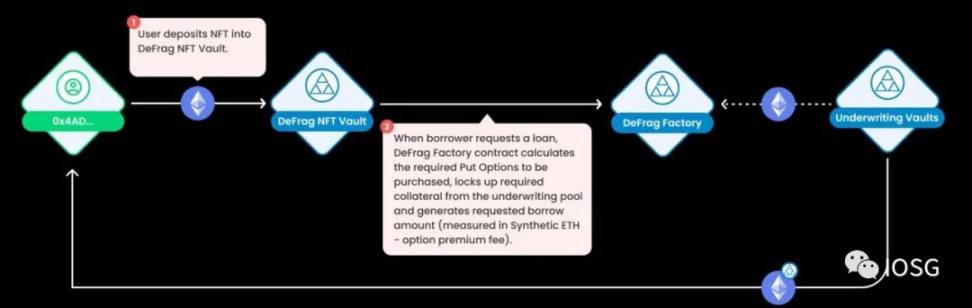
Source: https://twitter.com/DefragFinance/status/1461770614881067009/photo/1
Astaria:
, Just announced the financing of 8 million, an NFT P2Pool lending project that the former sushi cto came out to do, currently there is no specific protocol design. According to the existing information, its model is similar to maple finance, there is an intermediary (delegate/appraiser) to specify the terms-price/amount/rate of the pool, etc., and it has the function of last resort.
Comments on the P2Pool protocol:
Compared with the P2Pool of defi's erc20, the NFT P2Pool protocol with a higher tvl lacks innovation and innovation. We expect more interesting protocol designs to emerge in this field.
The points that distinguish different P2Pool protocols mainly include several points -Liquidation Mechanism, LTV, Risk Control。
There are two main liquidation mechanisms, time-based, price-based, and time-based are more friendly to borrowers, allowing them to repay within the specified time without the risk of liquidation. LTV is potentially a Trade-off.
Moreover, in P2Pool, the liquidator acts as a key link to ensure the risk control of the agreement, but it is also a relatively independent participant relative to the agreement itself and both borrowers and lenders. The meaning and requirements of its existence: 1. Profitable 2. Have a certain understanding of the pricing of collateral. Regarding the point of profitability, in the case of insufficient liquidity of NFT itself, especially in extreme market conditions, the rapid decline in collateral prices may also cause these independent liquidators to choose not to participate in the liquidation, resulting in The pricing cognition of the product ensures that it will not sell the NFT at an irrational price, which requires some more reasonable pricing mechanisms. (The third-party valuation system is not mature enough, even for blue-chip NFTs, there are large differences in the price of the same NFT)
image description
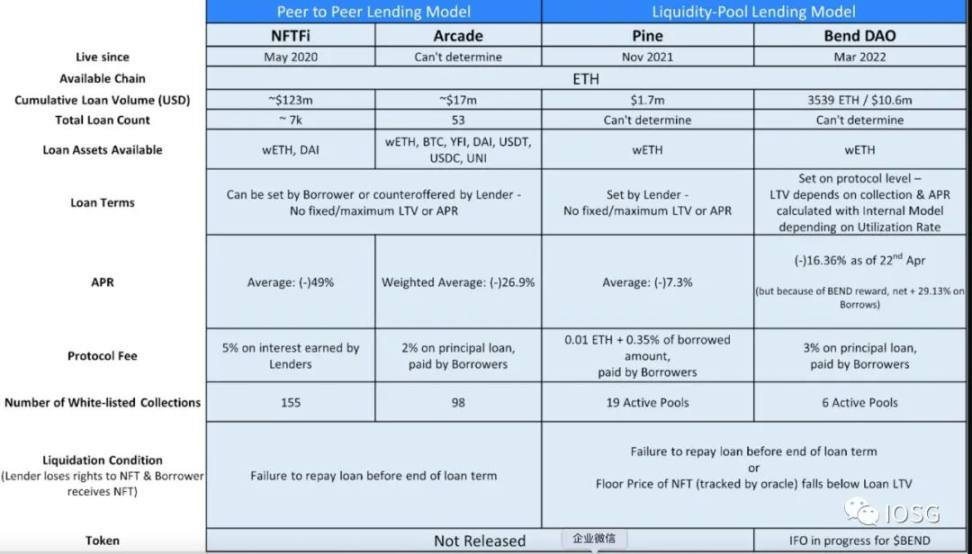
Source: https://blockcrunch.substack.com/p/NFTfi-understanding-the-NFT-lending
Closing thoughts
Many people say that NFT is like real estate, but I don't quite agree. NFT is a product on the chain, with its own liquidity attributes that real estate does not have. Although the current NFT agreement is mainly about the direction of NFT as collateral (similar to the low liquidity of real estate),An interesting direction in the future is whether there is a lending agreement in which the targets of lending/borrowing are all NFT(Such as mortgage bayc, lend crypto punk). A more positive signal in this direction is that the seaport protocol launched by opensea has opened a precedent for NFT trades NFT. It is not difficult to imagine the emergence of mortgage NFT and loan NFT in the future. In an efficient capital market, such as the btc lending market, the strength of both long and short sides of btc is evenly matched. The current NFT protocols are all NFT-as-collateral agreements (that is, Long NFT), which essentially promote the liquidity of erc-20 (erc-20 is borrowed). At the same time, the current development form of NFT is still dominated by pfp, and pfp itself does not have the characteristics of interest, so the demand of the borrower is very vague. This is also a very urgent question in this direction. Maybe for gaming NFT The NFT form of actual landing scenarios/production activity requirements is more appropriate.
In any case, the next cycle belonging to NFT lending must have a great correlation with the bulls/bears of the large crypto/NFT market. In a bull market, such a lending agreement is a natural means of increasing leverage, which will greatly promote Protocol Development.
P2P or P2Pool?
Logically speaking, P2P is more suitable for NFTs with higher net worth than the floor price, and p2pool is more suitable for NFTs with relatively low net worth and close to the floor price. P2P puts more emphasis on borrower's experience (customized terms), while p2pool puts more emphasis on lender's experience (multiple lenders spread risk while lowering entry barriers).
P2P does not have the liquidation risk of collateral price fluctuations, and only needs to repay on time. The borrower in P2Pool may often receive margin calls.
P2P LTV has a bar (even the average of bayc is about 80%), but the LTV of p2pool is relatively high - the highest LTV of BendDAO can reach 90%. Capital utilization is higher for P2Pool.
What is next?
Defi lending giant aave said about a year ago that it wanted to enter the NFT as collateral lending market, but has not made any new progress. And compared with traditional finance, NFT lending is still a behavior with a higher risk factor, which requires risk hedging methods to diversify risks, including and not limited to NFT insurance, futures, options, and even structured products.
NFT futures
NFTperp is an NFT futures trading market based on the vAMM model. The vAmm model is designed by the perpetual protocol. Compared with amm, it requires lp injection liquidity and pool size restrictions. There is a funding rate mechanism to ensure that the futures price is consistent with the underlying asset Price convergence - The price of vAmm is analogous to the price of perp, and the difference between its price and the spot price fed by the oracle machine is the basis for the calculation of the funding rate. However, this vAmm mechanism, like the amm mechanism, requires a cold start of transaction volume and whether there is any LP reward, so there will be some resistance in the early project launch.
NFTures launched by Synfutures is also an NFT futures contract trading market, which currently supports four NFT contract transactions - PUNK, UJENNY, NFD, The Doge NFT. Its underlying asset price feed is unicly/NFTx. Synfutures' sAMM is also battle-tested, and its transaction volume is comparable to that of perpetual protocol/dydx.
For NFT futures, there are several bottlenecks:
The price of the underlying asset.For benchmarking btc futures, such as dydx/perpetual protocol, the price of the underlying asset is fed by the spot price through the oracle (dydx uses the oracle of makerDAO, and the perpetual protocol uses chainlink). And for NFTs, there is a lack of a reliable price feed - essentially illiquidity. Maybe when a trading platform that undertakes higher Nft trading volume, such as blur/sudoswap, has a certain amount of liquidity, its trading price can be used as a price feeding option.
need.If you take btc futures as an example, one of its needs is as a hedging method for btc miners, but many NFT holders do not have such a demand. This is an opportunity for gaming NFT - the gamer continuously obtains NFT in the process of upgrading in the game, and there is a need for hedging.
NFT option
The main direction in NFT Option is still from the perspective of Nft holder, that is, hedging the risk of holding NFT by buying Put option.
Putty is a platform that provides ntf put option. Currently, there are 11 orders transactions (including 3 BAYC put options). The development of the platform is relatively early, and there is little activity. Support customized options (users who want to issue put option provide NFT, premium, strike price, duration), but the liquidity/trading volume of this option is not high in nature.
Nifty options is also a platform that provides NFT put option. NFT holders can lock NFT on this platform or other mortgage lending agreements such as NFTfi, and initiate a put option at the same time. The counterparty needs to lock the eth of the strike price as well. The issuer can choose exercise/cancel at any time. The exercise is equivalent to selling the NFT to get the strike price, and the cancel will get back the original NFT. The counterparty will be rewarded with a certain interest rate anyway. The lowest interest rate here needs to be higher than the interest rate of mainstream lending agreements such as aave/compound, because the counterparty bears more risks. Traction is similar to putty. It is still in early exploration and has little usage. There is a solution similar to defrag, which is to buy this option while mortgaging Nft, which ensures that even if it is liquidated, the lender can get a certain value of assets anyway. Compared with defrag, option seller and lender are not a group, so this design will be more reasonable.
Jpex.finance is an option platform different from the above two. NFT holder sells call option instead of buying put option. Equivalent to a covered call strategy. But liquidity is a problem - 1. The counterparty needs to pay to enter the pool 2. The European option is only cashed on the delivery date, and the counterparty cannot collect profits in the case of in-the-money.
For NFT option, there are several bottlenecks
low liquidity.Whether it is ftx or binance, the option setting mechanism is very simple (strike price, expiration date, premium) - there are several fixed options for strike price on ftx, while binance directly uses futures price as strike price, both ftx and binance The premium is calculated automatically. As for the NFT options, they are all filled in by the NFT holder, and the premium is also written with brains. Naturally, there are very few counterparties who are willing to trade. And the UI/UX aspect is much less satisfactory than professional trading platforms.
Option price.Option pricing is mainly determined by two factors - intrinsic value and time value. The time value is the reason why the price of NFT option is relatively high - because of high volatility (historical & implied). One way to consider lowering the price of premium is to narrow the time window for exercise to promote betting by speculators on the Nft price in a smaller time window.
Number of NFT collections.Especially in a bull market, the demand for calls is relatively high, and there are relatively few call sellers (compared to btc holders), which cannot well meet the leverage needs in a bull market.
NFT insurance
For some high-net-worth/high-scarcity NFT holders, in addition to relatively indirect hedging methods, it is more direct to insure. Relatively speaking, the cost of borrowing will increase, but some risks will also be transferred. Even when users choose a P2P/P2Pool platform, if the agreement has internal insurance/cooperates with third-party insurance, this is likely to become a point of attraction for users.
NFT structured products
NFT20 has an NFT index that tracks the floor price of a series of NFTs, similar to s&p500 in tradfi.
In the metaverse, land is used as an interest-bearing asset NFT (for example, users need to pay rent to produce activities on the land), which can refer to real-life mortgages as a financial derivative, such as CDS.
Original link


