






Is Solana decentralized? This Verifier report can give you the answer


This article comes fromsolana, Odaily translator | Moni
This article comes from
, Odaily translator | Moni
The mission of the Solana Foundation is to support the further development of the Solana blockchain, including breakthroughs in decentralization, security, adaptability, and adoption. To accomplish this mission, the Solana Foundation has a number of initiatives in place, from creating profiles for validators, to granting grants to decentralized projects, to monitoring the health and resilience of the Solana network.
In order to enable the community to easily monitor key indicators, such as the number of verifiers and network outage time, the Solana Foundation has made great efforts in data publication. As the network continues to mature and the number of users expands, the disclosure of network health information is critical to the Solana ecosystem and the growing Web3 community. The Solana Foundation is also expected to release a series of reports covering network operations, including network performance, software and client updates, over the next few months. Next, let us take a look at what dry goods are in this report.
secondary title
Solana Validator Overview
The Solana network consists of all individuals and entities running Solana validators. Anyone can view, download, modify the validator source code, run the software, and participate in the operation of the network, but no one entity can control the operation of the network, or control the construction and use of specific types of applications and services on the network . Therefore, Solana is also known as a "permissionless" blockchain, and you don't need anyone's permission to participate, develop, expand, and use the network.A growing Solana community of core developers develops, tests, and releases Solana validator software that is freely available to community validators.so far,
The Solana blockchain already has over 3,400 validators from six continents
. There are many ways to evaluate the health of the validator network. The Solana Foundation has selected the following indicators for tracking analysis:
Nakamoto Coefficient: This metric, proposed by Balaji Srinivasan, is a statistic used to quantify the degree of decentralization of various blockchains, and represents the number of node operators that can "collude" to shut down a network, thereby "censoring" all or part of the network ". A high Nakamoto coefficient ensures that the network is censorship-resistant so that any user will not be hindered while using the network.
Node distribution: Even a blockchain with many validators and a high Nakamoto coefficient can still be affected by external factors that affect its functionality. Here, we examine the effects of geographic location, data center ownership, and physical control on validators to better understand how Solana resiliently adapts to external factors.
secondary title
Total Solana validators
It goes without saying that the more validators a blockchain has, the more resilient it is. When users perform transactions on the blockchain, they expect their transactions to be recorded. Ideally, every transaction on the blockchain will indeed be recorded on every validator on the chain, and the more transactions are recorded, the more confident users are that their transactions will not be tampered with. This is why more validators are better.
There are two types of validators on the Solana network:
Consensus node: The consensus node is the core of the network operation. It provides two basic functions - creating a network and proposing new blocks, and verifying new blocks proposed by other nodes. Each block contains many transactions of various types submitted by users and applications on the network. Each consensus node independently validates all new transactions in a proposed block before voting on their validity.
RPC (Remote Procedure Call) Nodes: RPC nodes perform the same duties as consensus nodes, but also provide an "application gateway" to the Solana infrastructure. They provide a convenient way for users to interact with the core Solana network in an application-specific manner. The presence of a large number of nodes is essential for the network to function. While there is no definitive answer to how many nodes are enough, the following are important:
(1) In any case, users must be confident that their transactions will be recorded. This is why numerous copies of the current "state" are provided on many nodes, and these copies are distributed globally. The latest balance of each wallet can be tracked and kept updated in real time.
(3) Users can verify the accuracy of transactions by viewing other nodes. In the event of a single node failure or problems recording transactions, users can rely on other nodes to verify the accuracy of the blockchain.
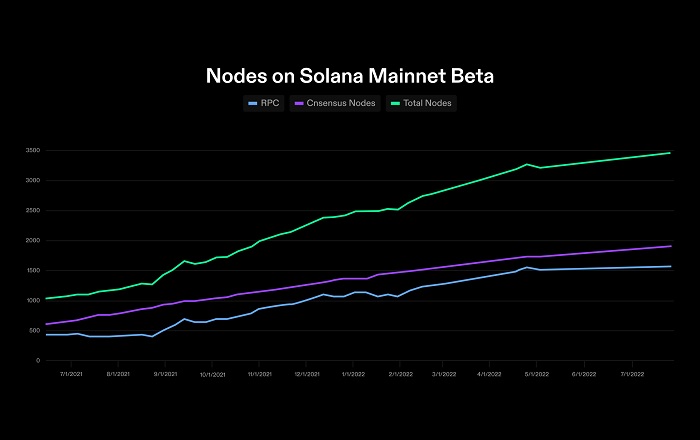
The Solana Mainnet Beta network went live in March 2020 and currently has over 3,400 validators, over 1,900 of which are consensus nodes. Additionally, since June 2021, an average of 95 consensus nodes and 99 RPC nodes have joined the network each month.
secondary title
Nakamoto coefficient
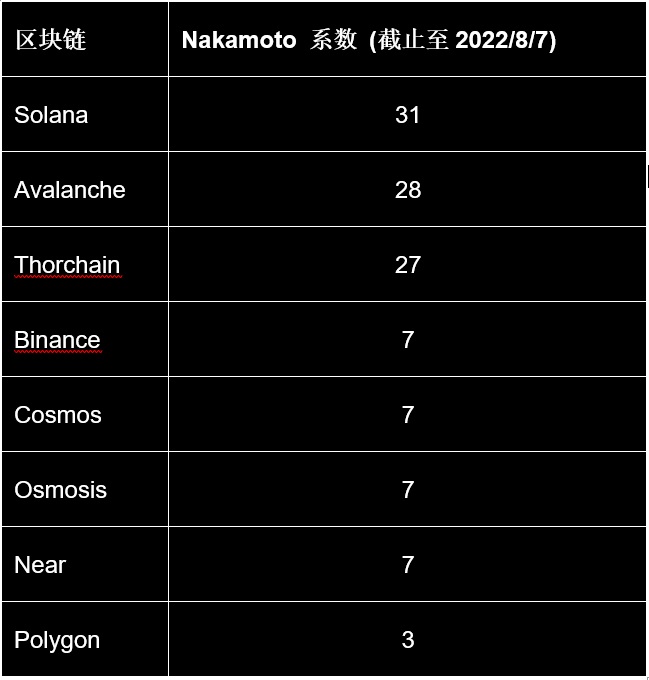
The following lists the Nakamoto coefficients of several proof-of-stake blockchains as of August 7, 2002:
It is worth mentioning that although the Nakamoto coefficient is important, it does not take into account other external factors involved in running a blockchain, such as political factors, natural disasters, and corporate interests, etc. These external factors will also affect the blockchain. chain elasticity.
secondary title
Solana node distribution
While anyone can run a Solana node, because Solana requires high-performance hardware, validators typically rent servers from private data centers to run their nodes. Since this is not uncommon, the majority of computation on most blockchains is done on private servers in large data centers.
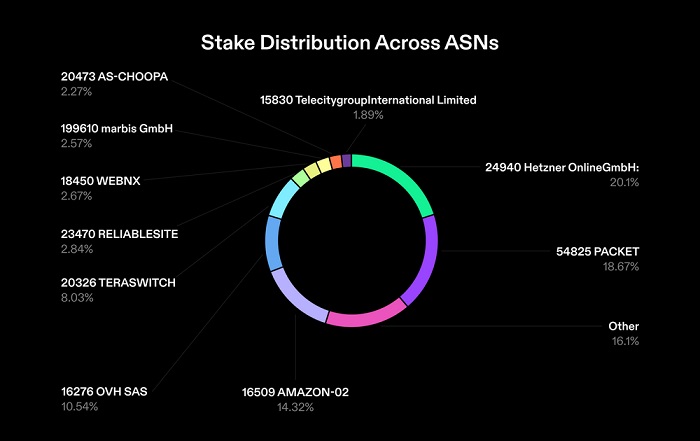
So far, despite a total of 9 million SOL holders, the top 100 alone control 30.81% of the total supply, and funds on the Solana chain are relatively evenly distributed across ASNs, with no autonomous system hosting close to 33.3% of active pledge shares. The Solana Foundation is also continuously monitoring the staking distribution of private data centers and encourages users to continue to equally distribute their staking funds across a wider range of data centers.
looking to the future
secondary title


