The 4D long article explains in detail the development path and future trends of this round of GameFi



Original Author: Rache
Original title: "Summary and Prospect of Gamefi Investment in This Round"
first level title
1. What is Gamefi?
secondary title
1. Looking at gamefi from the perspective of games: the product of game+X
From the perspective of content carriers, I tend to regard the evolution process of the entire game as the evolution process of board games, arcade machines, consoles, page games, client games, mobile games, and migration to new content carriers.
- 1980s-2000s: Atari, Famicom (1983), Sega Saturn (1992), Nintendo, Sony and other products (after 1993), Xbox
- After 1990-2010: the era of web games with the development of PC
- 2000-present: With the improvement of computing and processing capabilities on the PC side, the rise of PC games has still occupied part of the market until now.
- After 2010-present: The penetration rate of mobile devices has increased, the computing power has increased, and the mobile game market has emerged as a supplement and extension of end games
- Around 2015 to now: VR, AR and other new carriers began to be combined with games, VR hardware appeared a variety of affordable and easy-to-use devices that meet the needs (Pico V3, Oculus2, etc.); blockchain is one of the new "carriers" Start trying to run the game and explore the game shape
- 2021-:game+X
The change of content carrier in each different stage will have a process of transplanting, learning from the content and form of the previous generation of games, adapting, and then facing blowout innovation.
1) Transplanting and borrowing from the previous generation of categories: For example, early client games still borrowed from console games in terms of fighting methods and mechanism design, but in the end, with the improvement of PC performance, various types of games exploded in the market.
2) The stage of blowout innovation may produce unique types, but it is not inevitable.
secondary title
2. Looking at gamefi from the perspective of Crpyto: gamefi is the first application close to the real economy
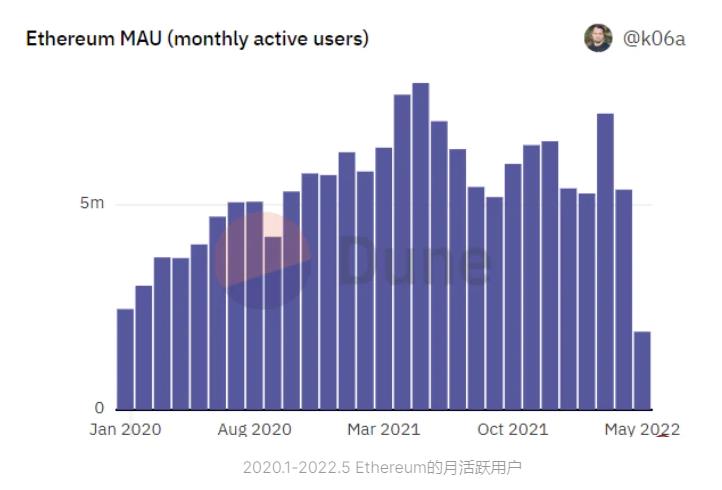
In addition to infrastructure, there should be rich ecological applications growing from the soil of infra. The progress of the Crypto application layer is only reflected in this cycle. Defi in 2020, NFT and Gamefi in 2021, the development of these application layers has expanded Crypto's user base.
You can think of the public chain as a country. This country needs to establish basic political and economic rules (consensus algorithm) before the country can start to operate. Each subject builds a business ecosystem under the basic framework: Federal Reserve - Commercial Bank - "Commercial Entity" , It is also necessary to cultivate enough population to ensure the operation of the entire economy. For public chains, the Federal Reserve (stable currency) and commercial banks (DEX/lending) are often required. After the financial service infrastructure is established, a large number of large and small businesses are required to settle in, bring more users, and increase economic activity and fiscal revenue (public chain revenue). With the prosperity of the economy and the increasingly complex forms, derivatives appear, assets need to be circulated across chains, and cross-chain infrastructure development. Gamefi, some Defi, and NFT can basically be attributed to the category of "real economy".
secondary title
3. Looking at gamefi from a realistic perspective: an economy with decentralized currency issuance
Commonalities between the economic system in the general world and the game economic system:
1) An enclosed space
The space defined here means that all the currency flows can be affected within this space, so in reality, the human society of the world is this space. As far as online games are concerned, a server is a space.
2) is an economic system
• a. General equivalent exchange, ie currency
• b. Individuals that can conduct free trade, that is, players or human trade individuals (individuals or groups)
• c. There are commodities, and the basic definition of commodities is items with exchange value
3) In line with the general law of economics, that is, commodity prices are determined by value, affected by supply and demand, and prices fluctuate within a certain range of value
The difference between the economy system in the normal world and the game economy system:
Currency issuance mechanism: In reality, the government is the only currency issuing institution, and the currency issuance right is unique and controlled by the government, while trading individuals in the economic system do not have any currency issuance rights or intervention rights. In the game, monsters are the main currency issuer (of course there are other mechanisms like missions, but they are excluded here for the time being), and the currency issuance is determined by the behavior of all players in the server, that is, the behavior set of trading individuals in the economic system Decide.
first level title
text
1. Provide a new cold start solution
text
2. Change the way the game is adjusted
At present, most Gamefis are based on economic mechanism design and use economic interests as a means to guide players' behavior decisions in the middle and late stages. There is a condition implied here, that is, we assume that the player is a rational person by default, and the core decision-making basis is purely based on the economic benefits in the game, and other interesting designs will not have a significant impact on the decision-making. Then a series of subsequent complex problems are simplified into the adjustment problems of the economic system. As a project party, there is no need to think too much about issues such as plot and effect presentation, and the pressure comes to the numerical planning side.
first level title
text
1. The game has the characteristics suitable for on-chain
1) Games with economic mechanisms naturally have transactions, and most games have their own economic systems
Gold mining and free markets in traditional online games and PC games have long existed. Whether it is the on-site market or the off-site market, mature adjustment mechanisms and design logic have been developed. There is also a demand for item circulation and gold coin circulation in the game.
**2) Games in a broad sense include not only modern electronic games, but also games with concise mechanisms and diverse result spaces as basic features. **The latter is more suitable for winding. The transparency of the mechanism, the privacy of the results, and the decentralization of calculations are realized by smart contracts; even if there are a large number of possible results, the results themselves can be concisely defined, complexly calculated, and diversely derived. The different ways of obtaining possible results in the game, the game of obtaining first and last, and the design and formation of consensus seem to be more in line with the design logic of the concept of decentralization.
3) The multiple purposes of unique assets in the game (transaction, speculation, collection) have a relatively high fit with NFT
In-game items tend to be unique, or at least we want them to be. At the same time, these props also have differences in rarity and function, and NFTization is a matter of course. Similarly, the project party can provide a trading and leasing platform in the game, and players can also solve the problem of trading and leasing through other markets (such as Opensea) or peer-to-peer transactions.
4) Brand new UGC and DAO governance paradigm
Decentralization will bring many possibilities for game governance and content production. Decentralized game content production is extremely experimental. It is a commonplace to decide the direction of game content from the bottom up, but what about bottom-up decisions on the shape and future evolution of the entire game? If each player has a tool (NFT/other), it can be randomly combined or calculated, and a new state can be obtained through the result combination of player A and player B. All players who are online at the same time or not at the same time combine their own result space , and conduct them in different order to finally get the state of the whole network/whole server. Regarding in-game governance issues, players can hold tokens to make voting decisions on major adjustments in the game, which has been widely used; or we think more complicated, the wealth exchange between multiple player DAOs in the same game, the external What about decision making? Combined with the acquisition mechanism of token assets in the game, a simplified but exquisite political and economic sandbox deduction will be obtained.
5) The flow inlet of L1 and the test field of L2
text
2. Blockchain changes the game industry chain relationship
text
text
Why do games need to add tokens?
first level title
secondary title
1. Game CP classification
1) Game Mechanism: Playability is generated by the mechanism
Physics: Game mechanics can sometimes determine in-game physics (which can be different from real-world physics). Characters in games are often constantly moving, jumping up and down, or driving vehicles. In many games, the position, moving direction and overlapping collision between objects are the main calculation tasks. "angry Birds"
Internal economy: Mechanisms such as collection, consumption, and trading of game elements constitute the internal economy of the game. The internal game economy often includes common resources such as money, energy, and ammunition, but in addition to these tangible items, abstract concepts such as health, prestige, and magic power also belong to the game economy. "Zelda"
Progression Mechanics: In many games, the level design dictates how the player can act in the game world. Traditionally, the player needs to control his avatar in the game to go to a designated location, where he can rescue someone or defeat the main villain to pass the level. There are many mechanisms in this type of game to close or unlock access to a certain area, and the player's progress is controlled by these mechanisms.
Tactical Maneuver: This mechanic allows players to assign units to specific locations on the map to gain an offensive or defensive advantage. Tactical maneuver is not only extremely important in most strategy games. It is also a key feature in some role-playing games and simulation games. StarCraft and Command & Conquer: Red Alert
Social Interaction: Many online games today have mechanics that encourage players to exchange gifts, invite new friends to join the game, or engage in other social interactions. In addition, role-playing games may have rules stipulating how characters should perform, and strategy games may have rules stipulating how players form alliances and dissolve alliances.
(Source: Game Mechanics: Advanced Game Design Techniques)
The weight of different mechanisms will profoundly affect the category selection of blockchain games. For example, on a decentralized server, it is difficult for some games with high real-time computing requirements to achieve the same effect as on a centralized server. Therefore, games that simulate and calculate actual physical mechanisms in real time often cannot achieve better results. Another example is games that require a lot of real-time social interaction on the chain, which was also difficult to realize due to the efficiency of the infrastructure at that time. Therefore, it is expected that chain games with economic mechanism as the core will take the lead.
However, as more and more traditional game companies enter the market, all traditional categories can basically be found in gamefi. Perhaps for them, doing "chain reform" is not a high-threshold thing. If it is difficult to perform real-time calculations on the chain, they only need to convert some props to NFT and purchase some code packages to complete the smart contract development. Art design, Character plots, parameter designs, etc. have been backlogged in the hands for a long time, but limited by the past version number restrictions and involution of distribution channels, these semi-finished products and even finished products have no day to come. So the game studios scrambled to resell them or "assemble" them themselves, and realized the "chain reform" like an assembly line in a few links. These projects in the first half of 2021 can still enjoy dividends. In the second half of the year, chain games will "let a hundred flowers bloom", and involution will intensify.
Thankfully, there are still projects dedicated to exploring new directions. Whether it is introducing the design of Defi into the game or doing some new explorations on the chain. So I am more inclined to use three dimensions to judge the positioning of a game. The first is the similarity with modern video games (the pursuit of movie-level performance/sufficiently concise and abstract rules), the second is the degree of on-chain (which elements in the game are on-chain), and the third is financial attributes (whether it is a defi variant/only base economic system).
2) Three-dimensional coordinate positioning classification
- Low similarity with modern electronic games, high degree of on-chain, high financial attributes, represented by defi kingdoms
- Low similarity with modern electronic games, low level of on-chain, high financial attributes, gambling
- Low similarity with modern electronic games, high degree of on-chain, low financial attributes, random number games
- Low similarity with modern electronic games, low level of chaining, low financial attributes, very few
- High similarity with modern electronic games, high degree of on-chain, low financial attributes, represented by dark forest
- High similarity with modern electronic games, high degree of on-chain, high financial attributes, very few
- High similarity with modern electronic games, low level of on-chain, low financial attributes, often exist in chain-reformed games, represented by Theta arena
- High similarity with modern electronic games, low degree of on-chain, high financial attributes, very few
3) Classification by Token Design Type
single currency
- Features: All economic output and consumption activities in the game are linked to the same token, which is easy to control; death spirals are prone to occur later. That is, it is difficult to cope with extreme market conditions, such as large households selling coins and the price plummets, and cannot return to the original price after the plunge
- Representative game: spaceship
- Concerns: consumption mechanism design, choice of value anchoring
dual currency
- Features: Most games adopt the form of main currency (value currency) + auxiliary currency; in general, the consumption and output of main currency are linked to auxiliary currency; sometimes the output of main currency and auxiliary currency are linked to PVP system and PVE system respectively; generally Under the circumstances, "diamond" is changed to the main currency, and "gold coin" is changed to the auxiliary currency; the main currency can be applied to most application scenarios in the game
- Representative game: Axie and its imitation disk
- Concerns: the supply ratio of the main currency and the auxiliary currency; the correlation design of the consumption method of the main currency and the auxiliary currency; the ratio of consumption and output; subsequent adjustments are related to the diversification of consumption channels
multi currency
- Features: often used in games with more resources: SLG, open world
- Representative games: farmers world; Star sharks
secondary title
2. Gamefi upstream and downstream classification
Engine: UE, Unity, Cocos, etc.
- At present, there is no need to develop an engine from scratch for Gamefi, or in other words, a gamefi-specific engine does not make much sense.
Lightweight game development tools: mainly in the form of SDK to provide on-chain solutions for light games.
Rendering: cloud rendering platform
Game application chain: Ronin, Defi kingdoms, etc.
- Mainly suitable for games with large user groups, high DAU and long life cycle
- But there are asset cross-chain and cross-chain bridge security issues
Game-specific chains: Immuatable X, WAX, Klaytn, etc.
Among them, the operation of WAX is very successful, and the current active users have always maintained a high level. Head games include Alien Worlds, R-PLANET, PROSPECTORS, Kolobok Adventures, and Farmers World.
Immuatable X is constantly in motion, working with Starkware to make more attempts at the base layer. But the problem is that there are still no active game projects with a large user base.
Decentralized cloud platform:
- The core is to build nodes and use decentralized computing power to provide computing support
- For now, the decentralized cloud platform is still in its early stages, the development cost is high, and the delay problem may not be solved yet
- The future will be a development direction that can be expected
Decentralized Computing: Fluence, LivePeer
To a certain extent, it solves some problems of real-time computing on the chain
Content Distribution Platform: Gala, Come2Us, P12
- The operation mode of the content platform is significantly different from that of traditional games, mainly in the utility of platform tokens and the relationship between the platform and CP. Some platforms choose to use their own tokens as the exit and entrance of CP, that is, they need to exchange platform tokens for CP native tokens before entering the game, and the withdrawal of funds also needs to be converted into platform tokens, which is disguised as an endorsement for CP tokens; through platform tokens and The exchange of CP currency participates in the investment of CP;
- There is still an independent destruction and production mechanism for platform tokens, which can control CP tokens to a certain extent.
CP: See the detailed classification above
IGO platform/content incubation platform:
- resource driven
- Whether it will be integrated with the content distribution platform to form an oligarch that connects the upper and lower industrial chains is the future that needs to be paid attention to
Goldsmithing Guild: YGG, MC, Guildfi, etc.
- It has very obvious regional characteristics, does not have obvious head aggregation effect, and has low business barriers;
- Mostly distributed in countries and regions with high demographic dividend but low per capita income;
- Starting from September and October 2021, the guild's financing will gradually increase in number;
- There are problems: the valuation logic is close to a DAO with a profit model, the first-level valuation of the "heavy asset" target is expensive, but the second-level is issued with governance token, the token value capture is weak, and the second-level premium is small
Guild Service Provider:
- Access multiple guilds to provide SaaS services: user behavior statistics, game category recommendations, guild rankings, guild asset statistics and analysis, etc.;
- In the future, it may extend to the DID and social fields, breaking the boundaries between socialfi and gamefi
Deposit and withdrawal: Moonpay
- Channel business with rigid demand has very obvious characteristics of monopoly and aggregation;
first level title
secondary title
1、Play to earn
Let’s extend the timeline a little longer—there were some attempts in the direction of gamefi in the last cycle. CP is mainly for funds, gambling, and simple online games. The infrastructure is mostly at the engine level, and it does not extend from the engine to the platform level. Content applications may continue to develop on an independent chain. Starting from 2021, the gamefi primary market will be detonated by Axie; in the case of a stronger overall market, gamefi has also stepped out of its own Alpha. Some representative products have appeared in the first half of 2021, and they have a long-lasting life cycle. Although Axie’s reputation in the market has not been surpassed due to issues such as token design and money-making effects, the effect is very amazing: driving the public Chain transaction volume, for example, Splinterland has driven the overall transaction volume of the hive public chain, and has also gone through the business model of CGG in the gamefi field. More and more projects have followed suit; the destruction and exchange logic of ilv tokens has brought two The terrifying money-making effect of the high-level market; even some games have gradually developed the idea of ARPG, issuing concurrent coins in May and June. On the eve of the detonation of the gamefi level-1 track and when many players have tasted the sweetness of gold, Their tokens earn sufficient secondary premiums. Since then, more and more institutions have paid attention to this track that they never cared about before. It can be seen that the number of gamefi financing deals and the financing amount in the second half of 2021 have increased significantly compared with the first half of the year. At the same time, countless projects have jumped out and claimed that they may be the next Axie. At this time, the frenzy of the market and the decline of Axie also gave investors and project owners a more ambitious idea: the Metaverse is the best use case for GameFi, and the simple game of **dual currency is just a "remnant" of the last cycle. It will be the narrative of this cycle, and it will not be the starting point of the next cycle. **So what is the Metaverse? How to achieve? There may be a thousand metaverses in the eyes of a thousand people.
In addition to CP, an independent game chain has been put on the agenda. IMX is the first, but there is no very strong CP to drive the growth of active users; The guild has grown a lot, and game guild service providers have emerged as the times require. Distributed cloud computing service platforms are trying, and the decentralized gamefi "steam" competition is fierce.
Compared with the progress of various public chains in full swing around CP to improve the ecology, the development of L2's game ecology seems to be slower. Nevertheless, what L2 brings to the game is boundless imagination. Since the STARK data structure is better supported in the re-execution environment, all states in the game can be stored. When the expansion is satisfied, many high-performance games are expected to be fully on-chain. There are also several projects in development dedicated to the composability of game NFTs.
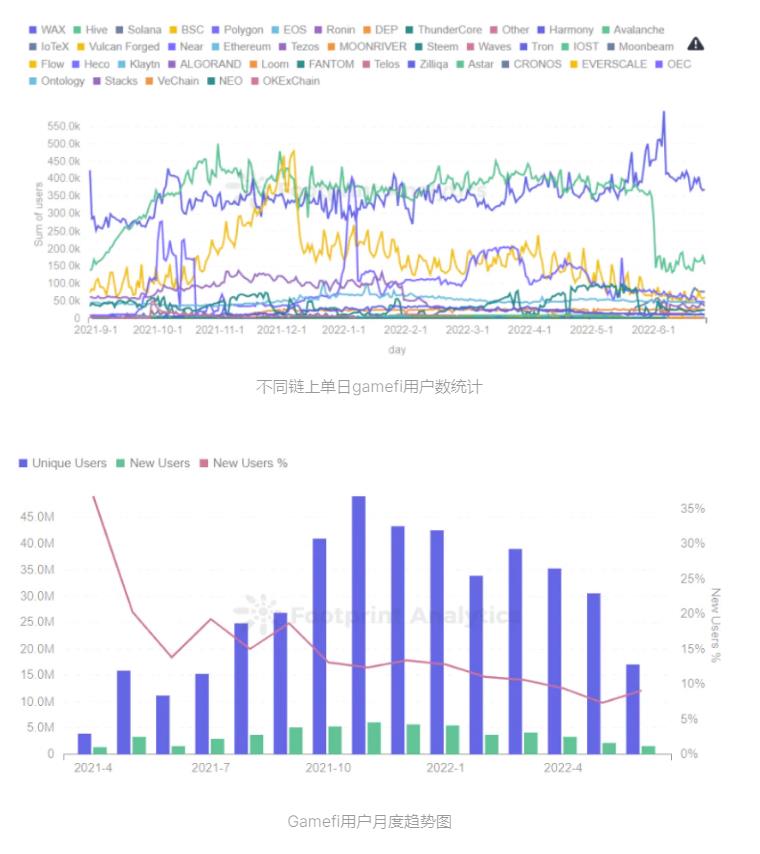
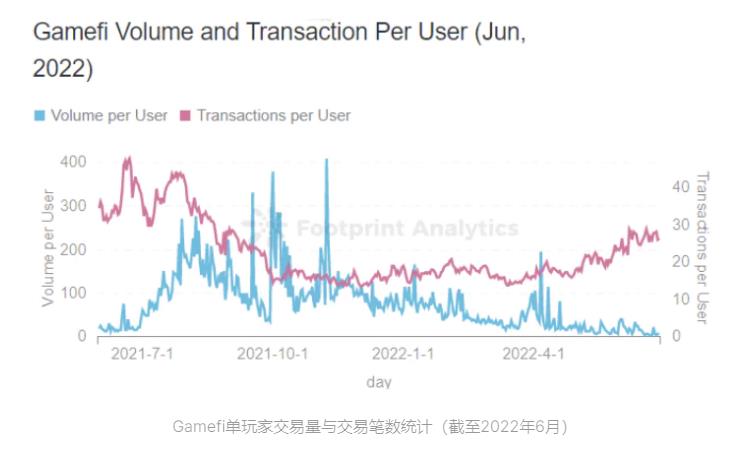
Data Sources:https://www.footprint.network/@u7tkguSKt2/Gamefi-Monthly-Report-Jun-2022
The good times don’t last long. By the first quarter of 2022, there will be more and more empty talk about GameFi, which is not surprising. At the end of 2021, some games that have passed a quarter or longer have experienced a sharp drop in currency prices and new developments. In November 2021, the collapse of the "Four Great Deaths" severely hit the confidence of players: Is the gamefi of the dual currency system a Ponzi with his left foot on the right? Is it an earth mine that will be emptied and sold one day? The result of this collapse of belief is: completely overthrow the belief in Axie, and found a new banner of Play for fun. If the distribution of profits to players may be hollowed out and cause the economic system to collapse, then should we return to modern video games and use more interesting add-on value to keep players in the economic system for a long time? Not for the purpose of playing gold, but for the fun of the game to participate in it. This leads to another question. Compared with the current video games, why do you think that gamefi can definitely attract more people in terms of fun? If it's just for fun, it seems that it can return to the embrace of Steam. This question has not been answered for a long time, but entrepreneurs are still going on to "chain reform" a large number of low-financial, multi-category traditional CPs.
secondary title
2、X to earn
By the second quarter of 2022, Play to Earn is at the end of its strength, and it will take some time to wait for the emergence of transformative innovations. X to earn has become the new darling of capital pursuit due to the emergence of STEPN.
The success of STEPN cannot be replicated, and it is also very obviously accidental. Before STEPN (competitive product comparison tablehttps://www.notion.so/61b11de57d314e4c9bfa1b6af4fdb09c?v=7f5a38ece4cb4cb8ba0819ad30511286) There have been a variety of Fitfis, but none of them designed tokens in the way of games, and did market operations with game thinking. Some Crypto teams have tried from the direction of the game, but the final effect is not good. So STEPN is playIt is not unreasonable for the new generation of successors to earn.
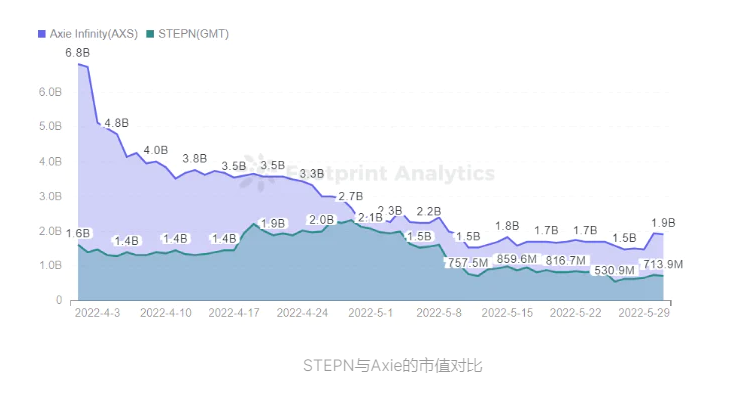
Data Sources:https://www.footprint.network/@u7tkguSKt2/Gamefi-Monthly-Report-Jun-2022
1) Reasons for the success of STEPN
Many say it's a great product, even though it may seem like a flop so far. I do not deny that we cannot erase the value and significance of a phenomenon-level product that has been born out of nowhere. But does STEPN's success mean that its product power surpasses Web2? Or is it because of the money-making effect of tokens? Or because of Solana? Or is it because of capital operation?
I think it makes sense, but not entirely. The core is to use numerical values to create the user's illusion + find a suitable backer to tell the first-level and second-level stories + exquisite gamification operation. The most ingenious thing is to give full play to the role of the regulator of NFT shoes, not only as a shovel, but also as a market value buffer for large coins and small coins. The essence of the currency adjustment cycle of GST-NFT shoes-GMT should be three coins The economic system of layer-by-layer conduction, but the liquidity of NFT is poor, and it carries complex and diverse utilities, the conduction becomes complicated and NFT is the core, and due to the hysteresis of NFT changes, the market value of GMT and GST has been buffered; The complex design of gems, treasure chests, shoe boxes and shoe attributes conceals the great changes in GST and GMT consumption and reduces the user's sensitivity to the token output ratio. Release a very small proportion of circulation, create a myth of wealth in the secondary market, and the price of tokens will rise against the trend to attract players to enter the market, expand the "demographic dividend", and maintain the operation of the economic system.
2) Future prospects of STEPN
It is very interesting to talk about STEPN with a friend from a traditional VC agency. She thinks that STEPN has surpassed Axie in terms of effect, but in order to really do well in the future, it needs to improve some paid monetization methods, such as advertising. Raise the cost of entry to the game. But this is also the place I can't understand the most, as if Web2 and Web3 have a deviation in their understanding of traffic. For the traditional Internet, when the DAU of the product is high enough, the recommendation algorithm can be used to "exploit" more value from the user; but for the peer-to-peer decentralized network, every transaction and interaction of the user on the chain It is already the traffic itself, so STEPN can obtain such a large profit from the rental commission of NFT shoes, which itself is a kind of traffic realization.
X to earn is already a relatively mature model in web2. The basic logic is the financialization of user behavior data and the gamification of behavioral goals. Scenarios include various fields such as reading, fitness, and short videos. In web2, there are more or less problems in the monetization of these scenarios, and the best one should be the monetization of short video traffic. The question of X to earn is whether there are monetization conditions in the scene itself, and whether the introduction of tokens can change the distribution relationship. First of all, X should have the characteristics of high frequency, low participation threshold, and easy disassembly and tracking of user behavior. At present, many X to earn projects are basically forks of STPEN, which is a helpless choice for long-tail players in web2. The key to this model is how to combine the token economy design with the user behavior path, and how to "realize" the expectations through the first-level narrative and the second-level market making. This is the vast majority of X to earn project parties and even all Gamefi projects. It is difficult for both parties to do well.
first level title
4. The regional evolution of Gamefi
The regional evolution of Gamefi is related to many factors, and it still needs to be viewed from two perspectives: games and crypto.
The number of users and penetration rate of Crypto are related to the population structure, economic structure, sovereign currency, domestic inflation level, laws and regulations of the country and region. For Southeast Asia, Latin America and Africa, these regions have a higher proportion of young and middle-aged population, relatively unbalanced economic structure, weak sovereign currency, high inflation, and large foreign exchange fluctuations, and are more likely to accept digital currencies. Just imagine, a young man in Thailand who is facing a macroeconomic recession and has no way to make a living, holding the national currency that is increasingly like a piece of waste paper in his hand, maybe BTC is as attractive as gold/dollar at this time. For Europe and the United States, most crypto developers and investors gather here. For ordinary people in Europe and the United States, primary investment and development are not what they need to care about. Defi and token secondary transactions are more attractive investment methods besides stocks. For some people, the purpose of registering a wallet and interacting on the chain is to preserve value and earn a living, while for others it is to obtain a higher return on investment. These younger people in underdeveloped areas, with a lower average education level, and perhaps without a PC and only a mobile phone, will be more likely to participate in gamefi earlier.
From the perspective of games, the main developers of games are mainly located in Europe and the United States, and the main consumption area of games is the Asia-Pacific region. The Asia-Pacific region has the most players in the world, accounting for 55% of the total number of players worldwide. It’s no surprise that the region also has roughly the same share of the world’s internet population (54%). The high player share in the Asia-Pacific region is largely due to China's large population base, but the region also includes emerging regions such as India and Southeast Asia. At the same time, the proportion of income from different regions is another picture. The consumption of players from the European and North American markets is very high, accounting for more than 40% of the game market revenue. It is also worth noting that in 2021, players in these two markets will account for less than a quarter of the total number of global players (14% in Europe and 7% in North America).
In addition, more than 90% of the world's gamers in 2021 will be mobile players. Due to the demand and love for mobile games in the Asia-Pacific market, as well as the accessibility and universality of this market segment in various regions of the world. This year, 2.8 billion of the world's 3 billion gamers will play games on mobile devices. That compares with 1.4 billion and 900 million PC and console gamers, respectively.
Here is a rough classification:
- Countries with high crypto penetration rate + high game consumption + low game development - Gamefi is an early participant, but it is difficult to maintain for a long time. Typical representatives Southeast Asia, Latin America, Africa
- Countries with high crypto penetration rate + high game consumption + high game development - can keenly capture Gamefi upgrade needs and have sufficient development capabilities to meet the needs, and may be the leader in Gamefi investment and development Europe, America, South Korea
1. Rise in Southeast Asia, but the core will not be in Southeast Asia
As mentioned above, Southeast Asia is an early major consumer market, and its overall development capability and development stage still lag behind other regions.
2. The Korean market: Xiao He succeeds, and Xiao He loses
The crypto participation of South Korean people is extremely high, and the policy is relatively relaxed. The local game industry chain is mature, with popular products such as CP, and the world's top e-sports events. In general, it can be said that the proportion of game players and the proportion of crypto participants are relatively high. Success also Xiao He, all because of the fanaticism of crypto and game genes; failure also Xiao He, the Korean crypto market and even the entire crypto market quickly ended due to excessive fanaticism, Terra has a huge impact, retail investors, VCs, ecological projects, developers , and even South Korea's economy and society have a certain impact. The "crazy bull market (end)" in 2021 coincided with the presidential election in South Korea. Yin Xiyue tried his best to win over young middle-class men, and finally won the election. Who would have thought that DK's black swan caught everyone by surprise, how to deal with DK, whether to restrict crypto, and how to restrict crypto became his difficult problems.
3. Japanese market: Conservative and prudent
In East Asia, a region with strong game culture and not weak game development, China and South Korea are scrambling to join GameFi to find opportunities. In comparison, Japan seems a bit out of place. Most traditional game developers seem to be trying, but have been slow to do so. Some local first-tier investors are also working hard to participate, but in the end there is not much splash due to entry time, decision-making, voice volume and other reasons. Lack of innovation, difficulty in turning around, and long decision-making cycle are all footnotes of conservative.
4. African and South American markets
At present, there is a lack of first-hand information on the African and South American markets. According to the current news, the African and South American governments are relatively open to crypto; the communication infrastructure is more robust than we thought, and the number of independent wallets is relatively high, which may be a potential market.
5. European and American markets: investment and innovation centers
first level title
5. Existing problems of gamefi
1. Development
- On the whole, the team's CP research and development capabilities have improved, and the proportion of self-development has increased, but there are fewer innovative designs for game mechanisms
- The research and development of the decentralized infrastructure level is still in its infancy, you can wait and see and follow up
2. Design and operation
- Traditional teams lack bottom-up community mobilization capabilities: the use of social media accounts such as Discord/Twitter, the image of the founding team and community exposure, whether the game mechanism design can meet the needs of crypto users and take into account their usage habits;
- The crypto native team lacks experience in game numerical design and game economic model adjustment, and is not proficient in various means to maintain the stability of the game economic system
3. Issue
It is still impossible to completely get rid of traditional distribution and publicity channels, such as Google Store, Facebook, YouTube, etc. Most of the games that are close to modern video games, have low barriers to entry, and low financial attributes rely on this channel to break the circle. Such as STEPN, THG and so on. From the results, compared with products of the same type but relying on crypto media and KOL, the cost of publicity and distribution may be lower.
4. Policy and supervision
- License: Due to various restrictions in mainland China, game companies involved in token issuance need to register overseas entities and operate overseas.
- Deposit and withdrawal: In some regions, the use of in-game virtual currency to exchange stable currency and US dollars requires the company to hold a payment license. Almost all games involve the deposit and withdrawal process of US dollars-stable coins-in-game tokens-stable coins/US dollars, and cooperation with local payment companies, banks, and deposit and withdrawal service providers has become very important
first level title
secondary title
1、CP
1) Pay attention to the progress of Defi direction
Introduce more defi designs to refine the design of the in-game economic model. At the same time, pay attention to the innovative projects of defi.
- Use business fee income as staking rewards
- Use some governance tokens for staking rewards
- Application of Ve model in game economic model
2) Pay attention to the extension of X to earn
In the future, there will be more and more second- and third-tier web2 teams and even leading teams that quickly learn token design to enter the market, and make more explorations in the development of scenarios and the numerical design of token design.
3) Pay attention to more empowerment of NFT
The value of NFT in the game is currently still in the role of "shovel", and NFT can be endowed with social attributes and display functions.
- Open up with other social platforms to display the achievement system;
- NFT serves as CP's participation identity proof to obtain more rights and value on the content platform;
- NFT PASS card: the access threshold of the community
- Rewards for random exploration or completion of game content: easter eggs are used as NFT rewards and displayed
secondary title
2. Middleware and services
1) Middleware: game player behavior tracking and classification service
At present, most dashboards analyze players or guilds more from the data level on the project chain. But few similar projects address the problem of player behavior data. For example, which types of games are more preferred by users, what is the overall decision-making process in these games, the upgrade and consumption habits of game props, etc., and even accumulated data can provide behavioral guidance for guilds: such as how to make decisions more efficiently.
It can be combined with DID and tagged through user behavior to realize social functions inside and outside the game.
2) Opportunities for overseas operation of Chinese games
Due to the limited distribution of domestic version numbers, a large number of domestic game CPs are waiting to be converted.
3) On-chain operators
secondary title
3. Infrastructure
1) Cloud gaming
- Since the ARPU of chain games far exceeds that of traditional games, the revenue of cloud game CP may cover costs.
- Cloud games will subvert gamefi's income charge logic, and may change from free-to-play or buying NFT shovels as a threshold to shovel + point card payment.
2)VR/AR
Many metaverse projects that claim to develop VR/AR versions in the future have not made any progress.
Content source:
Content source:https://github.com/ls361664056/GameAI-paper-list
PCG (Procedural content generation), uses AI methods to assist in the design of game systems. The pre-requisites are relatively good data (including data quality, data representation, and data quantity) and representative evaluation methods (including aesthetics, playability, novelty).
(1) Application-oriented
a. (Auxiliary) Generate content in the game (affecting rules): levels, maps, items, weapons, tasks, characters, rules, etc.
b. (Auxiliary) Generate the appearance in the game (does not affect the rules): character appearance, expression, weapon appearance, sound effects, etc.
c. Aided design
d. Fix map bugs: detect and replace unreachable dead corners, etc.
e. Data Compression: Compress game data to a smaller size.
(2) Method-oriented
a. Cellular Automata
Use domain rules to generate a large number of irregular graphics based on random initial states, which can be used for modeling environmental systems such as heat, rain, liquid flow, and pressure explosions, and can also generate small maps such as caves, but controllability cannot be guaranteed.
b. Grammar-based approach
Define a set of grammar rules to generate content.
c. Based on the search method (usually Evolutionary Algorithms, EA):
Compared with the method of machine learning, the search method can greatly reduce the amount of data required. The key issues are, for example, the need to determine a better content representation form and a better evaluation method. There are several categories:
EA Algorithms: Genetic Algorithms, Evolutionary Strategies, Evolutionary Programming
EA like algorithm: particle swarm algorithm, differential evolution algorithm
assessment method
Direct evaluation is to use some function to constrain the content generated by the evaluation, including Theory-driven and Data-driven. The difference lies in whether the evaluation function is based on a theoretical or empirical model.
Simulation-based is the use of bot AI to play the game to evaluate the content of the game. Including static evaluation and dynamic evaluation, the difference is whether the evaluation function will change over time.
Interactive evaluation is a real-time evaluation, which is evaluated through the experience of human players. Including implicit evaluation-analysis of content quality through the data generated by players playing games, and explicit evaluation-player direct scoring
d. Machine learning methods
A new direction of PCG research is to train generators on existing content so as to be able to produce more content of the same type and style. This is inspired by recent results of deep neural network research, where network architectures such as generative adversarial networks and variational autoencoders have achieved good results in learning to generate images such as bedrooms, cats, or human faces, and by early Inspired by the findings, where simpler learning mechanisms such as Markov chains and more complex architectures such as recurrent neural networks learn to generate text and music after training on a few corpora.
Neural networks, including GAN, AutoEncoder and NeuroEvolution, etc.
Probabilistic models, including decision trees, etc.
e. Combining game-generated content with player experience (EDPCG, Expierience-driven PCG), which includes three core aspects: emotion stimulation, emotion detection, and emotion expression.
- Emotional Stimulation: Games provide excellent background building blocks for emotional arousal, as the stimuli are varied and come from different sources such as images, sounds, stories, etc.
- Emotion detection: Game users (players) are generally more willing to provide more input of a multimodal nature (via sensors) as long as this leads to an enhanced experience. In a sense, players are the best users for affective computing and multimodal interaction research.
- Emotional expression: The user voluntarily experiences a range of experiences in the game: these experiences range from very positive to very negative. At the same time, the emotional experience in the game is influenced by the player! Therefore, the player is used to and is largely open to emotion-based expressions!
4)NFT
- NFTfi: NFT lending and NFT combinations will have considerable development on the game track; NFT lending platforms may not have a single giant, and most of them will extend from guild service providers or the in-game NFT rental market.
ERC4907: It provides technical support for the "native lease" on the chain, and realizes the separation of ownership and use rights of NFT
ERC1155 and EIP5006: The capital turnover rate of heavy assets in the GameFi ecosystem will be greatly improved.
first level title
7. How to judge gamefi CP and how to do a good job in gamefi
1. Public chain + capital
The public chain and the game achieve each other. The public chain with rich ecology, high performance, and capital support can bring a relatively high Beta to the game CP itself: mainly reflected in the fast transaction speed, low latency, large user base of the public chain wallet entrance, public The value of chain tokens is stable, DEX transactions are convenient, etc.; games are also a starting point for active application diversion for public chains.
2. Token Design and Subsequent Adjustments
- Whether the design of the number of tokens conforms to the economic depth of CP itself;
- Token destruction and output rhythm and quantity ratio;
- There are enough diverse and continuous scenes for reasonable consumption of in-game assets;
- Whether the team has the ability to make emergency adjustments according to the actual extreme situation
3. Category selection
- Heavy-duty games: The development cycle and life cycle of the category are relatively long, but it may not be a category with high risk and high return. The current large-scale games still do not have many successful cases.
- Leisure category: At present, it mainly focuses on simulated business and social networking, with low barriers to entry, but simulated business has high economic depth and high token complexity, and the upper limit still exists.
- Partial to Defi category: need to have sufficient data analysis and understanding of Defi products. And it can fully combine the pledge of DeFi with lending and game scenarios to realize the "materialization of DeFi products".
first level title
8. Future Outlook
1. What is the game?
From the first time I came into contact with gamefi until now, I have thought about this question repeatedly. What should the game be? It is Tic Tac Toe in the 1950s, it is a simple electronic game operated with a bulky game console in the 1970s, it is the playful Blue Moon of "If you are a brother, come and kill me", it is the Witcher 3 that has dominated the best-selling list of steam all the year round, it is the "simulation game". "Reality" Half-Life Alyx is the original god of fire... I have no intention of arguing about the definition of the game, such as whether it is fun enough, has enough movie-level picture performance, and has enough sense of substitution to be "fundamentalism" game. But I think that in the next ten or twenty years, or even a longer future, the connotation and extension of the game will undergo subversive changes. Don't use the so-called "definition" of the posterior to frame your imagination in advance.
2. What is GameFi in the future?
It is foreseeable that GameFi is the application closest to the "entity" in the crypto world. Judging from the proportion of GameFi's market value in the overall market value, there is still room for growth in its market value. At the same time, the application layer is still in the early stages of exploration, but there have been amazing developments in just a few years. Of course, while firmly believing in a bright future, we must also be aware of the current difficulties and the complexity of the process: gamefi still has many pain points that have not been resolved, and these problems cannot be resolved in the short term. Personally, I think that in the future, gamefi may be more game-oriented, and crypto will be more polarized, that is, gamefi that is close to modern electronic games will be more "light-chain reformed", gradually reducing its own ponzi characteristics and increasing player consumption Behavior; CP with a more crypto native form will be composed of a core team with a background in mathematics and cryptography, and will never return to the "interesting" road that geeks and financial players will find.
Finally: I really like the movie "Ready Player One", especially Halliday's line "Thank you for playing my game". I hope that there will still be pure Hallidays building a new oasis after the chicken feathers all over the place.