






Essential guide for Web3 founders and builders: How to build a suitable community?


introduce
Compilation of the original text: The Way of DeFi
introduce
Over the past two years, we have witnessed the rapid rise of the power of decentralized community building. In a crypto-native, ownership-first era, users choose to spend their time in digital places that not only provide a better user experience, but also provide more autonomy and influence, more economic incentives, more connections , and ultimately more fun.
As a result, starting with a new crypto-native project idea, questions from the community arise almost immediately. It begs the question: "As a founder or builder of Web3, what do you need to know about integrating community into your project? In what decentralized way?"
Before 2020, I spent a lot of time analyzing the ins and outs of centralized community building best practices, mostly from me as a user (Foursquare, Meetup, Twitter), as an employee (Stack Overflow), or in my time at Union Square Ventures. Examples of successful Web2 networks learned during infiltration. Last fall, I synthesized many of my observations about community building in web2 into a presentation that raised some parallels (and many open questions) about what these lessons might mean in a Web3 world.
But when I started working more closely with a community of Web3 builders called Zeitgeist, I realized that the questions Web3 founders were asking were much more pointed.
How do we start Web3?
How do we decentralize the way work gets done?
How do we move people from awareness to participant to builder?
How do we measure success?
first level title
project
Drawing on advice from community members in many of these areas, I explored 12 projects with an eye toward better understanding best practices in the crypto-native community. While I conducted most of the initial research independently, I also spoke with core contributors to many of these initiatives to validate some of my findings and fill in some gaps.
they are:
Crowdfunding DAOs
PartyBid: A Protocol for Group Buying of NFTs
Juicebox: Decentralized financing platform
Decentralized Finance (DeFi)
Decentralized Finance (DeFi)
Chain game
Chain game
Dark Forest: A Decentralized World Building Game
Loot: Adventure gear stored on-chain in the form of NFTs
NFT
Nouns: A knowledge sharing community for on-chain avatars
Crypto Coven: A Female-Centric Witch Crypto Community
other apps:
Helium: Decentralized Wireless Infrastructure
Mirror: Decentralized on-chain publishing and financing platform
Numerai: A Decentralized Hedge Fund Based on Data Science Championships
*If you are new to the space, start by reading these primers on DAOs, DeFi, NFTs, and decentralized games.
The main output of this work consists of three parts:
When asking the question "How do I build a decentralized community into my product?", keep this best practice overview from Web3 founders and builders in mind.
This article consists of a series of 12 separate stories, a timeline for each project I explored to understand how things started and where they stand as of today (July 2022). I'll be putting these under my Mirror for the next month. You can find the first one on PartyBid/PartyDAO.
A complete open source library of all links, articles and resources cited throughout the course of a research project.
You can find the full list of articles here and submit your own links here.
My hope is that this can spark continued interest and exploration, or collaborations with anyone else who wants to pick up some loose stuff or help me stay updated over time.
1. start
Sometimes the most important part of getting started is that you don't even know when to start; CabinDAO Core Contributors start with the physical space first, then the DAO. (passhttps://www.creatorcabins.com/visit)
The most common question I get asked about community building is also the simplest: How do you get started? But the problem with asking people how they got started is that these stories quickly become part of the romanticized folklore of any entrepreneurial experience. Throughout the research process, I did my best to unroll each project to its starting kernel. Here are the web3 specific nuances and observations that emerged:
Build first and plan later.
One of the most powerful principles of Web3 (or at least the stages of the adoption curve we find today) is a culture of building first and planning later. CabinDAO's Joh built Cabins without knowing how he wanted to use them. A builder sees a tweet with an idea for a new app called "Partybid" and decides to spend his weekends writing a v1 version. Doing something "just because" makes these early cycles believable.
This "don't think, just do" approach seems especially true in some great DAOs that start off with sheer adrenaline and "good vibes". I’m thinking in particular of SharkDAO, which started with the idea of people wanting to collectively bid on Nouns NFTs, and the Constitution DAO, which raised a ton of money in a week seeking to buy a copy of the US Constitution.
Interestingly, in this article aboutThe Verge article on Constitutional DAO, the reporter keeps asking what happens when they buy a copy of the U.S. Constitution, asking pragmatic questions like: "Where does this copy go? Who takes care of it?" The reality is: That's beside the point. At least, not the point right away. The most innovative projects I know of in Web3 don't start with curation - they start with possibility.
Sell the dream.
No matter how natively crypto and digital-first your project is, your end users are still human (even if they embrace pfps and pseudonyms), and the projects that gain traction the fastest are those that lean toward basic human psychology. I've noticed that there are four key motivators that drive people to join a new project or initiative. (There are clear parallels to some of the early moments of traction in the Web2 world.)
1. "You'll be first."
One of the first DeFi projects to DAO-ify, Index Coop completely decentralized their governance while the rest of us are still trying to remember what the three-letter acronym stands for. As a result, in addition to unlocking a network of early DeFi evangelists, they have attracted top-notch community builders who have all but given up their day jobs to come up with guiding principles and new organizational design concepts to experiment with entirely new ways of working and collaborating. The first-mover advantage does have benefits.
2. "You'll be joining an incredible community of (builders)."
It's no secret to web3, but it bears repeating: people want to work with good people. Today, much of this manifests itself as developers wanting to build together - which is a big part of the driving force behind the strength of the community of contributors behind Juicebox and PartyBid, or why earning a spot on the Dark Forest leaderboard is the equivalent of being in Stack Overflow reputation points in the web3 era. Jango, one of Juicebox's core contributors, said it best - "Developers love to develop with other developers."
But it's also evident in non-developer networks like CabinDAO, Crypto Coven, and Mirror. In particular, Mirror's innovative approach to leading the community through the $WRITE Race attracts high-quality new writers at a controlled, consistent pace. Virtually every Web3 community I've explored mentioned the quality of the people in their network. Figure out what "that special thing" is to your community and use that to attract more like-minded community members.
3. “You will push the boundaries of what’s possible.”
In one of the more ingenious twists on incentive structures to meet organizational goals, the game Dark Forest is actually built to be broken. The only way to win this on-chain game of world building and planetary claims is to simplify your gaming experience by automatically coding your way. The mission of 0xPARC, the foundation that funds games (among other projects), is to foster application-level innovation on Ethereum. Their open-ended approach to competitive game design has attracted some of the most serious Solidity developers as gamers, all excited by the opportunity to push the limits of their code.
4. "You'll make money."
image description

Getting into the "top 10" of the game leaderboard, Dark Forest, is pretty much one of the highest honors you can get as a Solidity developer today. (pass:https://zkga.me/)
Your core team (still) matters more than ever.
The sentiment is the same whether you call them founders, builders, or core contributors. The four projects I analyzed could attribute at least part of their initial traction phase to the fact that their core teams were previously well known or trusted in the field. Like it or not, someone with an audience and a brand is more likely to spark community and early traction.
See: Loot, founded by Dom, creator of Vine and Nouns, has a core team of Nounders that includes not only Dom, but other heavyweights like artist @gremplin and prominent thinker and investor @punk4156. Just like any other industry, smart people tend to turn up again in other smart projects. The more people and projects I spend time with, the more I find that intersections and cross-project engagement are the norm. Just look at the origin story of Partybid, which actually started with a tweet from former founder and a16z crypto partner Denis Nazarov, not to mention the founder of Mirror, another successful web3 project. Another great benefit of a trusted early builder? This is a surefire way to ensure that the "first follower" effect attracts a network of highly qualified secondary builders and contributors.
Beware: Speculation and Mania
Almost everyone in web3 knows someone who made the right move at the right time and got hundreds of thousands (if not millions) of dollars in the bank. Even in the most well-intentioned projects, you might end up talking to YouTubers about how Helium is "a magic box that earns you thousands of dollars," or that loot bags containing divine robes are worth a whopping 250 ETH. But soaring spikes of viral growth (and profit seekers) actually dilute the community. It might be hard to avoid, but it's still worth noting. The Optimism airdrop earlier this year was an early example of a project to stop arbitrage, but there is still work to be done. There's something to be said for the bear market we're in: While people objectively lose money, it does provide an opportunity to build speculation.
2. Decentralize how work gets done
Protocol improvement proposals are the process of proposing changes to a platform or project, usually voted on in a snapshot, as is the case with Uniswap's governance process. (passhttps://snapshot.org/#/uniswap)
Once you have established a Web3 community, you may start to wonder how much power is given to the community in terms of decision making and how work is performed. While most Web3 projects consider how decisions are made as a determinant of their decentralized status, an emerging theory from Spencer Graham suggests that in its purest form it should include both decentralized decision making and decentralized execution. In other words: "How 'decentralized' are you?"
Decentralized Spectrum
You'll notice that, at least in this subset of arguably well-known projects, "pure decentralization" (where all decisions and actions take place in a decentralized manner) is the outlier, not the norm. Other than Bitcoin itself, and possibly Loot, few projects start out fully decentralized. The vast majority fall somewhere in the middle.
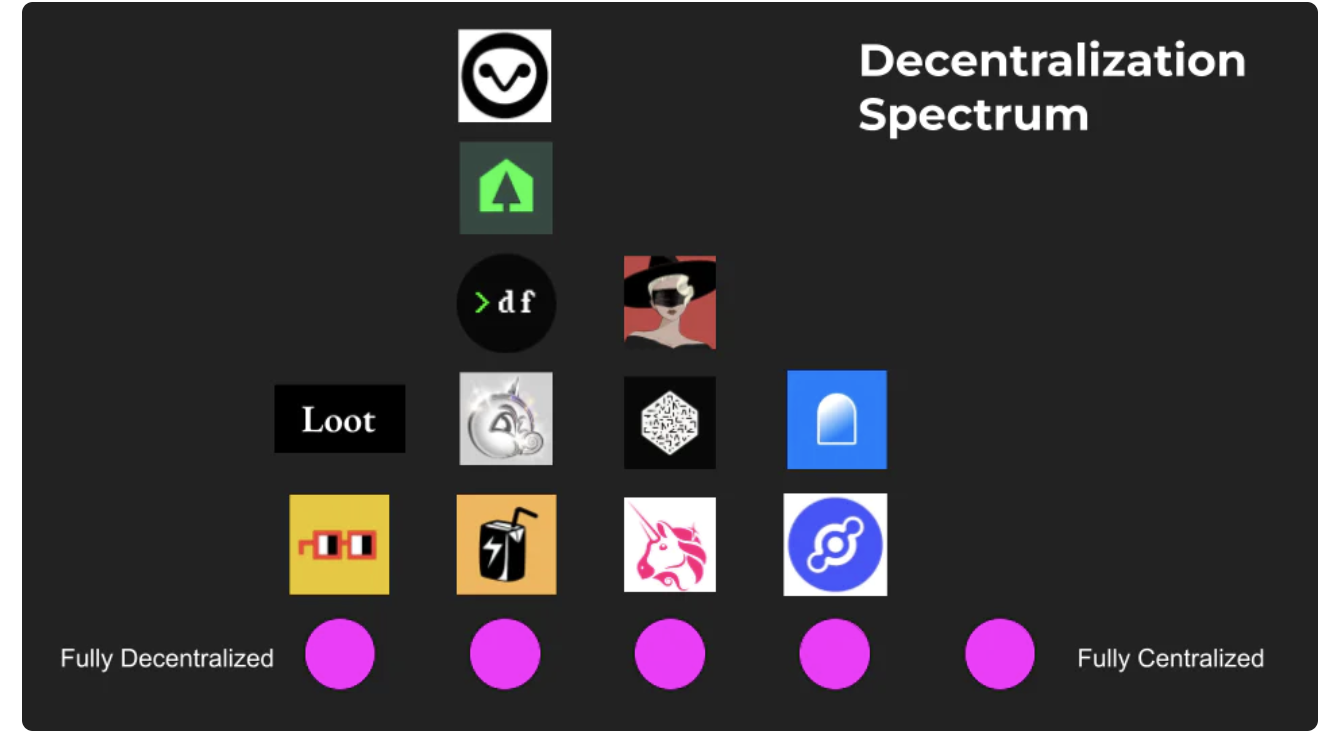
The Decentralization Spectrum is a 5-point approximation of the relative level of decentralization of any project based on how decisions are made and work is done.
Share transparent and open documents.
It's no secret that the web3 project builds publicly. With open Discord servers, Twitter posts, public-facing governance forums, and voting via Snapshots, nearly every project provides extensive, transparent documentation for its users and communities.
But -- just because something exists on the open web doesn't mean it's equally accessible to all. I originally started this project with the intention of doing a completely separate independent study of each Web3 community. But I quickly discovered that this was not sustainable. Being new to all of these fields, I spent hours untangling sometimes mysterious websites, dozens of pages of documentation, and deciphering the meaning behind each Discord server channel name.
In Web2, we attribute the widespread adoption of new technologies to the product's ease of API access and documentation. In web3 we look at their Notion page, Discord group, and onboarding process. In terms of the accessibility and robustness of its material, here are a few examples that stand out immediately: Index Coop, both in terms of its new member onboarding and handbook; and Juicebox concept, with both project creators and developers in mind. NFT project Crypto Coven received an honorable mention for its community-generated public library of stories surrounding the "lore" of its network as well as DAO and web3 fundamentals.
Index Coop's public community handbook is one of its most well-documented and transparent projects for current and prospective community members. (pass:https://docs.indexcoop.com/)
Give your community a voice built independently of the core.
Perhaps one of the most noteworthy trends in decentralized community management is the separation of the influence of the community from that of the core builders. Helium and Uniswap provide the strongest examples of this “church and state” effect in their decision frameworks. Both come with a C-corp consisting of core builders and team members, and a non-profit entity (or foundation) managed by the community.
In the case of Uniswap, their core team, Uniswap Labs, owns the product (including the web application interface, widgets, and whatever else they might launch), but the Uniswap DAO owns the protocol. Decisions about the protocol are managed by the foundation through its open governance proposal process. For example, the recent decision to deploy Uniswap v3 dates back to a conversation that began in March and followed the four steps of its governance: atmosphere checks, consensus checks, and governance proposals, culminating in a successful deployment on July 13.
Helium is one of many projects that utilizes a proposal process to manage requested changes to its protocol, known as the HIP. (Other examples include the Ethereum Improvement Proposal (EIP), and similar processes for Zcash and Rust.) These changes are managed through GitHub and then sent to the core team at Helium, Inc., most of the core developers of the Helium blockchain. be employed there. Both of these examples strike a middle balance of how to leverage community involvement and input while still allowing some level of agility and agility from the core team.
Start with an incomplete build.
An interesting trend among some web3 projects is to intentionally start with "incomplete builds". A pair of Loot backpacks as an NFT collectible inspired dozens of side projects, teams, and builders to wrap around a "player's deck" and build worlds out of other elements: maps, realms, HyperLoot characters. A 100% knowledge-sharing collection of NFTs known as the Nouns beacon provides a new wave of designers, animators, and storytellers to contribute to this burgeoning ecosystem. Dark Forest's decentralized world-building game is designed to be exploited — developers are actively encouraged to build plugins, integrations, and other boundary-pushing gaming strategies — even if that sometimes means admitting things are a little too far. Each of these projects, and many more in this space, act as magnets in their gameplay and community collaboration, where the community not only decides what comes next, but also builds it themselves.
In each of these examples (arguably the most truly decentralized project I've explored), getting the starting conditions right is more important than ever. Sina Habibian who helped build web3 at Zeitgeist said:
image description
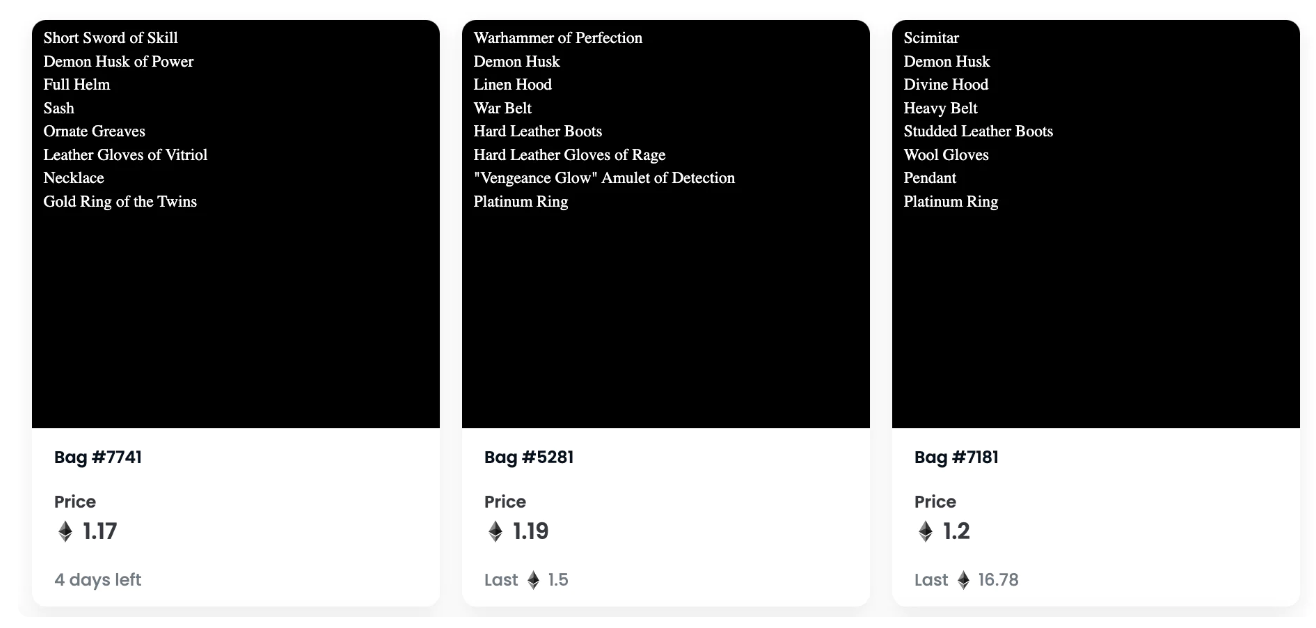
Loot backpacks, which you can buy on NFT marketplaces like OpenSea, consist of just eight lines of text that contain random items, objects, and gear. What becomes of these "trading cards" is up to the community. (pass:https://opensea.io/collection/lootproject)
Consider a middle tier of community leadership
Almost every DAO I've talked to has some additional layer of community leadership to help manage their wider network. While the obvious idea might be to simply assign Discord privileges to upgraded server members, the actual design of the Community Ambassador program is more organic. Index Coop uses something called "owl ranks" to designate different seniority levels in the community (gold, silver, and bronze, each with voting weight). Numerai elects a "board of elders" of senior community members who can make decisions more quickly on behalf of the wider network. Creator Cabins have a "city council" made up of people with at least $500 of CABIN. These names seem to be extensions of common web2 community building models, such as "developer evangelist", "influencer", or even just "brand ambassador", because they not only have title and privilege, but also some influence and authority.
Beware: the temptation to turn everything into a community vote.
Prolific web3 community thought leader @rafathebuilder, who has been involved in communities including Creator Cabins and Mirror, observes:
"I think there is a 'minimum decentralization' - there are real trade-offs. Many organizations need to sacrifice efficiency and build decentralization through slow organic growth. If your goal is decentralization, your goal isn't Make it cheap. You are not optimizing the cost of production, you are optimizing the resilience of the network.
One of the most thoughtful articles I've read on this topic comes from CabinDAO's Jon Hills' How Decentralized Organizations Win (and Lose) . In this post, Jon challenges the notion of "decentralized absolutism" and identifies four principles for (non-crypto-native) organizations that flexibly adapt to the needs of the community without giving people 100% that power. This tension is one that many crypto-native builders need to reconcile between their own projects and protocols—both the opportunities and challenges involved.
3. Turn people into participants, into builders
Despite the digital-first nature of web3, community is at the heart of the ethos of the field’s builders; at the Devconnect conference in Amsterdam earlier this year, a pop-up coworking space that can accommodate more than 500 people at a time.
In an ownership economy, the active participation of members in the web3 community is as important as the importance of users in web2. Many builders and founders are asking: "What is a web3 conversion funnel? How do I get people from a casual observer to a community member to an active participant in my project?" While there's no magic to this question The answer (just as there is no one-size-fits-all answer for classic marketing funnel campaigns in Web2), but here are some observations (and a misconception) I made from my research project.
Know who your audience is (and who isn't).
The strongest Web3 communities I've come across have absolutely no qualms about identifying who they're targeting. Crypto Coven best exemplifies this - pursuing a "feminine" culture in Web3 and positioning itself as an "anti-crypto bro" culture. From the moment you land on their website, you are transported to a different place - a land of witchcraft, folklore, omens and prophecies.
While you might start out intentionally targeting an audience for your project like Crypto Coven's "High Witches" team did, it's much more common for teams to discover it organically. Such was the case with Index Coop, whose audience of DeFi evangelists gradually emerged with each new product launch. With each additional product release, a new sub-community niche emerges on the Index, each contributing to the DAO in their own way.
In contrast, Helium, a project originally founded in 2013 as an IoT company, has a very high rate of new crypto users — for many of them, Helium is the only crypto project they’ve ever been involved with, impacting Community organizing style. These severe audience differences also make it impossible to define a universal approach to community.
From the moment you land on the Crypto Coven website, you know you've entered another world entirely. This self-selection mechanism helps them become magnets for the audience that best matches their community. (pass:https://www.cryptocoven.xyz/lore)
Recognize your most enthusiastic community members willing to work for free
I used to believe that most of the power in Web3 resided in the intrinsic incentive structure for the actions each community took. Whether you get a bounty, recommend a new collaborator, or otherwise contribute, my impression is that all actions are rewarded with some incentive or compensation.
But the more I unfold the layers of these communities I talk to, the more I understand that incentives are a bit "soft" - even in Web3. On the one hand, hundreds of people donated to CabinDAO’s original mission — to fund creative retreats for emerging artists — without personally benefiting from the results. The 17,000 people who donated to ConstitutionDAO's frenzied crowdfunding campaign were simply curious, with zero expectation of return on investment. But people are not only willing to donate, they are willing to donate. They also donate their time. Danny Aranda, now a core contributor to PartyDAO, started like any other community participant. He said:
“I was a member of the DAO like everyone else. I started working on the project very organically and got paid next to nothing. There was a governance proposal that we should start paying Danny and then there were more jobs and I started getting paid full time.”
Danny's use case is a particularly good example of how projects can assess project-market fit between a project and a community: if people are willing to work for free (at least initially), then you've found your hook.
investigationinvestigation, about half of the respondents indicated that DAOs are not their main source of income. (Interestingly, this is the same percentage of people who report saving for at least 12 months, so the relative financial security of DAO contributors may help them do pro bono work seriously.) My favorite example is learning about Numerai's " The elders" aren't exactly paid to do the work either - but the reputation as elders stands alone, and they do give them capes, which the team wears in solidarity and excitement at meetings IRL.
To be clear: I am not suggesting that you stop paying your community members for their hard work and labor. Most of these programs make it clear to me that there is a threshold to go from free work to bounty based work and eventually to full time paid work. I just noticed - even in the hyper-tokenized world of Web3, sometimes you can get great people to do great things by buying them cool-looking capes.
Numerai is always looking for opportunities to reward contributors to their project in unique ways, including giving away free "NFTees" through this recent campaign. (pass:https://Twitter.com/NumeraiCoE/status/1547243673519214593)
Focus on a small core team of builders and a broad team of communicators
To outside observers, the size of a Discord server is a false indicator of true engagement. Even for projects with Discord communities in the tens of thousands (Uniswap) or hundreds of thousands (Helium) of members, the relative size of the contributing teams is small in comparison. As a project leader, it's easy to get sucked into the needs, requests, ideas, and suggestions of these bottomless communities. But a more disciplined, constraint-based approach to growth can help you focus on your community's North Star. For most projects, the percentage of community members who are also core contributors or builders is much smaller than you might think.
The best example of a strategic and intentional launch of a product-led community strategy is via Mirror's $WRITE Race. Over six months, Mirror invited writers to submit content for that week's contest, and token holders voted to recruit 10 new members each week. These new members quickly became early adopters, not only finding kinship in a peer community of high-quality writers, but also informing future product and protocol development by Mirror's core team.
Finally, I should point out that some DAOs — and many NFT projects — are quick to pick out an easy and simple way to serve as evangelists for their broad membership. This could be actively encouraging members to showcase their swag (like Bored Apes), funding projects that simultaneously boost brand awareness (like Nouns), or even being active on Twitter through memes and pfps. One of the main reasons I chose Crypto Coven as an NFT project for this research was because of the high level of community outreach I had from the Witches network during my original Twitter survey on community research.
High-profile partnerships and hype installations, such as the Bored Apes promotion as part of NFT NYC Week, are popular strategies for increasing brand awareness within the web3 community. (pass:https://www.wsj.com/articles/marketers-at-nft-nyc-upbeat-on-brand-building-in-the-metaverse-11656324000)
Note: Facilitates chatting with real community engagement.
Passing a community motion, or simply following suit to "run another DAO or crypto-native project's playbook" would be wrong. Conway Anderson, web3 builder and early Loot adopter has observed this in many of the networks he's been a part of. He said:
“If you just create a Discord and put people on there, nothing happens. Nobody really knows what they want to do. The best DAOs/products in the space are usually a group of people who execute, and through that, the wider of communities started thinking, "What if...? "Usually setting a threshold for others to start entering."
Part of achieving this level of engagement involves uniquely Web3 parts of your project - and legally impossible to build in a Web2 structure. Rafa points out:
"I think Web3 is special because a lot of protocols prior to Web3 were not public infrastructure, but private infrastructure. It's really hard to build a community around private infrastructure that's not just a 'fan base' (like Apple). But in terms of private infrastructure, it's much harder to maintain that community. The opportunity to unleash the power of evangelism is different today. You have so much connectivity; you can customize your message, do automatic translation, crowdfunding, anyone can send money or pool resources to anyone.”
4. Measure success
Every community defines success differently. SharkDAO's mission is to pool resources to purchase Nouns, and ultimately help people find their way into the Nouns NFT ecosystem. (via: https://sharks.wtf/)
Just as every company has a different definition of success, so does every community. But in this research, I came across some fundamental principles that seem to help some projects identify their true goals, maintain momentum, and inspire continued community engagement. Here's what it looks like in practice.
Decide if you're building infrastructure, or providing engagement.
First of all - determine your true goal direction. Some of the best advice I've received on this project came from understanding the difference between Rafa's infrastructure and engagement. In a real example, he asked me to think about ways to foster community within a community. One option is to build infrastructure—parks, churches, community centers—and let people organize themselves organically. Another option is to design events—block parties, game nights, town meetings—and involve people in them.
As the leader of the web3 project, clear choices need to be made. You can build a community around your protocol (like Helium, Mirror, and Uniswap do), or you can provide event-based programming to keep your community members coming back. (The latter applies not only to most NFT projects, but to the myriad DAOs, learning communities, and other decentralized, member-based networks in web3 today.) While the choice isn't necessarily binary, it is Something you should develop a dissertation for your particular project.
Bias to action.
Second - the Web3 equivalent of "move fast and break things" - say yes to new partnerships and opportunities. This happens all the time in real-time: a new connection at a conference becomes the NFT artist for your next project; a misinformation on Twitter or Telegram morphs into a new Discord and a game plan to bid for a copy of the US Constitution via the DAO. With the rapid cycle of experimentation and iteration required in this new era, saving some space to say yes to (and be open to) more spontaneous opportunities is just one of the best decisions you can make. A few examples: CabinDAO didn't start out as a DAO. Their founder Jon hosted a group of friends for a soft launch after his initial property was completed, and one of the attendees spoke about the opportunity to use cryptocurrency to expand the creator co-op they’ve been working with. The two early projects that initially gave Juicebox traction came from their core contributor, Jango, who threw himself directly into two fast-growing hype projects (SharkDAO and ConstitutionDAO) — volunteering their products as a way to make this happen. means. If you're ready, it doesn't matter so much: what matters is that you're there.
Invite your community to play along.
Third - make people unable to walk away. Let’s be honest: there are a lot of “not fun” things in the world today. It's easy to forget how enjoyable it is to have a good laugh with strangers on the internet or take in something completely ridiculous. But some of the toughest projects I've come across -- the ones you can't help but support anyway -- are fun, plain and simple.
I bet you can't sit through "Noun'o'clock" for 10 minutes at Noun Square without laughing. These daily Twitter space commentaries treat the end of each live NFT auction as a sporting event, complete with wacky sound effects and witty banter as the group follows in real time to watch potential new Noun NFTs randomly spawn.
(Think of a group of people yelling at the same time: "This design is messy, but I like it." "I like bonsai, but not that shirt." "Sunglasses flamingos? Come on!" "I'm still thinking That pineapple.")
Part of the "Noun'o'clock" includes a social engagement strategy called "Fomo Nouns," in which random Nouns (like this flamingo headshot) are presented and participants quickly vote on which one to mint. (pass:https://fomonouns.wtf/)
When I attended DevConnect earlier this year, I sat down with the core contributors behind dfdao, the DAO that came together to play the game Dark Forest. As a non-gamer, I'm stuck with the question: "Why?" Why would you take time off from your full-time job to compete in a world-building game with anonymous people all over the world? Why do you have to make sure someone is always the "pilot" running the game every five minutes for a week without a break?
It didn't click until I watched Ivan's presentation on Dark Forest at 0xPARC. While discussing the community's involvement in their game, he paused to talk about how dfdao exposed a vulnerability that allowed them to directly target their opponents and drain all their resources on Odaily. When he showed what it looked like in the generic map (slide 32 in his deck here), I saw the dfdao team grinning proudly at each other and heard them being cheeky about the road to victory giggling. That's when it finally hit me: For them, it's all just play. They are having the time of their lives.
Some of the best fun I've had on the Internet in the past year was watching Sotheby's livestream of the sale of a copy of the U.S. Constitution. Chat, Discord, and Twitter are simultaneously filled with memes, inside jokes, and speculation. Even when we learned that we had lost a bid—when the project's stated goals were not achieved—the community continued to work hard. This point is best highlighted in an interview with ConstitutionDAO core contributor Jonah Erlich:
“You know why people are creating a secondary market for this [$PEOPLE] token?”
"People love memes."
"Do you think so?"
Yes. People love memes; they love having fun. I think one of the things I've learned from exploring the crypto world is that it's hard to rationalize a lot of different momentums -- things that happen in memes and meme messaging. I think if people are having fun and they're doing their thing, then I don't try to explain too deeply because I'm just going to hurt my brain. "
Sometimes, you have to cast aside rationality and "catch the meme of production".
Nicholas Cage was the star of the show as it surrounded much of the meme culture that existed around ConstitutionDAO's marketing strategy. Follow the hashtag #WAGBTC for more fun. (pass:https://Twitter.com/laurenlself/status/1459341510655180803/photo/1)
Beware: too soon" to call it a success (or failure).
The entire web3 ecosystem is moving too fast for any project to be the de facto "winner" in the space. (Probably with the exception of Uniswap, which is the most popular blockchain-enabled application. At least for now.) If the volatility of Web2 has taught us anything, it's that projects that can't pivot are projects that fail. Adaptability is the key to success.
Suffice it to say, a lot has happened in the past two years. Until the end of 2021, the rise of the bull market has filled these spaces and communities with more energy than ever before in web3 - through the saturation of energy, we have witnessed a huge degree of experimentation and iteration. While temperatures have cooled and slowed in the recent macroeconomic environment, we find ourselves at an interesting inflection point that allows us to take stock, dig deeper, and grasp our direction to steer us more cautiously and intentionally The attention encryption adopts the method of the next stage of the curve.
So far, there’s still no clear winner — no company or project has fully “solved” decentralization (if that’s even the goal). But it's exciting to see some of the early patterns and behaviors emerge that may guide the next generation of builders and creators (maybe including you).
I invite you to continue this project by exploring the repositories I've used along the way and providing links of your own.
I'll be posting the rest of these personal stories each week on Mirror. You can read the first one here:
Read the PartyBid/PartyDAO story
This work would not have been possible without the dozens of people I have contacted over the past few months as direct and indirect contributors, including:0xZakk,Brad,Chris Carella,conway,danny,Jamie Dubs,jango,kenbot,LCap,LFeld,llpresswell,NJ,penryn,Rachel Price,rafa0,Remy Hall,Robleh,Steph Bell,Summer Delaney,Tarun Sachdeva,Timshel,Will Robinson,Xuannu. Special thanks toSina,Brunoand the entire Zeitgeist team supported this research.


