Understanding EthSign in one article: How to realize the "signature and pledge" based on blockchain?



Original Author: Poplar
For thousands of years, "signature and pledge" has always been the most legally effective form of personal commitment in the real world, such as common sales contracts, loan agreements, letter invitations, etc., as long as there is a personal signature on the payment, it basically directly represents the signature Party, and can be understood as reaching a contract approved by the signing party.
However, with the advent of the Internet age, electronic documents are gradually replacing paper documents, and new business forms such as telecommuting and cross-border trade are also in the ascendant.How to realize the "signature and pledge" with legal effect in the network scene, and allow a new form of contract based on electronic agreements to be derived based on this, it becomes the underlying infrastructure requirement to support the development of Internet credit business.
On July 24, the Beta version of EthSign Signatures also announced the aggregation of more than 100,000 signatures on the Polygon network. One of the Web3 solutions for the "electronic signature" solution.
EthSign: Web3-based electronic agreement signing platform
Ethsign is a decentralized electronic agreement signing platform that supports users to sign and manage agreements electronically. Users can log in to EthSign through encrypted wallets such as MetaMask or traditional Web2 methods, upload files and perform "electronic signatures".
Among them, ETHSign has cooperated with Magic, a digital identity solution. Users can use Magic to automatically create a public-private key pair by email, and then register and log in through the link in the email.
ETHSign also integrates with Web3 login service provider Web3Auth (formerly Torus), users can also log in to DApp via email or link OAuth via Google, Twitter, Discord and Reddit, or use their wallet of choice (MetaMask, Trust Wallet, Coinbase Wallet, etc.) ) without involving the mnemonic.
In addition, the signature data of EthSign will be recorded on the chain, but the private data such as contracts and agreements will be stored in the decentralized storage platform off the chain.
Currently, EthSign uses both IPFS and Arweave. On the one hand, it facilitates retrieval on IPFS, and on the other hand, Arweave provides persistence. All protocols and off-chain data will be stored in these two networks by default.
In short,
In short,EthSign is a product that "Web3ized" the traditional electronic agreement signature platform——Through decentralized storage, public and private keys and other technical attributes to further ensure the trust guarantee of electronic signatures, and combine smart contracts to create a new contract application paradigm.
A decentralized form of "electronic signature"
Here we need to be clear that "electronic signature" is an electronic signature of an electronic document through cryptographic technology, not a digital image of a written signature, that is, an "electronic signature" is more formal and has legal effect:
Signing a contract indicates the signatory's intent and agreement to uphold the terms of the agreement;
The signatories trust each other to fulfill their responsibilities;
In the event of a dispute, the signatory trusts the legal jurisdiction to reach a just resolution;
So its core is undoubtedly "determining electronic identities" - it is necessary to verify the real identities of both parties to ensure the security and non-repudiation of transactions, and finally play an electronic technical confirmation that is equivalent to handwritten signatures or stamps.
However, the traditional "electronic signature" has some disadvantages due to centralization, such as:
Users must go through an authoritative third-party service provider to verify their identity and retrieve agreements;
Protocols involving privacy are stored on third-party platforms. Once the service provider goes bankrupt, the data stored on the server faces the risk of loss and leakage;
The blockchain's public and private keys and decentralized storage technology can perfectly provide corresponding solutions - traditional users can passGenerate a private key to directly sign a specific document, and record the digital signature and related operations.
This allows users to bypass authoritative intermediaries and realize peer-to-peer transactions and collaborations. After both parties sign, the data will be stored on blockchains such as Ethereum. The validity of the contract is proved by many nodes on the chain, rather than authoritative intermediaries. mechanism.
At the same time, in the form of smart contracts, EthSign signs agreements on the chain to make trustless agreements possible-smart contract templates can enforce certain agreement terms.
Currently, EthSign Signatures (EthSign Signatures) is an agreement signing platform built on Web3, which provides the same functions, user experience and legal effect as the Web2 electronic signature platform, while using the power of blockchain to improve transparency and security.
EthSign Signature Test Experience
Currently EthSign signature beta is live, users can upload documents, add signers and define various fields (signature, date, wallet address, checkbox) for each signer.
This version provides the same functionality, user experience, and legal validity as the Web2 electronic signature platform, and adds features such as permission settings, signing order settings for signers, PDF annotations and text field sets, push notifications via EPNS and Blockscan Chat, and more.
Among them, users can first link to the EthSign signature test version on the Polygon network through their personal wallets, select and upload files that need to be "electronically signed" (currently supports PDF format).
Then users can set permissions through their own Polygon address (or specify other addresses and set corresponding permissions).
Then set the address with permissions, and then you can make an electronic signature based on this address in the PDF file (you can also add links, etc. at the signature).
Finally, it is encrypted and stored on the chain. Wait for the jump to "Sign Now" to enter the password and sign it, and then you can download and view the electronically signed file.
Project team and investment and financing
EthSign started in the second half of 2019. In June 2020, the founding team participated in the Hackfs Hackathon co-organized by ETHGlobal and Protocol Labs before making the first usable version. EthSign was then demonstrated at the Dorahacks Hackathon in February this year. The second version, and with the skyrocketing price of Ethereum, smart contracts had to be migrated to the Polygon network to reduce the gas consumption of users.
In terms of investment and financing, EthSign not only won the favor of Coinlist, but also rarely received collective bets from Sequoia Capital, Sequoia Capital India and Sequoia Capital China.
Among them, in July 2021, EthSign completed a $650,000 seed round of financing, led by early-stage venture capital firm Draper Associates, with participation from Hashkey Capital and ImToken Ventures.
On March 2, 2022, Coinlist officially announced the 2022 winter batch of seed projects. A total of 7 projects were shortlisted from more than 1,000 startups, and EthSign was among them.
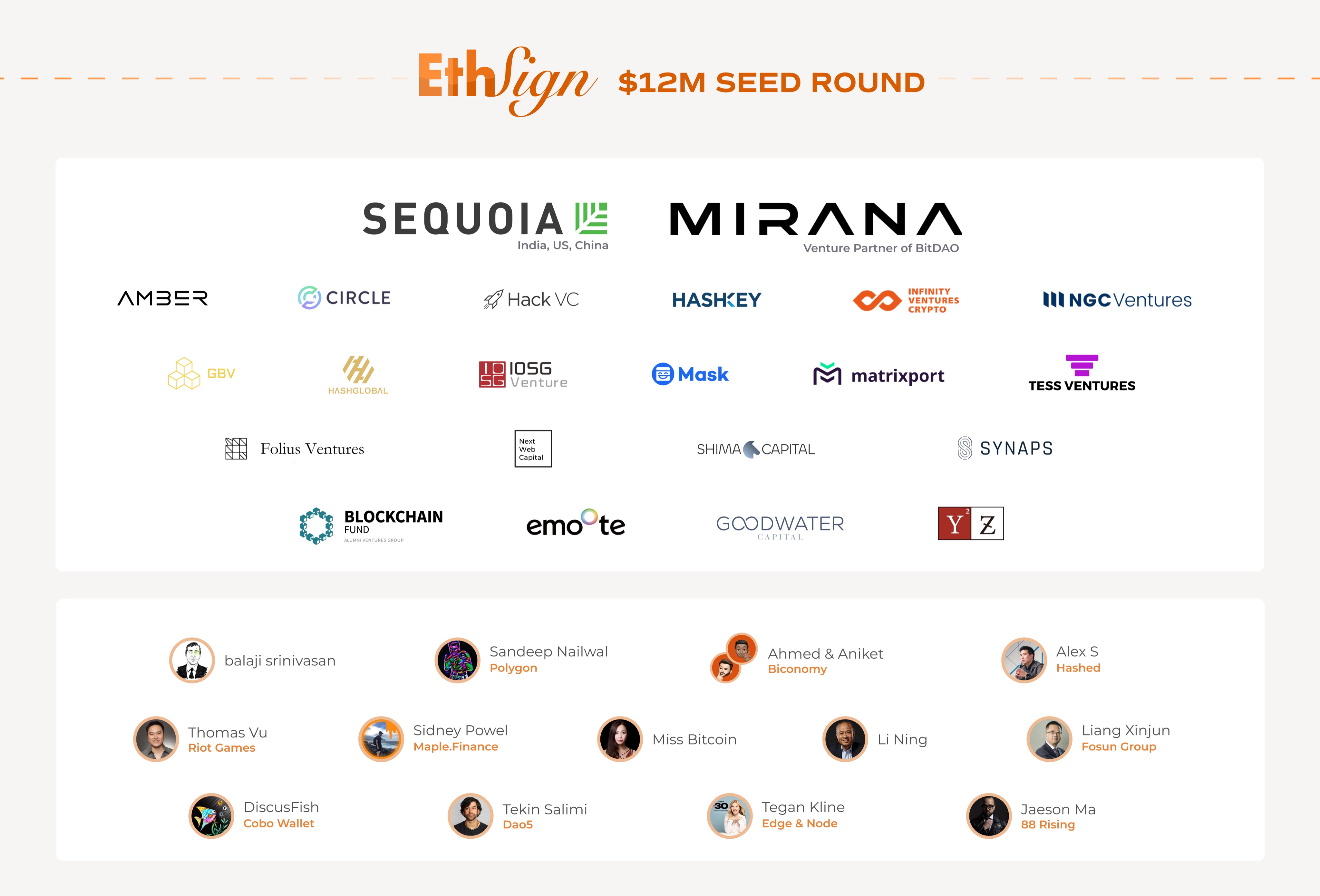
Subsequently, on March 9, EthSign completed a US$12 million seed round of financing, led by Sequoia Capital India (Sequoia Capital India) and Mirana Ventures, Amber Group, Circle Ventures, NGC Ventures, HashKey Group, IOSG Ventures, Mask Network, Matrixport, etc. Participate, this is alsoFor the first time, three of Sequoia's funds participated in an investment round together.
According to the officially disclosed project roadmap, EthSign has gradually clarified the layering of protocols and applications in the design. The front end of the project is an electronic protocol signature platform, but the smart contract can be abstracted into an interaction platform between identity and content, so further support can be provided in the future. Or expand a larger application space:
Credentials for off-chain assets on-chain
Endorsement or certification platform
Credit system construction of identity on the chain
Interface for DAO to interact with the off-chain world