






Understanding Rollup cost economics in one article: Why the more users, the cheaper the cost?


Original author:Alex Beckett
Original author:

"Original compilation: Evelyn|W3.hitchhiker"cost
cost
cost
Rollups commit batches of block groups to a single blockchain, our base layer. The cost of producing and submitting a batch of blocks to the base layer consists of six key variables.
Fixed cost: the cost of submitting a batch to the base layer with zero transaction activity on the rollup (state commitment, plus proof of validity for Zk-rollups).
Variable costs: Costs that vary with the level of transaction activity on the rollup (transaction data, plus signatures for optimism rollups).
Average Variable Cost: The variable cost of each additional rollup transaction.
Total Cost: The total cost of publishing the batch to the base layer.
Marginal Cost: The cost (fixed + variable) of each additional rollup transaction.
Average Cost: What an individual user pays."When the average cost decreases while the number of transactions per batch increases,"The more users, the cheaper the rollup
This sentence is correct.
Average cost = total cost / number of transactions per batch
This is because the marginal cost of submitting an additional transaction in the rollup batch is less than the average cost per transaction. Let's assume a rollup batch of 500 transactions with an average cost of $1 per transaction, bringing the total cost to $500. If the marginal cost of one additional transaction is $0.70, then the same batch of 501 transactions becomes $500.70. Therefore, the average cost is reduced to $0.9994. Note that marginal costs consist only of variable costs, mainly transaction data, since fixed costs are amortized across batches and are paid anyway.
The phenomenon of cheaper fees while increasing activity is in stark contrast to monolithic blockchains, which only have negative network effects - fees increase with each additional user. Rollups change this paradigm as they are the first blockchains that can have positive network effects in terms of transaction fees - the data availability layer that implements data availability sampling also falls into this type of scalability."However, this pattern breaks down once the marginal cost of including an additional transaction equals the average cost. Rollup's cost curve will roughly follow a standard short-run cost curve. Positive network effects occur at the front of the curve", that is, the marginal cost curve is lower than the average variable cost and average cost curves (labeled AVC and ATC, respectively).
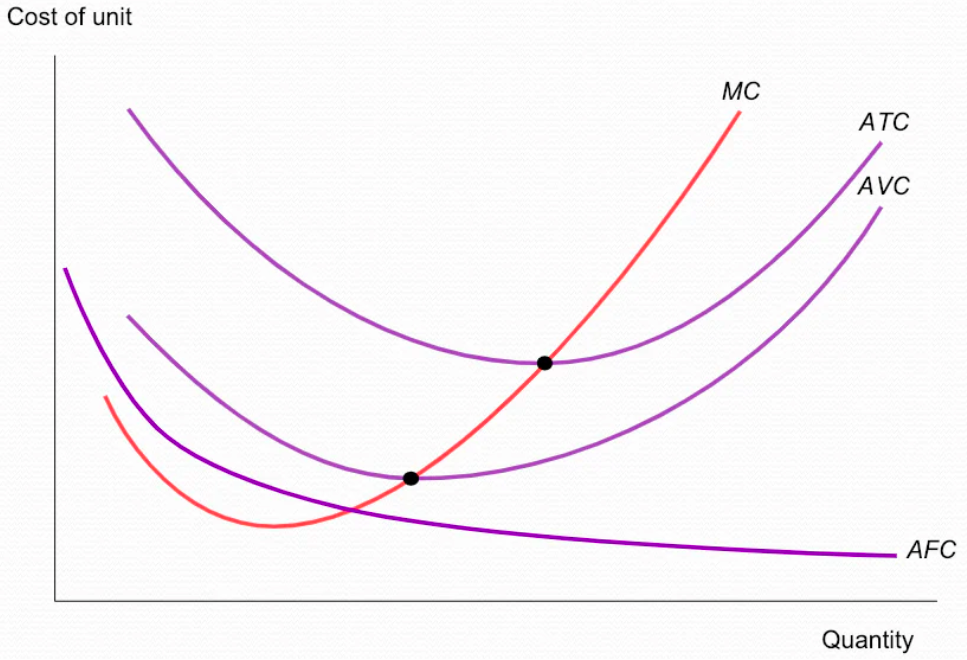
(Image by Amana Vallillee)
image description
Let's assume another rollup batch with the same initial variables, each with 500 transactions, an average cost of $1, and a total cost of $500. If the marginal cost of one additional transaction is $1.10, then the total cost of 501 transactions becomes $501.10. Therefore, the average cost increases to $1.002.
Once the marginal cost curve crosses the average variable cost (AVC) and average cost (ATC) curves, intersecting the minimum of each curve, Rollup enters into the same negative network effects as monolithic blockchains, where each additional Every transaction adds a fee. Since transaction data is the largest variable cost, the main factor leading to the increase in rollup cost is transaction data, which affects the emergence of hybrid rollups, such as validiums and volitions, seeking cheaper average costs by leveraging the availability of off-chain data.
To mitigate the frequency of cost spikes affecting rollups, the base layer needs to focus on increasing data throughput, since transaction data is the largest variable cost of rollups. Due to lower variable costs, increasing data throughput allows rollups to maintain positive network effects at larger capacities while still enjoying additional throughput gains. To achieve this, a scalable data availability layer will be the basis for making rollups cheaper for users without sacrificing security and decentralization.


