






Bankless: Talking about the business model of L2, how does the L2 platform implement the value accumulation strategy?


Original author:Ben Giove
Original source: Bankless
Compilation of the original text: The Way of DeFi
Original author:
Original source: Bankless
Compilation of the original text: The Way of DeFi
Investing is a forecasting exercise. Savvy investors don't make decisions based on the present, but on the future and the potential to create value over the long term.
One crypto space where traders are currently showing short-term thinking is the L2 token. This is a great opportunity for the prescient investor.
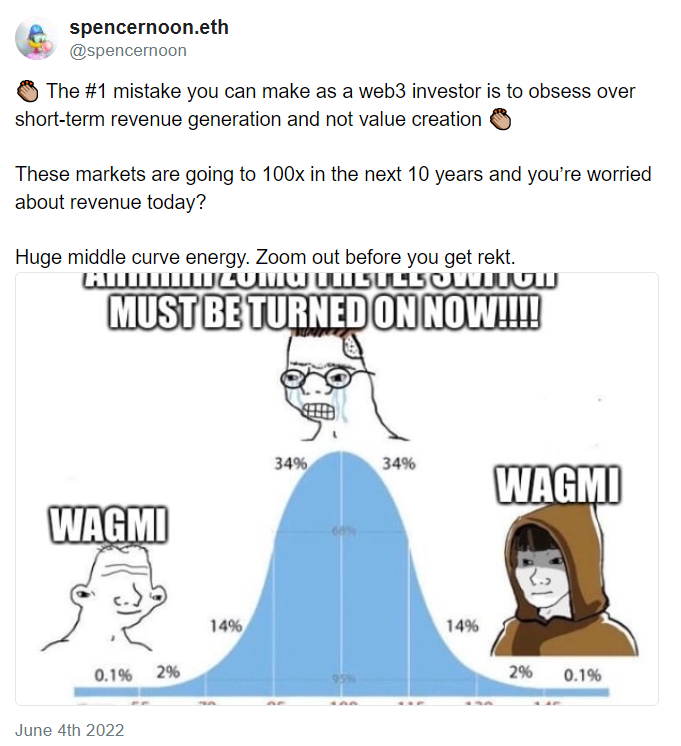
“The number one mistake you can make as an investor in web3 is to become obsessed with short-term revenue creation instead of value creation.
These markets will grow 100 times in the next 10 years, and you are worried about the revenue today?Great mid-curve energy. Zoom in before you get rekt. " - spencernoon.eth。
L2 Rollup technology on Ethereum continues to grow in user adoption, developer attention, and real-world utility. Lately, Layer 2 tokens -- specifically the valuation of L2 tokens -- came into the spotlight following the launch of Optimism's OP.
The OP was greeted by traders and investors across the crypto space
Suspect
Here are the three main skepticisms I see.
1. Has no effect
Currently, OP is only used for governance through Optimism's bicameral governance system. In this system, OP holders form the so-called "token house". Token Houses are able to vote on upgrades and distribute incentives to different projects within the rollup ecosystem.
2. Tokens do not generate any value
Network revenue -- the revenue generated from the rollup's sequencer (more on that later) -- is not given directly to token holders, but instead is used to retroactively fund public goods. The distribution of this value will be determined by a second branch of Optimism's governance - the "citizen's house", whose membership will be communicated via a non-transferable NFT.
3. Low circulating supply and excessive supply stock
OP currently has a market cap of $187.9 million and an FDV of $3.7 billion. This means that only 5% of the total OP supply is in circulation.
These criticisms are justified. But they are based on what the OP token is today -- not what it and the L2 token will be in the future.
This disconnect represents an opportunity. OP tokens, and similar L2 tokens, are on a path of greatly increasing utility and becoming highly accretive. This is because the design of the L2 token in the future will be completely different from the design of today.
L2 business model
income
You can think of rollup technology providers as resellers of block space: they buy block space on L1, use it more efficiently, and sell it at a premium to users via L2.article)。
incomeRollup's revenue comes from two sources: transaction fees and miners/Maximum Extractable Value (MEV). MEV is a rent-seeking form of value extraction that opportunistic block producers (miners in PoW, validators in PoS) can accomplish by specifically reordering transactions (see David'sJust like users pay gas to miners or validators on Ethereum, they must also pay gas fees to so-called sequencers on L2.
is the entity responsible for ordering, batching, and submitting transactions to L1. Since the sequencer fulfills its duty of determining the order of transactions, it can also earn revenue by extracting MEV.
cost
image description
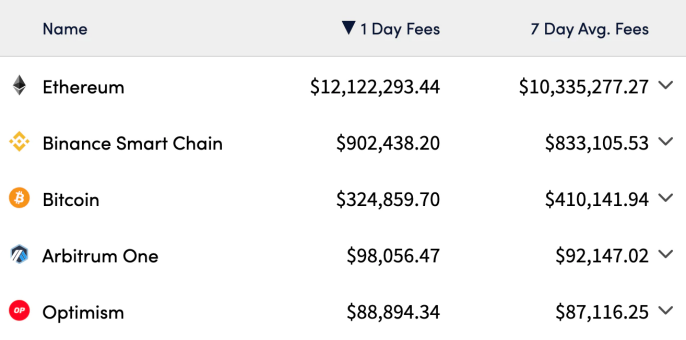
L1 and L2 ranked by fees, data from cryptofees.info
To function, rollups incur some costs that are passed on to users in the form of gas fees.Data Availability IssuesL2 also incurs the cost of publishing transaction data -- called calldata -- on L1. Calldata costs constitute the so-called "
Data Availability Issues
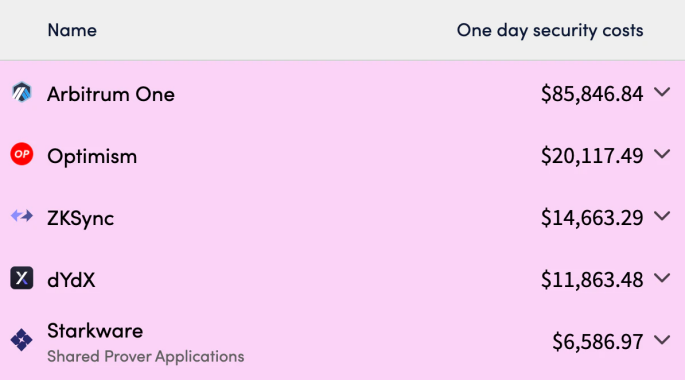
At its core, it refers to the cost of publishing and storing data on a network like Ethereum.
image descriptionL2 fee ranking, data from l2fees.infoThere are currently several solutions underway to address L2 costs.EIP-4488the first is
, which reduces the size of data posted by L2 to L1. While rollups can take advantage of their data compression techniques, an upcoming EIP proposed by Vitalik --dankshardingandproto-danksharding-- is also intended to help in this regard.Celestiaand
profit
, they increase the amount of data that can be stored on Ethereum, and like
Such a special purpose data availability layer.
MEV
profit
The way the Rollup platform "profits" through this model is to charge a "premium", that is, to pocket the difference between the transaction fee paid by the user and the cost of purchasing the L1 block space.
This is what Optimism has done by implementing what it calls a “fee scale,” a dynamic additional fee charged to users for each transaction. Optimism's goal is to provide a 10% profit to the sequencer. Such profits represent a potential source of value that can be spent directly on L2 tokens and their holders.Another source of revenue for the Rollup platform is MEV. As an increasingly important distinction between the various L2s, each rollup platform's MEV approach has a significant impact on the future value accumulation of its native token.To understand this better, let's explore the differences between Optimism and Arbitrum's approach to MEV.Optimism's approach to MEV is the so-called "" method. Optimism believes thatMEV Auction (MEVA)。
MEV is the foundation of the blockchain, trying to eliminate it is futile
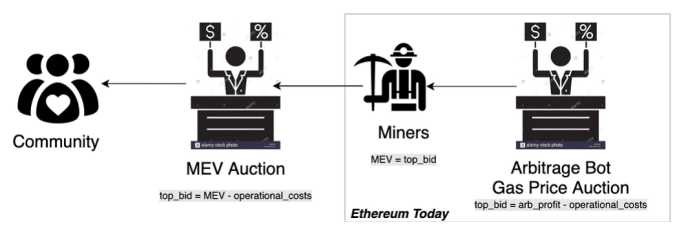
, which will eventually incorporate the so-calledOptimismMEV Auction (MEVA)
MEVA attempts to isolate and redirect the revenue generated by MEV by auctioning off the rights to extract MEV to the highest bidder.Optimism plans to use the revenue it earns through MEVA to fund public goods by retroactively funding public goods. By doing this,Arbitrum, on the other hand, takes a "taxDefensive
” method, which considers MEV as a kind oftax. Rather than seeking to capture and redistribute MEV, Arbitrum focused on minimizing MEV within its system.
In order to do this, the Arbitrum network will implement the so-called
Fair Ordering or Fair Sequencing
, where all transactions in a batch will be processed in the order they were received. By doing so, Arbitrum intends to reduce the number of MEVs extracted, making rollups less expensive and thus more attractive to users and builders.
The debate around how L2 should handle MEV is nuanced and complex, and well beyond the scope of this article. However, if we are talking about an investment strategy, then the accumulation of the value of the L2 token is worth interpreting.
What does MEV mean for L2 investment strategies?
Offensive MEV provides L2 with a revenue stream that can be used to directly accrue value for its native token. While Optimism's MEV revenue will initially be used entirely to fund public goods, some - or even all - could eventually be distributed to token holders through traditional one-sided staking pools, or through the decentralization of the sequencer ( will be introduced in detail later).
When used to fund public goods, MEV may help L2 tokens accrue more value indirectly by improving the overall health and long-term sustainability of their ecosystem.
While defensive MEV deprives rollups of a revenue stream that can be used to directly accumulate the value of its native token or strengthen its ecosystem, it may indirectly increase the value of the L2 token. Users may be more inclined to transact on a network where MEV is less rampant, supporting its adoption and network effects.While it remains to be seen which approach will lead to more long-term adoption, it is clear that MEV can be used to accrue value for L2 tokens. L2 platforms that embrace MEV will have an easier time accumulating value for their native assets than those that do not.Decentralized Sequencer
While L2 tokens can be used toDecentralize various protocol functions。
, but the most obvious way to do this is to decentralize the sequencer, by which transaction fees and the value of MEV can be captured, while also increasing utility.
Currently, the sequencers on many well-known rollups are centralized and operated by a single entity. For example: Offchain Labs and Optimism PBC are the sequencers of Arbitrum and Optimism respectively
sole operatorSince each platform is so nascent, these systems are treated as guardrails.。
In the future, it will be critical that these sequencers are eventually decentralized for maximum censorship resistance.L2 like Arbitrum and Optimism can be achieved by using native tokens. In addition, there are other decentralized sequencer designs. For example,Sequencers can be selected through a proof-of-stake (PoS) method
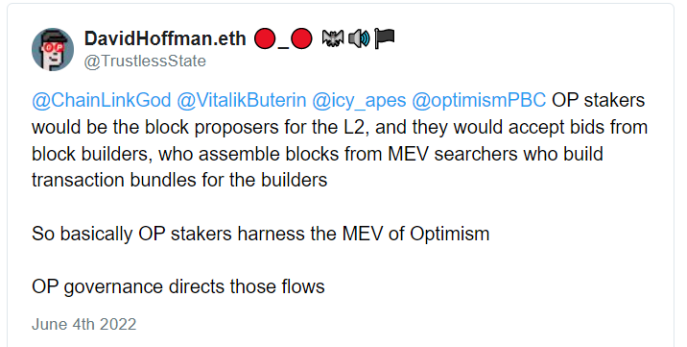
Here's how it works: Similar to PoS on L1, a potential sequencer will stake a rollup's native token for the right to assume the role. The probability of each sequencer being selected will be proportional to its pledge size, and the newly selected sequencer can earn transaction fees, MEV and
Potential Token Rewards
to get the value generated by rollup.zkSyncIn the case of rollups with aggressive MEV strategies like Optimism, this mechanism can be implemented with MEV auctions.
The staking mechanism will provide a source of utility - and therefore demand - for L2 tokens. In order to participate in the system and earn the aforementioned cash flow, future sequencers will be required to purchase tokens on the open market.
While details have yet to be confirmed, the
It has been confirmed that its token will be used for this purpose.
clear path
There is a clear path for L2 tokens to use and accumulate value. The profits generated by Rollup come from transaction fees and MEV, which can be used to directly accumulate the value of the native token, or indirectly through reinvestment in areas such as public goods.
L2 tokens can capture value by being used for decentralized sequencers or other protocol functions, such as through PoS systems. This creates further utility and demand for L2 tokens.
If these tokenomics look familiar, it's because they mirror what's happening with ETH itself.
While L2 tokens are unlikely to be net deflationary — or have the same currency premium as ETH — they could still trade at an “index premium” as they represent the broadest way to gain exposure to their respective ecosystems.


