






Detailed explanation of GameFi's best model Fantasy Westward Journey: How does the open economic model last for 20 years?


Original title: "A Gamefi product that goes through the cycle - Detailed explanation of Fantasy Westward Journey and enlightenment to Gameifi"
Original author: Cloud Nine Capital investor Frost (Twitter:@frost_lam)
The web3 games represented by Axie Infinity gained wide attention last year,A small team of fewer than 50 people makes $1.2 billion in annual revenue for a low-budget game.Since then, countless Axie imitation disks have been born, and Gamefi based on the AXS-SLP dual currency model has sprung up like mushrooms, but no one has reproduced the Axie myth, falling into the curse of 3 months of small collapse and 5 months of collapse. However, only a few projects care about the underlying logic and iterate on it, and most projects just chase superficial updates rather than innovation.
When dealing with project parties in the past, I kept talking about that Gamefi should carefully design the token economic model, and then explore the depth and breadth of the gameplay, otherwise it would be difficult to maintain the value of game assets and active players under the open economy gameplay Spend.
In terms of economic model design, Fantasy Westward Journey is the sky. The core of this game includes the PC version released in 2004, and the mobile game version released in 2013. It's been 18 years since its first release, but its IP still ranks among the top 10-15 worldwide in terms of total revenue to this day. Fantasy Westward Journey mobile game terminal has been online for nearly 10 years. From the data of SensorTower, we can see that the revenue of mobile game IOS terminal alone will reach 500 million US dollars in 2021.
The in-game economic transactions of Fantasy Westward Journey are completely free and open, which is essentially similar to Gamefi products with a single currency model. The economic model of mobile games is different from that of PC games, but it is largely based on the design of PC games.I highly recommend that all Gamefi teams take a hard look at this game, especially its PC version, an open economy classicUnfortunately, there are few articles discussing the economic model of Fantasy Westward Journey on the market.
The following is the table of contents of this article, and it is recommended to read it in combination with the main points.
The following is the table of contents of this article, and it is recommended to read it in combination with the main points.
01 The core gameplay of Fantasy Westward Journey
basic concept
trade
social contact
trade
02 Player value capture
Different ways of capturing value
Economic Design and Socialization
03 Inspiration for Gamefi
first level title
01.
secondary title
basic concept
Fantasy Westward Journey is an MMORPG game based on "Journey to the West". The game's main missions and NPC story backgrounds inherit the grand storyline of "Journey to the West". Players can experience the development of the plot in the first person in the game. The PC version was released in late 2003, and commercialization began in early 2004.
Players up to level 10 can experience the basic plot and gameplay on the initial map for free. After level 10, they need to recharge the point card, which is equivalent to RMB 0.6 per hour (initially 0.4 yuan per hour, and the price has been adjusted once). The point card serves as an anchor point for the economic system of Fantasy Westward Journey, and provides a pricing guarantee for the user's output per unit time. The game consists of several parts:
game character
The characters include three races: Human, Demon, and Immortal. Different races can choose different sects. There are 18 sects in the game, including 6 sects for humans, demons, and immortals. Each character can only join one of the sects by race, and some sects have gender requirements for apprentices. Schools are cyclical, and each school has a certain killing skill corresponding to another school. Different sects determine the tasks that the character is good at, attribute configuration, equipment/stunts, position in the team, etc. Efficient tasks often require the cooperation of multiple types of sects, physical output, legal system output, seals, and assistance each perform their duties. If you want to transfer to another school later, you need to pay a high fee.
Like most games, there will be schools with relative advantages in each version, and the game planner will target games/roles with relatively weak krypton gold levels or popularity, and carry out major iterations and enhancements on a regular basis.
Gamefi can learn from this planning method and values, and constantly balance and readjust the balance of game elements. ". Under Gamefi's fully open economy, the balance of the game directly affects the income of gold mining, and it must not be changed frequently or drastically, let alone infringe on the interests of old players.
Skyweaver does this very well. As a CAG game, it has been testing the balance of different heroes and cards for 4 years. The economical design is also very restrained. Currently, it only does skin design, which has no impact on gameplay. Even when Gamefi was hot last year, a token was not easily launched.
The initial level limit of the game is 145. After the expansion pack, the character can choose to ascend to increase the level limit to 155; But most players don't blindly pursue to reach the full level, but choose the card level.
The original reason is that the gameplay of the Hero Conference (Contest) divides players into groups according to their level. Levels 50-69 are the elite group, levels 70-89 are the brave group, levels 90-109 are the divine power group, and levels 110-129 are the Tianke group. Level 130-159 is the Apocalypse group, and level 160-175 is the Tianyuan group. So players tend to be at the highest level card levels in each group, that is 69, 89, 109, 129, 159, 175 levels. In the later period, as the threshold of competition became higher and higher, most players' card levels were just to maximize efficiency.
The design of this level cut is a must, and it is also of great reference significance for Gamefi. Its benefits include:
Equipment preservation.When players upgrade from one level to the next level, they can sell their equipment almost without loss, and some rare equipment will even appreciate in value, which increases the player's desire to krypton gold. After all, they can still sell it if they don't play.
Payability tiers.Generally speaking, the higher the level, the greater the investment required. Players can choose the appropriate level segment according to their payment ability, so that people with similar payment ability can roll with each other, rather than simply being crushed by big brothers. It can not only optimize the experience of ordinary players, but also encourage the big brothers to intertwine to the extreme.
Liver segmentation.Fantasy Westward Journey is actually a very lively game, but players do not have a very intuitive feeling for its "liver degree". One of the core reasons is that the vertical level division allows players to explore the horizontal content. And this has also led to some unconventional card levels, eg level 59, after the magic weapon legend expansion, characters above level 60 will open magic weapons, pet cultivation and other gameplay, players stopping at level 59 can reduce the complexity of the game and the degree of krypton gold.
A character has five attributes, including constitution, magic power, strength, endurance, and agility, corresponding to the character's blood, magic, hit, damage, defense, speed, spell damage, and spell defense. The initial values of character attributes are given by the system, and characters of different races have different initial attributes. Every time a character upgrades to a level, he gets 10 "potential" points, of which 5 points are evenly distributed to each attribute, and the remaining 5 points are freely distributed by the player. Different races have differences in the use of innate attributes and innately endowed points. A character can save multiple sets of attribute schemes, but each switch needs to pay a certain fee.
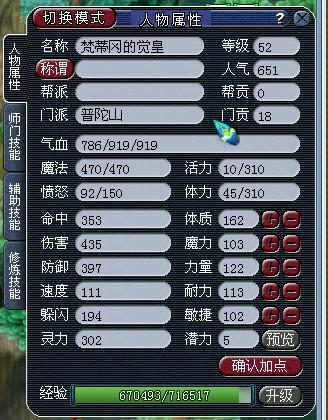
In addition to basic attributes, characters can also improve attribute effects through the cultivation system, and the cultivation level has an upper limit according to the character level. Cultivation needs to be studied in the gang, also called spot cultivation. According to the level of practice, there are gang contribution (also called tribute, gang task acquisition) threshold requirements, but it does not consume tribute, mainly money.
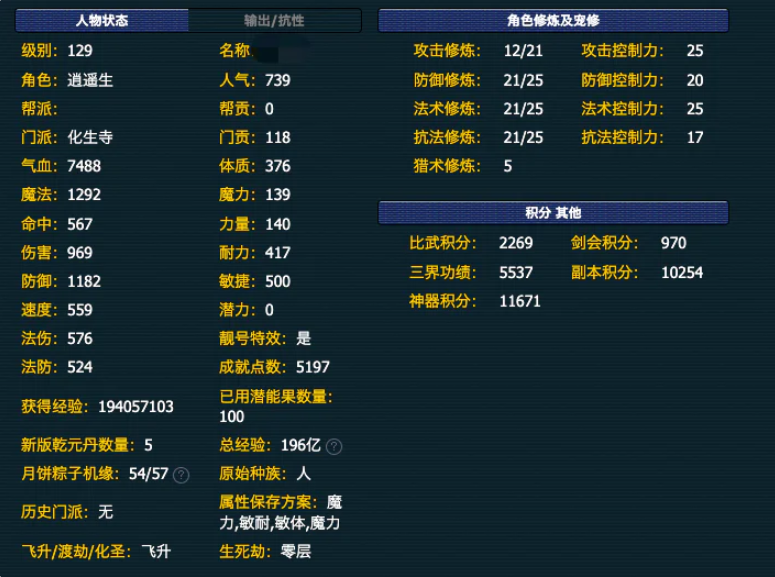
Skill
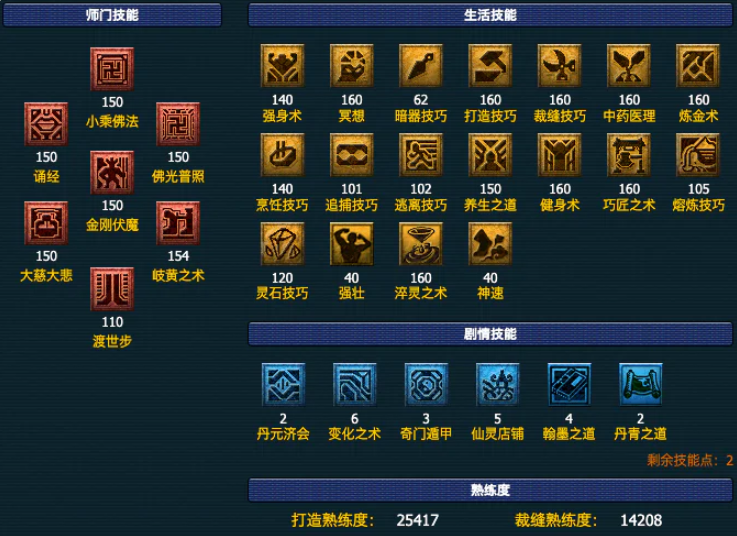
The skill system of Fantasy Westward Journey includes master skills, life skills and plot skills, which can consume a lot of experience, money and tribute:
Master skills are combat skills, and the upper limit of the skill level is the upper limit of the character level + level 10.
Life skills need to be learned in the gang, and learning consumes money, experience, and tribute. Life skills are mainly divided into three categories, 1. Skills that improve attributes, eg, strengthening the body to improve blood, meditation to improve magic, etc. 2. Auxiliary skills that play the role of social division of labor. Along with the choice of commercialization capabilities, eg manufacturing weapons requires corresponding levels of crafting skills and proficiency, and manufacturing third-level medicines that restore a large amount of blood requires traditional Chinese medicine medical skills. Auxiliary skills usually consume vitality or stamina. Vitality is obtained by completing routine tasks and online time, and stamina is obtained by online time, purchasing centennials, and seahorses (only one can be used per day).
Plot skills, players will get plot points after completing the main plot, and they can choose different skills according to their own needs. a) Tournament players usually choose to learn the art of transformation (you can use transformation cards and buffs) and Dan Yuan Jihui (enhance the recovery effect of medicines). b) Ordinary players or merchants may learn skills with commercialization capabilities, eg gem crafting can increase the success rate of synthetic gems (embedded on equipment to increase attributes), Qimen Dunjia can synthesize flying flags (transported to a certain place on the map) location, otherwise it takes time to walk there).
props and equipment
The character has 6 basic equipment slots, including weapons and armor. Players ≥ level 65 add 4 spiritual decoration slots. Basic equipment and spiritual decorations are essentially equipment systems, but the training system and consumption materials are different. The weapons that each character can use are different, and the helmets and armor that can be used by male and female characters are different. Equipment has basic attributes, additional attributes, stunts, special effects, gems, runestones, smelting effects, and set effects, and spirit ornaments have basic attributes, additional attributes, special effects, and set effects. Among them, the unlimited level of special effects (there is no character level limit when wearing it) and simplicity (the character level required to wear the equipment is reduced by 5 levels) are the most sought after.
image description
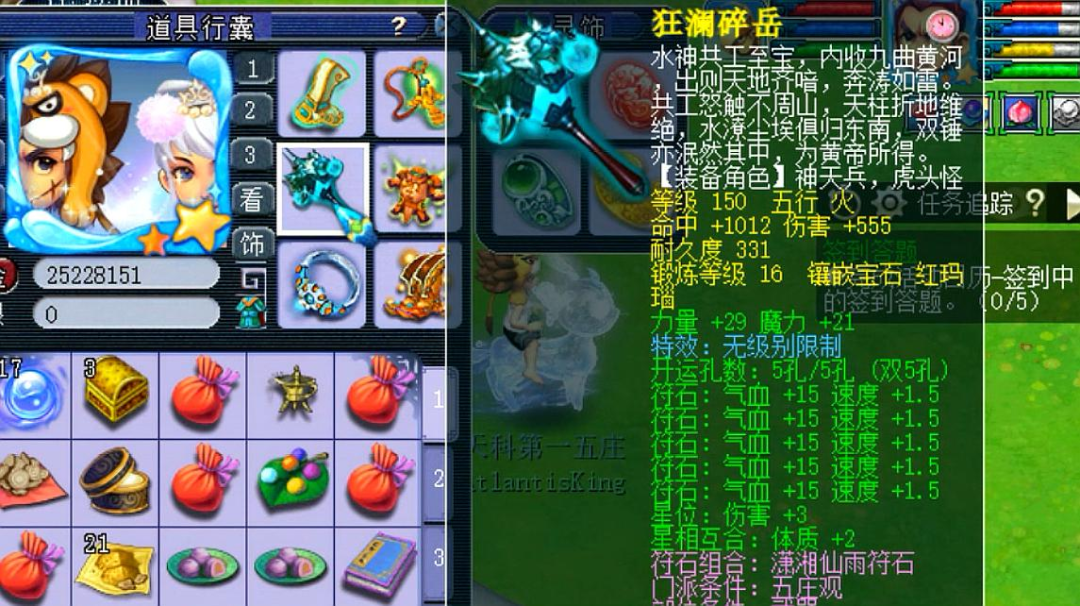
The price of such non-level weapons reaches millions of RMB
In addition, players ≥ level 65 can open the magic weapon system, ≥ level 109 can open the artifact system, and ≥ 129 can open the spirit treasure system. The three are essentially magic weapon systems, but the means of acquisition, training methods, consumption materials, and corresponding activities And points system is different. Most magic weapons are used for combat, essentially to increase attributes or skills, and a small number of magic weapons are used for life skills. Treasures are only tradable at level 1.
summon monster
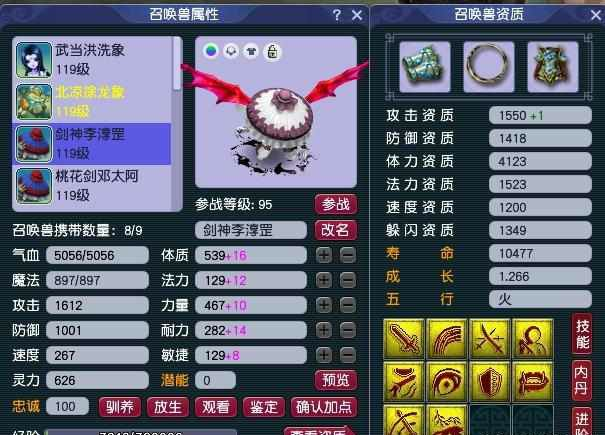
Players can bring summoned beasts or children to fight in battle. Both belong to the pet system in essence, but the training system is different and the materials consumed are different. Ordinary players basically only need pets for basic tasks, while martial arts players usually equip multiple summoned beasts and children to meet the needs of physical damage, magic damage, pace, and blood resistance. Pets have basic attributes, skills, qualifications, alchemy, characteristics, and have their own summoned animal equipment system. Among the pet skills, the low-level skills are blue, and the high-level skills are red, so the best pets are usually called all-red babies.
The pet system of Fantasy Westward Journey is another extremely exquisite design. The finished summoned beasts used by players are basically artificially synthesized. This process is also called beating babies, and it is one of the most important consumption systems in the game.image description
secondary title
task activity
There are various types of tasks and activities in Fantasy Westward Journey, and it is basically impossible for players to complete all tasks. Each task will produce different rewards, and tasks with rich rewards usually require teamwork.Teamwork tasks are also a good entry point for Gamefi to gradually add social elements. The tasks and activities of Fantasy Westward Journey include:
Main storyline: The main storyline missions based on "Journey to the West". Players can take on corresponding storyline missions as their level increases. There is a certain degree of difficulty, and the corresponding rewards are relatively rich.
Regular tasks: daily/weekly tasks, including division door, ghost hunting, treasure maps, task chains, artifact tasks, etc. Different tasks produce different materials. The output of materials is random, and can be sold directly through stalls, or put into production as production materials. In addition to materials, some tasks also produce points, which can be exchanged for advanced materials, titles, etc.
Dungeon mission: Different types of dungeons will be opened at different times, some dungeons will only get a lot of rewards for the first pass, and some dungeons will get similar rewards every week. The number of people required for different dungeons is also different. Players can search for the dungeon they want to participate in and apply to join in the dungeon center.
Gang missions: Players can receive gang missions after joining the gang, including Qinglong, Baihu, Suzaku, and Xuanwu four mission types. Different mission types consume different time and funds. You can get tribute, money, and experience rewards by completing gang tasks. The tribute is mainly used for the cultivation and life skills mentioned above. In addition, gangs also have regular events, including gang mazes, gang competitions, and more.
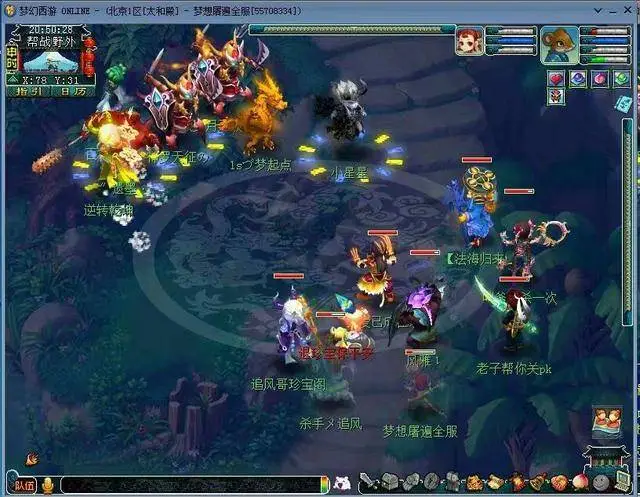
Regular activities: including daily gameplay and weekend gameplay, such as twenty-eight constellations, martial arts breakthroughs, imperial examination competitions, hero conferences, etc. Among them, the hero meeting (competition) is held on the afternoon of the fourth Sunday of each month.For players, whether to participate in the contest or not is almost two games. Ordinary players do not seek to be on the list of martial arts competitions, but focus on daily gameplay; while martial arts players pursue the ultimate equipment and baby configuration, and consume a large amount of consumables, eg medicines, transformation cards, etc. in each competition. Tournament players' demand for high configuration creates an economic consumption port for the entire game.
Limited activities: According to festivals, limited activities or emergencies are launched. After Fantasy Westward Journey enters the stage of gold mining, most players pay more attention to the income of the event. Usually, gold mining studios will share the comparison between the input and output of this event and regular tasks. .
image description
social contact
social contact
The social attributes of Fantasy Westward Journey are reflected in each gameplay, and players have a high degree of recognition of their social identities, for high-end gameplay, sociability even brings a certain discrimination chain.Players cannot see the attributes of other characters in the game, but they can see the appearance of weapons worn by the characters, mounts/auspicious signs and their various skins. Therefore, players usually "judge people by their appearance" and judge their krypton level by their appearance. If you hold a normal weapon without any skin effects, there is a high probability that you will not be able to form a team.
This design brought great positive feedback to sociability in the early stage, but in the middle and late stages, due to serious discrimination, high cost of late entrants, and high cost of team formation time, it brought many side effects, one of which is low-end players Enthusiasm has diminished, and stand-alone gameplay is rampant. Gamefi is not only faced with the admission problem caused by social discrimination, but also has a stronger mentality of playing gold. It should try to learn lessons from the case of Fantasy Westward Journey to prevent the premature differentiation between the gold playing party and the big players.
The social gameplay in the game includes:
Character relationship: The character relationship in the game corresponds to different systems, including the mentoring system, marriage system, sworn system, family system, etc. Among them, the marriage system leads to the heir system and the housing system, and the housing system includes Fengshui, gardens, ranches and other gameplays. The design of the character relationship has greatly promoted the player's desire to purchase social assets, and it is also a good promotion channel.
Gangs: Players must join gangs based on the needs of life skills and cultivation, and gangs are like communities and guilds, which have their own management methods. Gangs have guild leaders, deputy guild leaders, hall lords, elites, and members of the gang. Usually, the managers and guild leaders will set up a set of gang management objectives in order to maintain the vitality and funds of the gang. Unqualified members of the gang will be raised as gang members. The core purpose of the manager is to motivate the activity of gang members and increase the strength of the gang. The design of the gang system is equivalent to adding the SLG gameplay to the large system of Fantasy Westward Journey. At the same time, it can well stimulate the activity and retention of players through gang governance.
Mounts/Auspiciousness: Both mounts and auspiciousness belong to the mount system in essence. Players at level ≥65 can live race mounts by completing the mount race plot. Mounts can add certain attributes to the character. Players at level ≥30 can buy auspicious signs, most of which are mainly for appearance value, a few auspicious signs have life skills, eg flying skills can ignore ground obstacles and cross the map.
Skins: There are a large number of skin designs in the game. From the early days of coloring the characters, a variety of consumption points have been added. The dyeing point alone has increased the dyeing effects of summoned beasts, weapons, and mounts. In addition, there are special effects, avatar frames, dialog boxes, team logos, brocade clothes and other designs. Some limited-edition brocade clothes are even priced as high as 20,000 to 30,000 yuan. A businessman once monopolized a brocade jacket and bought it at a price of 200 per piece, making a profit of millions.
Achievements: The achievement system mainly encourages players to explore various gameplays, and there are corresponding leaderboards.
trade
trade
The economic transactions of Fantasy Westward Journey are completely free and open, and players can use Fantasy Coins to trade in-game assets.Players at level ≥30 can set up stalls in several fixed areas through the stall system. Materials, summoned beasts and life skills can be placed on the stalls, and a certain handling fee will be charged for some commodities.
Players need various materials in daily tasks, and a large amount of content requires a certain level of life skills, such as building equipment, synthesizing gems, etc. Players alone cannot obtain all the required materials, which means that trading is necessary. Groups also emerged. Gamefi should avoid excessive official occupation of this ecological niche, and better guide the gold mining party in its own ecology to become a healthy group of merchants.
As shown in the figure below, the stalls in the game are not an aggregated market, but are displayed based on geographic location. The distribution of the stalls is just like the grocery market in real life. Each area gathers the same type of stalls. The prices of the same items are often different between different stalls, and there are merchants buying and selling them. Benefits are:
To increase the fun of the game, many players like to go to the stalls to pan for gold in their spare time.
Increase the friction of trading behavior, players need to pay time costs to sell items, and increase player consumption.
Introduce commodity economy. Commodity economy is the sum of the production, exchange and sale of commodities, and it is a social and economic model. Compared with the self-sufficient natural economy, the commodity economy is characterized by a clear social division of labor, high frequency of commodity exchange, and high efficiency. It will be described later, here we only need to understandimage description
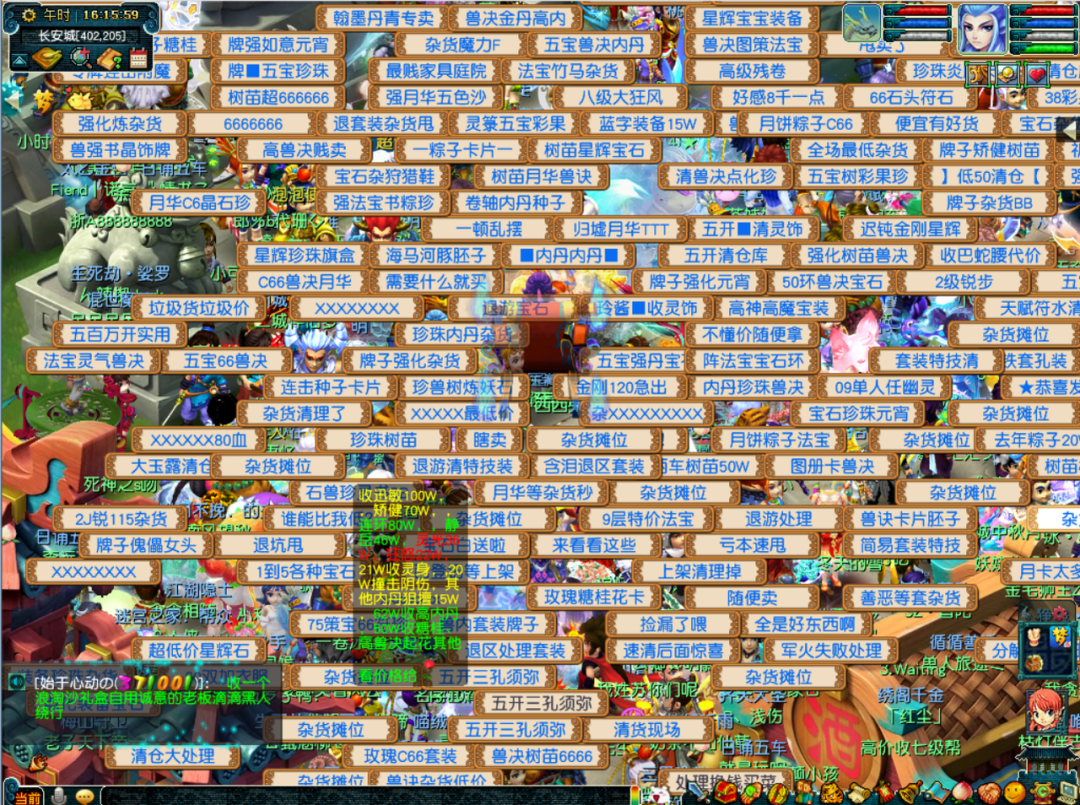
An example of a stall, this area is in front of the "hotel" on the game "Chang'an City" map, usually selling various groceries
In addition to setting up stalls, players can also open stores in the game and sell various assets. After successfully opening a store, players can invest and withdraw funds through daily management. During the opening of the store, daily maintenance fees and operating expenses need to be paid. The fees are determined according to the commercial index of the sales content. Compared with the stall system, the Chamber of Commerce charges higher handling fees and store opening costs. The chamber of commerce system aims to provide players with a more professional and vertical trading place. For some assets with high demand and high frequency of use, an aggregated trading market is provided through the chamber of commerce system.
As mentioned above, there is a lot of friction in the stall system, which cannot meet the needs of some players to buy a large amount of the same type of items in a short period of time. It can be seen from this that the products sold in the stores of the chamber of commerce are usually very expensive and relatively subdivided categories, such as various types of summoned beasts, beast skills, medicines, etc.
The trading scenes of the stall and the chamber of commerce system are all in-game, using fantasy coins for transactions; while Zangbaoge is an officially recognized asset trading platform outside the game, using legal currency (RMB) for transactions.Players can directly use RMB to buy in-game assets through Zangbaoge, or sell in-game assets in exchange for RMB. The official will charge a 3-5% handling fee, with a daily limit of 9,999 yuan.
The design of Zangbao Pavilion increases the security and captures the value of game asset intermediary platforms like 5173. Secondly, it gives the game assets RMB value, which further ensures the preservation of assets.
The design of the entire trading system has contributed to the stability of the exchange rate between the game currency and the legal currency.Relying on the free circulation of the in-game economic system, the value of fantasy game currency remains relatively stable, RMB 100 was exchanged for about 6 million fantasy coins at the beginning of the game, and now it can be exchanged for 12 million fantasy coins, which means:
In the past 20 years, the currency has only depreciated by half, and the annual inflation rate is only about 3.9%, which is even more stable than many legal currencies
first level title
02.
secondary title
Different ways of capturing value
After years of precipitation, the gameplay in Fantasy Westward Journey has a good depth and breadth, which makes a very good division of its liver.
As mentioned above, the vertical level division allows players to explore the horizontal content, and in the process, they can get a variety of ways to play and bring different positive feedback. Players continue to produce in positive feedback. And these outputs can also be consumed in different dimensions: the experience gained today is used to point master skills, tomorrow is to save money and go to the stall to buy a cost-effective summoned beast, and the day after tomorrow can be used to upgrade the gem of the weapon by a level .
The consumption of these dimensions is essentially to improve the overall combat power of the character, but because of the different consumption methods and materials, it is not a meager combat power improvement for the player, but I have become stronger in all aspects.
Under this division of liver, players will not feel that they are doing repetitive unnecessary labor, but gain the pleasure of cultivation, which greatly motivates the activity of players and prolongs the retention of players.
For different players, the value capture method of the game is also different:
Big R: Basically every surviving server in Fantasy Westward Journey has a few servers who bring hope to the whole village.The big R boss only accounts for 10-20% of the total players, but it supports the consumption of the entire server.For big R, full skills, training, magic weapons, artifacts, all-red babies, simple/super easy/no levels are all basic operations, daily is to collect the rarest equipment across servers, pursue the most extreme attributes, and collect the best Baby, buy the rarest brocade clothes/special effects, it can be called a roll in the roll. Fantasy Westward Journey also gives the greatest respect for Big R's ultimate pursuit and krypton gold ability. High-level artifacts, spirit treasures, ascension, crossing robbery, and listening to the truth, the official continues to launch more complex systems, prompting Big R to pursue a Another marginal benefit.
Medium R: Fantasy Westward Journey contest and non-competition are completely two ways to play, the difference between medium R and small R is defined here as whether or not a contestant player. Although the middle Rs are not as powerful as the big Rs, who can spend tens of thousands of dollars, they are full-fledged per capita and all-red babies. The middle R is the mainstay of the game, and the interplay between the middle Rs deepens the player's sense of social identity.
Little R: Under the rich gameplay, many casual players have been born. Little Rs don’t pursue being famous in the competition list, but get output from regular activities and basic transactions, and then invest in the characters again, and gradually gain A sense of accomplishment from increasing character strength. But after all, Fantasy Westward Journey is a game that was born nearly 20 years ago. The depth of the game has accumulated over time. In order to cater to the big players, the official has launched more difficult gameplay, and the task threshold is getting higher and higher. The small R who was imprisoned needed to rely on strong cooperation and established routines to complete the task. It was difficult to form a team under the culture of "judging people by their appearance", and they were forced to pursue efficiency at all costs.
Merchant: The merchant here refers to a pure merchant who is purely for play to earn. In the game, whether it is a small R, a medium R, or a big R, they must be more or less exposed to trading methods. From this point of view, everyone is a businessman. But pure businessmen don't pay attention to gameplay, and all production is for profit. In the process of profiting from the exchange of commodities, businessmen often continue to expand production in order to maximize efficiency, and ultimately promote the increase in the total value of social production. For small R, it provides better liquidity, for medium R and large R, it increases efficiency, and the government can get more taxes in it.Merchants and the commodity economy are in a symbiotic relationship. The existence of Fantasy Westward Journey’s commodity economy has promoted the birth of merchant groups, and the existence of merchant groups has promoted the prosperity of the in-game economy.
secondary title
Economic Design and Socialized Division of Labor
output
The output refers to the assets released in the game, mainly the materials, money, experience, etc. that the player will get from the system when performing missions and activities in the game. It should be noted that different task activities (that is, output paths) will get different asset classes. Usually these outputs are semi-finished products that can be processed or re-input into finished products, which have a higher value. When players decide to process the output or sell it to players with processing needs, these materials are endowed with production value and become means of production.
Some people may ask, under the design of Fantasy Westward Journey's open economy, the price is automatically adjusted according to supply and demand. Will the means of production not overflow as time goes by?But in fact, Fantasia’s asset preservation is very good. The core reasons are as follows:
Players' time and capital investment costs are limited, while the output content of the game is diversified. With the inflation of player attribute values, the official will continue to add new systems.For example, the Famous Three Realms expansion pack Dream adds a spirit decoration system, and spirit decorations and existing equipment are actually equipment systems in essence, but the output methods, consumption materials, and supporting assets are completely different. The newly added spirit decoration system equals 4 more equipment grids, and the short-term demand will surge. Under the premise that the total amount of investment is limited, as shown in the figure below, based on the production possibility curve (PPF) of both spiritual ornaments and equipment, we can see that when there is only Product1 basic equipment in the market, the total output is at point A; and when Product2 is launched At the time of spiritual ornament, the increase of Product2's output will cause the decrease of Product1's output, and gradually migrate to point B, point C, and even point D. However, because the marginal benefit of increasing the output of a single product is diminishing, the total output will tend to return to around point C, maintaining the balance of supply and demand between the two.
Finished products are non-homogeneous assets, and good finished products are scarce.Fantasy Westward Journey's character, school, card level and other designs add a lot of restrictions to a suitable finished product. For example, suppose a 129-level big R wants to buy a top-quality 140 non-level weapon, the character is Xiaoyaosheng, and the school is Datang Guanfu (physical attack school), then the finished product must meet a) 140 level, b) must It is a sword or fan that Xiaoyaosheng can wear, c) the basic attribute is no worse than a simple weapon of level 120 or 130, d) has a special effect "no level limit". Each of the above limiting conditions has a probability, and the probability of meeting all the conditions at the same time is extremely low. Even if you search in the Treasure Pavilion now, there are only 4 weapons that meet the requirements for sale.
Bad finished products have a steady consumption outlet.image description
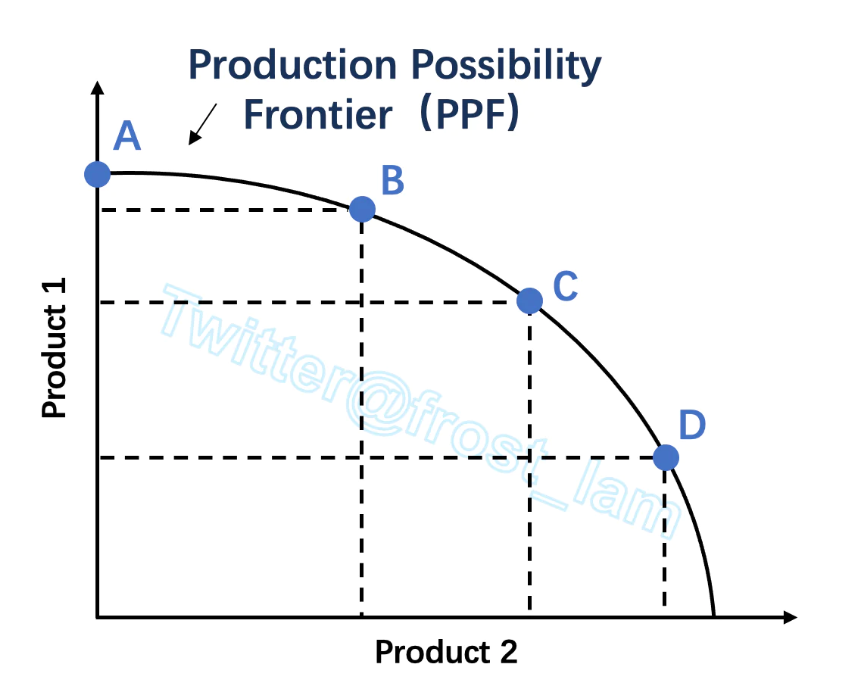
production possibility curve
The existence of merchant groups gives players the external pressure of market competition, stimulates producers to increase labor productivity, and creates social division of labor. The social division of labor in the game is extremely fragmented, and some social divisions of labor even go beyond the game itself.As mentioned above, the gameplay of Fantasy Westward Journey is very deep, and players may not have time to complete daily tasks due to busy work and other reasons. Therefore, many players will let other players manage daily character maintenance on their behalf out of trust.Participatory roles at the core of the social division of labor include three categories:
Boss: Mainly big R and medium R, which consume the top of the pyramid. For some league teams, there are usually captains (commanders) who perform daily role maintenance, game consumables management, and attribute debugging on their behalf. Players will pay small daily expenses according to the captain's requirements, including a certain command fee. The higher the ranking The former team commander's income will be higher.
Merchants: Receive/sell goods to earn the difference. Some top-level merchants receive the customized needs of the boss, and collect the commodities of corresponding vertical merchants for consumption according to the needs.
Producers: All players are producers, producing means of production through various channels, for their own use or for sale to merchants.
The core logic of this social division of labor is that the entire game design achieves a balance through multi-terminal output and consumption.
consume
Consumption refers to the behavior of using "output" assets in the game, such as using gold coins to upgrade characters, making materials into equipment, etc.
The consumption content of Fantasy Westward Journey is very diverse and fragmented. In addition to the most basic point card - time payment, there are also experience, items, money (immortal jade, money, silver coins), energy, skill points (men tribute, tribute, various class points), etc. Items in the game are roughly divided into three categories:
Consumables include food, medicine, crafting raw materials, synthetic raw materials, hidden weapons, Sheyao incense, flying charms, pet rations, etc.;
Equipment items include equipment and spirit ornaments;
Mission items include plot props, gang goods, etc., and cannot be traded.
Different systems need to consume different content:
Attributes: Consume money, experience, skill points, including basic attributes and additional attributes. Some life skills such as physical strength, fitness, strength, depth, meditation, etc. can also increase certain attributes.
Training: Consumes money, experience, and skill points, including character training, summoning beast training, and eight meridians.
Skills: Consume money, experience, skill points, including master skills, auxiliary skills, etc.
Props and equipment: Consume money, including equipment, spirit ornaments (≥level 65), magic weapons (≥level 65), artifacts (≥level 109), spirit treasures (≥level 129), etc.
Summoned beasts: Consume money, including different types of task pets, contest pets, children, etc.
Mount/Auspicious: Consume money.
Skin category: Consumes money, including brocade clothes, special effects, avatar frames, dialog boxes, team logos, etc.
Other: housing, leisure, trading, etc.
Among the above consumption systems, the two most important consumption paths are character equipment (including basic equipment and spirit decorations) and summoned beasts.Each finished product is a collection of several means of production, and the higher the value of the finished product, the higher the complexity of the means of production required.
Character equipment
Taking the basic equipment of characters as an example, Figure 1 shows the process of a piece of finished equipment from the accumulation of initial production materials to the completion of equipment processing, in which each production link involves the social division of labor of different stakeholders. Players play different interests, and the corresponding driving force and positive feedback obtained are different.
image description
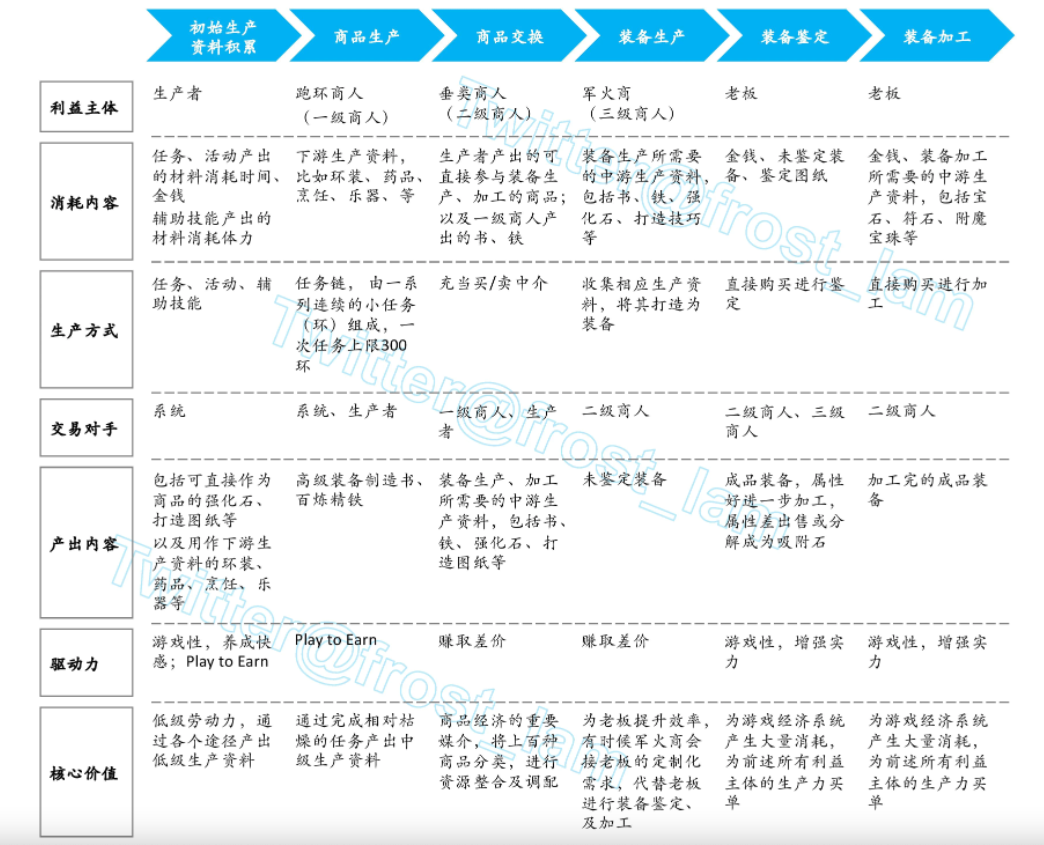
image description
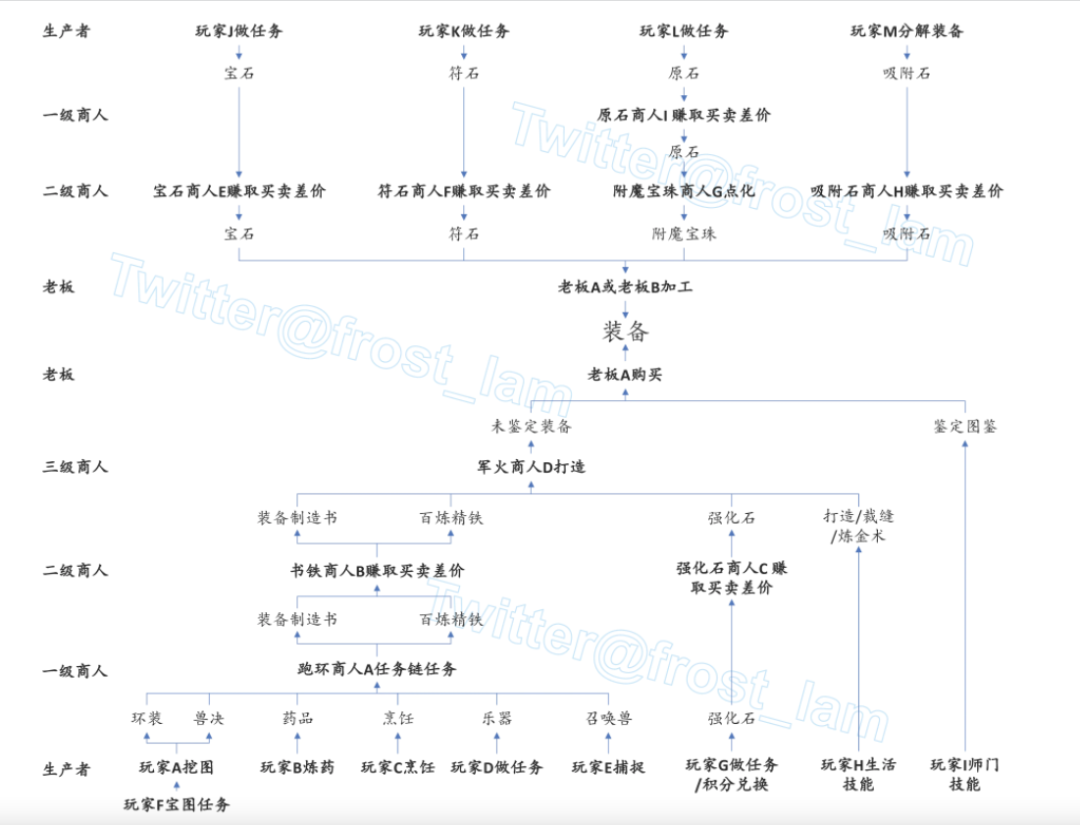
Figure 2. Social division of labor among stakeholders
It should be noted that the above-mentioned production process only represents the basic equipment of characters at level 150 and below. If you want to produce the equipment of the spiritual decoration system, you need almost completely different production materials. For example, the Equipment Manufacturing Book and Hundred Refined Iron have become the Spiritual Ornament Guide Book and Yuanling spar. The core output methods of these two production materials have become the Linglong Treasure Map that can only be obtained by consuming dungeon points, and the treasure map that can only be obtained through artifact tasks. Artifact points. Gems have become astral stones, and the required life skills have changed from crafting/tailoring/alchemy to spirit quenching.
If you want to produce level 160 equipment, you need another set of production materials such as Meteorite, Primordial Body, and Battle Soul.This shows its fragmented social division of labor and its high production complexity.
summon monster
In the same way, the creation of a finished summoned beast (beating a baby) is also a collection of multiple production materials, which also involves multiple stakeholders. The entire mechanism design of its liquidity and inflation control is very important for Gamefi's high-value game assets. reference. Before understanding the consumption link of hitting the baby, let's first understand how the summoning system works:
First of all, the summoned beasts with training qualifications are usually monster babies. Players may encounter babies in emergencies or hidden mine games and can capture them. Secondly, the baby has natural aptitude, number of skills and skills, but the number of innate skills that the system can capture is generally only 1-2.
Therefore, to get a finished summoned beast, the following 3 steps need to be taken:
By capturing or consuming refining materials, producers have a certain probability of obtaining babies with innate aptitude and satisfactory skills.
Synthesize 2 babies into a new baby through demon refining. The qualifications and abilities of the summoned beasts after synthesis are obtained according to the qualifications and abilities of the summoned beasts before synthesis. There is a certain probability to get a baby embryo with more skills.
Consume the secrets of Warcraft and let the baby learn the target skills. This process is also called hitting the book.
Each of these steps is full of randomness, and what needs to be specially mentioned are:
Step 2 produced a lot of baby consumption,Created a deflationary mechanism for the baby.
Magical Beast Tips can give a summoned beast a certain skill, but each time it is used, it will overwrite an original skill of the summoned beast. Although the number of summoned beasts with skills ≤ 2 has a certain chance that the original skills will not be eliminated, but usually the embryos with multiple skills are used to beat babies, so it will inevitably produce coverage. Warcraft tips include most baby skills, divided into low-level Warcraft tips and advanced Warcraft tips. Low-level tricks are generally obtained by digging ordinary treasure maps, while high-level tricks are obtained by collecting all 5 treasures and digging high-level treasure maps. In addition, there are also rewards to be decided in some plot tasks and activities.
Because playing the book will cover the existing skills, step 3 will consume a lot of beast skills. Especially the top-grade all-red baby will consume a lot of high-level beast skills. After all, every time you hit a book, it may overwrite the skills you just hit.Therefore, the fluidity of the beast art is guaranteed.
Summoned beasts have their own equipment system, alchemy system, characteristics, etc.Related consumption also has its own independent social division of labor.first level title
03.
Inspiration for Gamefi
Before talking about the token economic model, we must first understand what are the current income means of Gamefi? Taking Axie as an example, the income of the project party includes:
Axies NFT assets, Land NFT asset sales income, that is, the official income from direct sales of game assets to players
The fee income collected by Axies breeding is essentially the income from the sale of game assets
Market transaction fee income, 4.5% fee for each transaction, similar to tax
According to Nansen's data, the total revenue of the game since its launch is US$1.35 billion, of which 87% is from breeding costs, which is the income from selling game assets.
In this model, the income of the project party comes from the initial asset purchase of new players, the purchase of game assets by old players, and the taxes generated by asset exchange. However, since the gameplay of the game does not require players to exchange goods, most of the time players consume and produce assets to meet their own needs, not for capital accumulation and expansion of reproduction. Only in the case of excess assets will they release assets exchange in the market.
Therefore, the player's commodity exchange is relatively low frequency, which can also be seen from the income distribution of Axie. In fact, Axie's economic system is similar to the traditional natural economic form, that is, self-sufficiency, not production for exchange. The disadvantage of the natural economy is that the productivity of individual stakeholders is low, and the difference between the rich and the poor is large according to the initial capital accumulation, and only a few people benefit.
The counterpart of the natural economy is the commodity economy, which is also the economic system used by Fantasy Westward Journey.Let’s look at the income means of Fantasy Westward Journey, which include:
Point card income, the official does not sell game assets to players, but pays for production materials to players through time payment, which is essentially a tax
Market transaction fee income is essentially a tax
Social Property Sales Revenue
In order to expand the scale of income, the goal of the project party is to promote the exchange of goods, expand the overall production value, and then increase taxation; increase the player's sense of identity with their social identity, and then increase the player's sunk cost. Fantasy Westward Journey has achieved the above goals well through the design of its commodity economic system. Its revelation to Gamefi specifically includes the following points:
"The food and drink we need every day do not come from the benevolence of the butcher, the brewer or the baker, but from their self-interested considerations", although everyone in the market does not consider the public interest when making decisions, but in an objective In fact, each of them seems to be "guided by an invisible hand, to try to achieve an end which he did not intend to achieve. His pursuit of his own interest often makes him better circumstances to promote the interests of society more effectively”.
-- "Wealth of Nations"
Gamefi must have merchants whose sole purpose is to make gold. Merchants and Gamefi are symbiotic. This pursuit of self-interest allows the market to operate effectively.In an open economy, players and project parties are a community of interests. In the process of pursuing interests, businessmen are also trying to produce and sell what others need.
Merchants themselves do not harm the economic system, but it should be noted that not all players are merchants.Civilian players (producers), merchants, and bosses should all exist in the system and have a reasonable and healthy ratio. Second, let businessmen create value for the system instead of simply extracting value from the system. Fantasy Westward Journey has increased the friction of commodity exchange through the design of the stall system. The existence of merchants can greatly improve the efficiency of the boss and provide better liquidity for the producer. Finally, merchants cannot obtain benefits at zero cost. Fantasy Westward Journey solves this problem by point card system time payment. Gamefi should do a good job in anti-crowding. One is to increase the cost of scrambling wool, the other is to set the upper limit of scrambling wool, and the third is to make the behavior of scrambling wool work for the society as much as possible.
Social division of labor is the prerequisite for the existence of commodity economy.In Fantasy Westward Journey, the social division of labor is extremely fragmented. Producers, businessmen, and bosses embody their value in different production links. Every consumption of the boss is the consumption of various means of production. Gamefi should disassemble the production process of game assets as much as possible, and cannot use a single "combat force" to determine the production method, so that stakeholders with different consumption levels have ways to produce production materials. In addition, the output method of production materials should be sufficiently random, so that players with low consumption levels can also have the opportunity to produce high-value production materials.
The gameplay of Fantasy Westward Journey has a good depth and breadth, and the means of production are highly complex. The means of production and commodities belong to different stakeholders.The production materials produced by players through tasks and activities will definitely overflow, and there will definitely be gaps. They cannot be self-sufficient, and there will inevitably be a demand for commodity exchange. Gamefi should enrich the output path and production method of its production materials, so as to encourage players to actively participate in commodity exchange.
A commodity economy is characterized by expanded reproduction.In order to obtain more value, commodity producers tend to increase input and shape competitive advantages, thereby expanding the scale of production. In order to pursue the ultimate production efficiency in the competition, the merchant group of Fantasy Westward Journey has continuously subdivided into a multi-level merchant system, and finally shifted the overall production input upwards. Gamefi should encourage the competition of merchant groups. Under the specialization of labor, an economy can create more means of production with the same resources and expand the overall production possibility frontier.
The fundamental reason why the entire economic system of Fantasy Westward Journey can continue to operate is that some players pay for gameplay and social features.This part of consumption is not for more output, but "effective consumption". Gamefi should try to cultivate players' sense of identification with their social identities and attract players to invest more in such sunk assets.
In the later period, Fantasy Westward Journey gradually lost its sociality, end game users and income gradually lost, and the retention level of mobile games was average. The core reason was that too many krypton gold systems were launched in a short period of time, and the threshold for civilians was getting higher and higher. The gameplay is similar or even identical to the existing system.write at the end
04.
write at the end
Fantasy Westward Journey is undoubtedly a masterpiece of in-game economic design. NetEase not only created a game, but also created a sustainable ecology.
Although under the pressure of commercialization in the later stage, many game designs began to deform, and some newly launched systems were rushed, using similar routines to ruthlessly harvest the investment of bosses. The sociality is lost, and the gameplay is gradually stand-alone. But it does not prevent it from becoming the ceiling in my mind. When I was in junior high school, in order to complete the "Imperial Examination Competition" faster, I memorized a lot of Chinese test points, and I lamented that the game changed education.
The emergence of Web3 has brought natural tools to the opening of the game economic system, accelerated user growth, magnified the potential of game innovation, and rationalized the contribution of contributors (producers) and service providers (project parties) and speculators (businessmen). )Relationship. Although current applications are more or less flawed, we have already seen the potential of Gamefi.
I look forward to seeing a truly everlasting Gamefi one day, and even go further. Regardless of Web2 or Web3, players may not only pursue gameplay and economics when playing games, but have educational and social significance.
If you are interested in Web3, I recommend reading the white papers of Bitcoin and Ethereum.
Original link


