






Cryptocurrencies: A Natural Medium for Charity


Original source: The SeeDAO
Author: Takens Theorem
Original source: The SeeDAO
Author: Takens Theorem
Original translation: zik
Through the analysis of 20 Ethereum charity/donation addresses and their approximately 100,000 transaction records, this paper explores the current state of charity/donation based on the blockchain network. And summed up four models of charitable collaboration on the chain: viral, incentive-based, automatic and spontaneous. With this article, you can glimpse the power, efficiency and speed of cryptocurrencies in charity (donation/fundraising).
A record of 100,000 transactions on the Ethereum mainnet reveals how charitable donations work collaboratively on the blockchain.
Cryptocurrencies raise a curious paradox. The first is the sovereign individual, which some see as a core concept. But there is also a seemingly opposing force, the process of collaboration and consensus. This paradox is puzzling: in this technology, there can be no sovereign individual without trust-minimized collaboration. These are two sides of the same coin. At the same time, while things like self-service banking and self-custody are often at the center of the conversation, so too are the rich forms of collaboration that the cryptocurrency world brings.
Because charities sometimes have public addresses, their collaboration patterns can be mined on the blockchain. I collected a modest dataset consisting of 100,000 transaction records from about 20 public addresses on the Ethereum mainnet (see the appendix for the complete list and important caveats). This is only a subset of overall cryptocurrency donations and focuses on data samples using the Etherscan API. While this record of on-chain donations is incomplete, it reveals the power, speed, and efficiency of collaboration, and the different forms it takes.
While studying these data samples, I observed four distinct patterns of collaboration, summarized in the conclusion: viral, incentive-based, automatic, and spontaneous. These characteristics are particularly important for humanitarian operations, which require efficient resources and global attention. So before summarizing these patterns, let's look at some important examples.
secondary title
01. Some main examples
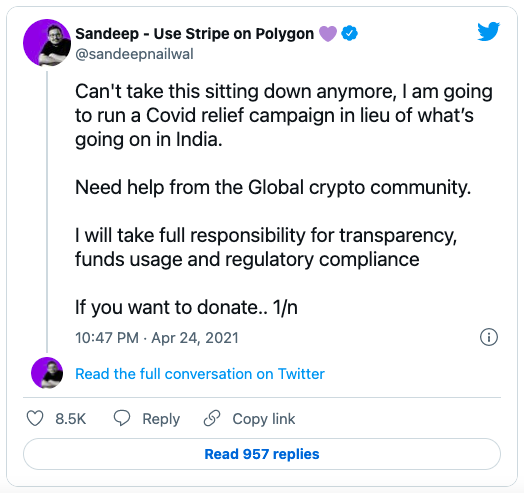
There are two very clear examples of this type of collaboration to consider. The first occurred in 2021, when the largest wave of COVID hit India, and many cryptocurrency practitioners felt that measures were necessary to further support humanitarian operations. A major initiative started with a tweet from Polygon co-founder Sandeep Nailwal.
No longer sitting still, I am ready to start a Covid relief campaign in response to what is happening in India.
Need help from the global cryptocurrency community.
If you want to donate...1/n
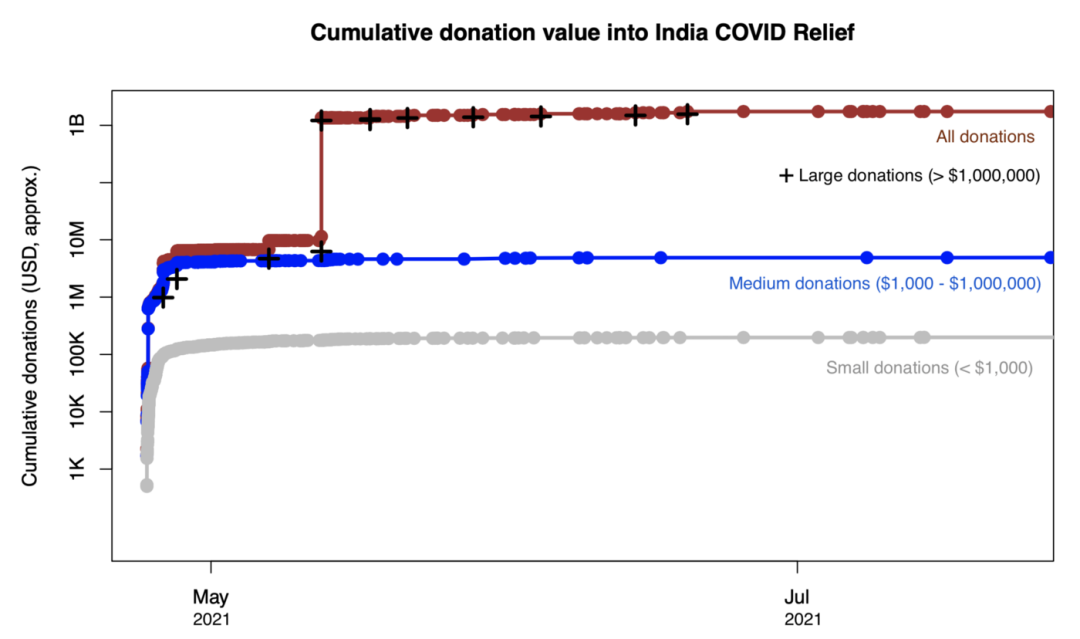
Hundreds of donations poured in after the news broke, for a final total of about 1,200 donations. India's COVID relief multisig wallets are the largest recipients in this dataset at over $1.5 billion (early April 2022 USD prices; see note in endnote).
image description
V god's large donation in May
Most donations are small, and most of the money accrues from whales.
Cumulative amount donated to COVID Relief India
Abscissa: May 2021/July 2021
Vertical axis: Cumulative donations (USD, approx.)
brown: total donations;
Black: large donations (greater than $1 million);
Blue: medium-sized donations (between $1,000 and $1 million);
Gray: Small donations (less than $1,000).
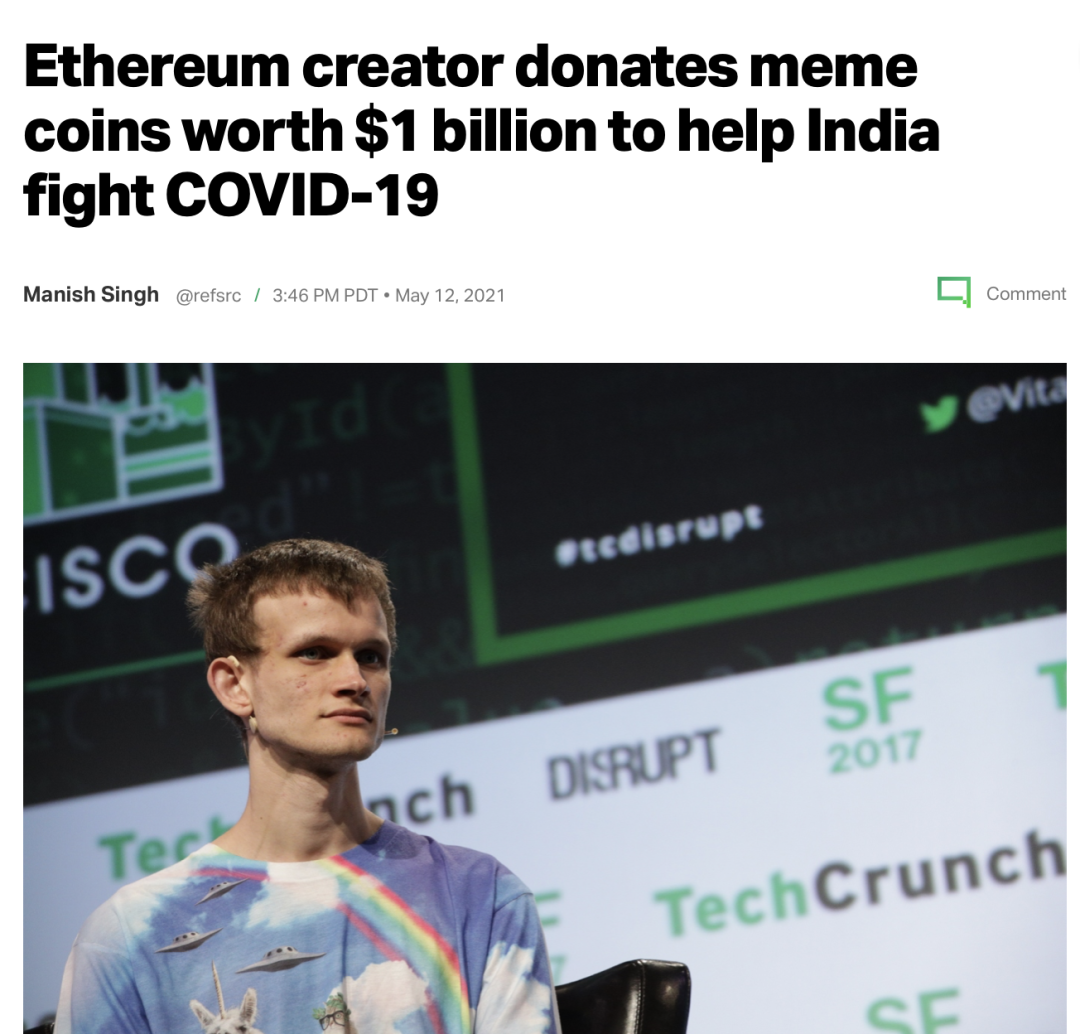
A famous donation increased the balance of this contract by a factor of 10. V God received a gift, an unsolicited Shiba Inu token (the ERC-20 token of Ethereum). He decided to donate 50 trillion SHIB tokens, worth almost $1 billion at the time. He sent it directly to the address for COVID Relief India. Here is the transaction log on Etherscan. This may be the largest single charitable donation in the history of cryptocurrency.
Tech Crunch coverage of the matter, 2021. /Ethereum founder donates $1 billion worth of Meme coins to help India fight COVID-19.
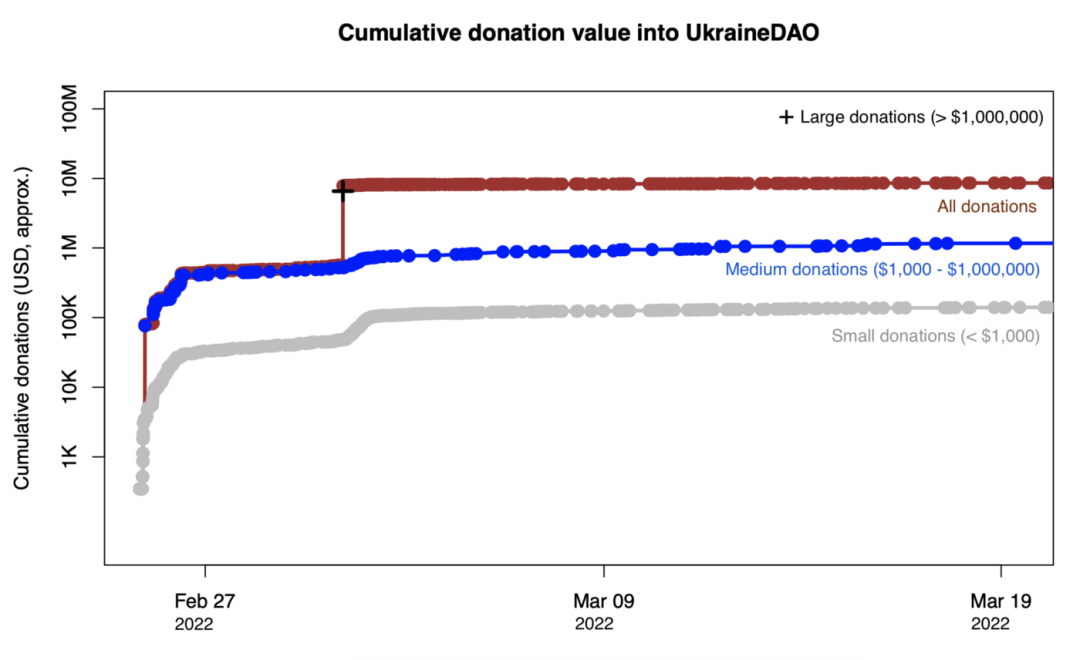
Another recent example is philanthropic donations in response to the war in Ukraine, as Ukraine was invaded and millions of Ukrainians were displaced (or worse) and their lives greatly affected. Several Ethereum community members teamed up with the Pussy Riot band to build UkraineDAO, an example that highlights just how flexible cryptocurrency coordination can be, from conception and planning, to near-instant humanitarian funding. In just a few weeks, the fund received more than ten million dollars in more than 1,000 donations. This is just a wallet of UkraineDAO on the Ethereum mainnet. Combined with another Ukrainian official wallet and other chains, the funds raised to help the Ukrainian initiative could approach or exceed $100 million.
UkraineDAO within a few weeks of launch;
It can be seen that there were a large number of NFT sales in early March.
Cumulative amount donated to UkraineDAO (UkraineDAO)
Abscissa: 2022.02.27 / 2022.03.09 / 2022.05.19
Vertical axis: Cumulative donations (USD, approx.)
brown: total donations;
Black: large donations (greater than $1 million);
Gray: Small donations (less than $1,000).
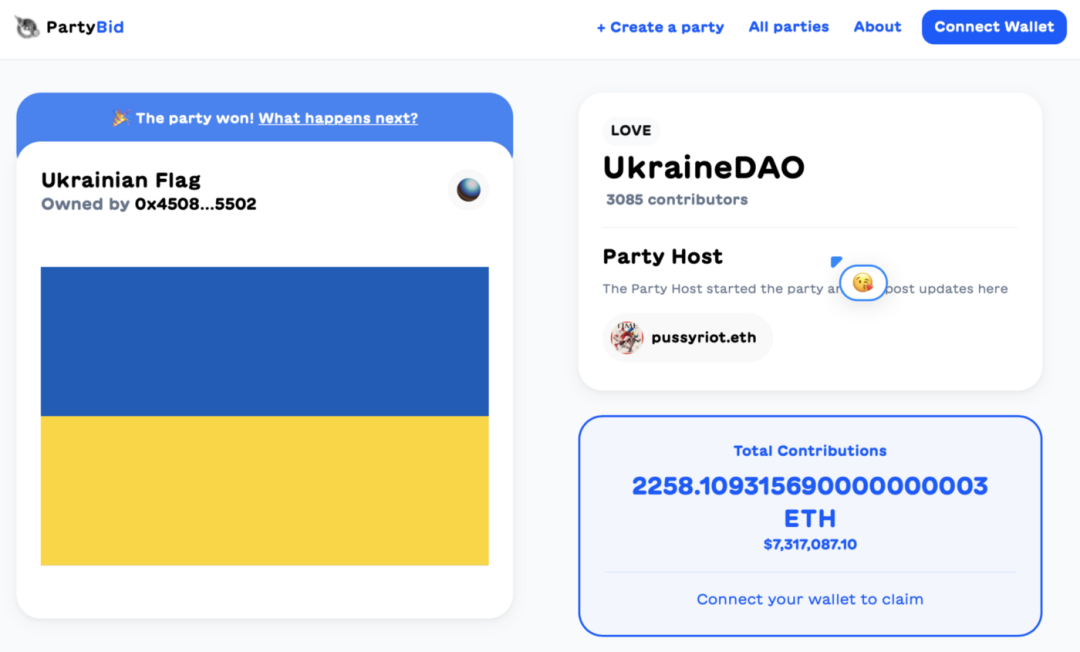
The donation initiative also added an NFT approach — an NFT of the Ukrainian flag — raising a further 2,258 ether. This amount was raised from more than 3,000 small donations through the PartyBid collaboration.
image description
NFT of the flag of Ukraine
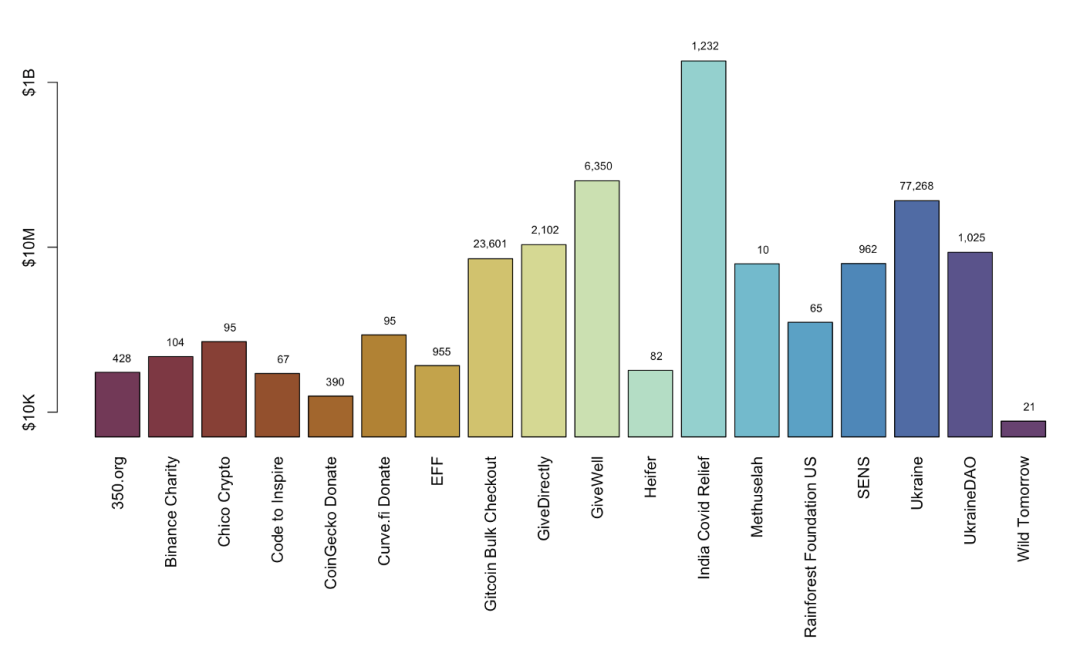
Contributions (in US dollars, approximate) for each donation initiative in the analyzed sample; the number of donations is shown above each bar.
Interestingly, of the 100,000 donation records, more than 75,000 entered official Ukrainian wallets (shown above each bar in the bar graph above). Many donation initiatives have been advanced to help this official Ukrainian wallet, including thousands of transactions from Uniswap and directly from exchanges (for example, Coinbase wallets contributed over 3000 transactions to Ukrainian wallets in total).
secondary title
02. Models and principles
When assessing the distribution of these donations, we see a pattern all too familiar in cryptocurrencies: the significant influence of whales. Roughly 95% of individual donations under $1,000 add up to only about 1% of the total value of cryptocurrency donations in this dataset, while the top 100 donations alone account for over 95%. This is mostly due to V God's donation, but if we remove his, the top 99 also accounts for over 90% of the rest. This pattern is common in many systems, including socioeconomic systems. But the pattern is more evident in some metrics for cryptocurrencies, although that has been changing in recent years.
About 90% of donors donate several times, but there are also several wallets with hundreds or even thousands of donations. Zooming in on these frequent donors reveals some important moves. Here are some examples:
Art Blocks made 1,508 transfers to GiveDirectly and GiveWell
Colorglyphs donated 480 to EFF through minting
Autoglyphs has donated 384 to 350.org through minting
Cryptocurrency facilitates programmable giving, which may be unique because it is incorporated into the blockchain. Projects like Art Blocks and Colorglyphs can automatically handle initial mintage royalties (royalties), and when a sale occurs, smart contracts transfer these royalties to charity recipients according to existing codes. No one is involved in this cycle (in fact, Art Blocks gives far more than this, distributed among other charities, as described here).
One concern above is that the distribution of philanthropy is largely concentrated among a small number of senders and recipients. How do we expand the reach of giving, from more donors to more recipients? One way to do this is to design a donation mechanism where when donors donate to their favorite projects, as a kind of "vote", they will be rewarded with corresponding funds. Projects with more independent voters get more matching funds. This is the goal of Gitcoin Funding Rounds, which distributes millions of dollars to hundreds of projects.
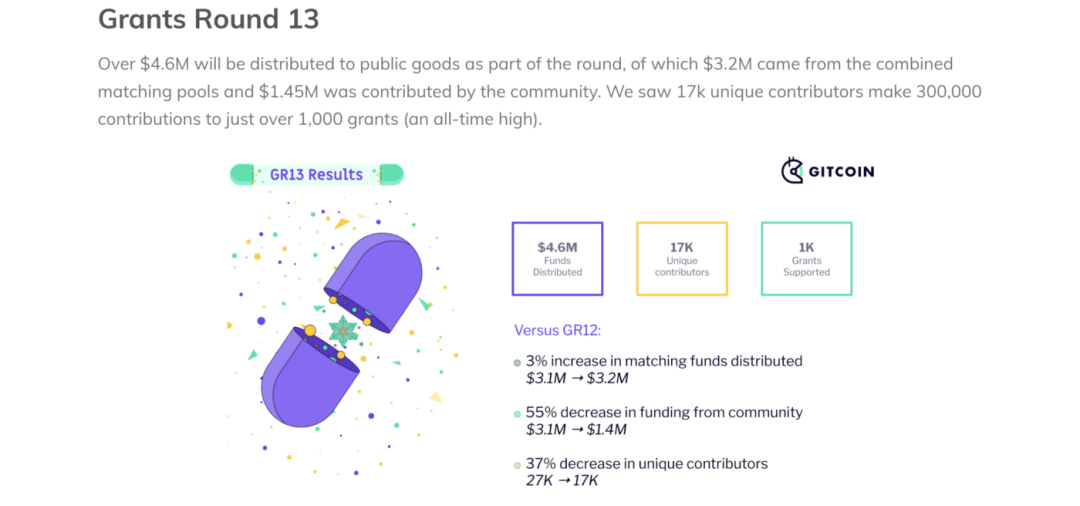
Gitcoin's GR13 distribution, from their results announcement.
Fundraising Round 13
As part of this funding round, more than $4.6 million will be allocated to public goods, with $3.2 million from a comprehensive matching pool and $1.45 million from community contributions. We saw 17,000 unique contributors contribute 300,000 times to over 1,000 grants (an all-time high).
Compared to the 12th round
Syndicated match pool distribution increased 3% (from $3.1 million to $3.2 million);
55% reduction in community contributions (from $3.1 million to $1.4 million);
37% decrease in unique contributors (from 27,000 to 17,000).
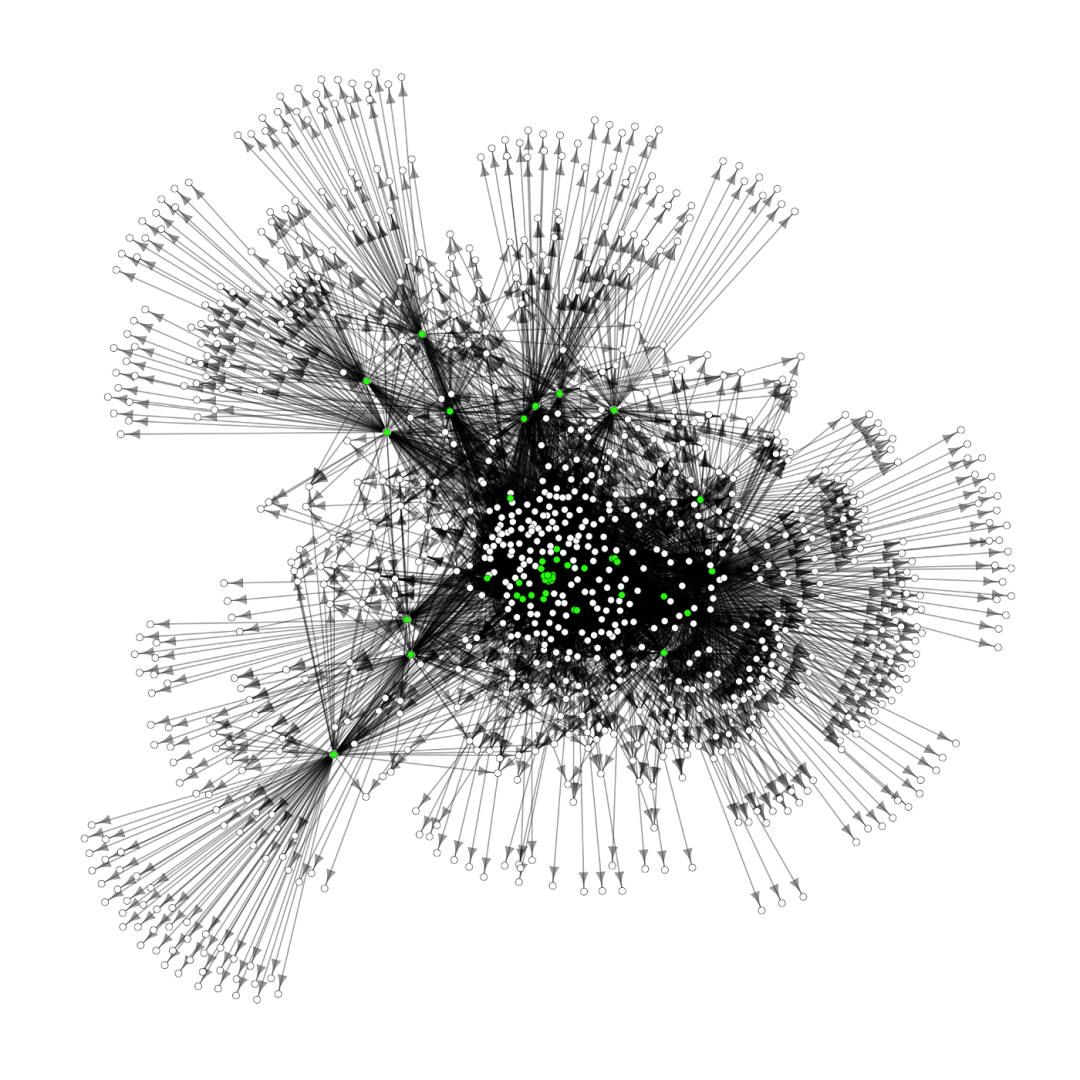
Gitcoin just completed its 13th round of these grants, which includes projects related to web3, social and community initiatives and philanthropic activities (such as several new grants for Ukraine).
Green dots are donors who have made widespread donations on Gitcoin; hollow dots are recipients.
As with previous observations, there is still a "some get the most" pattern. Some projects (like Rotki and ether.js and other leaders) get more donations than others. But in general, the scope of donations has become wider. Because of the encouragement of the voting mechanism, people are more willing to support many projects they like, which makes the projects receive more attention. Granted, there are still "winners," but support for projects spreads more widely, and it may be easier to spot "undiscovered gems," or support for start-up projects.
secondary title
03. Summary
Some clear patterns have emerged above, with familiar elements such as the continued presence of giant whales. Even more interesting are the strategies that emerge from these patterns. We can focus on four collaborative models for cryptocurrency donations:
Viral: Tends to be a time-limited charitable campaign driven by a major interest event such as COVID or the war in Ukraine. Their collaborative dynamics are often simpler, such as direct crowdsourcing donations, and on this basis, some clever projects have also been established, such as attracting more attention through NFT and other methods. The crypto world may help charities unearth our social dynamics by drawing attention to an important initiative, transparently revealing who and how many people are participating. This may encourage others to help.
Incentive-based: Donations can also come from careful fine-tuning of collaborative dynamics, e.g. Gitcoin uses quadratic financing to encourage support for many projects, by rewarding projects with more donations (or "votes") Balance the “rich get richer” effect. This type presents perhaps the finest coordination possibilities. As interest in DAOs grows, it may prompt broader experimentation with donation mechanisms.
Automatic: With a charity's public wallet, smart contracts can be programmed so that donations go to them automatically. Colorglyphs and Autoglyphs have done this in their coinage, and Art Blocks in many projects. In my own recent The Mesh project, owners can interact with smart contracts to make small automatic donations to charities. Such collaboration may seem simple, but it also makes donations correspondingly simple: mindless automation.
I understand that this data set is limited, but I still hope to find these kinds of patterns. Blockchains provide a wealth of data, and on-chain data reveals patterns that can be isolated even if the patterns are not known in advance. Another reason this dataset is limited is that charitable services like Giving Block help donors remain anonymous. Giving Block helps charities and donors by creating one-time addresses for use in their web interface. See here for details. Obviously, I don't have access to these donation data.
Still, despite the limited data, $2 billion in donations to these charities seems impressive to me. And, while whales make up most of it, even the smallest donations, through the donations of thousands of people, raise tens of millions of dollars to help others.
secondary title
04. Matters needing attention and information disclosure
The above summary should not be considered an endorsement of any donor or charity. I've donated quite a few of these promoters. My visualization projects in the form of NFT are mainly charitable donations, such as Ethstory. Follow me on Twitter.
India COVID Relief
GiveDirectly
GiveWell
Heifer
EFF
Wild Tomorrow
SENS
350.org
Rainforest Foundation US 1
Rainforest Foundation US 2
Methuselah
Ukraine
UkraineDAO
Binance Charity
Code to Inspire
Chico Crypto
Coingecko Donate
Curve.fi Donate


