






In-Depth Analysis of 5 Ways to Evaluate NFT Collateral


Original author:taetaehoho.eth
Original title: "Valuing NFTs as Collateral - Overview, Landscape, Pros/Cons》
Compilation of the original text: Lynch, Chain Catcher
Original author:Original title: "Compilation of the original text: Lynch, Chain CatcherMy colleagueBefore
Ways to generate liquidity for NFTs using some of these protocols.
cause
Now, I'll focus on one of the areas of NFT financialization that I think is the most obvious use case right now - creating liquidity for your NFTs through NFT collateralization - and explain how the protocol values NFT collateralization in this space products, and the pros and cons of each approach.
first level title
cause
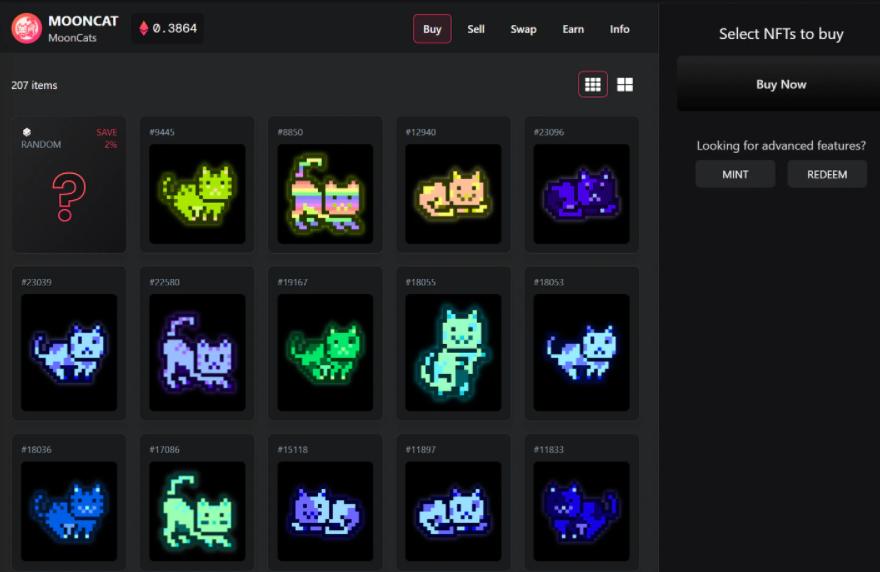
I have a valuable NFT. I don't want to sell it, but I want to rely on its value for liquidity. What I can do is have someone write me a loan collateralized by the value of the NFT. After I get ETH, I can play defi and still keep my Mooncat.
An important step in this process is assessing collateral value. Lenders will only provide liquidity if they can adequately safeguard their capital and be fairly compensated for the risks they take—such as your default.
Determining that borrowers are trustworthy, but this is difficult to do in a permissionless, anonymous environment
Or guarantee that the value of the collateral is sufficient to preserve the loaned capital in the event of user default
first level title
1.P2P
NFT Mortgage Ecology
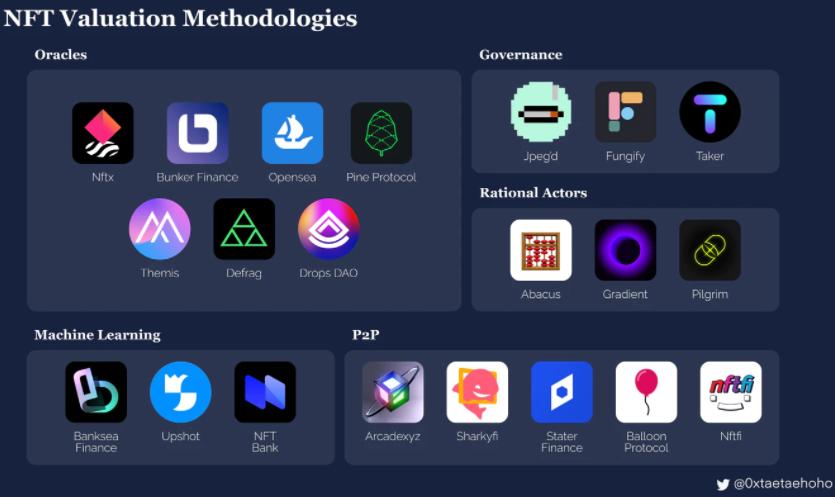
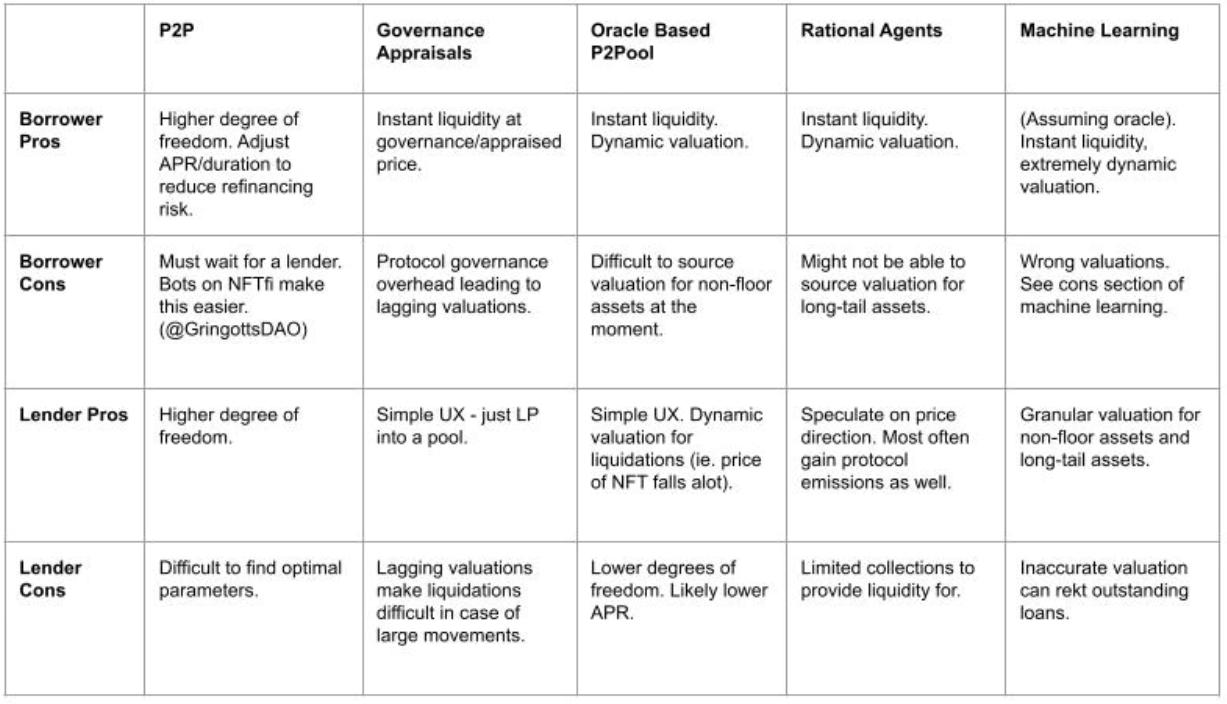
Currently, protocols operating in the field use 5 main vectors to determine valuations.
secondary title
The p2p model pioneered by NFTfi puts the onus of valuation on the borrower and lender. The platform acts as a marketplace where its participants can meet, negotiate terms and execute loans. Quick overview:
Alice needs Mooncat's liquidity and uses it as collateral for loans.
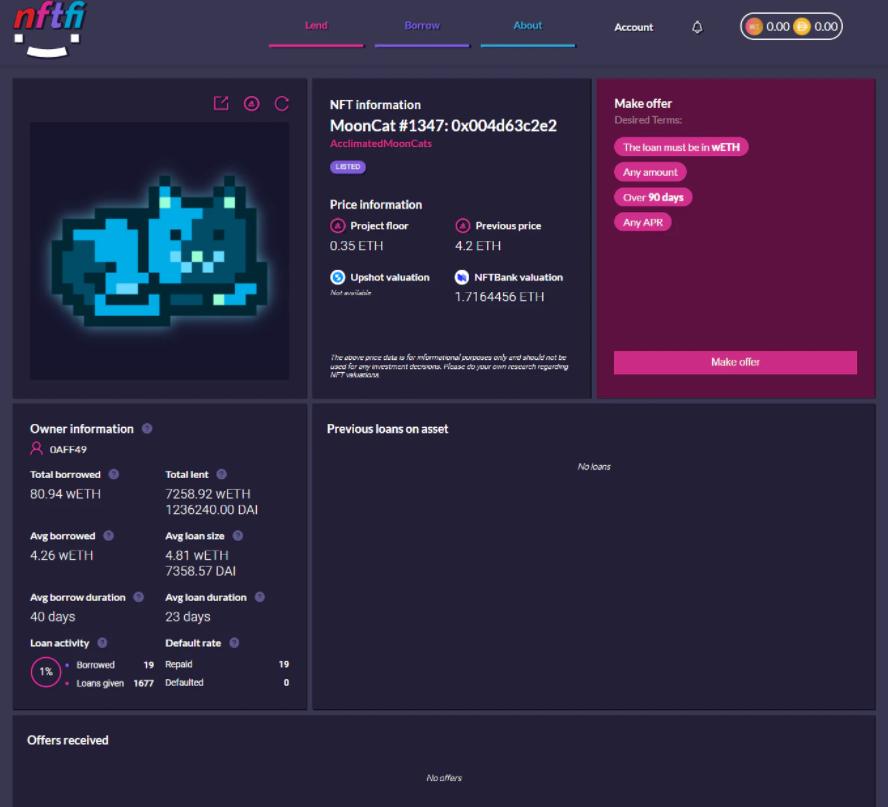
Bob, who needs to earn yield on eth, submits an off-chain loan offer detailing the principal, term, and APR.
If Alice gets an offer she approves of, she transfers the loan amount onto the chain. At the same time her NFT is locked and ETH is transferred to her EOA (External Owned Account).
Among all valuation mechanisms, the p2p market gives participants the greatest degree of freedom. Borrowers and lenders can dynamically negotiate multiple variables to best match their individual risk appetite and environmental factors. For example, a borrower who wants to execute a 15-day DeFi strategy might want to get a 15-day loan to minimize refinancing risk. In a protocol that simplifies the user experience, traders cannot execute such strategies because they do not provide users with enough degrees of freedom (fixed APR, term length).
Protocols modified and created based on this model vary widely in the choices they offer market participants.
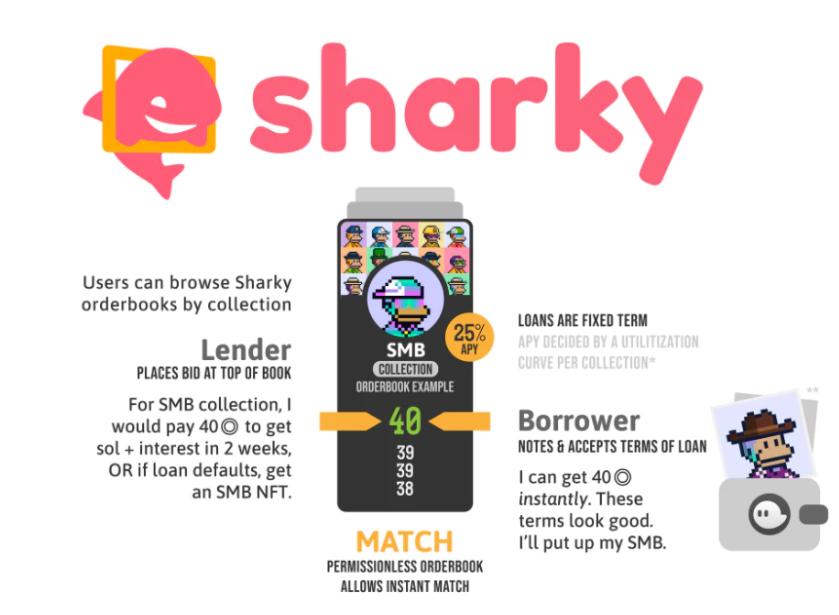
For example, on Sharkyfi, the loan term is fixed, and the APR is determined according to the utilization rate curve. The lender can only decide the size of the loan. On the borrower side, they are automatically able to see the largest loan size at the top of the loan order book with a flat APR and tenor.
Arcade requires borrowers to specify loan terms, which are then filled out by lenders.
Advantages of P2P
Highly customizable. This enables the negotiation of idiosyncratic deals (i.e. borrowers and lenders know each other and therefore enter into more favorable terms, borrowers and lenders have term preferences and are willing to settle on non-market terms...etc).
Determining the best parameters can be difficult and resource intensive
Borrowers do not have immediate access to liquidity
No dynamic valuation adjustments, liquidation is based on LTVsecondary title
2. Governance/evaluation
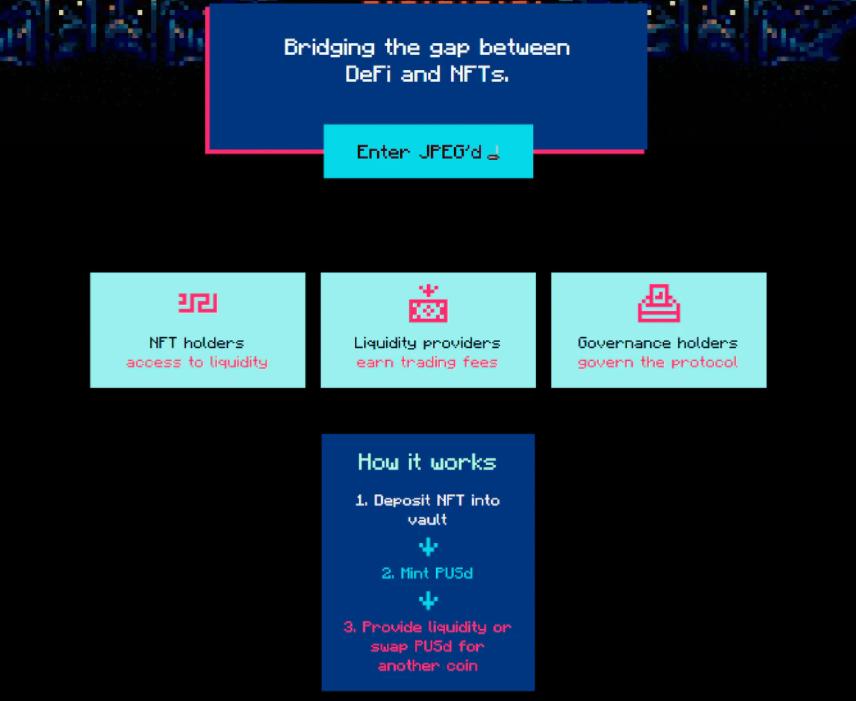
On JPEG'd, users can mint stablecoins collateralized by NFT deposits (similar to how Maker mints DAI). At launch, the protocol values Alien Punks at 4000ETH and Ape Punks at 2000ETH. Medium according to the protocol:
"Project governance can change these values later".
The Taker protocol similarly uses governance to determine the value of NFTs, but instead of being determined by the protocol's managers, the valuation is determined by consensus among expert evaluators.
CuratorDAO is made up of "well-known individuals and projects in each NFT category."
CuratorDAO provides an appraisal value against which all borrowers can obtain loans (via LTV buffer).
CuratorDAO guarantees loans with its own funds and assumes the loan and default risk, so its platform is self-incentived to provide accurate valuations. (There is significant overlap between this design and p2p/rational actors).
Advantages of Governance/Evaluation
Borrowers get instant liquidity
Valuations are determined by consensus and validated through a lengthy voting process, making them less vulnerable to price manipulation.
Governance can make adjustments slow
Difficulty adjusting valuations dynamically
secondary title
Data Sources
3. Oracles and P2Pool using oracles
Oracles enable real-time dynamic pricing of NFTs based on external price feeds. Protocols that use oracle data feeds make a big difference in the following ways
NFTXFloor Price
Opensea API—Data Sources
how they aggregate source data
Among the protocols we studied, there are two most widely used sources.This information is uploaded via the Chainlink oracle.This data is then aggregated into a price feed, usually in the form of a TWAP. Data from different sources is then combined into a weighted average final price.
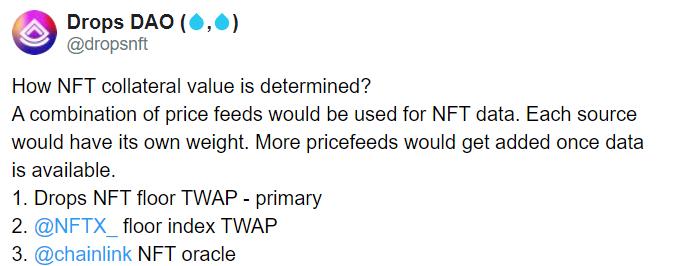
For example, Drops DAO uses three data sources, namely Drops NFT Floor TWAP, NFTX Floor Price TWAP and
Chainlink NFT Oracle
, and then aggregate the data into a set of weighted average reserve prices. The borrower then lends at the LTV % of this dynamically adjusted valuation.
Pine Protocol uses the min (7-day average transaction price, collect floor price) obtained from Opensea API. In general, TWAP is the most common data aggregation method we see in NFT mortgage agreements.
Advantages of oracles
Borrowers get instant liquidity
Disadvantages of oracles
Can be manipulated - The more illiquid a market is, the easier it is to be manipulated. Malicious actors can continue to place orders for NFTs at low prices and purchase NFTs themselves, resulting in a liquidation of that particular collection. This only works if the NFT in question is extremely illiquid and there are very few arbitrage bots. Therefore, securing listing requirements (either through governance or automatically) is important.
Abacus Spot
secondary title“optimistic proof of stake”Incentivize profit maximizing agents to ensure correct valuation of NFTs. The most common approach is to establish a "shared risk" mechanism between valuation providers, that is, agents will incur losses in user defaults or valuation errors, and profit in the opposite case. We'll explore two different approaches, but there are many different options at the same time.white paper)
Abacus uses a
valuation method. (
white paper
Alice is a profit maximizing trader. She sees an open pool of rare punk and decides to lock ETH in the pool (we'll explain why later). The longer she locks up ETH, the more protocol token release ABC she gets.
Because she is fast, she gets the first "ticket" - the first 0-1ETH in the pool is hers.
Bob and his friends also lock ETH in the pool.
Charlie, the NFT holder, sees 20 ETH in the pool, locked by Alice and Bob, but Charlie thinks his NFT is worth less than this value.
Charlie immediately "closes" the pool (only Charlie can do this because he owns the NFT), all ETH in the pool is transferred to Charlie, and the NFT is auctioned for 48 hours.
If the NFT is sold for more than 20 ETH, the profit will be transferred to Alice and Bob and friends. Those who lock in later will receive proportionally higher profits. This is because…
If the selling price of the NFT is less than 20 ETH, the profit will be divided in a first-in, first-out (FIFO) manner. Alice locked in 0-1 ETH ticket will get 1ETH back, but Bob locked in 19-20 ETH gets nothing.GradientThus, in step 6, Bob gets a greater reward for taking a greater risk.
Pilgrim
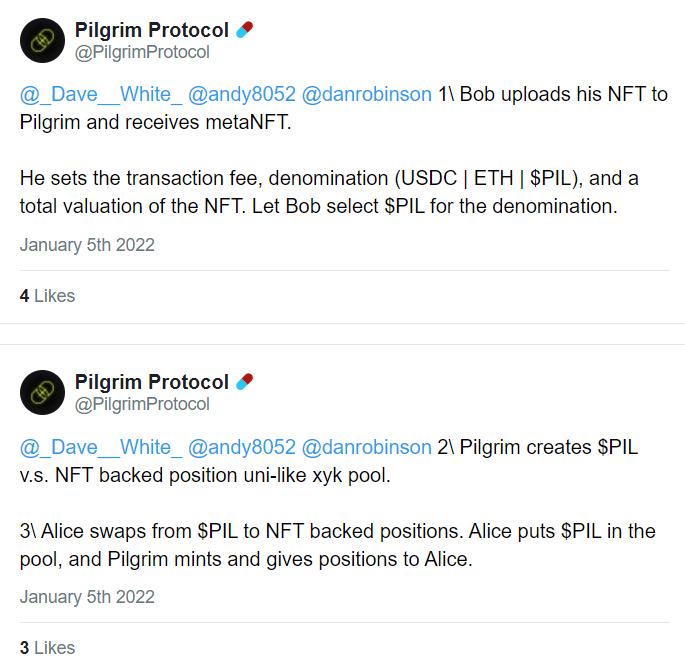
There are also some complications that happen around the expiry date, but in general, the incentive for traders is to lock up enough ETH such that the potential profit of the sale + token emissions = opportunity cost of capital (locked ETH) .
Once Abacus determines the valuation, other protocols can lend at that valuation.
This is one such example.
Therefore, the protocol uses profit-maximizing rational actors to determine the valuation of NFTs, in this case, the total liquidity in the pool.
Advantages of Rational Agent
Disadvantages of Rational Agent
The protocol must attract traders to the platform
Currently, these protocols establish valuations on individual NFTs, but this is difficult to scaleBanksea Financesecondary title
5. Machine LearningHow to value items in NFT projects? — Part 1The Valuation Protocol uses ML to predict valuations by taking past transactions and features as input. NFTBank and
is the best example.
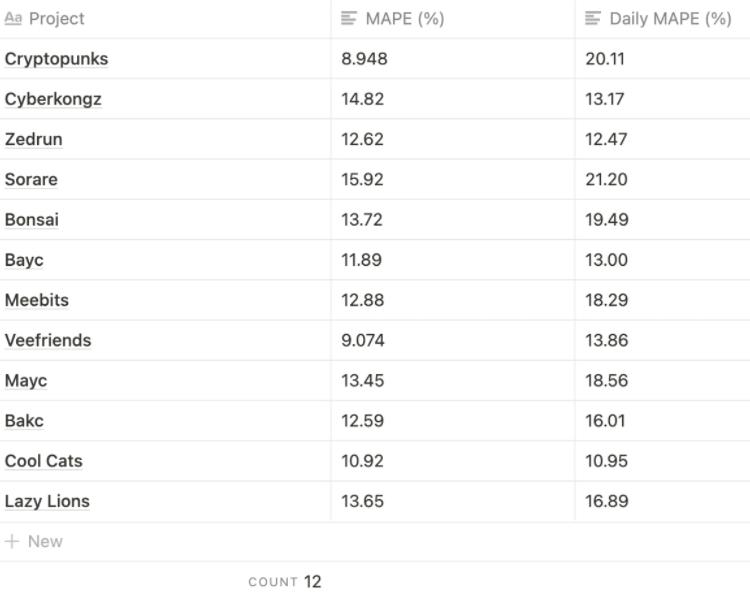
To better understand NFTbank's algorithm, check out
. As of November 2021, their model's accuracy on Axie has reached single-digit mean absolute percentage error.
NFTBank model performance as of November 2021.
NFTBank has announced a partnership with Chainlink to bring their predicted prices on-chain, so protocols that require real-time NFT valuations can use their data to feed prices.
In its initial funding proposal, Banksea Finance stated that it hopes to incorporate "NFT creator information, attributes, historical transactions, media coverage, community status, popularity, and other information to assess NFT value trends and NFT public opinion trends" to Confirm the price of.
Advantages of Machine Learning
Real-time dynamic data, updating every transaction that occurs in the collection
Disadvantages of machine learning"NFTs within the same trait group are sold as outliers with a larger margin of error"It may not be possible to predict systemic market trends (i.e. Meta changes in game NFTs, changes in market conditions for ordinary NFTs). An experienced trader/appraiser might catch on to this.
game changer
React.
It is currently non-forward-looking.


