Crypto Insiders Founder: Why the Future Belongs to Near?



On April 7, Crypto Insiders founder Zoran Kole’s article “The Future Belongs to Near” aroused discussions in the crypto community. He wrote that on April 20, Near will announce that it will cooperate with other well-capitalized stablecoins to launch their Its own native algorithm stablecoin USN will provide an annualized interest rate of about 20%. This article also comprehensively analyzes the Near public chain from the perspectives of technology and developers.
The following is the full text translated by PANews:
first level title
general overview
Near is a development platform designed for usability based on sharding, proof-of-stake, and Layer1 blockchains. It includes a permissionless base layer, independent native tokens, a predetermined monetary policy, and a marketplace for computing resources. The Near team is made up of more than 90 world-class developers and researchers from tech giants such as Google, Meta, Microsoft, and MemSQL, who have formed Near through extensive open source, decentralized collaborative efforts.
first level title
Blockchain Architecture
At its core, Near is a community-run cloud that acts as a marketplace for computing resources among participants. On the supply side, there are validator nodes (currently 100 nodes) that are incentivized to maintain network security. On the demand side, developers and end users are the main focus of the platform.
There is an inherent trilemma in Layer 1 protocols that is the biggest obstacle to mass adoption and success. First, users want security, but platforms often don't care as long as the user experience is smooth. Second, developers are most concerned with adoption, making sure it has a sustainable source of long-term revenue. Additionally, validators expect higher income to secure the proof-of-stake network. In the end, users are the primary token holders who want this native token to act as a store of value in the long term.
first level title
NEAR and ETH 2.0
To paraphrase Naval Ravikant (co-founder of AngleList, early investor in Uber, Twitter, etc.), "Near looks like the roadmap for Ethereum 2.0, except that it's already implemented." Ethereum 2.0 aims to be a shard , a proof-of-stake, EVM-compatible layer-1 blockchain that enables cheap and fast transactions while being friendly to the environment and developers. The launch of Simple Nightshade (the first phase launched last November, split into four shards and shared among 60 or so validators) brings Near one step closer to its goal of a fully sharded and secure blockchain.
Near adopts the Delegated Proof of Stake (DPoS) consensus mechanism, which can currently achieve 2,500 to 3,000 transactions per second. It consists of shards and validator seats (100 validator seats per shard) that can scale linearly with network demand, thus lowering the barrier to entry and enabling mass adoption in the future.
The Near network optimizes liveness rather than security through Byzantine fault tolerance assumptions, so that the finality of all transactions is less than 2 seconds.
first level title
Developer-Centric Protocol
Near’s strongest competitive advantage over alternative layer-1 blockchains is its developer-friendliness. Near also prides itself on being developer-first, encouraging mass adoption and use of the network by focusing on the developer experience. Since Node runs Web Assembly (WASM, a way to take non-JavaScript code and make it run in the browser), developers can write applications in Rust or Assembly Script and start using them without learning a new programming language. Develop on Near.
first level title
analyze growth
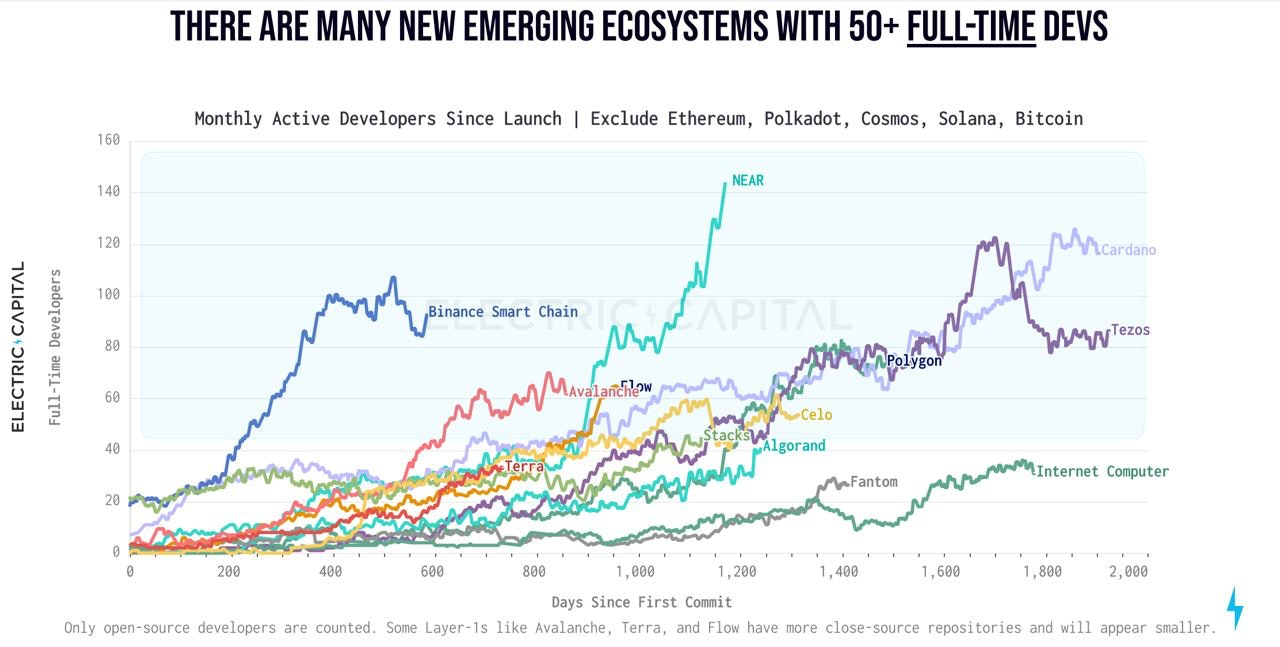
According to Electric Capital, Near has one of the most alternative layer-1 blockchains (besides Bitcoin, Ethereum, Polkadot, Cosmos, Solana) with the most full-time developers.
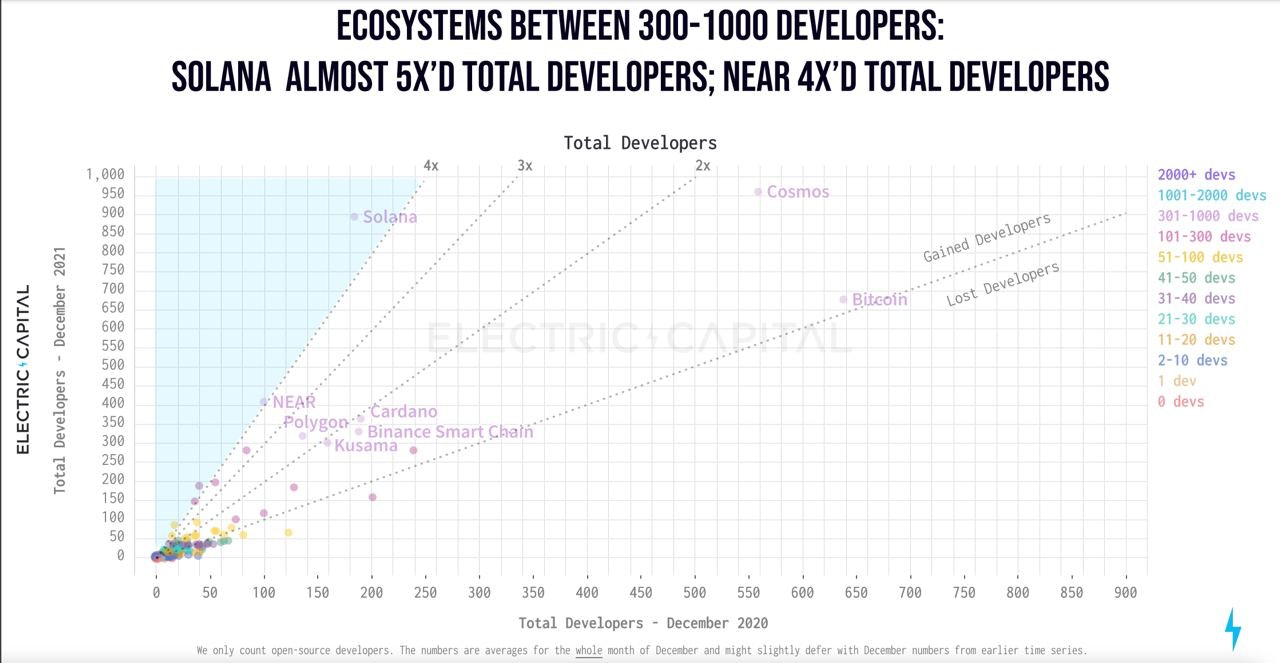
Near has one of the fastest growing ecosystems, with a 4x increase in the total number of developers in the past 2 years. This high growth rate of developers is a key indicator that adoption and usage of the protocol will continue to grow.
developer incentives
Developers can pay for gas and transaction costs if they believe the lifetime value of the user will exceed the gas cost. This provides predictable pricing to the expectations of budget end users.
30% of transaction fees are given to smart contracts (split evenly between all contracts used during a transaction), which provides a sustainable revenue stream for smart contract development. With the announcement of an $800 million incentive fund, developers have added another compelling reason to build on Near.
first level title
recent change factors
Near has several triggers that make it an entirely attractive investment. At the end of January, Near closed a $350 million funding round led by Tiger Global, adding to the star list of venture capital giants backing the Near ecosystem. As of Q3 2021, Near was the second most commonly held asset by crypto funds, according to Messari.
Additionally, Near will be listed on the Coinbase exchange in the coming months, which will help increase visibility among retail investors like never before. This also paves the way for the integration of Near NFTs into Coinbase’s upcoming NFT marketplace. Finally, on April 20, Near will announce the launch of their own native algorithmic stablecoin, USN, in partnership with other well-capitalized stablecoins. They will offer around 20% APR, which is extremely attractive and will also facilitate the rotation of DeFi capital into the Near ecosystem, sucking out the total TVL from other layer 1 protocols.
With growth from attractive stablecoin yields, this would put Near in comparison to Terra. Terra currently has a market cap of around $40 billion, while Near is worth $10 billion. The aforementioned triggers for change will strengthen Near's fundamentals in the short and long term and could lead to at least a 100% appreciation in its market cap over the next few months.
In short, the future belongs to Near.