






A Web3 Builder's Guide to Decentralization: Principles, Models, Methods


Compilation of the original text: Hu Tao, Chain Catcher
Original title: "Decentralization for Web3 Builders: Principles, Models, How》
Compilation of the original text: Hu Tao, Chain Catcher
The promise of decentralization of power has been much discussed and debated, from why it matters to the larger question of who will control internet software. These questions are critical because, as we have seen, violations of individual liberty, choice, and privacy are inherent when control is in the hands of a very few. "Don't be evil" is very different from "can't be evil" when a CEO is deciding on one strategy or the other.
But decentralizing the internet has been hard to do. Compared to the proven efficiency and stability of centralized systems, decentralized systems have struggled to keep pace. Now, however, emerging cryptography and Web3 technologies—particularly programmable blockchains, composable smart contracts, and digital assets—enable decentralized systems to achieve unprecedented levels of coordination and operational functionality. This evolution has enabled new forms of governance and organization, community owned and operated networks and services, robust economic systems, and countless other innovations.
We’ve already seen specific categories like decentralized finance “DeFi” and core infrastructure projects take off, and soon we’ll see decentralized versions of existing web2 categories like social media, video games, music, and marketplaces. The success of these systems will depend on their ability to deliver the real benefits of decentralization, including fairer ownership, less censorship, and greater diversity among stakeholders. However, the more familiar decentralized models used for DeFi do not necessarily apply to these more complex systems (i.e. systems with more UI functionality, richer client experiences, centralized products or services, or licensed IP).
first level title
1. Web3 decentralized design challenges
Decentralization of power can be thought of as a single design challenge spanning three distinct but interrelated elements: technical, economic, and legal. Understanding the differences between these elements is key to designing Web3 systems, because design decisions about one element can affect other elements.
Decentralization of technology
Technical decentralization mainly involves the security and structural mechanisms of the Web3 system. The core innovation behind programmable blockchains is that they can support the decentralization of technology by providing a permissionless, trustless and verifiable ecosystem in which value can be transferred and, more importantly, in Build Web3 products and services on top of it.
This means that products and services can be deployed and operated without the need for a trusted centralized intermediary to operate, opening up a vast world of possibilities. For these reasons, technological decentralization is the basis for both types of decentralization, economic and legal.
economic decentralization
Economic decentralization is related to the economics of the Web3 system. The advent of programmable blockchains (e.g. Ethereum, Solana, and Avalanche) and digital assets (e.g. ETH, SOL, and AVAX) has unleashed the ability for open source and decentralized systems to eventually have their own decentralized economies (i.e. autonomous freedom and market economy).
This is a critical breakthrough. Open source and decentralized protocols of previous generations of technology (like web1, like http, smtp, ftp, etc.) stagnated because they lacked the ability to incentivize continued development and/or further invest critical resources back into their systems. This leaves fertile ground for the emergence and success of web2's centralized companies, as they are able to leverage their efficiencies and resources to build products and services beyond those of Web1. But this centralization has also led to countless examples of abuse of user rights and aggressive rake ratios.
Technologies enabling Web3 now enable the creation of more complex open-source and decentralized systems—and enable decentralized economies to form around them—that will enable Web3 products and services to compete with and ultimately surpass those of web2 and service.
Builders of Web3 systems can contribute to the formation of a decentralized economy through careful design decisions that cause their systems to accumulate "value" from a wide variety of sources—whether information, economic value, voting rights, or other forms— And distribute that value fairly among system stakeholders according to their contributions. For this to happen, Web3 systems need to delegate meaningful power, control, and ownership to system stakeholders (via airdrops, other token distributions, decentralized governance, etc.). This in turn encourages stakeholders to contribute meaningful value as they have the power to decide how their contributions are treated and rewarded.
A constant balance of incentives among stakeholders—developers, contributors, and consumers—can further drive value contribution to the overall system and benefit all. In other words: all the benefits of modern network effects, but without the pitfalls of centralized control and captive economies.
decentralization of legal power
Legal decentralization is related to the legitimacy of the Web3 system. In this post, I focus primarily on US securities laws, which govern how and whether Web3 systems can use their own native digital assets. While there is no written standard for "decentralization of legal power," a first-principles analysis of U.S. securities law, case law, and SEC guidance (including the SEC's final April 2019 guidance) can help us develop practical standards.
First, U.S. securities laws generally aim to create a "level playing field" for securities trading by limiting the ability of those with more information to take advantage of others with less information. This is the principle of information asymmetry, and U.S. securities laws often apply disclosure requirements to eliminate asymmetries in certain securities transactions.
This principle comes into play in the Howey test, a subjective test of whether U.S. securities laws should apply to digital asset transactions, which include (1) being an investment in money (2) being an ordinary business (3) having reasonable expectations of profits (4) being based primarily on others management efforts. The fourth aspect seeks to address information asymmetry, in the belief that the risk of information asymmetry (management vs. outsiders) may be high where reliance on “management efforts” may be so high that the application of securities laws may be necessary.
Based on the foregoing and the SEC's guidance, we can speculate that if a Web3 system (a) removes the possibility of significant information asymmetries, and (b) removes reliance on others for essential management efforts to drive the success or failure of that enterprise, then The system may be “sufficiently decentralized” such that the application of U.S. securities laws to its digital assets should be unnecessary. For the purposes of this article, I will refer to these systems as legally decentralized. Admittedly, most businesses cannot meet the statutory threshold of decentralization, but as I outline below, the novel components of Web3 systems uniquely enable them to meet such a threshold.
Collectively, these three distinct aspects of decentralization—technical, economic, and legal—must be viewed holistically, as a single design challenge, because design decisions about one affect the other.
first level title
2. How to use the components of the Web3 system to achieve decentralization
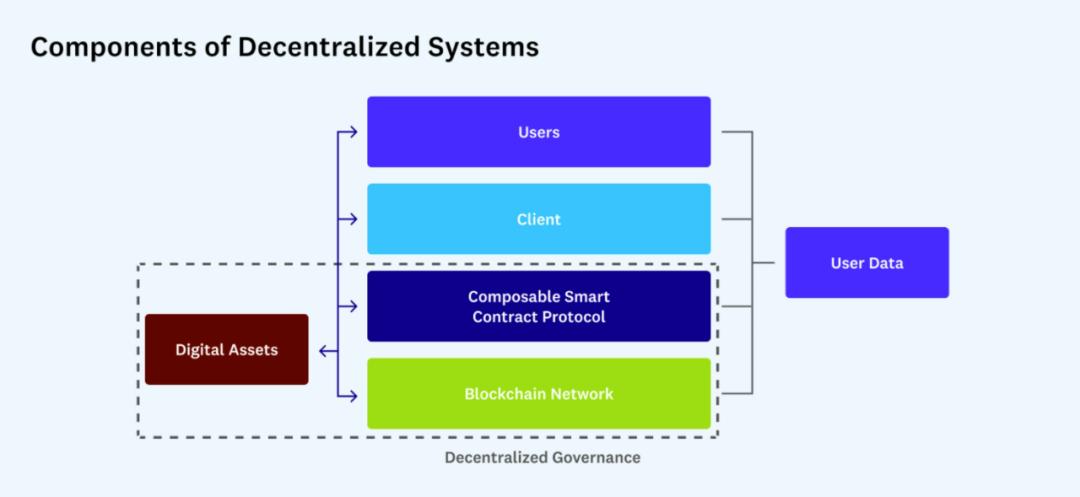
Blockchain network and smart contract protocol
Blockchain network and smart contract protocol
Fundamentally, blockchain networks and smart contract protocols enable technology decentralization. But they can also be designed in ways that promote decentralization of economic and legal power, including:
achieve transparency by- For example, anyone can currently view where the most digital assets are stored in Ethereum's DeFi ecosystem, and where the most fees are earned;
as an open source public product- Anyone can use and test features for free to ensure security, promote a decentralized economy, etc.;
By allowing data portability, mobility and interoperability- Users retain control over data, purchases and content of Web3 products and services;
By prioritizing composability- Elements can be programmed to interact with each other, making these programs a building block that anyone can use.
Collectively, these properties reduce the risk of information asymmetry, reduce the importance of any Web3 system know-how, and increase the importance of the system's network of contributors and consumers relative to its developers.
digital assets
digital assets
The decentralized economy of the Web3 system is driven by a combination of two incentives:
Intrinsic incentives, based on the underlying characteristics of the system, such as user base, network effects, technology, etc., trigger the innate willingness of third parties to participate in such systems.
in,
in,Digital assets are the most critical tool that Web3 builders must facilitate the formation and continued operation of their decentralized economy, as they balance the incentives between developers, contributors, and consumers.
Therefore, if properly designed, digital asset distribution has the potential to drive a "flywheel" of network effects, whereby the overall system becomes more valuable to more users as more people participate in the network. But unlike web2's network effects, Web3 digital assets enable users to shape their own experiences and benefit from their contributions.
Successful user acquisition and retention can significantly improve the intrinsic incentives of the Web3 system for developers and contributors, thereby bringing greater value to the system and ultimately attracting more users. The growth of Ethereum over the past two years is a good example: from the beginning of 2020 to the beginning of 2022, the value of digital assets stored in the Ethereum DeFi protocol grew from just over $600 million to just over $150 billion. But this isn't a narrative about volume and its monetary value - rather, it shows how developer activity can lead to products and services that attract users, which then attracts more developers and additional products and services, driving further User growth.
In addition to potentially creating such a flywheel, the network effects of Web3 systems can provide builders with a moat to prevent competitors from copying and redeploying their infrastructure, which is open source. how so? Because for a system with strong network effects, replication alone is unlikely to motivate users to switch to the new system.
This again emphasizesdecentralized governance
decentralized governance
The vast majority of blockchain networks and smart contract-based protocols have decentralized governance managed by a Decentralized Autonomous Organization (“DAO”). Decentralized governance and DAOs offer numerous benefits along each of the three decentralization criteria already discussed, including:
Web3 systems are made more secure by distributing technical control of such systems to a decentralized party - thereby limiting the ability of any one party to control the governance of the system.
Provide meaningful representation to stakeholders in decision-making and ensure long-term incentive alignment among stakeholders. This feature, along with enhanced security, helps make decentralized governance more effective - allowing it to contribute to the overall health and sustainability of the Web3 system's decentralized economy.
Supports the decentralization of legal power by reducing the reliance of stakeholders on the stewardship of any individual or group - thereby reducing the risk of potential information asymmetries.
When designing decentralized governance for any Web3 system, we can borrow some insights from several different models that have been developed and implemented in the DeFi space. For example:
subDAO (child DAO). To simplify decision making, some DAOs empower subDAOs with tailored authority over certain categories of actions (e.g. legal, financial, development, etc.).
Governance is minimized. To improve the reliability of DeFi protocols and overcome the challenges of DAO participation rates, some have called for minimizing the number of final decisions DAOs need to make, or creating a hierarchy where more important decisions require higher voter turnout.
Incentivize participation. To ensure effective DAO governance, some DAOs encourage active participation, including compensation for representatives. Note that while grant programs don't work well here,But retroactive reward schemes can be very effective because they defer the evaluation and reward of contributions until after value has been delivered.If designed properly, they can also help stimulate competition and open markets.
After all,
After all,Web3 builders should be careful not to give too much power to insiders. Instead, significant control should be given to the community. Where there is an imbalance of power, Web3 builders should look to delegation programs to help decentralize it.
first level title
3. Decentralized model in practice
Let’s now look at how the techno-economic-legal framework I shared earlier applies to several different decentralization models in practice. These models range from "full" decentralization (every component of the system is decentralized) to "open" decentralization (a shared decentralized system in which independent third parties all participate). I also included models that open up specific applications of decentralization, such as NFT projects and tokenization protocols.
Fully Decentralized: How to Decentralize DeFi and Other Simple Apps
Complete decentralization is currently the most common decentralization model in the DeFi field. As shown in the figure below, the transition from a centralized model (such as web2) to a decentralized model (such as Web3) includes:
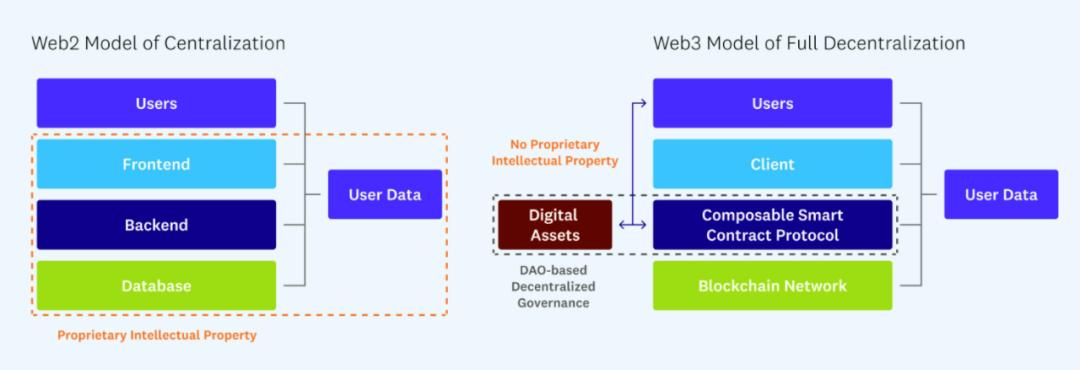
Deploy the open source smart contract protocol to the decentralized and programmable blockchain network to form the core infrastructure layer of the Web3 system - the smart contract protocol provides the execution layer for all back-end components that can be deployed on the chain (ie payment, messaging, etc.);
Run the "client" layer in a decentralized manner - the client represents all the software running off-chain of the system and acts as a gateway to the smart contract protocol (the client can be a simple front-end website or a complex application program);
Add digital asset distribution - this could be airdrops to contributors and consumers; issuance to insiders (employees, advisors and shareholders of the development company); distribution of digital assets to clear incentive schemes (e.g. mine); and the formation of a treasury controlled by the DAO for any future incentives;
Launch of DAO governance for smart contract protocol and DAO treasury;
Make sure users own and keep their own data (huge controversy in web2 systems right now).
This fully decentralized model assumes that the Web3 system is a novel smart contract protocol deployed on an existing programmable blockchain network. "User" here refers to both consumers and contributors.
For Web3 systems using this model, the decentralization of the blockchain network and smart contract protocols is mainly due to the technical decentralization of these layers and the control from the development companies that create the system by launching decentralized governance in the form of DAOs smart contract agreement. Deploying a smart contract protocol to a public blockchain and launching its DAO brings transparency and greater safety and security to the system, meaning no individual or group controls the system.
Decentralization of the client layer then happens in a few different ways. In DeFi, most clients are simply front-end websites that provide gateways to the underlying smart contract protocol (i.e. they allow users to interact with the protocol), and most development companies open source their clients/websites and host them on decentralized A standardized file system (such as IPFS).
As clients/websites are open sourced, third parties independent of the development company often end up hosting their own clients/websites to provide access to the same underlying protocol. Additionally, independent third parties often build protocol gateways into their own aggregators and dashboards. This means that the protocol's gateway is always available, whether or not the client/website of the developing company is maintained.
The above steps primarily eliminate the possibility of information asymmetry—the driving force behind much of U.S. securities law—because (1) information about the agreement and its operation is transparent on a public blockchain distributed ledger, and (2) ) The development company that launched the protocol is no longer critical to the success or failure of such a protocol.
Limitations of full decentralization
Limitations of full decentralization
While the fully decentralized model has been used successfully in DeFi, its simplicity may make it unsuitable for more complex Web3 systems. Builders should be aware of and plan for these factors, which can introduce complications:
complex client. Given the relative simplicity of DeFi, client-side decentralization in DeFi is somewhat simple - with few incentives for third parties to build independent and simple gateways (mostly in the form of websites) to such protocols. However, as Web3 products and services become more complex, with a computationally expensive/resource-intensive client layer built on top of the underlying smart contract protocol, client-side decentralization becomes more complicated. For example, consider the difference in complexity of a client/website protocol that provides access to Uniswap and Compound, compared to a hypothetical Web3 social media client that requires the full functionality of web2 applications like Twitter and Instagram. This complexity may reduce third-party programs willing to build and/or host alternative clients, or to integrate access to the protocol layers into their own systems without explicit incentives.
Major improvements are needed. Likewise, systems that require significant improvements after a digital asset is released may find it difficult to make these improvements in a decentralized manner. In DeFi, for example, many protocols have struggled to successfully use explicit token incentives to drive continued meaningful development of their smart contract protocols.
operation in progress. A development company may intend to conduct significant operations to increase the value of its Web3 system after its digital asset is released. This could weaken the decentralization of the system if additional value contributions do not come from independent third parties. Furthermore, since governance tokens themselves generally do not confer any rights to future products and services that a development company may produce, development companies should be careful not to give token holders the impression that any such relationship exists.
Exclusive rights reserved. If the original development company (or someone else) retains exclusive rights to any intellectual property used in the system, it could undermine the full decentralization of the system. For example, if developers of sophisticated Web3 social media clients want to keep those clients proprietary, then complete decentralization may not be possible.
Each of these limitations can be overcome with Web3 systems that can stimulate significant economic decentralization, creating a well-functioning decentralized economy. If a decentralized group of developers, contributors, and consumers builds and captures significant value—thus reducing the importance of the original developers to the overall system—it shifts the system from a fully decentralized model to an open Decentralized model.
Open Decentralization: How to Decentralize Complex Web3 Applications
Like the fully decentralized model, the open decentralized model includes a decentralized blockchain and smart contract protocol layer, digital assets, and a DAO.
But unlike a fully decentralized model, an open decentralized model will also let independent developers build and operate multiple clients (possibly centralized) on top of a shared smart contract protocol layer. For example, consider a potentially rich and complex client for Web3 social media, functionally similar to Web2 applications such as Twitter and Instagram, but all using a shared smart contract protocol rather than a separate proprietary backend system.
Web3 Open Decentralized Model
The model assumes that the Web3 system is a novel smart contract protocol deployed to an existing programmable blockchain network. "User" here refers to both consumers and contributors.
In this open decentralized model, all customers will use the digital assets of the underlying smart contract agreement, and its creation and operation will be incentivized as follows:
initial incentive. Initial development can be incentivized through explicit and implicit incentives, including rewarding digital assets from DAO-controlled vaults of the smart contract protocol; network effects of the protocol; and the fact that such developers can retain the intellectual property of their respective clients.
Ongoing incentives. Ongoing maintenance and ongoing development can be similarly incentivized, with digital asset-based incentives automatically awarded based on the performance metrics established by the DAO. An example in DeFi is Liquidity Protocol, which rewards hosts of independent frontends for providing access to the protocol, rewarding protocols associated with economic activity driven by such frontends.
In more complex Web3 systems, we expect the prevalence of such rewards to increase significantly. For example, in a decentralized social media ecosystem, tokens can be used to measure and reward customers for user engagement. Finally, in addition to the incentives of the protocol, the customer's operators will be incentivized by any financial returns they can generate through their own proprietary customers.
Builders seeking to decentralize their Web3 systems through an open decentralization model will need to design their incentives and decentralized governance model to be "client-agnostic" to encourage participation by many participants. Additionally, they will need to ensure that a single client does not experience a significant power imbalance that would allow it to dominate the entire ecosystem. If this imbalance can easily occur, the builders of these clients may have an unfavorable perception of the Web3 system and be less willing to invest time and resources in it. In some respects, such a system would have centralization and control issues similar to web2 systems.
Builders using an open decentralized model should also prioritize transparency, open source technology, data portability, and composability to further reduce the risk of power concentration in their systems in the hands of developers. These features remove information asymmetry, lower the barriers to entry for competing developers, and allow users to switch between clients—all of which promote a more open and decentralized ecosystem where users are independent from any one client. limitations or burdens imposed by the (This is a huge hindrance in the current web2 system, where user data is siled in every mandatory web2 system.)
Finally, for the system's decentralized economy to be truly resilient, the success or failure of the entire Web3 system should not depend on any individual or group, including any individual client. If, for a Web3 system, this condition, as well as the above-mentioned condition for economic decentralization, are met, then the risk of severe information asymmetry in such a system is greatly reduced, making it legitimately decentralized.
At first, it might be counterintuitive to suggest that development companies should prioritize the above design decisions, since they effectively incentivize their own competition. But doing so will help form a functional decentralized economy built on shared infrastructure, which in turn will lead to an ecosystem that is much broader and richer than any one company could build alone.
In other words, these actions expand the entire pie rather than prioritizing parts of it.
Web3 version of Web2
To see how these principles work in practice, let's apply the open decentralization model to create simplified Web3 versions of familiar web2 applications. The promise of Web3 is not just to decentralize known functionality and applications, as it makes entirely new things possible; but for the sake of illustration, I will focus on some simple examples.
Web3 games may require a system that includes multiple games, implements shared smart contract protocols and governance tokens; has separate in-game currencies and NFTs; and makes digital assets available to participants and contributors. These assets are also portable across the ecosystem. The most used games can then receive the largest percentage of governance tokens allocated by the system DAO, causing game creators in turn to fund additional development of their games.
Web3 social media will likely require a system with multiple iterations of social media services and messaging services, each built on the same open source smart contract protocol as a separate client. As the protocol will share a native governance token: consumers will earn tokens based on usage, contributors will earn tokens based on the content they create, and customers will earn tokens based on various metrics established by the DAO.
A Web3 marketplace may require a system where a set of smart contracts and clients coordinate service providers and facilitate their interactions and arrangements with clients. Developers can then build white-label versions of these customers, enabling providers to offer many different levels of customized services or products. Both customers and service providers will receive the same governance tokens based on their contribution to the system. There are growing examples of Web3 businesses already using token economics to create and capture long-term value.
Ultimately, the open infrastructure consisting of the blockchain network and smart contract protocols in this model provides a rich environment for various professional products and services built on top of its layers. By leveraging this shared infrastructure, builders can build Web3 products and services at a fraction of the cost of building a centralized Web2 application from scratch.
Gradual Openness and Decentralization
One of the challenges posed by the interplay between economic and legal decentralization in open decentralization models is that it often leads to a chicken-and-egg paradox: true economic decentralization Globalization may require the use of digital assets (i.e. legal decentralization), but the use of digital assets requires economic and legal decentralization of power. This problem is especially acute in open decentralized models, which require a fully functional decentralized economy (compared to DeFi protocols using fully decentralized models, which do not necessarily require economic decentralization).
While there are many ways to approach this from a technical and practical standpoint, Web3 systems can leverage a progressive process of decentralization and take precautionary measures for digital asset distribution before achieving full decentralization. Among other things, these precautions include limiting transferability and limiting distribution and listing in the United States until the system is fully decentralized.
Open Decentralization: How to use IP (and third-party resources) to decentralize the project
An iteration of the open decentralization model worth exploring further is where third parties contribute resources to the Web3 system with the goal of allowing system customers to use it for their products and services.
This can take the form of licensing intellectual property (video game engines, data assets, marketplaces, etc.), and a range of services (including regulatory compliance, marketing, and business development) that anyone in the ecosystem can use for or incorporate into their own client. The following models reflect the intellectual property contributed to the Web3 system:
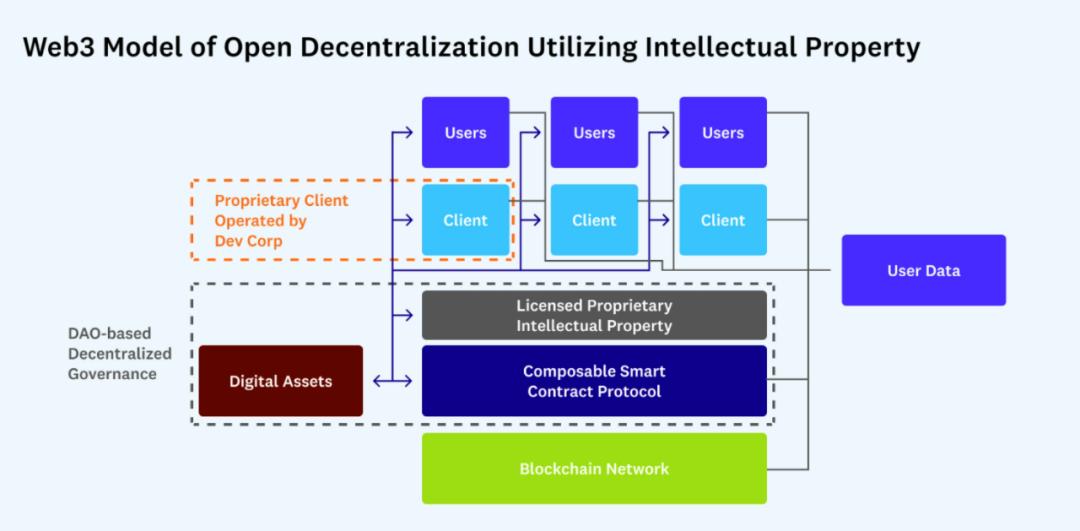
The introduction of dedicated IP seems to revert some of the system's decentralized economics to an owner-controlled Web2 economy, especially if the developers/operators of the client side are not willing to subject their products and services to the whims and whims of IP. Control the owner.
However, such risks can be mitigated by the contractual terms of the license (through irrevocable/perpetual terms, rights to modification/improvement, etc.). An important consideration in this regard is what services and ongoing maintenance of intellectual property are required, and whether such services and maintenance, if any, can be provided by independent third parties - as greater reliance on intellectual property A single third-party owner of intellectual property could dilute the overall economic decentralization of the system.
Ultimately, if the terms of the Web3 system are structured correctly, its decentralized economy will remain the same. For example, a Web3 system using a widely available API (Application Programming Interface) in its clients would not weaken the overall decentralization of the Web3 system, but might enhance it.
From the perspective of legal decentralization, the key question to consider is: Are fundamental management efforts by IP providers necessary to drive the success or failure of Web3 systems? Will there be serious information asymmetry? Even if intellectual property is critical to the success of the system, if the owner of the intellectual property cannot revoke it at any time, the answer to both questions is likely to be no—thus favoring the legitimate decentralization of the system. This would also arise if the owner of the intellectual property had to seek approval from the DAO before making any major changes to the intellectual property.
This concept can be extended to other resources besides intellectual property, which may also be contributed or licensed to the Web3 system. For example, if third-party regulatory compliance services allow DeFi protocols to confirm that their users are verified U.S. persons, such services should not undermine the decentralization of Web3 systems. Likewise, it is conceivable that third parties provide marketing and business development related services to the agreement - activities independent of the individual client business.
While the introduction of third-party resources can compromise the decentralization of the system in a number of ways, such risks can often be mitigated through structural and contractual mechanisms (as discussed above).
Open Decentralization: How to Decentralize NFT Projects
Non-fungible token (NFT) projects and their communities are an emerging and increasingly popular type of Web3 system, providing a great opportunity to discuss some other concepts of open decentralization.
First, it's important to understand the legal basis on which most artistic NFTs can be excluded from U.S. securities law, namely that they fail the fourth aspect of the Howey test: the value of NFTs is largely intrinsic, And not from the management efforts of others. But as NFT projects become more complex, Howey's analysis becomes less straightforward. NFT projects now often involve additional content creation/additional NFT casting, implementing NFTs in video games, community-driven product development, and other activities—all of which can increase NFT holders' reliance on the curation efforts of others.
Therefore, NFT projects should consider incorporating the principles of decentralization into their Web3 systems, especially if they intend to combine projects with NFTs. What would a decentralized model for NFT projects look like? The figure below is an example. It reflects: (1) a collection of NFTs minted on the blockchain and held by various users; (2) intellectual property that contributes to the NFT community, likely to be related to the NFT itself Pledge") and any legends created by the community; (3) digital asset distribution and incentive mechanism; (4) launch of DAO's governance of community intellectual property and DAO treasury; (5) launch of derivative projects; (6) holding social gatherings and activities.
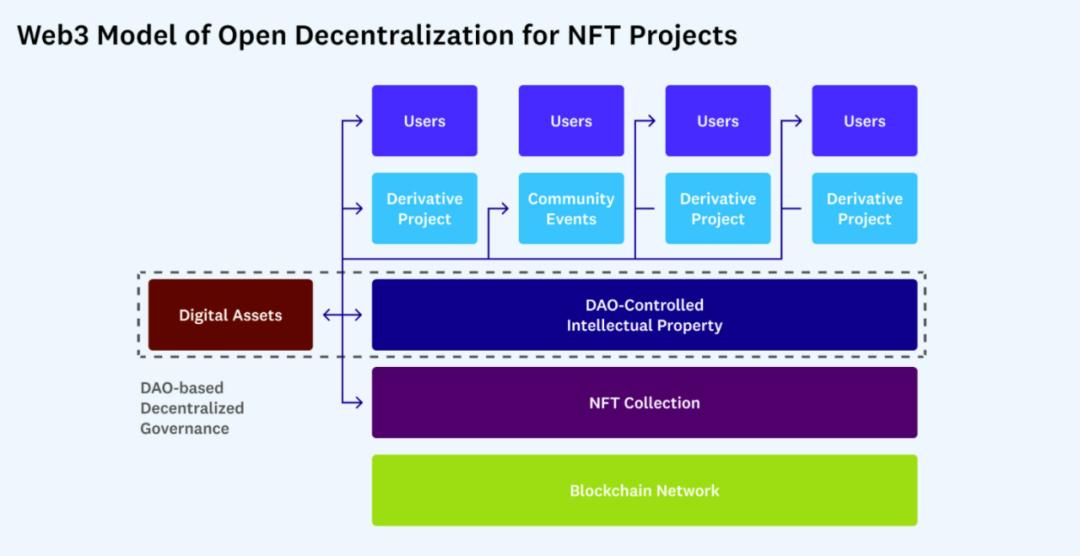
In this model, economic decentralization of NFT projects can be achieved in several steps:
First, a DAO can spend its initial resources on community engagement (e.g. Twitter, Discord, etc.) and fund social meetups and other events - thereby increasing the implicit incentive of the community (i.e. its popularity).
Second, these implicit incentives—along with explicit incentives (such as fungible token rewards, access to NFT sales, etc.)—can be used to incentivize the creation of spin-off projects that leverage the intellectual property of the community. Developers will be rewarded for developing such projects, and consumers will be rewarded for using them. For example, a DAO could hire a third-party developer to create a game that uses the community's characters to make money through play, with in-game tokenomics featuring the community's native digital assets. In this regard, spin-off projects behave similarly to clients described in earlier open decentralized models, thereby making the overall system less dependent on any single source to deliver value to NFT holders, which helps limit the emergence of material information Asymmetric risk.
Finally, another important tool that NFT projects can use is royalties on secondary sales of NFTs generated by DAOs, which can drive their decentralized economy. These royalties will provide the DAO with a decentralized revenue stream during a time when spin-off projects may not generate sufficient returns for the system.
Ultimately, the combination of spin-off projects and the value that secondary sales bring to the ecosystem can drive the creation of a healthy decentralized economy for NFT projects.
From the perspective of decentralization of legal power, the key question is again: Is the fundamental management effort of any third party necessary to drive the success or failure of a Web3 system? Is there a possibility of serious information asymmetry? The answers to these two questions will depend on many of the same considerations discussed above.
However, in this case, intellectual property in the NFT scene may facilitate rather than hinder the overall decentralization of the community. Why? Because intellectual property is contributed to the DAO from a decentralized source (NFT holders). Furthermore, if the DAO were to control the distribution of tokens, additional minting of NFTs and decentralized intellectual property — and decentralized revenue streams (from royalties or spin-off projects) — the system is unlikely to generate serious information asymmetry.
Most NFT projects are still in their early stages, so we haven't seen many examples of NFT projects deploying decentralized token economics, but we hope to see various mechanisms. At the same time, many learnings can also be integrated into NFT projects of other Web3 systems.
Open Decentralization: How To Decentralize Tokenization Protocols
Tokenization protocols are another emerging Web3 system. In these systems, assets are loaded onto the blockchain, tokenized through smart contract protocols, and then sold or used for other purposes. Types of tokenization protocols include serial NFT minting projects, digital asset marketplaces, and protocols for tokenizing real-world assets.
The Open Decentralization Model below reflects:
Bringing assets from multiple suppliers on-chain through a shared smart contract protocol;
A smart contract protocol to tokenize such assets;
sell or use such tokenized assets through multiple clients;
Native digital asset distribution and incentive mechanism;
DAO governance launch on community intellectual property and DAO treasury.
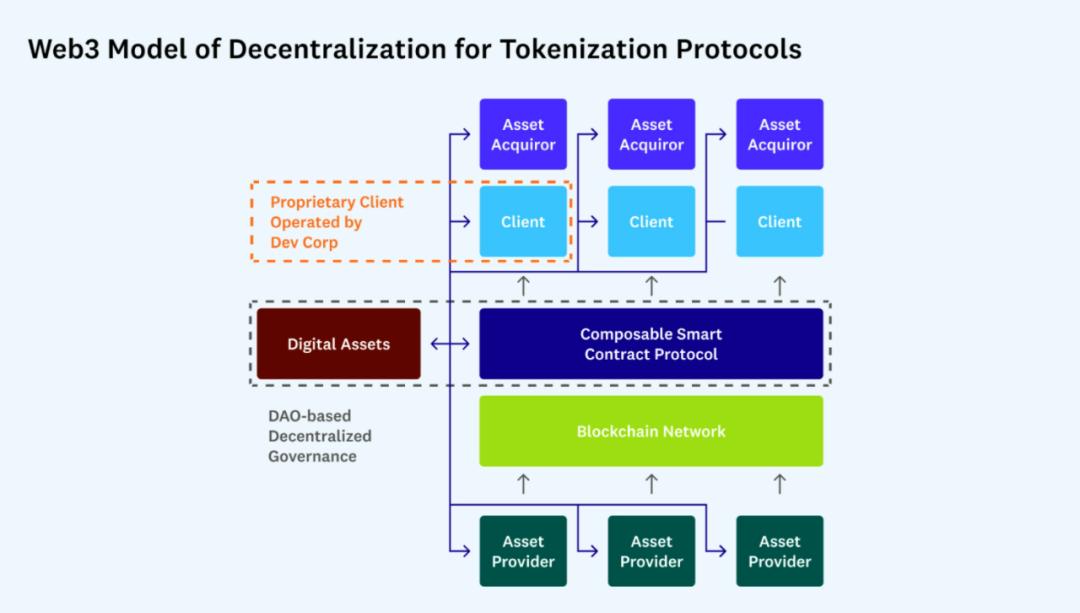
In this model, economic decentralization is through sufficiently diverse inputs (asset providers) and outputs (asset acquirers) and layers through which tokenized assets flow (blockchain, smart contracts, and clients) realized by transformation.
DAOs on the protocol can also use explicit incentives (fungible token rewards, no commissions/fees, etc.) to:
Incentivize asset providers to provide assets to the system;
Incentivize clients to make markets in tokenized assets;
Incentives for acquirers to acquire or consume such assets.
While the initial development company may initially play a significant role in any of these roles (asset provider, customer operator, asset acquirer), once the system is decentralized, the development company will end up being just a multitude of participants in any given role one of them. This will limit the risk of any significant information asymmetry it creates and reduce reliance on its management. Additionally, DAOs and/or subDAOs can assume many roles.
Explicit incentives can also be adjusted over time to address potential shortages on the supply side or demand side. For example, in a decentralized market, token incentives for sellers (supply side) can be increased to bring more goods to the platform for sale; and token incentives for buyers (demand side) can be increased to encourage more Buy more.
From the perspective of decentralization of legal power, the key question is again: Is the fundamental management effort of any third party necessary to drive the success or failure of a Web3 system? Is there a possibility of serious information asymmetry? The answer to both of these questions depends on whether the DAO can effectively manage its incentives to balance supply and demand as in the example above - but more broadly, it is really designed to prevent any single asset provider, asset acquirer, or Customers have become so important that the success of the entire system depends on the efforts of any one entity.
* * *
Builders of Web3 systems currently face many challenges in launching, managing, and scaling decentralization. But even though regulatory requirements may change, framing decentralization as a single design challenge, encompassing technical, economic, and legal aspects, should provide a strong reference guide to help builders use new components of Web3 systems to overcome these challenges.
Failure to consider all three of these elements will prevent us from realizing the Web3 of the future that blockchain technology and cryptocurrencies enable.By building carefully designed decentralized systems, builders can create the digital infrastructure and breathe life into the decentralized economy that will be the foundation of the internet for decades to come.It's time to build that internet and that future.


