






Overview of Service DAO Ecosystem: Advantages, Challenges and Solutions


Original author:Terry Chung,1kx network
Compilation of the original text: The Way of DeFi
Original author:Compilation of the original text: The Way of DeFi。
Traditional companies turn to consulting firms for advice, while protocols and DAOs often have completely different needs, operating mechanisms, and cultures and are therefore best served by other crypto-native contributors. DAO-as-a-service are emerging and positioned as a platform for summoning cryptographic protocols and DAOs
Over the past month, we have interviewed various DAO operators as a service. We hope to provide an overview of the biggest challenges they face, as well as community-sourced ideas that have worked in practice to mitigate these challenges.
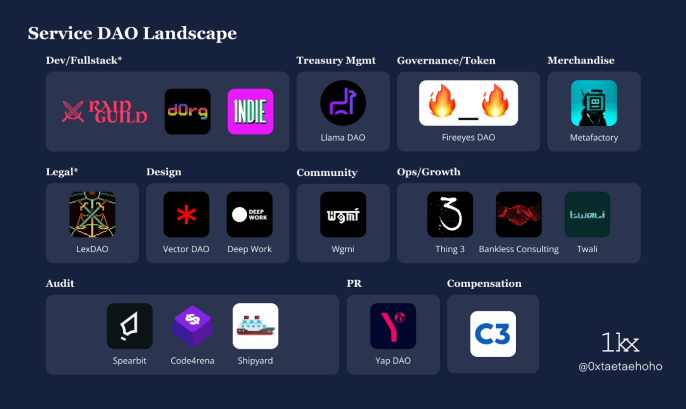
Service DAO Ecology
image description
Service-oriented DAO ecological map as of April 1, 2022
First - why do they form?
The service DAO operators we spoke to basically identified 3 key advantages over traditional consultancies.
Contributors to a DAO-as-a-service get both a share of the value they create for each client, and a share of the organization as a whole — its reputation or future revenue streams.
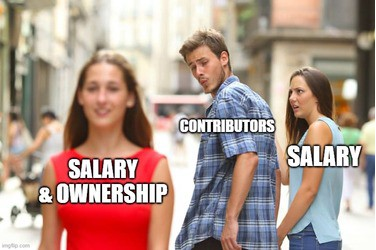
2. An open culture of contribution
According to the operators, ownership has fundamentally changed attitudes towards organizations. It better aligns incentives and induces a more collaborative and open culture.
Some service DAOs are structured to allow anyone to join and contribute.
3. Better understand the problem they are trying to solve
If you have skills and are valuable to the DAO, there is almost nothing stopping you from working on an account. For those DAOs that screen applicants (by interviewing, reviewing past work), they look at a person's ability to add value rather than their credentials - for example, anonymous contributors were common among those we interviewed .
3. Better understand the problem they are trying to solve
The largest customers of DAOs as a service are other DAOs and encryption protocols. These clients face unique challenges in development, operations, management, compensation, PR, legal, etc. that are best addressed by other DAOs.
For example, DAO2DAO salespeople are more familiar with the challenges surrounding lobbying token holders to pass governance proposals, multisig, and other challenges that can impact service cycles.
4. Reduce income volatility for contributors
We grouped the most frequently asked questions in interviews into the following four interwoven categories:
personnel
1. Difficulty finding and retaining contributors
personnel
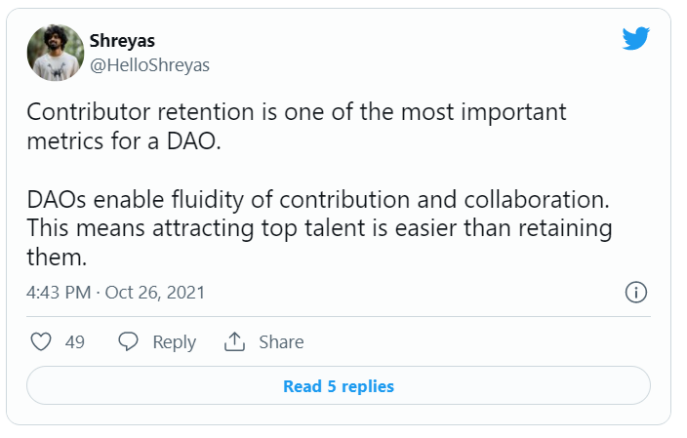
1. Difficulty finding and retaining contributors
Sophisticated contributors will bounce from DAO to DAO, making it difficult to retain them in the long term.
Contributor retention is one of the most important metrics for a DAO.
DAOs make contributions and collaboration fluid. This means it is easier to attract top talent than to keep them.
— Shreyas, co-founder of Llama DAO
Service DAOs are experiencing demand far exceeding their capacity. As a result, many service DAOs are struggling to find people with aligned values, a cultural fit, and enough familiarity with the job at hand to deliver output without management oversight.
Even for DAOs with access to talent, getting talent in the network to make real contributions is difficult.
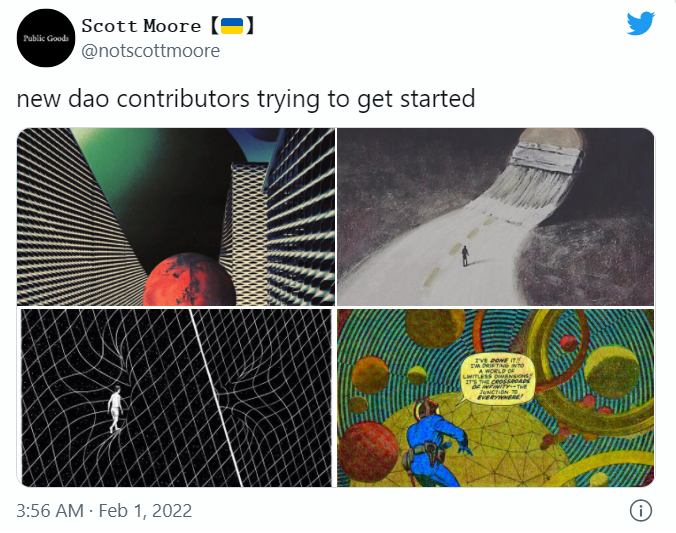
Operators identified shyness and confusion as the two main causes of this problem. Talent either doesn't understand the DAO culture (where it's common to be a contributor), waits for instructions, or isn't sure about the standardized process, who to communicate with, whether they'll be compensated, etc., to actively participate project.
image description
New DAO Contributors Try to Get Started
3. Difficulty maintaining consistency in culture and values, and disseminating these values throughout the DAO
The most frequently cited difficulty was that of culture building. Operators are working to:
Make sure contributors are aligned with value
Create culture-aligned internal processes, marketing and documentation
The operator emphasizes that culture refers to the entire experience of being part of a DAO—including the language used, platforms, documents, meeting formats, and more.Every interaction a contributor has with the organization and its members reflects the organization's philosophy and culture, which is by far the most cited determinant of talent retention, quality of contributions, ability to recruit, and overall better operations .A DAO operator cites
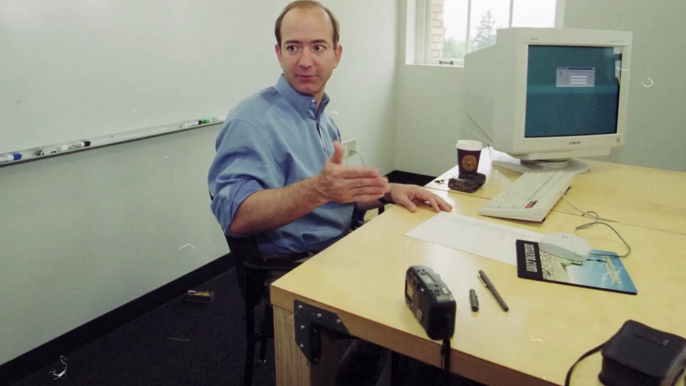
example of. In the early days of Amazon, everyone in the office used recycled doors as desks, in an apparent attempt to show that Amazon "only spends money where it improves the customer experience." This ethos then permeates every interaction within the company and between the company and its customers.
operate
DAO operators are working hard to align missions and create a DAO-wide culture in a non-hierarchical, asynchronous and remote environment.
operate
1. Lack of standardized process
Operators found it difficult to standardize processes and maintain documentation for these processes.
When the process is decided, it is difficult for the DAO to disseminate information to the contributors so that they continue to practice this process in practice.
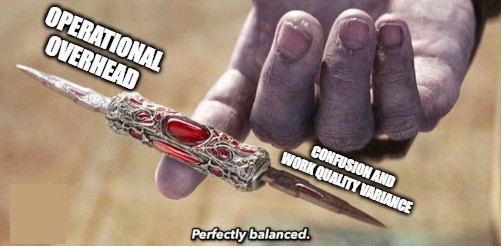
Some operators believe that the "bloat" of documents and processes is a big difficulty for newcomers who want to start contributing, but they have to wade through a thick stack of documents. This is in direct contrast to those who blame the lack of onboarding documentation as the direct cause of the lack of contributor activation.
In general, most DAOs are struggling to achieve a balance, on the one hand, there is too much communication, documentation, and process optimization overhead, and on the other hand, there are differences in the work of contributors, and the lack of a unified process delays work , and confusion about how to participate/join.
Many DAOs have a lot of challenges in setting up a company (especially if they are not based in the US), picking the best entity, issuing tokens, helping contributors pay taxes, paying suppliers/non-crypto external entities, etc.
1. Inconsistent customer experience
external challenge
1. Inconsistent customer experience
Next to culture, the second most-cited issue is the variability in customer experience. Because the process is not standardized and well communicated, or because there is a lack of layers of quality assurance, projects take longer to complete, and some customers experience is not as good.
2. Friction at end of service
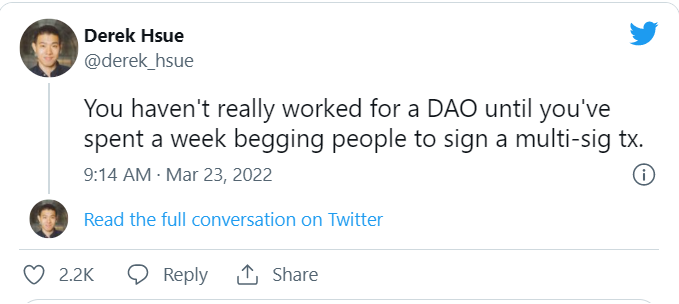
In DAO2DAO sales, operators face friction after the service ends, especially for DAOs that can only pay for services after voting and multisig.
You haven't actually worked for a DAO until you've spent a week begging people to sign a multisig transaction. —— Derek Hsue, former Blockchain Capital analyst
crowdsourced solutions
Contributors outlined the biggest problems they faced, and we asked what solutions they had in their DAOs to alleviate them. Here are these crowdsourced solutions we've compiled.Note that each solution worked for at least one DAO we interviewed, so there may be conflicting solutions that work for different DAOs. 。
Full text of the solution
law
Categories: Legal, People + Operations, Technology Stack, External Solutions
lawLCAWorkers Co-op - The downside is that it's hard to find a lawyer who really understands co-ops.
limited cooperative association (
) - allows for investor tiers with a two-tier systemSeries LLCLimited Liability Company (LLC) -- makes sense for small development companies, but hard to have anonymous contributors
Series LLC (
) -- easy to maintain, but the disadvantage is centralization.
Talk to lawyers early on, not when you need them.
personnel + operation
1. Compensation structure
Salespeople get 10%, the DAO treasury gets 10%, and the rest is split among contributors. Split payments by the role of each project.
2. Recruit and retain talent
Build a “give more” culture early on. Sometimes external token holders don't like paying DAO contributors, so build that culture early on.
Bring new people in and train them by asking everyone in the community to mentor everyone else in the project.
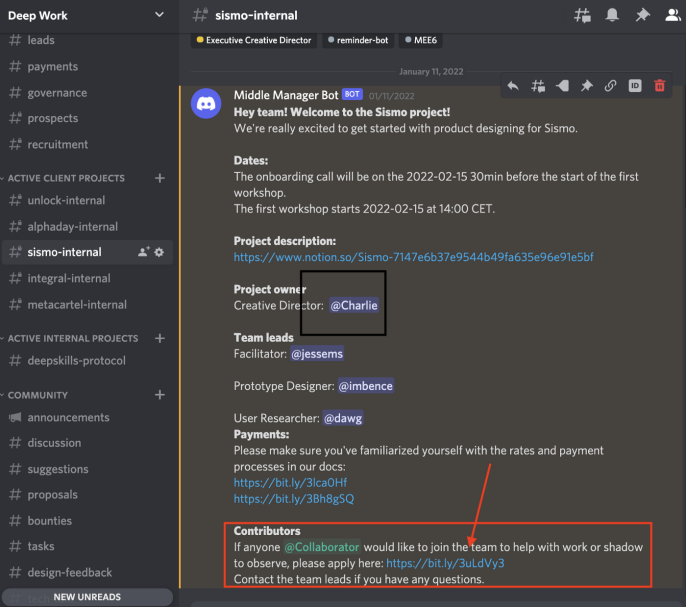
Allow new people to follow along and learn.from
3. Build a culture
Deepwork Quick Start GuideDonut3. Build a culture
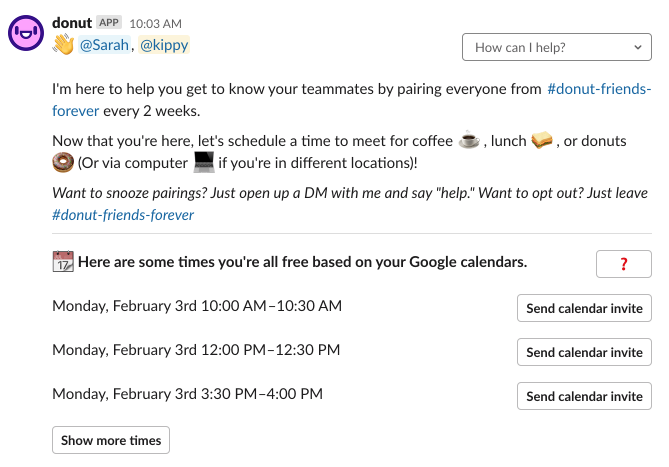
Encourage more 1:1 interactions (such as on Slack
). It's really important for people to get to know each other personally.
Repeat missions, narratives as much as possible.
Limit your rate of growth so the culture spreads first before you hire. Ideally, the DAO would always find someone with more experience than the newcomer.
Make a meme, some kind of shared "sacred" document/artwork that contains all the collective principles that the community can come together. (like Loot).
4. Streamline operations
Hire a project manager.Allocate talent/capital for communications, coordination improvements, process improvements, full-time member experience, documentation, QA of forum posts, sales process...etc.By adopting existing processes (
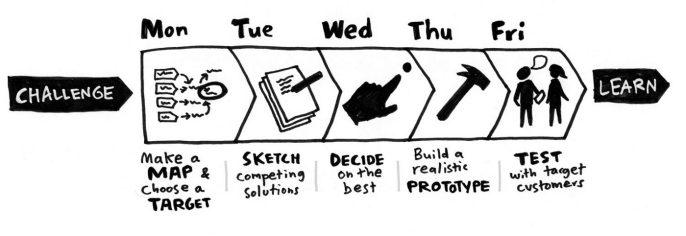
), maintain structure, quality of work/customer experience variance -- do what has been tested and works.
technology stack
Design sprint (a set of basic processes sorted out by Google on how to lead the team to quickly innovate and verify the design)https://smartinvoice.xyz/
Utopia / Gilded Finance
Discord, Gnosis, Lettucemeet, Airtable, Notion, Snapshot
technology stack
Customize CRM and Invoicing
external solution
Deploy several people responsible for managing the bridge between the working group, personnel and the public.
Transparency is an important element.
- If you are an open source, community driven project, be completely transparent.
- Balance transparency and operational focus depending on the project you're building.
image description
Summarize
Raidguild - Join the Raidguild and slay demons
Summarize


