






Token Economic Analysis Framework: How to study Token in the encrypted world?


Original title: "Practical | Token Economic Analysis Framework (Introduction)"
Original Author: Ren&Heinrich
Original compilation: Alpha Rabbit, Alpha Rabbit Research Notes
How to study Token in the encrypted world?
*This article is about 3500 words, and the reading time is 15-20 minutes
Let’s look at a set of data first: As of 2022, there will be about 6,000 cryptocurrencies (or more) on the market. This is certainly a great opportunity for investors. However, in 2021, investors encountered fraud in Crypto projects and lost $12 billion. Therefore, Token economics is a very important perspective on how to go from the outside to the inside and see the most essential things.
This article provides an introductory thinking framework for the research of Token economics.
Token economics is the science of studying Token design, distribution, and supply and demand models. Token economics is mainly the study of Token disciplines, including Token economic model design, Token distribution among business stakeholders, and the conditions for Token to start trading , and how transactions evolve over time.
Token economics in a broad sense also includes design, token engineering, etc., which are beyond the scope of this article.
background
background
First of all, it must be clear: what is the difference between Token and Coin in the encrypted world (English)?
Although the terms Token and Coin are often used synonymously, it should be noted that the term Coin usually refers to the cryptocurrency running on the Layer 1 public chain. the term"token "In different scenarios, it has different meanings. It sometimes refers to encrypted assets created at the Layer 2 protocol layer, which means that it must abide by the rules of the L1 blockchain it uses. For example, ERC20 Token, ERC721 NFT (Token) More generally, most encrypted assets can also be called Token. The functions of some Tokens include: voting rights, or as digital ownership of real-world assets, and Tokens can sometimes be used as payment within the agreement.
The value of Token mainly depends on the overall performance of the project.
What is Token Economics in the Crypto World?
The term Token Economics mainly refers to the research on the economics of cryptocurrencies and Tokens. This type of research can enable investors to determine the quality and value of potential investments to some extent. Token economics is very important for buying and selling decisions of encrypted assets.
How to Research Token Economics: An Introductory Framework
1. Study the Layer of Blockchain (Crypto Layers Explained)
First of all, we need to carefully study whether this blockchain belongs to Layer 1 or Layer 2. This is the foundation.
What needs to be clarified first is whether this Coin or Token is running on Layer 1 or Layer 2.
The Layer 1 blockchain operates independently of other blockchains. Examples of Layer 1 Tokens are Ethereum’s ETH, Avalanche’s Avax, and so on.
Layer 2 Solution is a third-party protocol built on the L1 public chain. For example, the Maker Protocol is built on Ethereum. It is an L2 layer protocol, so MKR and Dai are Layer 2 Tokens;
Note: The L1 public chain and the L2 protocol will affect each other. If the Layer 1 public chain provides a simple, efficient and secure infrastructure, it will attract more L2 projects. Conversely, if the L2 project does well, it will in turn have a positive impact on the L1, thereby increasing the value of the Layer 1 cryptocurrency.
2. How to study the ecosystem of a chain
Since L1 and L2 are intertwined and projects with different backgrounds, it is very important to understand the interdependence of different encrypted Tokens as comprehensively and detailedly as possible.
If you want to discover the next blockchain ecosystem with huge future growth potential. It means that there needs to be a solid Layer 1 blockchain, which is the basis for the healthy operation of L2 applications.
3. Original Chain vs Forked Chain
It should also be considered whether the blockchain to be studied is the initial blockchain or a forked blockchain
For example, Ethereum Classic is a fork of Ethereum. Litecoin, Bitcoin Cash is a fork of the Bitcoin blockchain.
It is important to study what modifications have been made to the forked chain to understand what specific aspects of it are better or worse than the original chain. For example, Bitcoin Cash will never have more users than Bitcoin. However, BSC is a very successful fork of the Go Ethereum protocol, but their consensus mechanism is different.
4. Research on Token
After studying the basic information of the relevant blockchain, a comprehensive analysis of the Token can begin.
4.1 Utility vs Security (Securities) Token
The purpose and purpose of the token is critical: for example, token holders can use tokens to pay transaction fees, enable holders to obtain related services, such as staking (PoS), or for governance (voting).
A token with practical value usually has a specific use case. For example: some Tokens allow users who hold them to obtain products or services on the blockchain, and some Tokens allow users to have voting rights.
Security tokens are somewhat similar to stocks: there are two types of tokens:
- Asset Tokenization: Traditional financial assets are represented by Tokens on the chain, for example, stocks representing the percentage of company ownership can be Tokenized. In another scenario, the ownership of a unit of gold can also be tokenized and expressed on the chain.
Generally speaking, according to the Howey test, if a Token cannot be characterized as a SecurityToken, then it is a Utility Token;
Note: In the United States, companies that want to issue Security Token need to be regulated by the SEC. Blockchain projects that fail to comply with these regulations risk being fined or shut down. Therefore, it is important to understand whether the Token you want to research or invest in is a target token or a Security Token.
Generally speaking, according to the Howey test, if a Token cannot be characterized as a SecurityToken, then it is a Utility Token;
Standards of the Howe test:
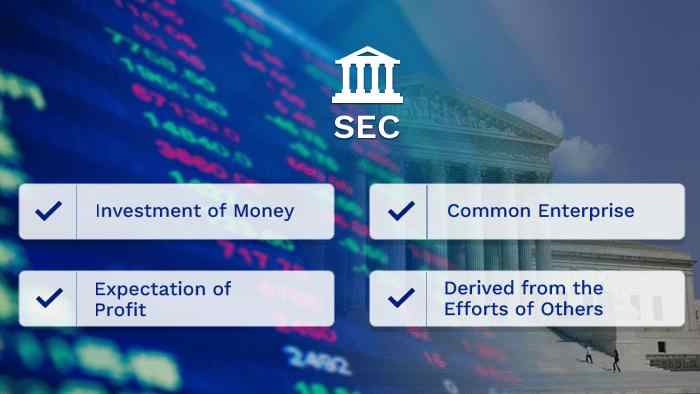
The Howey test refers to a standard for judging whether a particular transaction constitutes an offering of securities. This test stems largely from a 1946 decision by the U.S. Supreme Court that used a specific standard for determining whether a particular transaction constituted an offering of securities. If this transaction is deemed a security, it is subject to the US Securities Act of 1933 and the Securities Exchange Act of 1934. At present, many ICOs on the market may be identified as securities issuance and thus subject to relevant supervision.
Standards of the Howe test:
1. There is indeed money/capital investment (The Investment of Money)
2. Invest in the Common Enterprise
3. Investors have income expectations and expect to obtain profits (Expectation of Profit)
4. Do not directly participate in the operation, but only rely on the efforts of the promoter or a third party. (Effort of Others)
In order to determine the possibility of a Token being a Security Token or a Utility Token, you can use the score given by the Crypto Rating Council Website. The higher the score, the more likely the Token is a Security Token;
4.2 Fungible vs Non-Fungible Tokens
Fungible Tokens are not unique. For example, an ether you own is the same as an ether in my wallet.
Non-Fungible Tokens (NFT) are unique and cannot be copied, such as personal academic records, artwork, music, etc. For example, each CryptoKitty is unique and represented by an NFT, or each piece of land in Decentraland could also be represented by an NFT.
On the Ethereum blockchain, ERC721 Token is irreplaceable
generation, and ERC20 Token is replaceable.
4.3 Token supply side
When analyzing the supply of a token, the following points need to be considered:
Total supply: the number of Tokens created minus the"destroy"Token.
Total supply: the number of tokens created minus the tokens which have been「burned」.
Maximum supply (Maximum supply:): refers to the total amount of Token that will always exist. For example, Bitcoin has a max supply of 21 million, while ETH has no max supply.
Maximum supply: refers to the total amount of a token that will ever exist. For example, the maximum supply of Bitcoin is 21 million, whereas Ether has no maximum supply.
Circulating/Circulating Supply:It is very important, because it will affect the market value of Token (Circulating supply: is important, because it influences the market capitalization of a token.)
Here's how the market cap is calculated:
Here is how marketcap is calculated:
Marketcap = number of coins/circulating supply of the token * current price per coin/token)
Market cap (Marketcap) = Number of Tokens/Token Circulating Supply * Current Price of Each Token
Compare the market cap to the diluted market cap, which can usually be found on tools like coinmarketcap.com and coingecko.com.
Diluted market value means: the theoretical market value of a Token in the case of the maximum supply in circulation.
(The diluted marketcap indicates the theoretical marketcap if the maximum supply of a token is in circulation.)
To ensure accuracy, tools that record blockchain data should always be double-checked to ensure they are up to date.
Token's market value:The economic value of Token is better explained than the price of a single Token. Note that some projects issue a large number of Tokens at very cheap prices, such as $0.0001 per Token.
(Market capitalization of the token: a better indication of the token』s economic value than an individual token』s price.)
They do this to make investors think that the token price can easily rise 1000 times. But the reality is that if the market value of Token is already very large, then the price of Token may not be likely to rise very high.
Even though the prices of most cryptocurrencies are often manipulated by big players, it should be noted that the higher the market capitalization, the more difficult it is to manipulate prices.
4.4 Has the Token you care about been mint in advance (Pre-minted)?
Pre-minted means that Token has been created before it comes out. Note that this happens a lot in ICOs. Many Layey 2 tokens, such as ERC20 tokens, are pre-mint so that contributors, early investors, and contributors can be rewarded.
So, why is it important to know if a token is pre-mined?
Because Pre-mint Tokens are often distributed internally before they can be purchased by the public. If a large number of Tokens are held by insiders at the time of issuance, the Token price is easily manipulated.
Token allocation and distribution: We should always understand how tokens are allocated and distributed. First, research this information from the project's white paper and sites like icodrops.com. But remember to cross-check holders on the blockchain explorer, because sometimes the information in the white paper or other websites may be out of date.
When studying the allocation and distribution of tokens, other issues that need to be studied include:
- Who will receive Tokens as rewards?
- For ICO, what is the price of Token in Private Sale? This information can be found in a project's white paper and on sites such as icodrops. If the token is already listed on an exchange, you can compare the pre-sale price with the current price. If the pre-sale price is very cheap, investors who got tokens in the pre-sale can sell their tokens for a profit.
How is the Vesting Schedule of this Token arranged? Vesting Schedule means that a certain number of Tokens will be locked for a period of time to prevent a sudden large number of Token sell-offs, causing the price to collapse. If a large number of tokens are locked, you should study their release schedule, because when more tokens are released, it will affect the token price and market value. If the project unlocks a large number of Tokens at one time, there will be a high probability that the price will drop sharply.
4.5 Is the Token mode an inflation mode or a deflation mode?
Is the token model inflationary or deflationary?
This kind of model will affect the token supply model: if a cryptocurrency has no maximum supply limit, then it is similar to an inflationary model. Usually some projects use Token destruction to control price inflation.
Original link
References:
1.The Howey Test: Regulating the Blockchain Tokens (leewayhertz.com)
2.https://medium.com/the-capital/your-guide-to-researching-tokenomics-931c3e3b84c
3.https://research.thetie.io/token-economics/
4.https://time.com/nextadvisor/investing/cryptocurrency/common-crypto-scams/


