






Art Blocks: Generating art vending machines, the cumulative transaction volume exceeds 1.3 billion US dollars


Original Source: Overseas Unicorns
Original Source: Overseas Unicorns
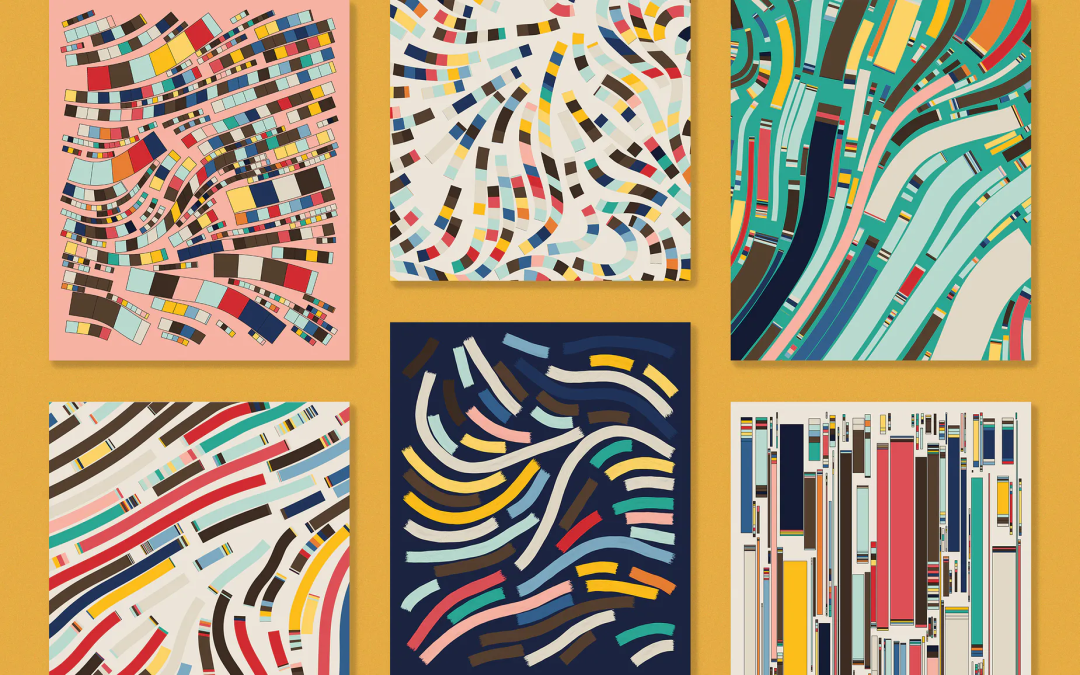
Code and software have taken over our lives, but generative art created using code has been underestimated for many years. The NFT and Art Blocks craze starting in the summer of 2021 has changed that.
Art Blocks was founded by Erick Calderon and others in 2020. It is a vending machine for generative art. It uses the hash value randomly generated during the transaction to generate the final work, subversively changing the relationship between creators and collectors of generative art. .
Chromie Squiggle, Ringers, and Fidenza issued by Art Blocks have all triggered a wave of investment in generative art in the NFT world. They perfectly embody the "controllable randomness" of generative art. Artists need to adjust the script many times to ensure that the works randomly obtained by thousands of users are unique and aesthetically pleasing.In 2021, Art Blocks has a cumulative transaction volume of more than US$1 billion, and earned more than US$25 million in revenue through royalties.In August 2021, it closed a $6 million round of financing. TRUE Ventures led the round, with participation from Galaxy Digital's VC Galaxy Interactive and Collab Currency.
As the market's attention shifted, Art Blocks and Generative Art NFT stopped skyrocketing, and the monthly transaction volume also dropped from the peak of 587 million US dollars in August 21, and continued to be below 100 million US dollars after October.But Art Blocks is already a recognized blue-chip NFT and has become an indispensable Portfolio for NFT index funds. Erick Calderon is not panicking, the company's cash flow is enough to support it for many years, and he is accelerating the recruitment of engineers and shaping the company's culture.
There are other interesting topics surrounding generative art: speculators are starting to ebb, and more Art Blocks are collectors, whose NFT display needs are far from being met; Imagination at work in the Metaverse.
The following is the table of contents of this article, and it is recommended to read in combination with the main points:
01 A Brief History of Generative Art
02 Birth of Art Blocks
03 Important Works on Art Blocks
Fidenza
Ringers
Chimera
04 Mutual achievements between Art Blocks and artists
Curated vs Playground vs Factory
Income far exceeded expectations
05 Invest in Art Blocks
Art Blocks as a Blue Chip NFT
Art Blocks as a startup
06 Other interesting problems with generative art
ebb tide of speculators
A more NFT Native display method
secondary title
01. A Brief History of Generative Art
The simplest definition of generative art is"art created using code that combines randomness and planning". In the creative process, the artist's "human brain" finds aesthetic taste and inspiration, and the "computer" turns inspiration into visual art on a large scale.
Take this code, for example, from Art Blocks Chief Creative Officer Jeff Davis:
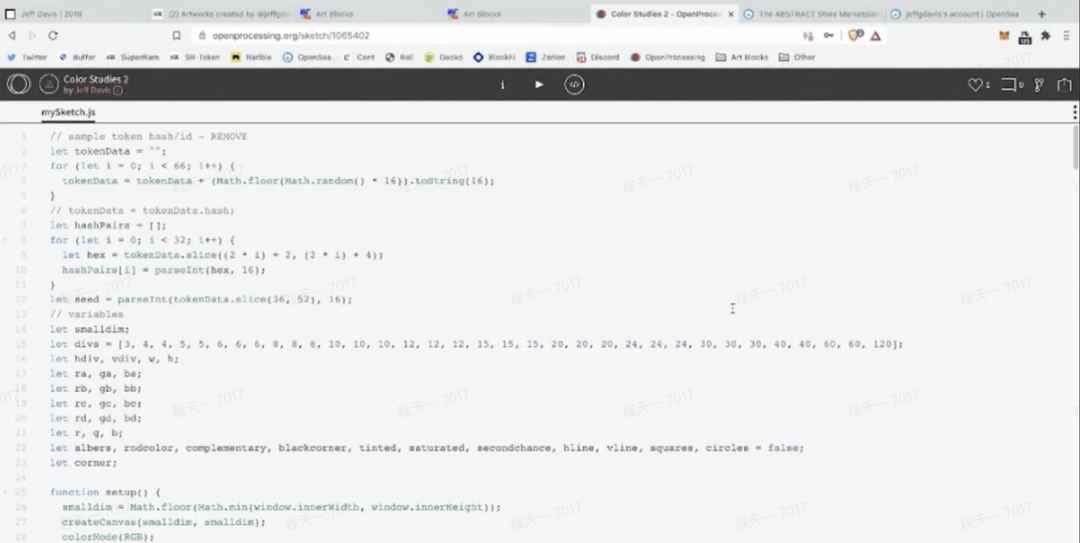
image description
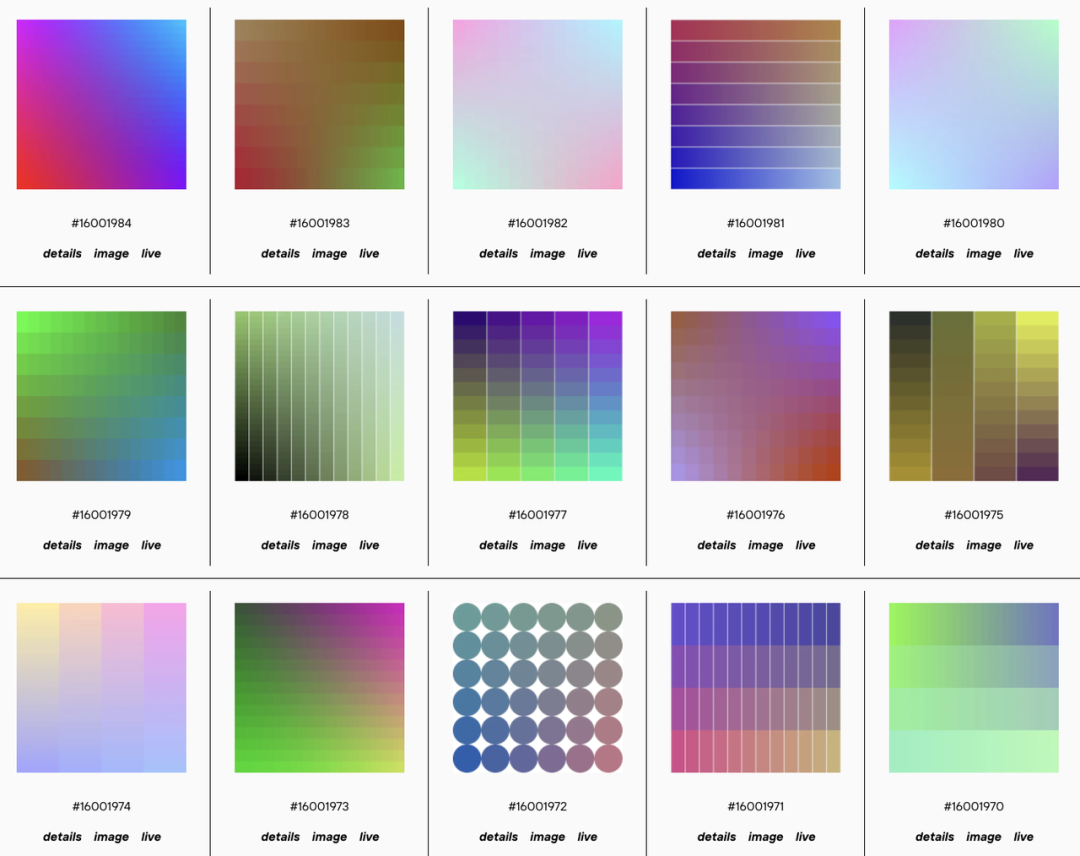
Jeff Davis 2021 Color Studies
The important aesthetic taste of this kind of art comes from its unique "controllable randomness"——Artists often cannot predict the results of code generation, and two runs of the same code may result in very different works, but they can maintain some control for themselves by controlling the "size and position" of randomness.
Jared Tarbell, co-founder of the $15 billion craft e-commerce company Etsy and a generative artist, describes the concept of "controllable randomness" this way:
If it's a normally written program, it will run the same way every time. But generative artists define a different system that allows the results to be randomized. As a creator, you will be amazed by your program (the output work).
image description
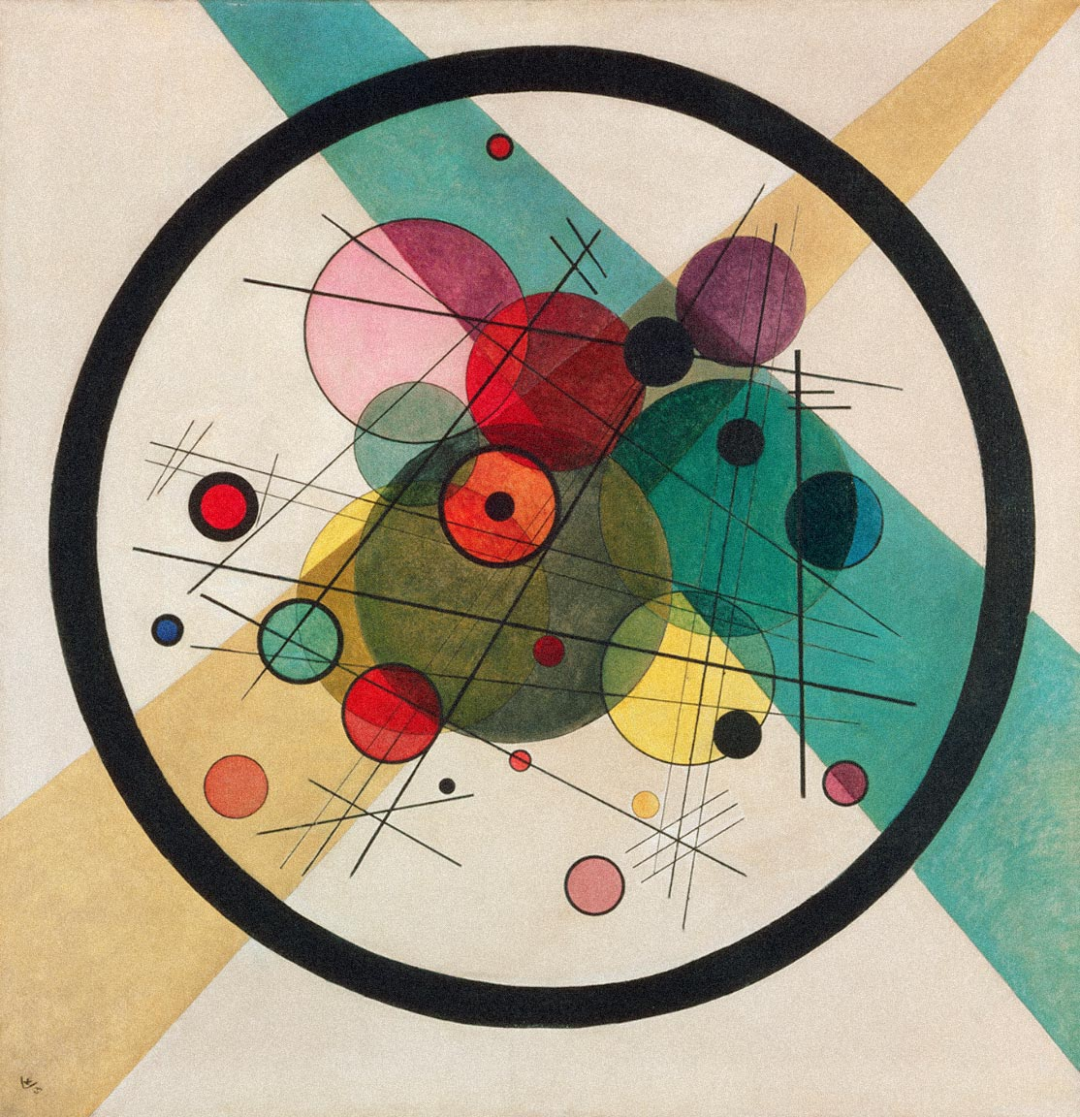
Kandinsky's "Circle within a Circle" 1923
In the 1960s, generative art creation had already begun to emerge. This is not only a natural evolution of the transformation from a mechanical society to an information society, but also because the use of computers for creation is indeed advanced—computers can effectively handle the increase in complexity and scale of creation.
Curator and art critic Jason Bailey introduces the work below in Why You Love Generative Art. As the number of rows increases, the randomness of the rotation angle and position of the squares in the work increases.image description
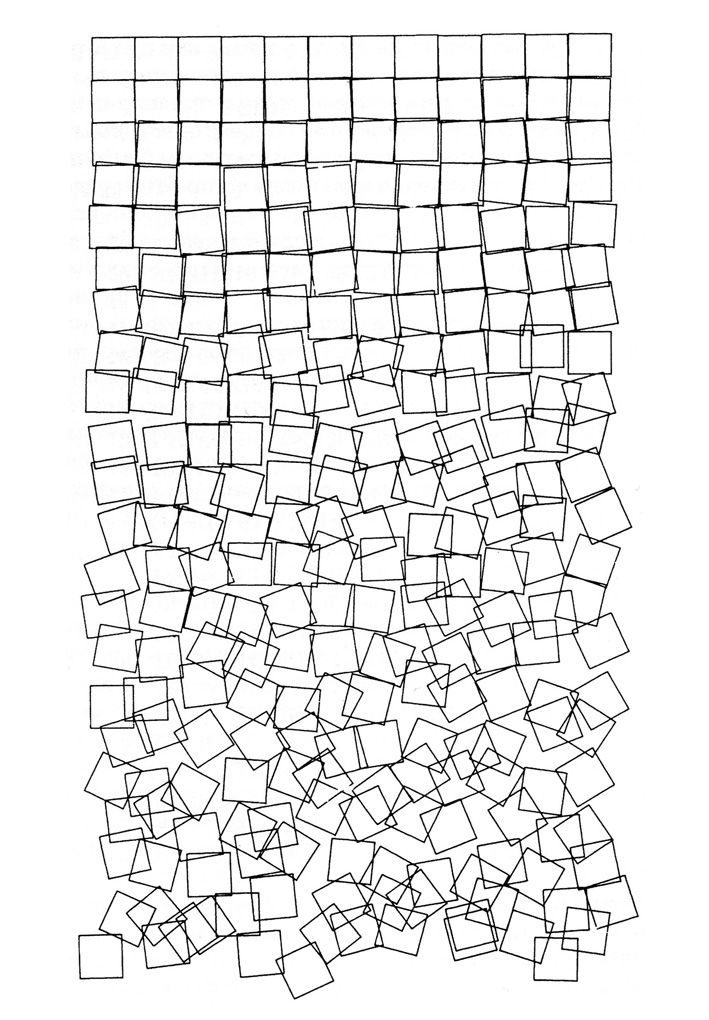
Gravel by Georg Nees, 1968
Despite this, generative art was still a small niche in the 80s - computers were too expensive and bulky at that time. In 2001, Processing was born. It is a flexible and easy-to-use drawing software and a programming language more suitable for visual arts.The rise of personal computers and Processing jointly promoted the rapid popularity of generative art after the 2010s.
image description
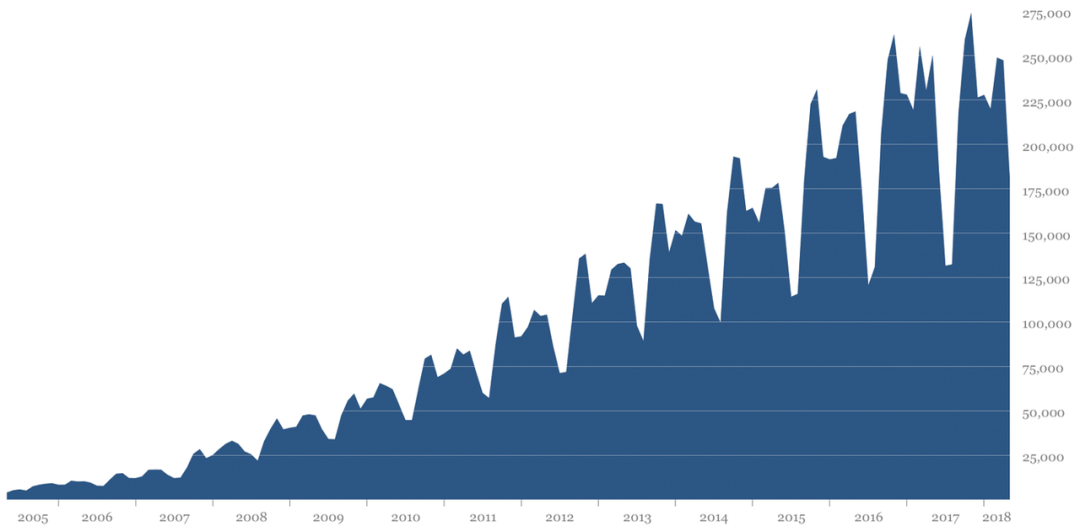
Number of times Processing is opened on different computers per month
Jared Tarbell is a user of Processing. Before founding Etsy, he created a series of generative art works:
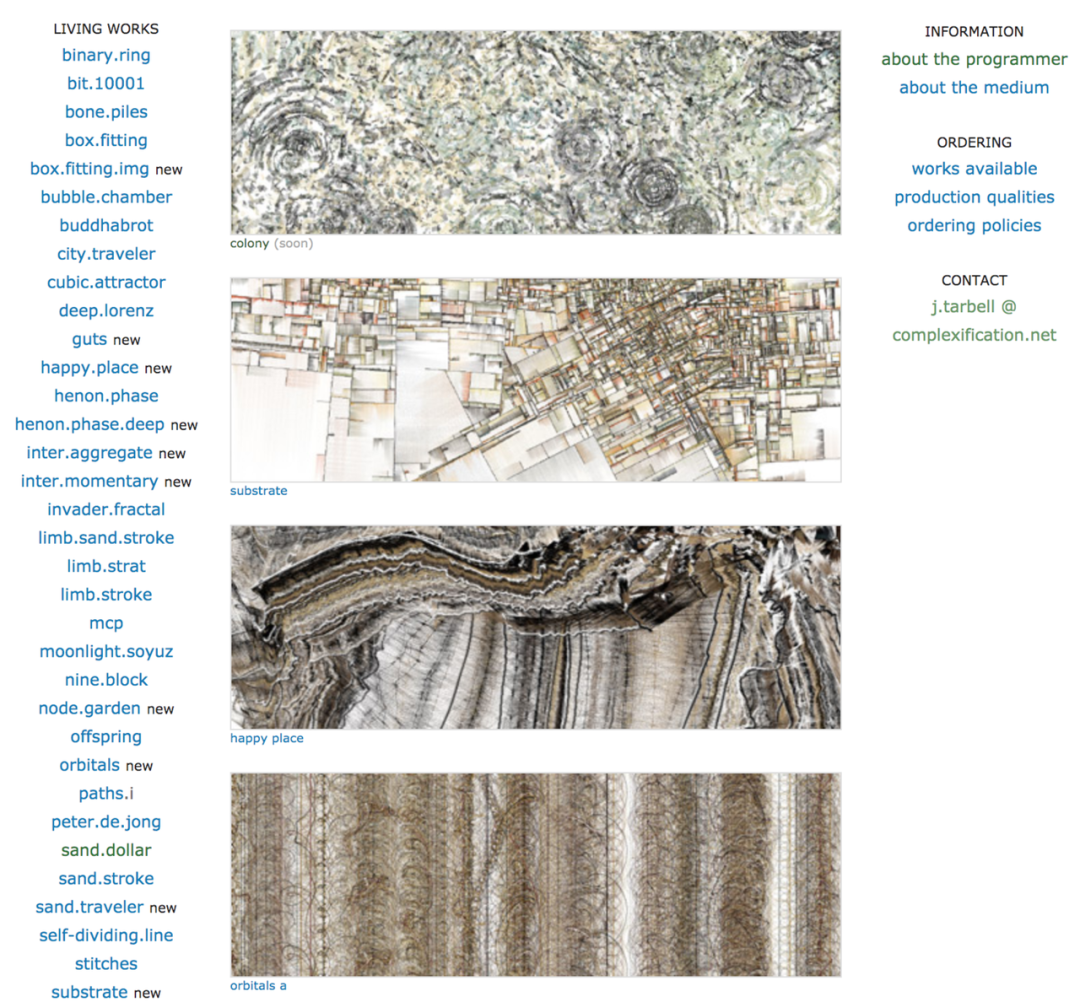
For creators of generative art, the emergence of NFT trading platforms is another key node. Prior to this, although they created on the computer, they still needed to print out their works in order to exhibit and sell them.
After Ethereum launched the NFT ERC721 token specification, NFT trading platforms specially designed for top artists appeared one after another in 2017. Only invited artists can publish works on platforms such as SuperRare and NIfty Gateway, and generative artists are the main force invited.
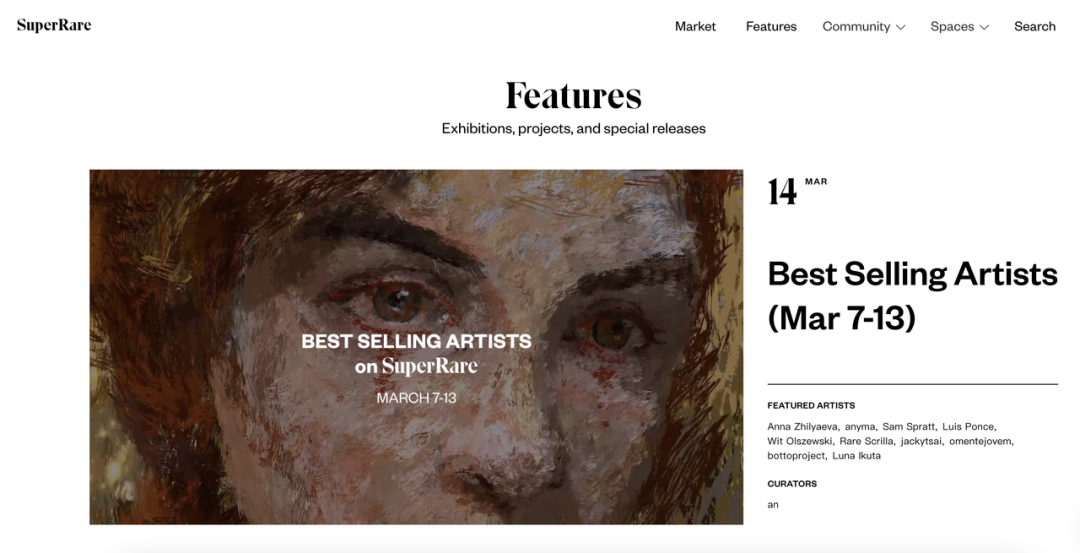
As the price of Ethereum rises and attention increases, more and more artists begin to imagine their careers around "generative art NFT", publish their works as NFT, and expand their influence through Twitter and Discord force.secondary title
02. The Birth of Art Blocks
Although trading platforms such as SuperRare have increased the market influence of generative artists to a certain extent, they have not closely integrated generative art itself with the blockchain. Art Blocks, which emerged under the epidemic, has changed this.
image description
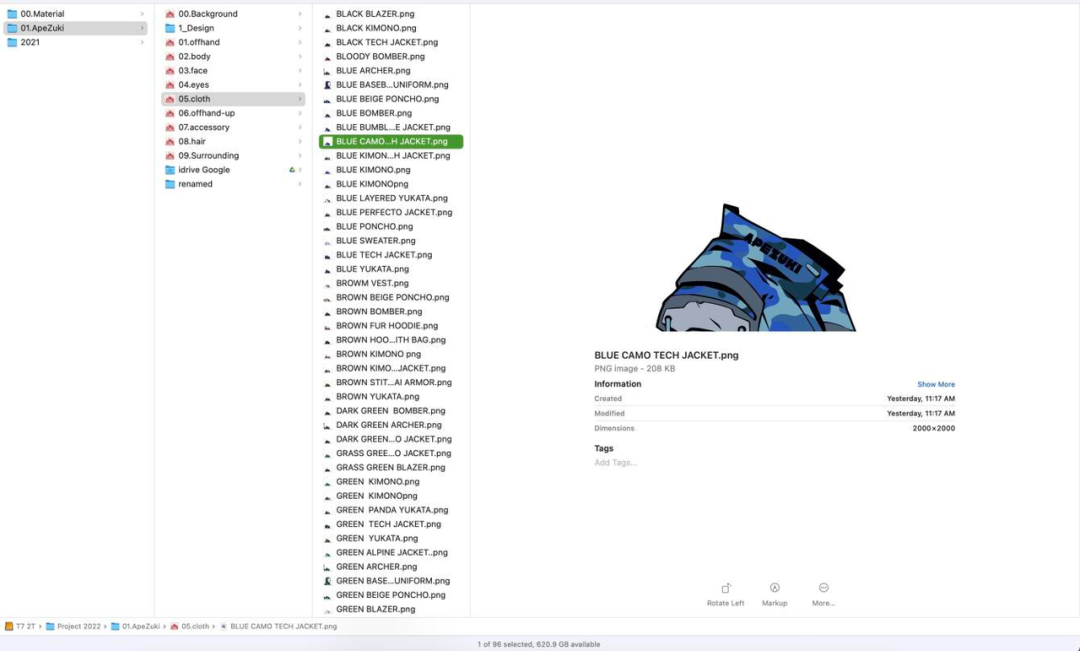
Most of the NFT avatar projects pre-made dozens of pictures for each part and then spliced them randomly during casting, while CryptoPunks and Art Blocks only had codes before casting
Under the DeFi boom in 2020, the sales of CryptoPunks began to increase significantly after September of that year.On the one hand, Erick is thinking about selling his 5 CryptoPunks, and on the other hand, he is thinking about how to use the blockchain to make art more accessible.According to reports from Texas Monthly, his original idea was to create digitally rendered versions of sculptures in real-world art galleries, and then users could scan and purchase these NFTs when visiting.
But the epidemic quickly made him dismiss this idea and turned to create an online creator platform: it is like an art vending machine, collectors buy artworks created on site, and Art Blocks is responsible for their production, sales and storage。This vending machine works as follows:
For creators: they need to adjust and deploy their generative art scripts on Art Blocks in advance, and ensure that its output results are related to the input hash value. This script will be stored on the Ethereum chain through Art Blocks.
For collectors: When collectors mint a series of works (you can understand it as clicking the buy button), they essentially get a random hash value, and then the script executes, a piece of generated art corresponding to this hash value Works are created on the spot.
This model allows collectors to also participate in the creation of generative art. The NFT navigator described the charm of the Art Blocks mode in this way:
The content of this work is actually determined by the style of the original artist, the generation algorithm and your casting timing. Tools, creators, and buyers have jointly completed such a work. This new NFT creation model makes this artwork have more commemorative value, leaving the imprint of the latest technology.
For generative artists, Art Blocks also represent a revolutionary mode of creation. Jeff Davis immediately understood the innovation of Art Blocks after listening to Erick Calderon:
Publishing works on SuperRare is similar to making prints - I create an algorithm, run it, generate many spin-offs, and choose the ones I like to cast/print.
Artblocks is very different, it's a vending machine. People can come and produce art on demand, my scripts are run by the user, and it's up to the user to decide which pieces get minted.
"Controlled randomness" is still key, if not more important.Artists need to adjust the script many times to ensure that the works randomly obtained by thousands of users are unique and aesthetically pleasing, there will be no ugly bad cases, and those rarer hash values correspond to more "beautiful" works.
image description
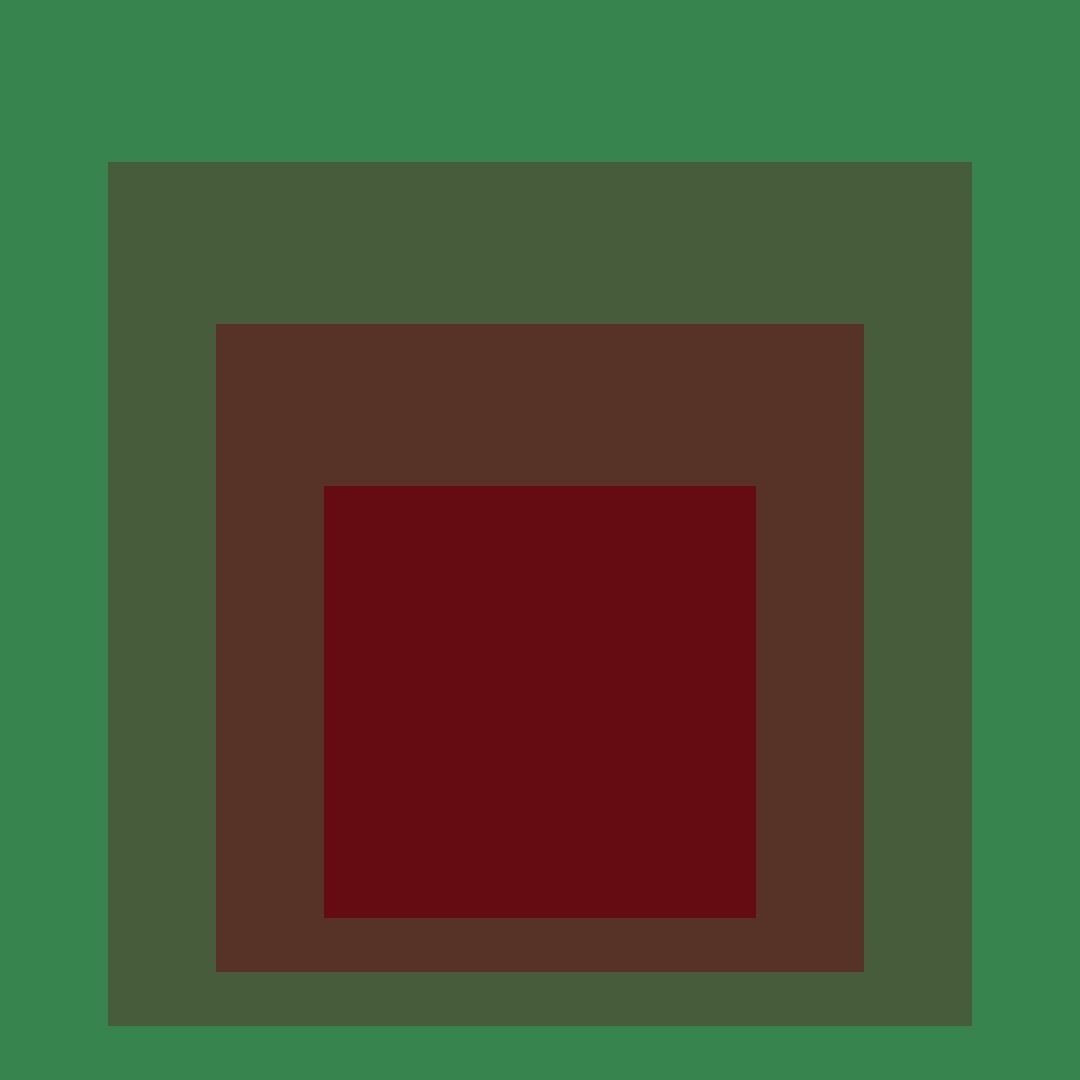
Color Study #126, one of the rarest entries in the series
Erick Calderon and Jeff Davis themselves became the first users of Art Blocks. On Black Friday in 2020, Erick had a whim to conduct their first public sale, putting his Chromie Squiggle, Jeff's Construction Token and Erick's sculptor brother Daniel's Genesis by DCA three series together online.
image description
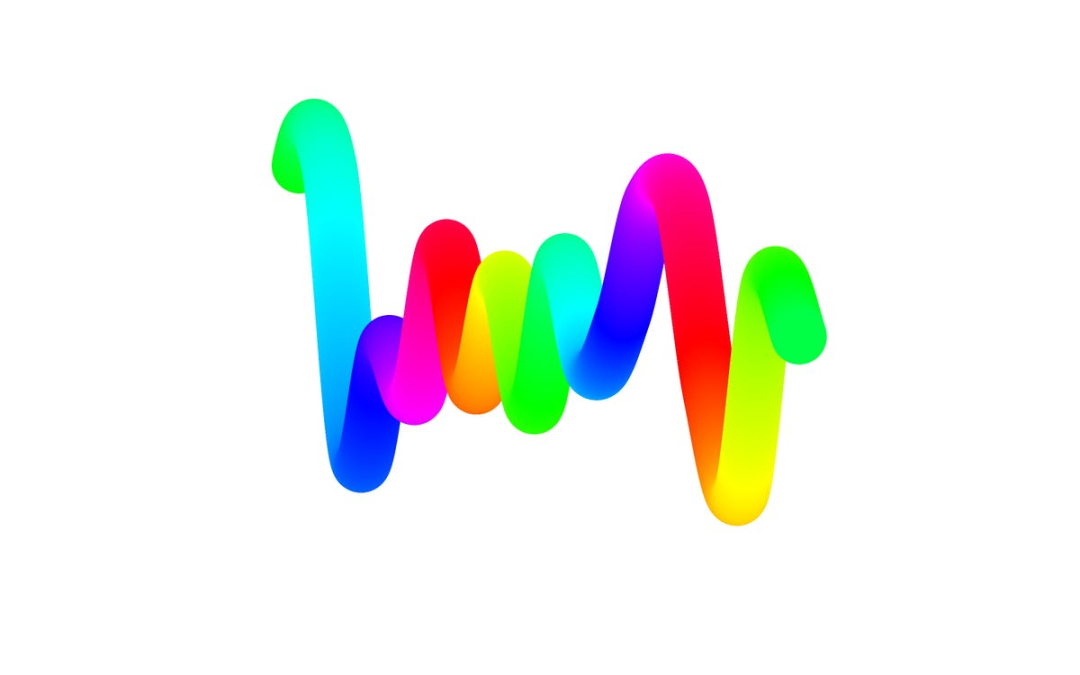
Chromie Squiggle #1981 by Erick Calderon
Chromie Squiggle's iconic doodles are now almost synonymous with Art Blocks. Erick seems to have deliberately imitated the practice of CryptoPunks, setting the minting fee to 0, and users only need to pay the gas fee.In the crazier summer of NFTs in 2021, the average price of these graffiti soared to hundreds of thousands of dollars, and it took less than 2 hours for Art Blocks to sell out the works released.
secondary title
03. Important works on Art Blocks
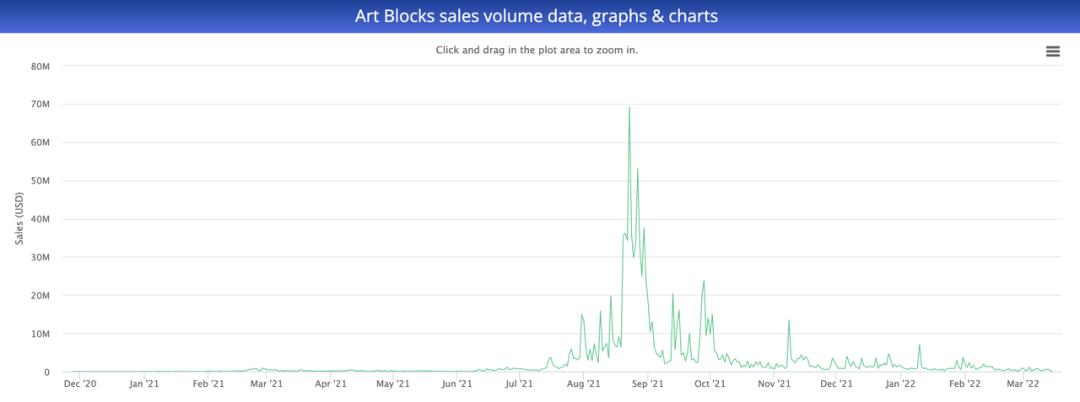
The fascination (and speculative interest) in generative art peaked in August 2021, with artworks published by Art Blocks generating $587 million in secondary market transactions, with more than 10,000 buyers trading in their works. Deal value dropped to $243 million in September and has never topped $100 million since then.
For generative art lovers, the core reason for the fluctuation of transaction volume is the departure of speculators, and the quality of generated art works on Art Blocks is getting higher and higher. Through the works of Fidenza, Ringers and Chimera, we can understand the evolution of the quality of works on Art Blocks.
Ringers
Created by Canadian artist Dmitri Cherniak, Ringers showcases "how many ways you can wrap a rope around a peg" with 1000 randomly generated pieces.
At the initial release in February 2021, Ringers will sell for 0.1 ETH. Over the past 90 days in March 2022, it has traded on OpenSea for an average of 62 ETH (roughly $160,000).
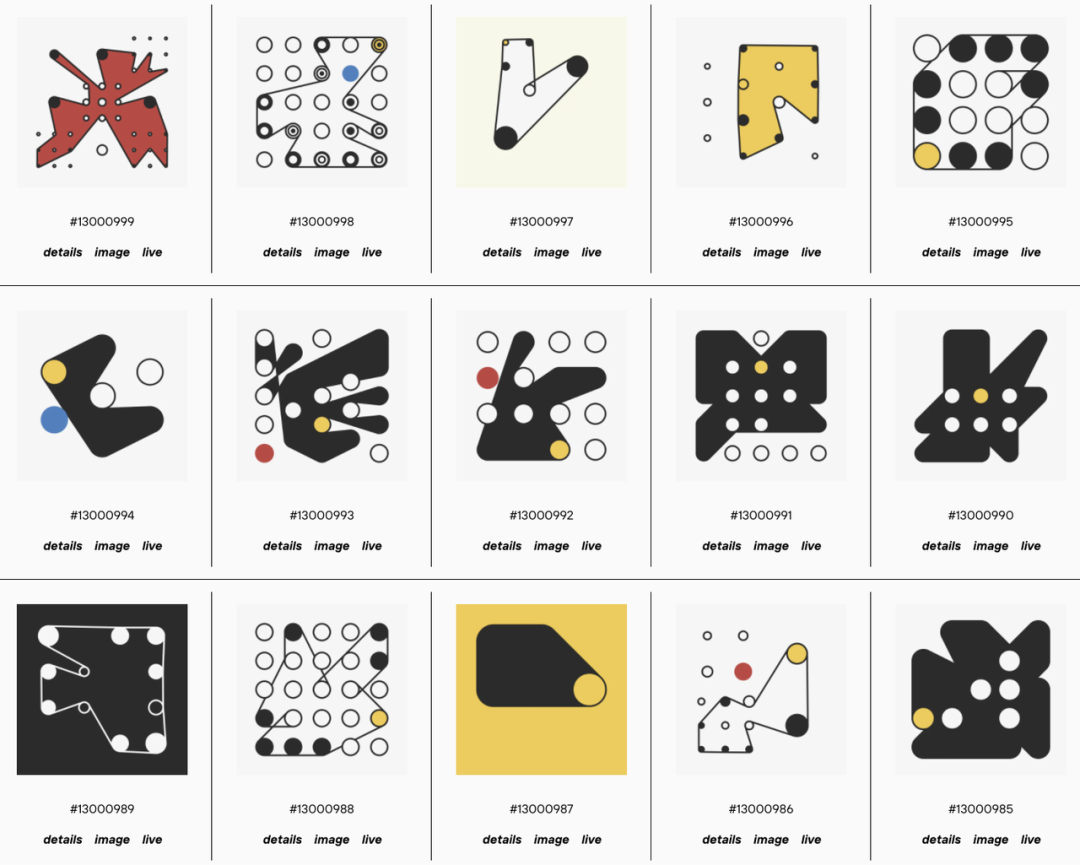
Ringers brought Art Blocks into the public eye for the first time, verifying the unique fit between Art Blocks and generative art.This quote from Dmitri Cherniak illustrates it well:
Each Ringers creation is derived from a unique transaction hash, which is then generated in the browser via JavaScript. Random attributes include the number of nails, size, layout, order, and some brightly colored embellishments.
This project fully realizes my artistic vision, everything is automated: selling through smart contracts, using unique hashes to generate artwork, and finally delivering works in the form of "tokens" sent to wallets. My "art" ensures that people can get an interesting and unique piece without interacting with me.
Fidenza
Fidenza was created by Tyler Hobbs, a 34-year-old engineer turned full-time artist who soon discovered the Art Blocks platform and created Fidenza—a total of 999 works, all algorithmically generated, with different sizes and degrees of distortion. The colored rectangle perfectly embodies the "controllable randomness" feature of generative art.
At its initial launch in June 2021, Fidenza sold for 0.17 ETH, and over the past 90 days in March 2022, it has traded on OpenSea for an average of 70 ETH (roughly $180,000).
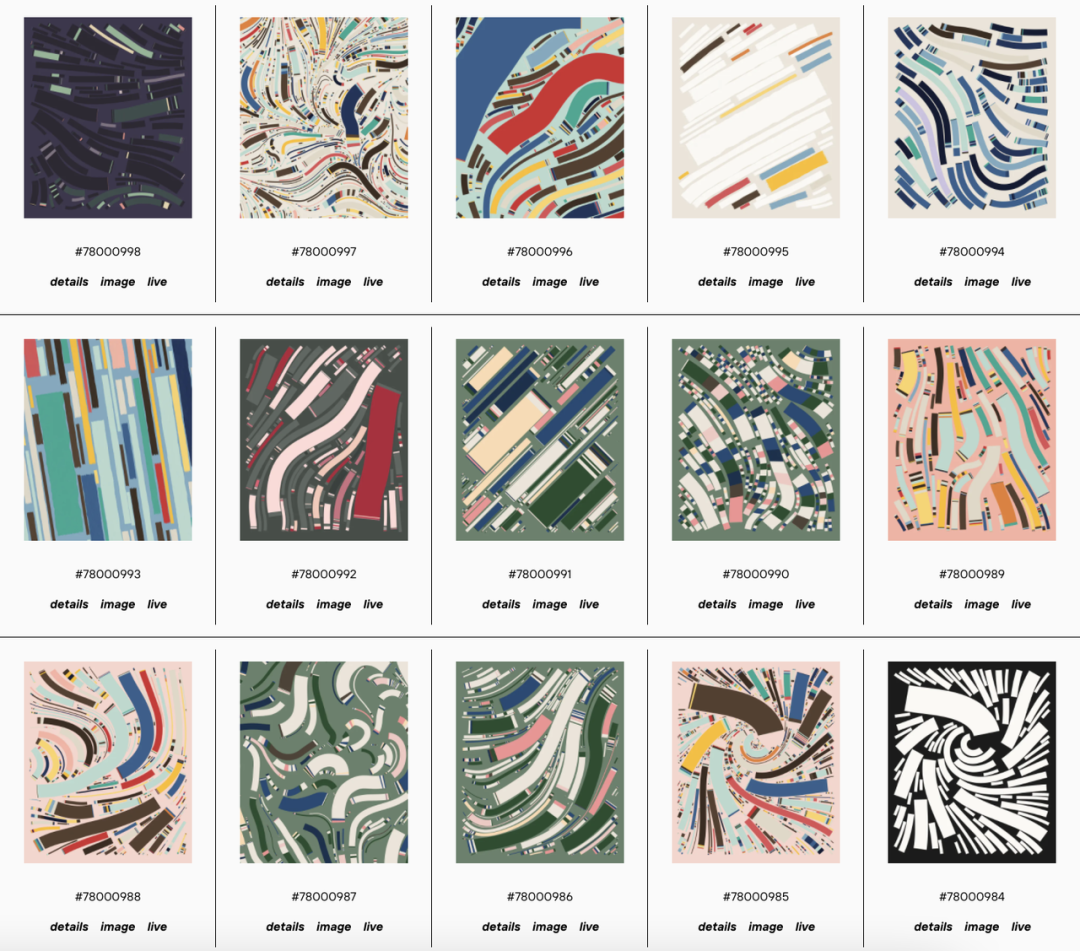
Fidenza proved for the first time that the works on Art Blocks can have a stable high quality, each work is very beautiful, and the rarer works are also recognized as having a unique beauty.Tyler Hobbs talks about his creation of generative art and Fidenza:
Code and software now take over our lives. The cultural content (words, images, videos, and games) we create, share, and view is all built with code. If wood, concrete, glass and steel were the core materials of new construction in the 20th century, code will replace them in the 21st century. Art must keep up with the evolution of social structures. Code is not just new architecture, it is shaping our relationships, communication, consumption, creativity, learning, memory, and perceptions of ourselves.
In generative art, the artist has to translate intuition into explicit instructions. Computers don't accept vague instructions, they have to know exactly what you want them to do and how to do it. Artists breathe life into this system that lacks surprises, and the computer becomes their perfect workhorse—a tireless, never-stopping design, no matter how large the scale.
image description
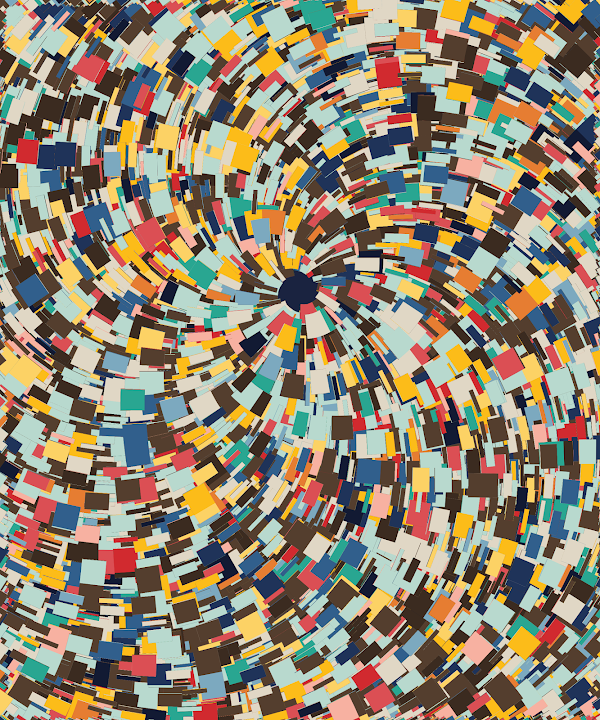
Fidenza #938, one of the rarest pieces in the series, also known as "The Eye of God"
Chimera
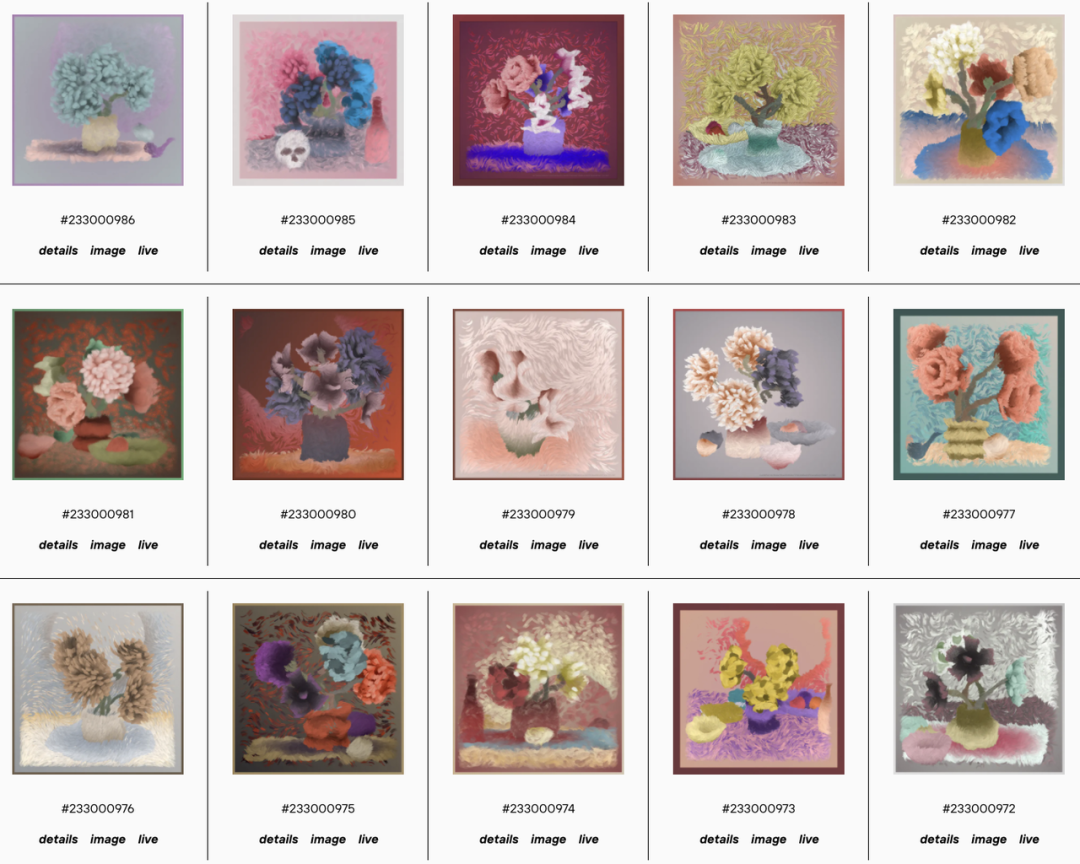
Chimera was created by Michael Kozlowski, who mainly creates animated and interactive generative art-Michael graduated from the USC School of Cinematic Arts and is interested in the transition zone of media from two-dimensional to three-dimensional.
At its initial release in January 2022, Chimera sold for 2.4 ETH, and over the past 90 days in March 2022, it has traded on OpenSea for an average of 3.1 ETH (nearly $10,000).
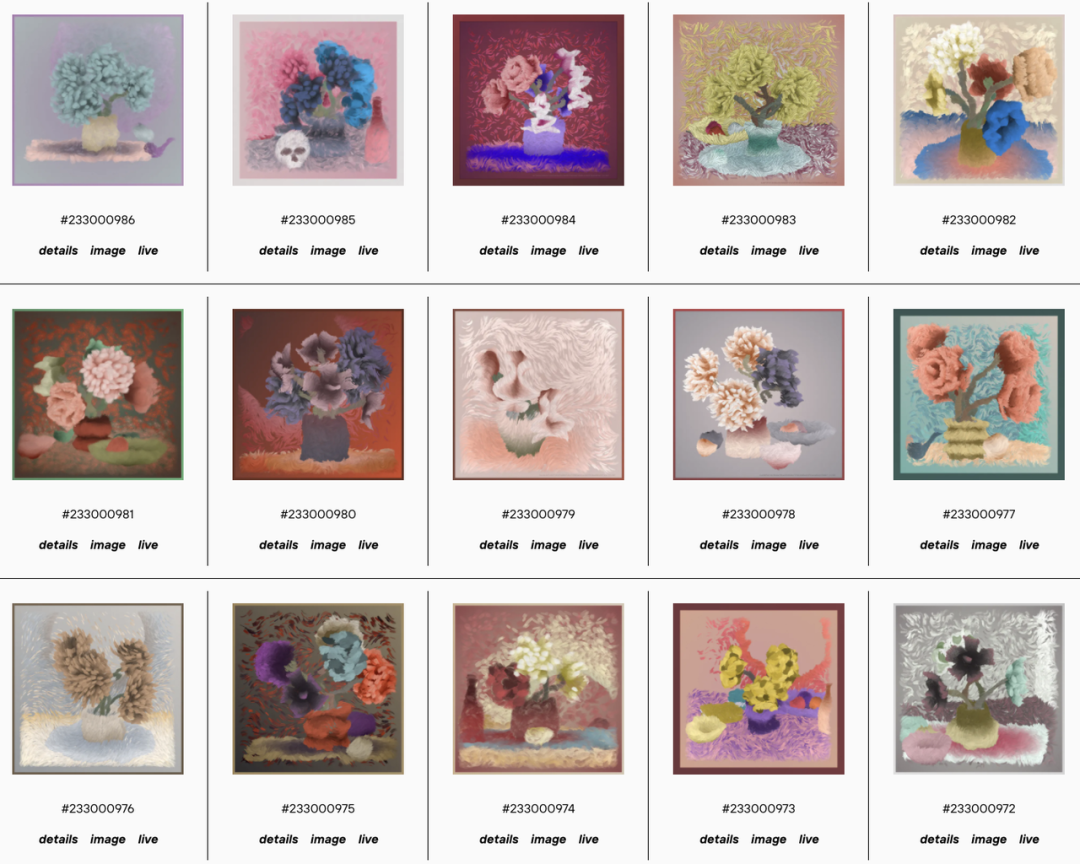
image description
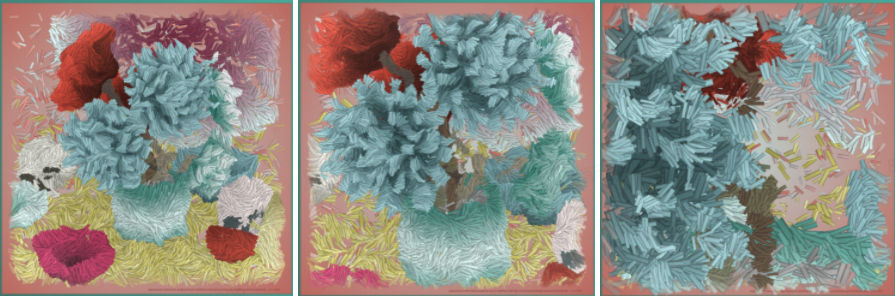
Chimera #488, the picture itself is dynamic, and viewers can interact with it by zooming
Fans will refer to Michael Kozlowski as "the Monet of generative art", and he seems to pay homage to Monet in the process of creation:
Chimera's motif is the fusion of old and new, digital and analog, 2D and 3D. At the same time it represents many aspects of still life painting. As a particularly interesting feature, Chimera has 12 brush styles, including oil, charcoal, watercolor, and even textile. I had a lot of fun figuring out how to better implement each style of simulation in code. Some styles will be more rare, but I think each style is a tribute to its real-life counterpart.
I also spend a lot of time on the central theme of each piece - flowers. There are a total of 8 kinds of flowers, including roses and sunflowers. Each bouquet can consist of up to 10 flowers of different varieties.
secondary title
04. Mutual achievements between Art Blocks and artists
Art Blocks is a product for artists and art lovers. As CEO, Erick Calderon describes what Art Blocks is going to do:
We're trying to advance the arts, trying to evolve the way people interact with art, trying to build communities around art, and we're just going to be focused on that.
Curated vs Playground vs Factory
Searching for Art Blocks in OpenSea is a slightly confusing process, you will get Art Blocks Curated, Playground and Factory three results, each result has a number of collections of works.Art Blocks designed this division between series to help balance the relationship between the artist's creative energy, work quality, platform threshold and collector's expectations.
Druid from Art Blocks details the differences:
Art Blocks Curated is a collection of the world's top generative art, projects like Ringers, Fidenza, and Chimera are part of it. In order to be selected for the series, artists will need to pre-load scripts to the Art Blocks testnet, where the resulting samples will be evaluated by their curatorial committee.
Art Blocks' curatorial committee is drawn from all walks of life, with different experiences and perspectives, but with one common goal:Find the most interesting and innovative generative art projects in the world and feature them in Curated.
Once an artist is successfully selected for Curated, they can publish their work under the Playground series. Playgrounds are used to encourage artists to go wild and experiment with different styles. Many good community experiences and works of Art Blocks come from Playground.
image description
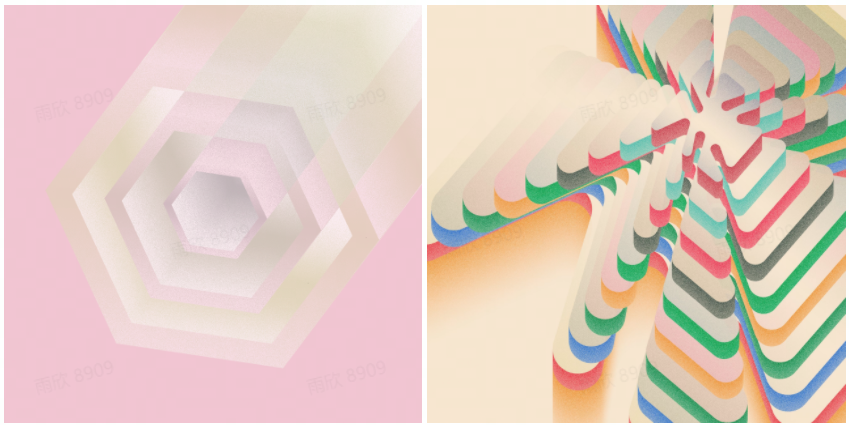
The Eternal Pump and Wrapture
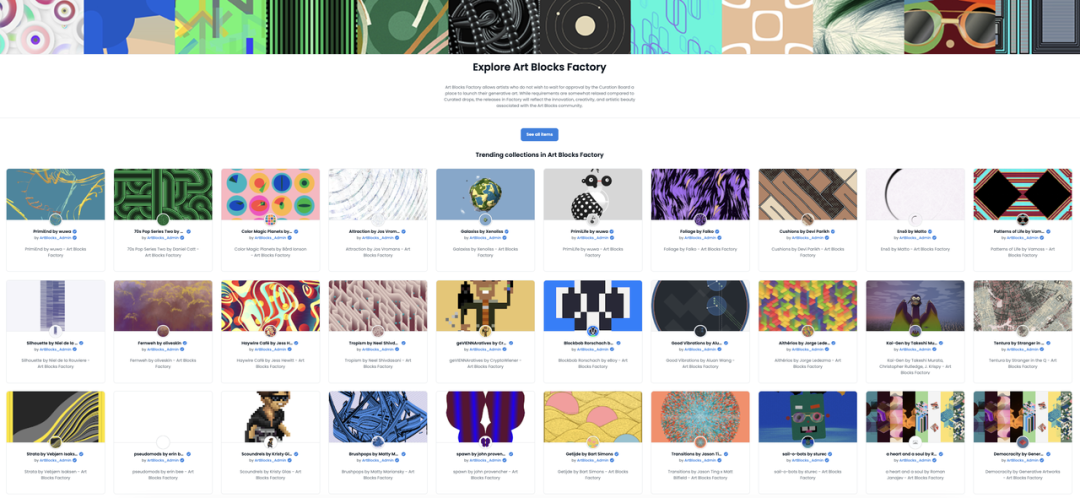
With Art Blocks out of the circle, the number of artists applying for Curated surged. Art Blocks therefore created the Factory series, where artists can publish their work more quickly without having to wait for approval from the curatorial committee.
Income far exceeded expectations
Unlike buying mainstream NFT avatar projects, buying NFT on Art Blocks is more like directly supporting an artist-these artists are often real-named, have a large number of historical works, and Art Blocks will conduct in-depth research on their works interview.
For Art Blocks, all this is not "art public welfare".For the initial sale on Art Blocks, the artist gets 90% of the proceeds, and the remaining 10% needs to be distributed to Art Blocks.
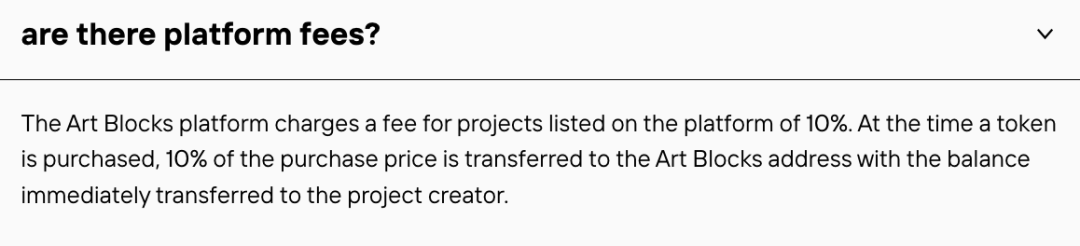
Take Fidenza as an example, the series sold 999 copies at a price of 0.17 ETH. Sales close to 170 ETH can generate 17 ETH of revenue for Art Blocks.
Compared with the copyright revenues traded on OpenSea, these revenues from the initial sale are almost negligible. On secondary markets like OpenSea, Art Blocks' works have soared from hundreds of dollars to tens of thousands or even millions of dollars. Through smart contracts, artists and Art Blocks can collect a fee for each resale of each Fidenza. The usual fee structure is as shown below, Art Blocks charges 2.5% of the transaction price, and the artist charges 5%.
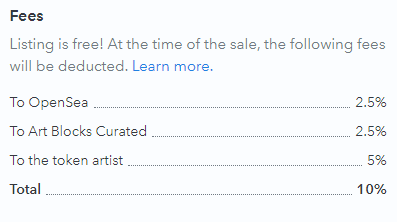
The cumulative transaction volume of Fidenza on OpenSea is 43,000 ETH, which means that the copyright income of Art Blocks exceeds 1,000 ETH, and the copyright income of artist Tyler Hobbs exceeds 2,000 ETH. Even after the price of ETH plummeted to $2,500, Hobbs’ ETH was still worth more than $5 million.
Neither Erick Calderon nor Tyler Hobbs expected their generative art to bring so much wealth.
According to Texas Daily, Hobbs donated $21,000 worth of ETH to the visual arts nonprofit Processing Foundation (the foundation behind Processing, which we introduced at the beginning of this article), and to another NGO, Girls Who Code. $21,000 in cash. He also purchased 250 tons of carbon offsets to offset the environmental impact of using the blockchain to cast art.
Art Blocks is clearly on the way to realize its product vision, and the attention and wealth these artists will gain in 2021 is exactly what Erick hopes:
secondary title
05. Invest in Art Blocks
Art Block as a Blue Chip NFT
Similar to the concept of blue-chip stocks, blue-chip NFTs refer to NFTs that are valuable and worth holding for a long time, including Crypto Punks, BAYC, Cool Cats, Doodles, and Art Blocks.
This consensus is not only reflected in NFT retail traders, but also in institutional behavior-more and more NFT funds appear, and Art Blocks is an indispensable collection in their Portfolio.
In March 2021, Curated, funded and supported by many GPs of a16z, was established. This $30 million fund will invest exclusively in NFT artworks. Curated plans to invest half of its funds in blue-chip NFTs, specifically Art Blocks.
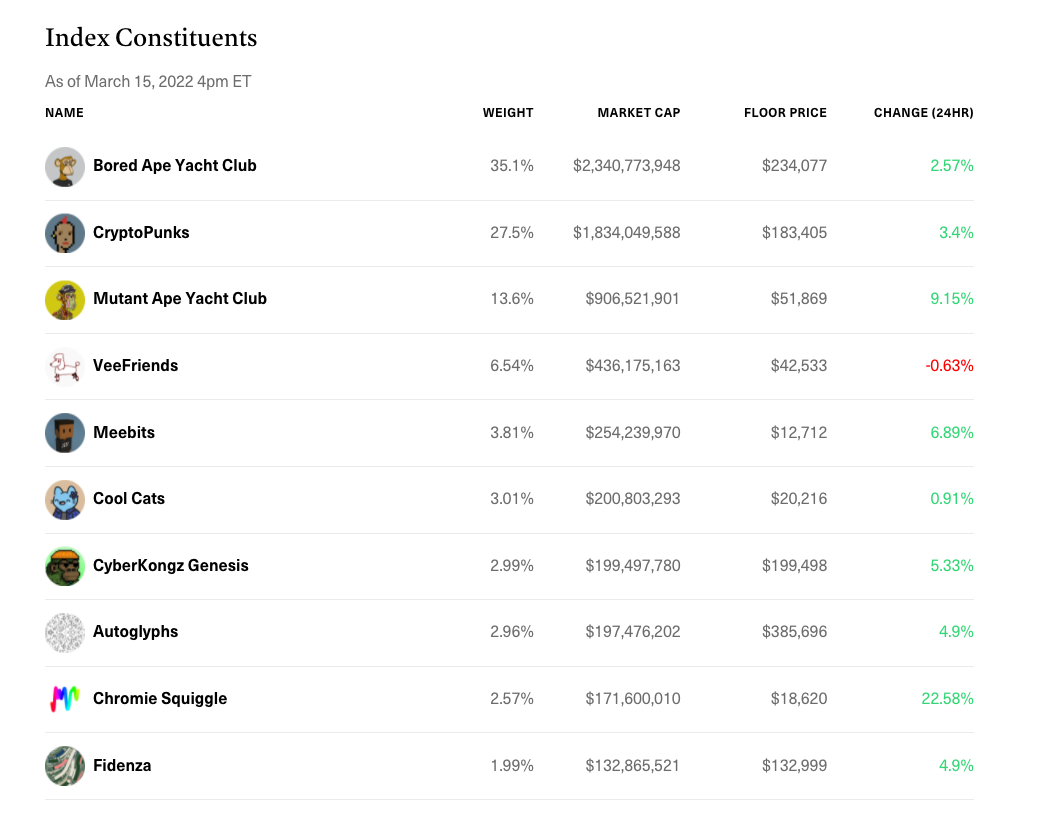
A little earlier, the Bitwise Index Fund, established in December 2021, focused on investing in blue-chip NFTs.Art Blocks' Chromie Squiggle and Fidenza account for 4.5% of its fund's position, outperforming other collections in March 2022.
The milestone of Art Blocks as a blue-chip NFT investment target is August 2021. The well-known Crypto VC Three Arrows Capital launched Starry Night Capital to enter the NFT investment field. The first investment of this fund was 3 Art Blocks works - a Ringer, a Fidenza and a Subscape, totaling 614 ETH (worth 2 million at the time) Dollar).
Art Blocks as a startup
Art Blocks' status as a blue-chip NFT is expected to remain, while another group of investors see value in Art Blocks' equity.
In 2021, the cumulative transaction volume of all Art Blocks works will be close to US$1 billion, which means an income of US$25 million based on a 2.5% royalty. In August 2021, Art Blocks completed a round of financing of $6 million. TRUE Ventures led the 50 percent round, with participation from Galaxy Interactive, a VC under Galaxy Digital, and Collab Currency.
Erick hopes to build Art Blocks into a company that can "cross the bull and bear market". Healthy cash flow determines that Art Blocks can survive the next bear market smoothly:
Art Blocks is a healthy company. We are very lucky to be able to continue to operate for many years now without selling any NFTs.
Growth remains key, especially as Art Blocks' deal frenzy cools.Erick conceived the next direction: expand the Art Blocks platform to VR game props and other fields, and turn Art Blocks into a service called by other NFT gallery websites and software.
The generative artist will pour most of his cash into building the team to realize these visions. He hired 10 full-time engineers by the end of 2021, and hopes to expand the development team to 20 by mid-2022.
Managing engineers is a new problem for Erick. He is in contact with corporate culture and brand consultants to try to make Art Blocks a unique team:
secondary title
06. Other interesting questions about generative art
ebb tide of speculators
Are true art lovers snapping up Art Blocks, or NFT speculators looking to make money?
image description
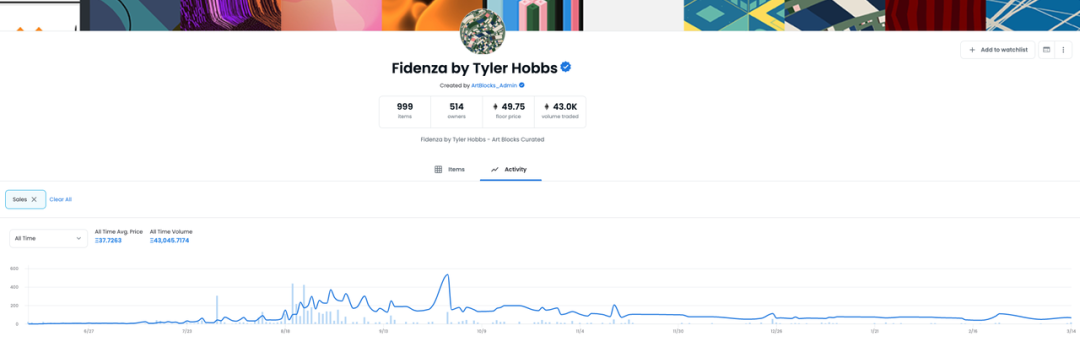
Average transaction price and volume change for Fidenza
Erick also doesn't like this speculative tide, he told Decrypt:
Explosions are fun, but they're more "scary" than "fun". It's a good start, but it's like someone taking your child and using it where you didn't expect it.
But what he thinks is "scary" is from the artist's point of view-Erick believes that those rare works that have been auctioned for millions or even tens of millions of dollars are worthwhile to a certain extent, and they have reasons to be sent to modern art museums, and Works by other masters are juxtaposed. However, there is still a "sweeping the floor" phenomenon in the NFT market. Speculators will buy more common but lower-priced works in bulk, which puzzles Erick.
The good news for Erick and Art Blocks is:The market will spontaneously eliminate speculators. As people's attention shifts from generative art to the endless stream of avatar NFT and GameFi props, the works of Art Blocks will gradually stop skyrocketing in the second half of 2021, and the transaction volume will also drop sharply.
Some speculators may feel the beauty of Art Blocks works after entering the market, so they decide to hold them for a long time. Others may be forced to "long-term hold" due to the decline in the heat of the secondary market to wait for the next selling cycle.
Erick and Artblocks tend to be "Buddhist" and do not actively interfere with the market to raise prices. Some collectors will complain about this practice. Erick is trying to find a balance between his persistence and their anxiety.
A more NFT Native display method
The way generative art NFTs are displayed is in the very early stages.
Most people admire their Art Blocks NFT on the laptop screen, which is almost the most perfect display scene at this stage——Once they want to integrate their NFT more closely with the real world and try to appreciate NFT like traditional paintings, they will encounter many challenges.
The easiest way to think of it is to print, but anyone with access to the Art Blocks website and OpenSea can print the image, the image has no animation, and the owner cannot interact with the printed image.
image description
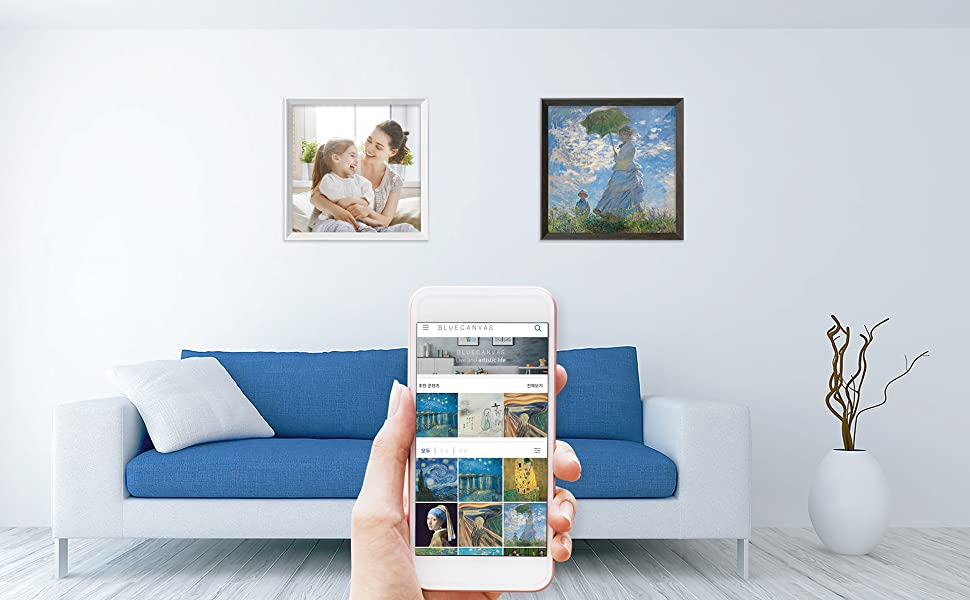
Blue Canvas product promotional image
The gradual integration of the hardware industry with Crypto and NFT practitioners may solve this problem. If there are good hardware facilities - realize the connection with MetaMask on the mobile phone, NFT will be displayed on the electronic photo frame, and the user will interact with the mobile phone or touch the electronic photo frame — Generative works of art will also receive more attention.
Ethereum generative artist Rhea Myers sees interactivity as the killer app of generative art, and is already imagining how interactivity itself could reshape NFTs:
You wear a piece of hardware to track movements, which are stored on-chain and become part of the generated artwork.
Generative Adversarial Networks
Generative Adversarial Network (GAN) has a completely different creative process from the generative art we talked about above.
Curator and art critic Jason Bailey introduces GANs in Why You Love Generative Art:
GAN is a subset of AI applications and can also be considered as a branch of generative art. It consists of two neural networks, programs that think like the human brain. In the context of art creation, we can imagine one neural network as a counterfeiter of art and the other as an art appraiser.
image description
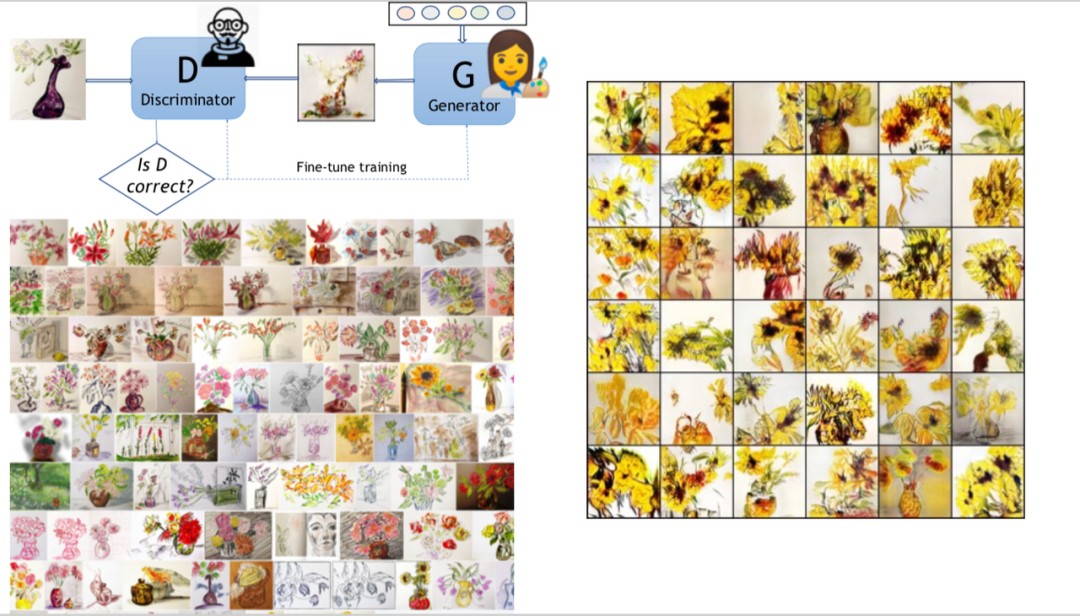
HeleSchematic diagram of the GAN process by na Sarin
The artist's participation in the creative process is an adjustment parameter, and after the GAN produces the results, the artist acts as a curator to preserve those really interesting images.
GAN's work will be a very good artwork NFT, and at the same time it has more room for imagination:
In 2021, the same concept as NFT has the metaverse. The immersive content of the metaverse needs to generate images on a large scale. At this time, paper and pen creation obviously cannot meet the demand. Art Blocks, which requires artists to pour their artistic ideas into generative art, may not be able to match the demand in terms of production scale. GAN seems to be more Good plan.


