






Core members of Juno Network: What are the implications of Governance Proposal No. 16 for the governance of the encryption community?


Original compilation: Amber
Original compilation: Amber
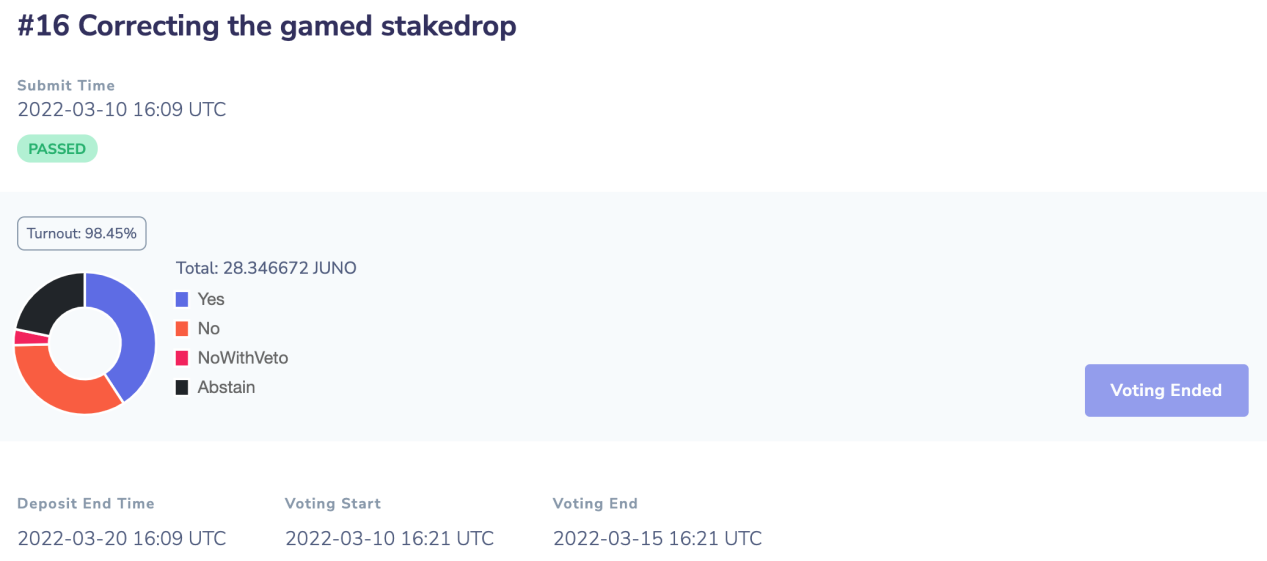
In the early morning of March 16th, Beijing time, Juno Network, the Cosmos ecological smart contract platform chain, released the No. 16 governance proposal. The voting ended with 40.85% support, 33.8% opposition, and 21.8% abstentions. Market-focused governance vote. A giant whale holding more than 3 million JUNOs (a total value of 120 million US dollars) will be reduced to 50,000, and the same amount of funds will be transferred to the community treasury.
But this time the "community" brings more than just the group carnival after "dividing the local tyrants and dividing the land", a debate about "governance" and "simple majority is the law". From seconds onwards, it continues to this day.
@JakeHartnell, one of the members of the Juno Network development team Core1, published a series of views and comments on the incident on Twitter, which was compiled by Foresight News. The core views are as follows:
As of now (March 14), more than 50,000 people have participated in the voting of the No. 16 governance proposal, and the turnout rate at that time was close to 85% (by the end of the voting, this data reached 98.45%, creating a record for the community to participate in governance voting. proportion to a record high). All of us are witnessing an event that "goes down in history."
It goes without saying that all of us would like to have better governance tools and experience a more rational governance process. But no matter how you look at it (on Proposition 16), this proposal (and its possible impact) should be taken seriously by all, and should be regarded as a wake-up call. Because the occurrence of this proposal actually means that "politics" has "invaded" the blockchain, and this will not only affect Juno, but will quickly lead to the imitation of other DAOs and chains with community governance designs.
For a long time, I have always firmly believed in the value of community governance and believed that the community should have effective tools to achieve self-government, but the fact is that in the process of community governance, it is inevitable to encounter many problems. For example, how should community governance play a role in practice? How to effectively avoid abuse of power or malicious manipulation? ....
In fact, community governance can almost be regarded as having the power of "God" in a decentralized world. Governance can include, but is not limited to, minting or burning tokens, forcing re-delegation, revoking validator validity, electing validators, rollbacks, freezing smart contracts, and more. In this world that advocates decentralization, community governance has more "dictatorial" power than centralized institutions in the Web2 era.
We are indeed standing at the gate of a new era, but we may not have enough awareness and preparation for the possibility and safety of this unknown world. It is a good sign that Proposition 16 has sparked a heated debate, but perhaps neither side is really "right" for both sides.
Regarding governance, I think a very important principle is that (good governance rules) must at least ensure the feasibility of establishing, exiting and forking a community. But the governance tools we have today are too primitive, and we need to design better design tools and systems. More importantly, we need more diverse governance solutions. Most of the current governance of the Cosmos ecology uses the same modules, and there are very few participants for personalized design, and this needs to be changed.
Proposition 16 has exposed the problems of Cosmos' current community governance, which is actually a good thing. Because no matter how you look at this vote, this ongoing debate has the opportunity to solve the problem faster and in a more reasonable way, and this has reached a certain consensus in the Cosmos community, because this kind ofmassive discussionherehereThere are some really great ideas to look at.
Submitting a text proposal that has not yet been code-backed has virtually no effect, and even if Proposition 16, which is already in progress, is finally passed, the result of this community governance vote does not actually mean that it will be immediately enforced. implement. The community can still change their minds at any time.
In an upcoming discussion of the Juno constitution, I will argue that the text proposal should give the community sufficient power to express ideas and wishes, but the text proposal itself should not be binding. The content of future governance proposals should be more fully discussed and optimized before they are officially launched on the chain. For example, it is a good choice to submit text proposals to @hicommonwealth for discussion before the chain is launched.
Proposition 16 is a poor example of a hastily opened event that was pushed in front of all community members without adequate consideration and preparation for an event that could have serious repercussions. So I think that many opinions with various attitudes are correct, and I can't convince myself to choose a certain side to stand in the team.
Some of the arguments mentioned in Proposition 16 are very "bad", especially the part about "violating the rules of the airdrop game", and I think the proposal itself is seriously flawed. If there is a centralized institution that can directly confiscate the airdrop tokens received by users without providing any compensation, then this behavior is not "decentralized".
What disturbs me is that this proposal that has attracted so much attention does not give enough really convincing narratives and evidence, and some are just repetitions and emphasis on a rather weak argument. What's worse is that the proposal also arbitrarily stated that this proposal was proposed by Core-1 (Juno Network's development team), but in fact this is not the case. If the proposal does not have multi-signature information from the official Core-1 team, it means that it has nothing to do with the Core-1 team.
Although I do think that the existence of such giant whales may indeed pose a threat to the normal operation of the chain, and I am not opposed to certain suppression and control of giant whales, but I am concerned about the way of fraudulently using the proposal of the Core-1 team, and for the The quality of the content of this proposal is quite unsatisfactory.
One of the most important points is that I believe that these potentially "confiscated" assets should not be transferred to the community pool, but should be destroyed.
Every proposal in the future should be fully discussed more carefully, and a series of guidelines that cannot be violated should be established in advance, and I think "personal wallets are sacrosanct" should be regarded as a very important one.
In any case, we should now be serious enough to discuss how to optimize and innovate in governance. And this is not limited to the design of the voting mechanism itself, it should also include discussions on how to review proposals, what the DAO's due process should look like, and so on.


