How will the Fed rate hike affect the crypto market?



Original Author: Jasmine
Original Author: Jasmine
Not surprisingly, the Federal Reserve is expected to release an interest rate resolution on March 17 (Beijing time), and raising the federal benchmark interest rate has become a high probability event.
In addition to the high CPI in the United States in February, the conflict between Russia and Ukraine has also pushed up the prices of commodities such as energy and food, which has exacerbated inflation. Global financial markets are highly concerned about the upcoming Fed interest rate meeting this week. Analysts The consensus forecast is for interest rates to reach 2.5%.
The Russia-Ukraine conflict has become a major variable ahead of a real rate hike, raising expectations for rate hikes and creating high volatility in financial markets.
Only last week, the price of gold soared to a record high of US$2,060 per ounce; crude oil and commodities rose sharply; the encrypted asset market fell back after a brief surge to US$45,800 on March 10, and the trend continued to slump; Despite a strong rebound, the Dow, S&P 500 and Nasdaq still ended the week in the red.
Greg McBride, chief financial analyst at financial services provider Bankrate, said that assets that have benefited the most from ultra-low interest rates in the past will be most vulnerable to a correction in rising interest rates, "such as high-growth stocks with good future returns and non-cash flow assets such as encrypted assets." assets generated.”
first level title
Financial markets tumble amid expectations of rate hike
While the Fed has yet to raise rates, the momentum to tighten monetary policy is almost certain.
According to data released by the US Department of Labor on March 10, the US consumer price index (CPI) surged 7.9% year-on-year in February, hitting a new high in 40 years. Average hourly wages adjusted for inflation in February fell 2.6% year-on-year, the largest drop since May last year and the 11th consecutive month of decline. Soaring prices offset wage growth.
In such an inflationary environment, the Russian-Ukrainian war broke out in late February, pushing up the prices of commodities. International oil prices soared as high as $100 a barrel in the early days of the conflict, reaching as high as $130 last week. Meanwhile, wheat futures surged from $8 to over $12 a bushel. The war has heightened fears that global inflation will climb to even higher levels.
To curb inflation, the Fed is "on the verge of raising interest rates." In the previous hearings of the US Congress, Federal Reserve Chairman Powell said that the neutral interest rate may be located at 2%-2.5%, but it may also be higher. Financial analysts, including CME's FedWatch tool, expect the Fed to raise rates by 0.25 percentage points.
Under the expectation of high interest rates, the financial market has shown the characteristics of general decline.
Taking US stocks as an example, many indexes were still close to their record highs at the close of last year. Since then, though, it's mostly been down, with the S&P 500 down about 12 percent since the start of the year, while the tech-heavy Nasdaq Composite has fallen even more, at 18 percent, and the Dow Jones Industrial Average has fallen 18 percent. The index fell about 10%.
"Stocks are forward-looking, so expectations for rate hikes have had an impact," said Caleb Tucker, head of portfolio strategy at Merit Financial Advisors in the Atlanta area. Greg Mack, chief financial analyst at Bankrate Greg McBride, an economist at the Wall Street Journal, also said that from the beginning of 2022, the stock market began to fall due to expectations that the Federal Reserve will raise interest rates to curb inflation. "
Riskier investments are even more affected by expectations of rate hikes. High-growth tech stocks like Cloudflare and Datadog have fallen about 58% and 35%, respectively, from their 52-week highs a few months ago. Bitcoin, the mainstream asset in the encrypted asset market, has fallen by about 44% from its all-time high in November last year, and Ethereum, the second largest by market value, has fallen by 49%.
But the volatility could also be short-lived if the underlying economy remains strong, as strong economic fundamentals also lead to higher rates. “Historical data and trends for the Nasdaq, Dow and S&P 500 show that markets tend to recover within about three weeks,” Raju said.
first level title
Will high interest rates be a headwind for crypto assets?
Whether it’s inflation, low interest rates, lack of purchasing power, or a falling dollar, as long as cryptoassets are on the rise, these positives can easily be misinterpreted as resiliency until the Russo-Ukrainian war shatters those illusions.
On February 24, the day when the Russia-Ukraine war broke out, the encrypted asset market plummeted. Bitcoin once dropped to 34,222 US dollars, and the intraday drop was close to 10%. Its labels of "digital gold" and "safe haven assets" were deeply questioned. The attributes of "risky assets" are becoming more and more obvious.
In fact, cryptocurrencies, like other risk assets, have reacted to reduced liquidity. Cryptocurrencies fell after the Federal Reserve announced in November that it would start tapering its bond purchases and signaled that interest rates would soon rise.
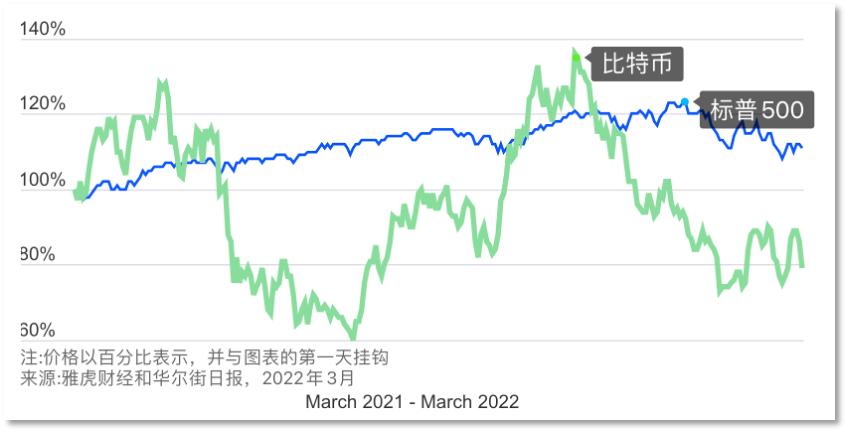
image description
Bitcoin falls ahead of S&P 500
As the chart above shows, Bitcoin started falling ahead of the S&P 500, and it does not hedge against the index. Bitcoin started falling in November ahead of the S&P 500 in response to the Fed's actions.
According to Greg McBride, chief financial analyst at Bankrate, the assets that have benefited the most from ultra-low interest rates in the past are the most vulnerable to a pullback against a backdrop of rising interest rates, “such as high-growth stocks with good future returns and Non-cash flow generating assets such as cryptocurrencies.”
Although Dan Raju, CEO of brokerage platform Tradier, admitted that crypto assets will definitely be adversely affected by higher interest rates, he expects a rise in the year, "I firmly believe that crypto assets will be a net positive in 2022. , as any short-term decline driven by rate hikes will be offset by more adoption by institutional and retail active traders."
On March 14, Tesla founder Elon Musk (Elon Musk) stated on Twitter that he still owns and "won't sell" his Bitcoin, Ethereum and Dogecoin, and advised people not to trade in them. Hold dollars when inflation is high. He sent shockwaves through the crypto world last year when he added $1.5 billion in bitcoin to Tesla's balance sheet.
The end of the quantitative easing policy will be the main tone of the US economic management department in 2022. The biggest question at present is how high interest rates may rise. The information meeting will give the answer.