






The New York Times looks at DAO: When reality invades the vision of crypto utopia


New York Times
source:New York Times
The American CryptoFed is a new type of company spawned by the advent of cryptocurrencies — in a way, it’s not a company at all.
According to its stated plans, the Crypto Fed has no owners, managers or employees. Instead, it’s a “decentralized autonomous organization (DAO),” automatically controlled by computer code and governed by how a community of users vote on proposals.
For supporters, DAOs are a new business model that could democratize commercial enterprise and break the hold of innovation by big tech companies and other entrenched middlemen in the information age. There are already more and more DAOs appearing online, such as financial service operations, news centers and social clubs.
But The DAO has also come under fire from multiple angles, demonstrating the disruptive innovation power of cryptocurrencies and struggling to prove that it has practical uses beyond financial speculation.
DAO members have been wrestling with each other over how to balance the need for good managers with an idealistic vision of shared decision-making. In some cases, crypto investors and regulators say, the DAOs amount to Ponzi schemes that seek nothing more than to boost the value of the associated digital tokens.
Regulators are swiftly stepping in, citing investor protection concerns, in such organizations that do not employ traditional business models and accounting practices.
The Encrypted Federal Reserve DAO, which is committed to building an encrypted payment system, was ordered to be shut down by the US Securities and Exchange Commission in November 2021, just 4 months after its launch. The SEC contends that the company "substantially misled" the public by using conflicting documents that failed to disclose key information, such as audited financial statements.
US Securities and Exchange Commission Commissioner Hester M. Peirce said the growth of DAO activity was very rapid.
“The past year or so has been a big time for DAOs, and there’s been a lot of experimentation going on,” Peirce said. “It’s been hard trying to understand what that actually means because everything is moving so fast.”
In fact, the DAO grapples with a variety of challenges, including massive financial losses from software bugs and hacks, internal divisions that threaten the continued existence of certain entities, and allegations of misappropriation of community funds. For some DAOs, low member turnout has been a persistent problem when voting on strategic or business decisions, effectively leaving control in the hands of the big investors who paid to help get the DAO off the ground.
The chaos brewing has sparked a debate: Are these DAOs tools for insiders to profit and exploit consumers, or are they early experiments in a new way of doing business?
According to DeepDAO, the value of cryptocurrencies held in the vaults of more than 4,000 DAOs has increased by 3,200% in 2021, and was worth more than $13 billion in December. Of course these numbers fluctuate wildly as the value of cryptocurrencies fluctuates.
DAOs have run a variety of projects, including decentralized financial services like Compound and SushiSwap, investment pools like Red DAO (where fashion lovers join to buy digital collectibles), and social clubs like Friends with Benefits (whose Token holders meet virtually and in-person).
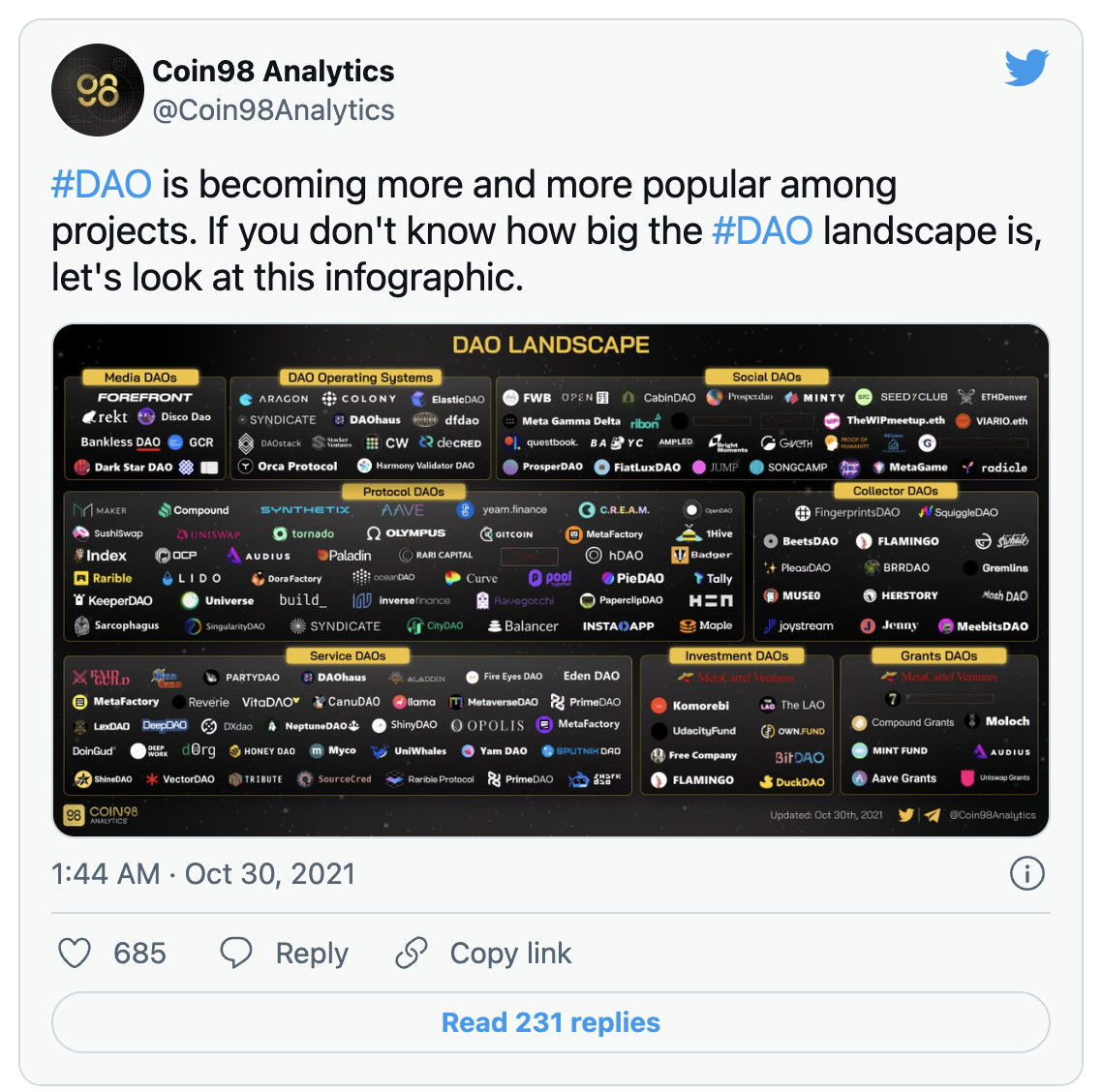
The DAO concept has already been embraced by individual crypto investors and industry titans, including Silicon Valley venture capital firm Andreessen Horowitz, which has billions of dollars to back blockchain projects. Industry lobbyists and lawyers, including those from A16z and the Crypto Fed, have been working in Washington and state capitals to push for DAO approval and revise what they call “outdated” laws.
Currently, the various federal regulators have little clear legal authority to oversee these entities, unless the DAO is suspected of violating securities laws. SEC Commissioner Peirce said that as regulators struggle to oversee new entities, the result is confusion and ongoing conflict.
Perhaps the most promising but also most worrisome aspect of DAOs is the way they make decisions.
Although DAOs can choose to lead groups or hire staff, the main decision-making power is theoretically left to the members, theoretically ensuring that the final decision serves the majority of participants.
"Virtual world in your hands" is the slogan of the virtual game space Decentraland. Like most DAOs, it relies on online voting to make decisions. Players can use tokens to purchase "land" or clothing, and participate in virtual social activities in avatars.
DeepDAO founder Eyal Eithcowich sees Decentraland and DXDAO as examples that come close to meeting the ideal DAO. Decentraland alone has had over 1,000 different referendums on topics like "Should wearables, including guns, be allowed?"
"There used to be Internet forums where you could debate and feel part of the community," says Eithcowich. "But here, you don't just get a sense of ownership. You actually own part of the platform, Your vote has a direct impact on the platform. That's the beauty of it to me."
In fact, multiple large corporations are also involved, such as JPMorgan Chase, which opened a former virtual space in Decentraland, a "lounge" to promote its Onyx payment network, which also houses its CEO Jamie Dimon digital portrait.
But the reality of setting up and running these DAOs is often complex.
OlympusDAO, which was born a year ago, has attracted widespread attention and doubts because it provides extremely high rates of return to cryptocurrency holders who submit tokens to the system at a specific time. At one point, it offered annualized returns of nearly 8,000%.
The platform regularly conducts online voting on proposals, such as the proposal in January with JonesDAO, a startup that allows users to invest in high-risk crypto derivatives and futures.
But Olympus is largely controlled by anonymous founder Zeus, whose statements about the business model have baffled industry insiders. It even made cryptocurrency enthusiasts openly question that it may be a Ponzi scheme, completely dependent on the continued belief of participants and the inflow of cryptocurrency to maintain.
Jordi Alexander, an executive at digital asset trading company Selini Capital, said little is known about OlympusDAO because there is no disclosure required of public companies or private companies raising public funds. "No one will ultimately audit it to make sure that these statements are true." He once elaborated on his doubts about Olympus in an article.
After reaching a high of about $1,400, one Olympus token is now worth only about $30, with the project losing nearly $4 billion in market cap. (A man calling himself Zeus defended the project in an interview, saying he had only been trying to be authentic and honest.)
Community conflicts have also triggered a plunge in the price of Wonderland DAO, whose founder was recently forced to reveal the true identity of the platform's treasurer, Sifu, as Michael Patryn. Patryn has previously been convicted of financial crimes in the U.S. and Canada, and was the co-founder of defunct Canadian cryptocurrency exchange QuadrigaCX. Earlier, the mysterious death of another QuadrigaCX founder cast law enforcement into doubt and customers lost an estimated $135 million in cryptocurrencies.
Since then, a much-debated topic on the Wonderland governance forum has been whether the DAO should be dismantled, or whether the DAO should be dismantled by hiring "a professional team with background checks (including the Chief Financial Officer, Chief Legal Officer, and Chief Operating Officer)" Transform into an entity more like a traditional corporation.
Many of the problems with DAOs often stem from the anonymity of DAOs and cryptocurrencies.
Such anonymity can undermine accountability and foster what critics say is an abuse of power, such as at SushiSwap, whose creator (Chef Nomi) abruptly left the project, cashing out nearly $13 million worth of tokens in infighting.
A developer named OxMaki, who helped create SushiSwap, told The New York Times in a group chat that the DAO’s strengths — diversity and decentralization — have also proven to be its weaknesses.
"The DAO is made up of various people from all over the world, without any relationship between the parties. Each group has a different vision and direction. The DAO has never reached a complete decision internally. This is a mistake." He added that he had never met other Sushi team members in person.
The Crypto Fed claims to be the first legally sanctioned DAO in the United States. It is registered in Wyoming, which passed the first state law to formally recognize DAOs and exempt crypto tokens from state securities laws.
Last September, it notified the SEC that it would create two new cryptocurrencies for payments and governance in its internal economy, both of which would be distributed to the public before being bought, sold and traded.
But the SEC moved swiftly in November to block the token offering, claiming it was an illegal securities offering.
Fearful of being subject to SEC enforcement jurisdiction, decentralized startups are increasingly turning to private equity funds for funding, selling large amounts of tokens to large investors. As a result, VCs like A16z end up having more influence in decision-making in some cases.
Encryption industry analyst Ryan Watkins has said that venture funds, founders, core team members and other insiders controlled nearly 50% of the Solana platform's token SOL when it was first issued, which gave them a lot of governance power in the DAO. .
This internal problem is also exacerbated by the generally low turnout of individual token holders, making it easy for large players to influence the outcome.
“The more centralized the token supply, the bigger the problem. That raises the question: Is this really a DAO? Or is it just a place where rich people decide everything?”
Watkins said some DAOs, realizing that running a truly decentralized entity can be difficult, are forming leadership councils to oversee certain key operations, which in turn are more akin to traditional corporate structures.
But it can also be a concern. Last summer, the DAO of decentralized cryptocurrency exchange Uniswap voted to form and support a lobbying group called the DeFi Education Fund, but when the new group sold millions of dollars worth of tokens earlier than promised, aroused strong opposition from the community.
Chris Blec, founder of DeFi Watch, a news website dedicated to promoting encryption transparency, said that insiders with large tokens such as investment agency A16z promoted the proposal.
“Essentially, they’re proposing and they vote on it, and it ends up being like a legitimate slush fund for them. The whole thing is for their corporate benefit.”
Miles Jennings, a lawyer for A16z, said the concerns about internal controls were legitimate.
"It's reasonable to be skeptical. We're still in the very early days."
He added that VCs based in the digital world are connected to the real world. "We need to follow the laws and regulations."


