






Talking about EVM compatibility: Why are non-EVM public chains embracing EVM?


Compilation of the original text: Gu Yu, Chain Catcher
Original title: "EVM compatibility and the future of blockchains》
Compilation of the original text: Gu Yu, Chain Catcher
Ethereum survived the first wave of "Ethereum Killers", and then low-cost chains (Polygon, BSC, Fantom) running the Ethereum Virtual Machine (EVM) became popular. And now, after launching with limited success, these same Ethereum killers are integrating the EVM and racing to enter the multi-chain world.
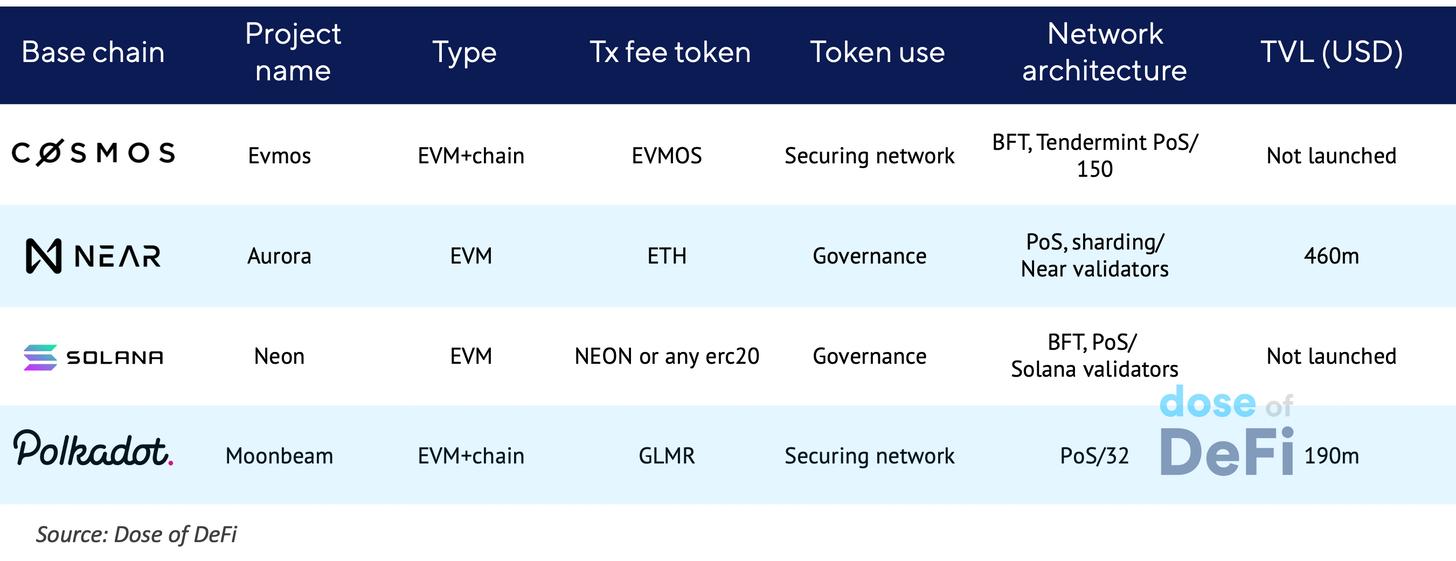
Specifically, Polkadot has addedMoonbeam, Near launchesAurora, and soon (announced but not released),Evmoswill be launched on Cosmos andNeonWill be live on Solana.
When these chains first launched (not EVM compatible), they claimed to have a superior design, with features such as popular programming language support and speed. As these chains start to support EVM, now they seem to be less optimistic about the advantages of their own technology, and realize that they need to support Ethereum. In doing so, these chains are going back to their original vision to build an alternative tech stack to Ethereum.
construction phase
construction phase
Think of the EVM as a computer that computes the output of a smart contract's operations given certain inputs. A copy of the EVM runs on each node - it has to be remembered that it is not located in one place. EVM is also known as "runtime" or "environment".
In addition to the runtime, there are some important tools built around the EVM, which are highlighted in red below.
The EVM accepts programs written in the Solidity language, and to make the language more powerful, a number of "libraries" were created. Developer tools like Truffle or Hardhat make writing and testing smart contracts easier. Also, since we're talking about a web environment, external wallets are connected to the EVM through API libraries such as Web3.js.
Among these tools, which are more familiar to the average user, is the powerful blockchain explorer Etherscan. It knows how to look at thousands of transactions and present them in a human-readable way. Additionally, there is the MetaMask wallet, which connects users to the EVM by broadcasting user commands over the network.
Hundreds of highly skilled developers have spent thousands of hours building these tools and infrastructure. In some cases, the difference in the time it takes to create a dApp with a mature tool versus an imperfect one can be 100:1.This is why the tooling and infrastructure for proprietary stack blockchain builds has been very slow by industry standards.
secondary title
model comparison
Proprietary stack chains take a different approach to EVM integration.
Solana and Near use a single chain, so in these cases the EVM will run alongside the main "smart contract computer" of the blockchain. This can also be seen in Near's Aurora EVM design.
quote aAurora Developersif:
"We rewrote all the EVM logic and compiled it to WASM bytecode, so it executes in the WASM fragment of the Near runtime. Now it's a near-native contract, there's nothing special about the EVM contract. Just put the EVM Adding to the Near kernel introduces a lot of complexity."
So it should be noted that Aurora is not a chain, but an EVM environment on Near (although it has its own block explorer). This is why the Near-Aurora bridge is not a bridge between chains, but a bridge between runtimes. This technical design affects business strategy: Aurora has no validators, and its token cannot secure the network. Therefore, a different model must be used when evaluating Aurora or Neon, which use a similar design, while Evmos or Moonbeam have their own native fee tokens.
Interestingly, EVM + Near's PoS consensus and data availability sharding make the overall architecture similar to the vision of ETH 2.0. Neon's strength lies in Solana's speed: the Neon EVM claims to process 4,500 transactions per second and supports sub-second confirmation times. Overall, this experimentation with combining EVMs with different types of architectures drives innovation in the industry.Ethereum is now too big to change flexibly, so the emergence of the EVM market creates an opportunity to move fast and break things without the cost and risk of Ethereum mainnet.
Polkadot and Cosmos, which support Moonbeam and Evmos respectively, are multi-chain design blockchains. Instead of adding the EVM alongside the main computer, they created a subchain just for it. This means that if scalability is required, more EVM instances can be launched as new child chains on Cosmos/Polkadot (and new shards on Near), paving the way for scalability. Solana's model, on the other hand, seems to lack this scalability.
secondary title
Blockchain EVM Future
advantage:
advantage:
These EVMs also connect the tokens of the underlying blockchain to the wider EVM ecosystem. For example, Polkadot's token DOT is connected to Moonriver through the official cross-chain bridge, and then spread further through widely available EVM cross-chain bridges (such as Synapse, Allbridge, etc.). Check out the image below, which highlights mining with DOT on the EVM-based Moonriver. In general, it is easier to build an EVM-EVM bridge than an EVM-different consensus bridge.
The EVM environment can be the entry point for assets from the EVM chain to these underlying chains. Users will choose the bridge that is most convenient and safe for them. The diagram below shows an example of Cosmos Hub and Evmos interacting with the EVM chain.
shortcoming:
shortcoming:
This model further strengthens Ethereum, where more demand for Ethereum tools means more resources are spent improving them, at the expense of the underlying chain's proprietary stack.
Early Ethereum killers initially distinguished themselves by popular programming language support and unique designs such as the chain's application specificity. This new direction took them away from their original philosophy. Does lack of differentiation commoditize blockchain for users and developers?
The addition of the EVM also brings the threat of product cannibalism. If the same application can be used both through the EVM and the underlying blockchain implementation, the latter must offer tangible advantages to the user in exchange for giving up a familiar experience.
all in all,Perhaps the biggest advantage of the underlying chain in adding EVM compatibility is to provide a new entry channel for users and assets.secondary title
EVM standard
The emergence of the EVM marketplace has created opportunities for protocol architects to drive innovations such as sharding (something Ethereum delivered slowly) or application-specific chains.
A widely accepted standard will likely lead to more composability, which will strengthen network effects in DeFi. The rapid growth of independent blockchains is fast enough in 2021, but greater connectivity may trigger even faster growth in the years to come due to common EVM support standards.
Whether it's good for the industry or not, the fact that nearly all major developers are integrating EVM shows that the stack is a must-have today, and without EVM compatibility, it's hard to compete.


