Token Engineering: A New Path to Organizational Construction



image description
Token engineering is the future of organizational design
Meeting the great challenges of civilization requires a new form of organization. Token engineering is one of the ways we achieve this.
failure of organizational imagination
Governments, corporations, and nonprofits can't seem to solve society's biggest challenges.
Granted, these entities do a lot of good in the world, but they also have serious structural flaws. Governments can be unresponsive and vulnerable to special interests. Nonprofits struggle to make a meaningful impact because their philanthropic support is often unreliable and difficult to scale. Businesses are good at innovating, but are increasingly being seized by the financial system, using them as machines to extract wealth.
It is not enough to manage these institutions better. To sustain large-scale public interest innovation, we must change the way we organize ourselves. For this, we need new organizational forms.
Value reconstruction on the blockchain
Building these new organizations requires rethinking some fundamental assumptions about organizational purpose and economic value. The good news is that we are in the early days of a technological revolution that will help us do just that.
Blockchain represents the third wave of the Internet - the "Internet of Value". The new technology decentralizes computing, making it difficult for intermediaries like Google, Amazon, and JPMorgan to act as gatekeepers to economic transactions. The resulting freedom will be more than a level playing field. It creates space to redefine concepts we initially thought were valuable. Blockchains give us the power to move transactions to new economic networks organized around other things than just maximizing shareholder returns.
Accelerate organizational design
The ability to question value assumptions is a huge lever for advancing alternative organizational goals. When combined with blockchain-based tools, this leverage opens up a set of economic "building blocks" that radically expand the possibilities of organizational design.
This increased flexibility reduces the time and cost of organizing trials, which is important because we don't have the time right now. Challenges like climate change and the collapse of biodiversity will not wait for human action. We need massive experiments to reorient human tissue to better respond to these crises—and we need them urgently.
Modularity is a catalyst for innovation
Modularity is how we do this. It is an extraordinary force for design iteration. With it, we combine useful parts to create new functionality without having to reinvent the wheel every time.
In Endless Forms Most Beautiful, Professor Sean B. Carroll explores an ancient "toolbox" of LEGO-like regulated genes. It was this toolbox that made the Cambrian Explosion possible, and with it, the basic size of nearly every animal in existence. Fast forward a few hundred million years and something similar is happening in technology. In "The Nature of Technology," economist Brian Arthur shows how technology emerges from more basic building blocks through a process he calls "combinatorial evolution." Putting these blocks together, we stand on the giant's module.
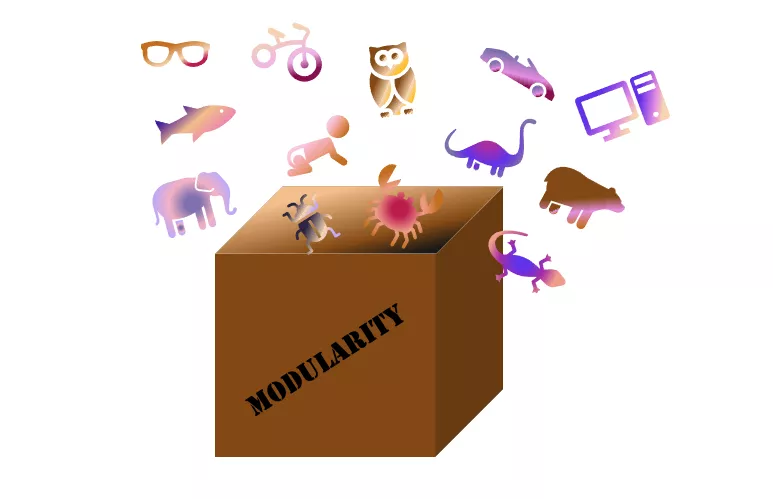
Modularity creates infinite possibilities, and as a force of novelty it is as powerful as evolution itself.
Blockchain Modularity
Modularity works on multiple levels of the blockchain:
Tokens convert various types of assets — currency, driver’s licenses, car ownership, company equity, and even artwork — into virtual objects that can be easily stored on a blockchain. Tokens represent economic value and can be easily manipulated by blockchain-based smart contract software.
Smart contracts work like software libraries and application programming interfaces (APIs) on early computing platforms. These modular approaches to software development allow one program to securely access another program's functionality without reinventing the wheel. Putting a smart contract on a public blockchain allows anyone to use it without permission, which further extends its modularity.
The next level of blockchain modularity mixes tokens, smart contracts, and organizational processes. These "cryptoeconomic primitives" serve as reusable patterns of abstract workflows for easy replication across organizations. Examples of this include prediction markets, token curation registries, and enhanced bonding curves. These building blocks further enhance the modularity of the blockchain by incorporating synergies of economic assets, workflows, and software. Cryptoeconomic primitives enable Decentralized Autonomous Organizations (DAOs) and future forms of economic coordination that we cannot even imagine today.
token engineering
In conclusion, this new wave of technology modularity is helping us overcome the shortcomings of today's organizations in creating and recognizing economic value. But who are the practitioners using the new constructs designed by these organizations?
"Token engineering" is an interdisciplinary practice that applies blockchain modularity. It is a field that combines expertise in software engineering, mathematics, economics, machine learning, law, governance, and many other fields.
This collaborative design process not only gave me optimism, but confidence in token engineering. It taught me that we can use this new field to design organizations that truly serve the goals and values of our communities.
secondary title
build a better future
Of course, it is important to turn these hopes into reality. Like many earlier tools, blockchains can easily be used to centralize wealth and power. Venture capital already has significant stakes in important blockchain projects that could be used to experiment with centralized control, like the first and second versions of the network.
It is also important to note that token engineering alone will not create the changes we need. Organizational workflows are complex. They interact with many systems, including those mysterious sociobiological systems we call humans. This is why we also need to invest in things like governance, community, culture and professional development.
There are many reasons to focus on this new field of token engineering, but for me, these are the most important. If you're interested in learning more, I suggest you start by exploring the Token Engineering Commons Discord Server. You can also connect with many partners in the community including: The Token Engineering Academy, The Commons Stack, Giveth and Block Science.
reference link
Endless Forms Most Beautiful:https://www.wikiwand.com/en/Endless_Forms_Most_Beautiful_(book)
reference link
Token Engineering Commons Discord Server:https://discord.gg/zs9jsnZR48
The Token Engineering Academy:https://tokenengineeringcommunity.github.io/website/docs/getting-started-welcome
The Commons Stack : https://commonsstack.org/index
Giveth : https://giveth.io/
Block Sciencez :https://block.science/