






A brief analysis of how NFT becomes the foundation of Web3 social networking?


Compilation of the original text: Deep Tide TechFlow
Compilation of the original text: Deep Tide TechFlow
This installment was inspired by several conversations with @anonalyx, and it's been a long time since a topic has excited me so much.
This week we're talking about Web 3 social experiences. These ideas are very novel, and I believe that a lot of content will continue to be improved in the next few issues. The following is a background introduction:
Web 2 social experience (also known as social media) refers to bringing offline life online, that is, recording real life moments in the form of photos or videos, and then putting them on social media platforms for others to consume, like and comment on .It's like a personal reality show, with material from our real lives.
With the development of Web 3 and Metaverse, the era we live in will change in the future: our virtual life (what we do online) will be as interesting, recorded and shareable as our real life, and even better than our real life. Our real life is more interesting.Web 3 social experiences are based on this.
Spoiler: NFTs are stealing the show.
first level title
From Web 2 Social to Web 3 Social
Think of the parallels between platforms like Instagram, Youtube, and TikTok. After summarizing, it can be found that they are all digital platforms for sharing real life. We can share vacation selfies on Instagram; upload a recorded parody video on Youtube; post a choreographed dance video with friends on TikTok.
All of this content is based on things that happened in real life. Social media allows those who are not there, who have not experienced it first-hand, to experience our real lives. In other words, our real lives are fodder for Web 2 social media content.
Another interesting aspect of social media is the use of visuals. With the exception of Twitter, every major social media platform relies on visuals. Why is this?
Photos and videos are the tools we use to capture real-life moments so we can share them with others. It's the only channel we have to show our lives to those who aren't around us.
Visuals are also our way of proving that things happen. They are evidence. It goes without saying that our entire social media content forms the basis of our online reputation. As long as I show you a bunch of great pictures and videos of my life, you will believe that these things actually happened. What you think of me is based entirely on these pictures and videos.
We pick shareable moments, make them into a slideshow, and show the world on our Instagram profile or Youtube channel. These are the collections of our carefully curated life.
Now let's summarize Web 2 social media:
1) Our real life as material
2) Based on visual material (photo, video)
3) Curated to present the version of our lives we want others to see
Now, we're transitioning to the next era: our virtual lives -- what we do online -- are just as interesting and documentable as our real lives. We can own virtual items; we can earn virtual certificates; we can work for DAOs; and we can create a brand and audience based entirely on our own virtual events. The next generation of social platforms will be digital tools for sharing our digital lives.
If real life moments, experiences and possessions are the material of Web 2 social interaction, then virtual moments, virtual experiences and virtual assets will be the material of Web 3 social interaction.
So how do you document these digital moments, experiences, and possessions?
first level title
NFT, the foundation of Web 3 social
If you've read an article about the Metaverse lately, chances are you've seen a futuristic, video game-like world painted in it, basically like Ready Player One. In the article I wrote last year about the Metaverse, I used the image below. Dozens of other magazines and websites use this image in their Metaverse articles.
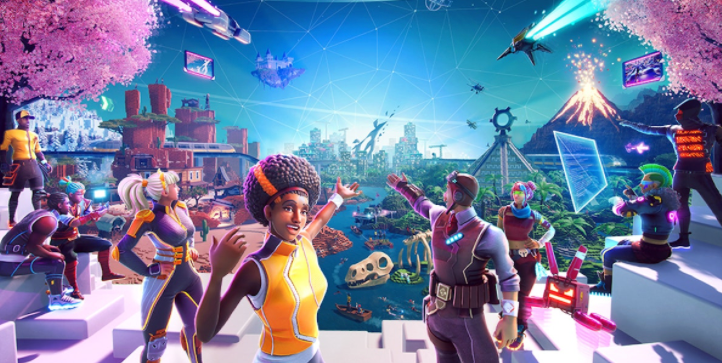
The problem is, the Metaverse in today's world doesn't look like this. The current Metaverse experience is still an Internet experience, which is mixed with some Dapps and NFTs. We still have to stare at a 13-inch screen and rely on 2D graphics and web application interaction to get everything done. We haven't achieved a fully immersive virtual reality yet.
But even without a fully immersive experience, we can already start creating the assets that populate these virtual worlds. NFTs and their associated images are the first generation of Metaverse visuals.
If you're wondering when the transition to Web 3 social will start, it's when NFTs become the PFP (avatar) on Twitter.A seemingly silly, inconsequential act marks the beginning of a new phase of socializing.
For the first time, people are showing their virtual lives instead of their real lives through social media platforms. The NFT’s visuals would say “I own this thing” to viewers, just as a photo of a new sports car says “I own this thing”.
Before ending the introduction of this trend, we have to keep in mind an assumption - more and more network behaviors and achievements will be expressed in the form of NFT in the future. I've called them microcredentials in previous installments, but more broadly, they're a way of documenting our virtual lives. Think about it, many fragmented memories of life have slowly faded over time. But when you see a photo, your mind immediately flashes back to the original place and time. NFT can not only prove that I own this, it can also mean "I did this" or "I am there".
Just like I post photos on Instagram, I will proudly display NFTs in my wallet in the future.
This is the future of NFTs. They are not only tools for recording digital property, but also digital behavior. Web 3 is as social as a photo
The most valuable members of every online community will use NFTs as a token of their reputation. If you are a seed investor in a new startup, you can get an NFT; if you are a member of an exclusive DAO, you can get an NFT. Everything you do, especially what you do better than others, will be represented by an NFT. And then within those communities, you'll be recognized, you'll have a status above everyone else. This is how the online status game plays out in Web 3.
secondary title
plan
Here's an interesting thought experiment: imagine what a Metaverse version of Instagram would look like. You can't share real-life photos, so what can you share?
How about sharing your avatar, digital art and other earned NFTs (which can represent anything)?
You can do this proof of concept by connecting your Metamask wallet with Opensea and viewing your "profile". All your NFTs are displayed in a gallery view and "I think" are arranged chronologically by acquisition date. NFT Gallery is the first generation of social media archives for Web 3/Metaverse.
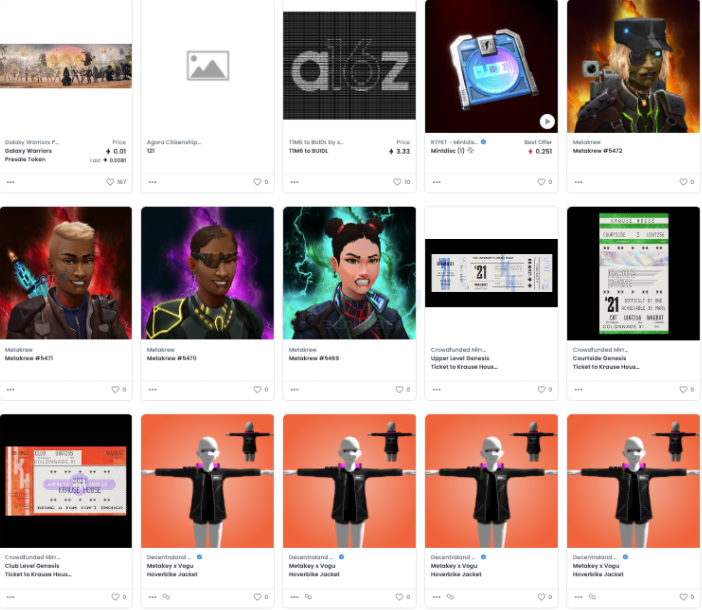
Currently, the NFT gallery displays every NFT in the wallet. However, when we have hundreds of NFTs in our wallets, the question becomes "do I want to show them all?" Since we can spend hours curating and editing the content we share on Instagram, so naturally It can be assumed that we have the same sense of choice and self-awareness about NFT galleries.
The next generation of NFT galleries will have improved curation capabilities—the ability to hide, sort, sort by community, and more. Keep an eye on Islands.xyz.
at last
at last
Image-based NFTs are just the beginning. We're not quite living in a virtual world right now. But you can imagine a day in the future where we might post a video of our avatar dancing.


