Current status of DAO documents and knowledge management


DAOrayaki DAO Research Bonus Pool:
Funding address: DAOrayaki.eth
Voting progress: DAO Committee 3/0 passed
Total bounty: 100USDC
DAOrayaki DAO Research Bonus Pool:
Voting progress: DAO Committee 3/0 passed
Contributors: Jup@DAOrayaki.org
Total bounty: 100USDC
Type of research: DAO
Author: Roxine Kee, Jonathan Hillis
Contributors: Jup@DAOrayaki.org
Original: The State of DAO Documentation & Knowledge Management
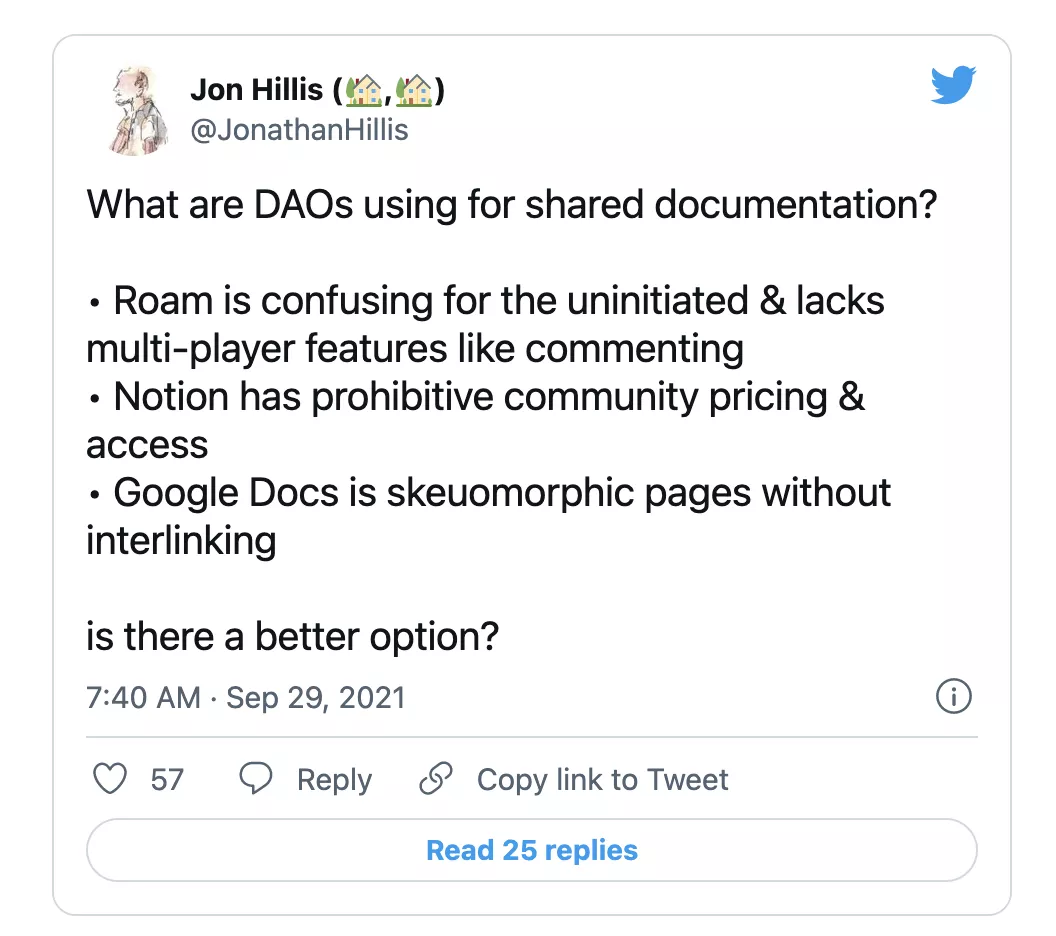
We tweeted the following about a week ago and got a ton of responses:
In this article, we first discuss which collaboration tools can be used to better accomplish the work of DAO, and then we evaluate existing tools on the market to see how they are configured and managed, including our own technology stack. Finally, we introduce the ideal tool that we expect from CabinDAO. It is a Frankenstein document tool and integrates most of the most suitable features of web2 tools for DAO.
We drew on experience gained in writing the documentation and managing the project at CabinDAO, and we also consulted with some of the people in the web3 ecosystem who are building DAOs and protocols, and drew on their shared experience and team workflow.
Finally, we don't make a clear distinction between writing and collaboration tools (such as Google Docs) and knowledge management tools (such as Notion). Because for DAO, informal notes, documents, and releases all belong to the category of team communication, and what we need is a tool that can realize the entire process from initial meeting minutes, brainstorming, to final version approval.
Then let's talk in depth.
secondary title
Basic functions of DAO knowledge management tools
Multi-person access rights management
Supporting multi-person access is the most difficult problem DAO faces in knowledge management tools, especially its pricing and permissions based on the number of people.
Because traditional companies have very clear lines between employees and non-employees. As a result, enterprise software was originally designed with this structure in mind, allowing its pricing to be based on the number of employees in the enterprise.
In contrast, the participation of DAO has a certain gradient. At any one time, the DAO is a concentric circle of a handful of core contributors and participants, community members, Discord lurkers, and the general public.
So this naturally involves access rights issues. A traditional company may have more than 300 employees, and they have an IT department responsible for granting, revoking, and managing access permissions for each user, however in most DAOs of the same size, there is only one or a few people responsible for managing all members permission.
Enterprise applications do a good job of managing access permissions for multiple people, such as Google Docs can manage the permissions of a single document, and Notion can set different pages as public or private. But it doesn't make much sense for a DAO to pay high software fees based on the number of members just to allow each member (especially non-contributors) to have the ability to view, comment, and share documents.
The Wikipedia contribution model is an ideal solution to the DAO's access problem. Wikipedia has a power-law distribution between contributors and editors. As an open source project, it does not distinguish between employees and non-employees, but sets various threshold mechanisms to ensure continuous output of high-quality information.
Distributed project management
Enterprise knowledge management applications in traditional companies have a top-down structure. Projects and tasks are assigned by upper management to subordinate groups and members.
In contrast, a DAO is more like a network of independent contractors interacting with each other than a company of employees. It is structured bottom-up, with contributors writing their job descriptions and proposing projects for community approval.
For example, Github encourages open source contributions and ensures the quality of contributed code through a built-in review process. It allows developers to submit requirements for the features they want to add and assign them to themselves. In short, Github encourages and promotes distributed project management.
When a potential contributor submits a proposal, an ideal knowledge management software should be able to match the appropriate governance or approval process and estimate an offer based on the specification and scope of the project proposal.
Web3 native
By using web3 native applications, DAO can manage document permissions for a group instead of individual members. Web3 no longer needs to constantly add new users and delete leaving users to modify permissions, but to assign permissions in code. This means that DAOs can more accurately manage access by judging membership by whether they own tokens or NFTs.
DAOHaus' Spencer Graham (Twitter @spengrah) describes his ideal scenario.
"When I log into a web3-native tool with my wallet address, the tool allows me to see my status in the DAO, and then it can show me what I can access, while hiding what I can't. This kind of program Humanization works the same way a human decides whether to give an individual editing or access rights."
Notion
A more advanced web3-native feature is the ability to bind projects to bounties, and even embed payment systems in projects and pay bounties based on the level of contribution of each member.
secondary title
Roam
Knowledge management tools currently used by DAOs
Knowledge management is a major pain point of CabinDAO. We currently use Roam, Google Docs, Notion, and Discord at the same time, as each alone doesn't quite meet our needs.
We use Notion to share common knowledge about DAOs and our long-term vision, because we like Notion's WYSIWYG (compared to Markdown) and its ability to manage permissions for different contributors and pages.
We admit that Notion solves at least half of our document and knowledge management problems, but as an enterprise tool, Notion costs users $8-$20 per month. Paying for the 300+ members of CabinDAO's Discord to use would be prohibitively expensive if there were no other solution.
We use Roam Research for project management and internal knowledge management.
Google Docs
Roam's multi-user architecture works for us. First of all, anyone can contribute to our Roam server without worrying about deleting other people's content. As such, it's easier to access than Google Docs or Notion, and its bi-directional link structure lends itself well to bottom-up project management.
For more information on using Roam with DAOs, see this video from @realfakepicnic on how code423n4 uses Roam.
HackMD
However, according to our experience, Roam's bullet-based interface is not suitable for long-form writing, so it will be difficult for people who are not familiar with its block structure or Markdown to master Roam.
Still others use a similar note-taking app called Obsidian, which, unlike Roam, doesn't support multi-user functionality.
We use Google Docs for collaborative writing. Its comment function and multi-person operation function are very powerful. But Docs doesn't have a linking feature. Even after all these years, the writing experience still resembles a slightly outdated Microsoft Word.
(Of course we know there's no need to fix it if it's not broken. But, unlike ever before, we're in the web3 era).
Clarity
We've never used HackMD, but it's a tool that's been featured on Twitter many times, so we interviewed several web3 teams that use it.
Both Jet Protocol and DAOHaus use HackMD as the primary collaboration tool for their teams. Both organizations use it for internal collaboration and shorthand.
For external collaboration, Jet uses Discourse, while DAOHaus uses Docusaurus to publish public and more formal documentation.
One of the cool features of Hackmd is that it integrates with Github. This way, edited documents can go through the merge request review process before being pushed live.
Clarity is the only app on this list that targets DAOs.
As a writing community that is not a DAO but functions like a DAO, Foster ditched Notion and turned to Clarity for the team's knowledge and project management. Because they realized that Notion was getting bloated, especially with custom tasks taking up too much time.
Foster's team likes the way Clarity handles tasks and knowledge, says co-founder Stew Fortier, "Clarity is so low-maintenance that you can easily start multiple tasks and assign them directly in the document."
From our initial testing of Clarity, we found that bidirectional linking can be a challenge. Its current pricing model is still based on the number of users, and the data storage is on the traditional web2 architecture, but the Clarity team revealed to us that they are planning to adjust the model to better serve the DAO.
According to founder Richie Bonilla, Clarity first wants to solve the problem of human coordination, and they are actively working with users to find the best way to decentralize the application.
secondary title
Documentation and Team Knowledge Management for DAOs: Who's the Winner?
DAO needs a solution for creating, editing and disseminating knowledge in a web3-native way. Currently available tools are mainly web2 tools. They are not built based on the needs of DAO's bottom-up, multi-person collaboration.
At CabinDAO, we dream of a knowledge management tool that combines the closest web3 features with the best web2 collaboration tools on the market. We expect it to have…
Notion's WYSIWYG interface
Wikipedia's Permeable Community Protocol
Roam's two-way link