






Analysis of the concept and key design of DAS: for the entire Web3.0


Original Source: Metaverse Consensus
Recently, there has been a debate in the ENS community about whether the range of available charsets for ENS is a bug or a feature. Some so-called big V pointed the finger at the DAS team, thinking that the DAS team was attacking ENS. In this regard, our attitude is:
If there is any evidence to confirm that those articles were done by the DAS team, or instigated by others. DAS will take out 10w U to reward the evidence provider. DAS has its own vision and path, and actively attacking other products is not the style of the DAS team.
secondary title
TL;DR
Idea 1: Web3.0 is not just a blockchain, and a blockchain is not just EVM compatible, nor is it just a specific public chain
Based on this, a key design of DAS is: facing the entire Web3.0.
This means that you can use the address of any public chain [1] to register, manage, and use DAS accounts. You can transfer a DAS account from a BTC address to an ETH address, from an ETH address to a TRON address, and then to a Doge address. In fact, DAS is applicable to any asymmetric encryption public-private key system, not just limited to blockchain. This kind of "cross-chain" feature is not "cross-chain" in the usual sense. But it is more secure than "cross-chain" in the usual sense, and it is a cryptographic-level security that does not require trust.
Today's decentralized domain name systems in the blockchain field are not designed for the entire Web3.0. The domain name system of each public chain operates independently and does not share a unified namespace. These domain name systems can only be applied to a specific public chain and are not universal. This is very similar to the pattern of Web2.0. In the Web2.0 world, each service has an account system, and they are separated from each other. Your username in Facebook is called alice, but the username of alice in Twitter probably belongs to someone else. I think it is difficult for us, and there is no need to accept a Web3.0 that is as fragmented as Web2.0.
Therefore, DAS can be regarded as the general account layer of the entire Web3.0.
If you are interested in the technical principle of "cross-chain" of DAS, you can refer to:secondary title
Idea 2: When it comes to security, you can never be too cautious
To build DAS into the general account layer of the entire Web3.0, and accounts are ultimately used by people, it is a necessary design criterion to improve the recognizability of DAS accounts and reduce the occurrence of fraud. To this end, DAS introduces a key design: the characters that can be used to register DAS accounts are strictly limited. in particular:
Currently, only lowercase letters, numbers, and a small number of emoji are allowed to register as DAS accounts (this is not to say that DAS will not support characters in other languages, in fact multi-language support has always been an important to-do item for DAS)
Characters from some languages cannot be mixed with characters from other languages
For detailed rules, see:Character Set - DAS
Why is fraud prevention so important to DAS that it was built into the underlying design of DAS from the beginning?
Because frauds are more likely to occur in the Web3.0 world, their harm is more direct and greater than those phishing in the Web2.0 world. In the Web2.0 world, if a user visits a wrong website, he needs to go through some steps to cause loss of information or property. But in the Web3.0 world, if a user cannot see the difference between satоshi.bit and satoshi.bit, he will transfer funds to the wrong object and access the wrong contract.
Can ordinary users see the difference between satоshi.bit and satoshi.bit with naked eyes? Obviously not, even if you look closely you can't tell the difference. But in fact, the former's о is a Russian character, while the latter's o is an English character, which are two completely different account names. Without any restrictions, it would be too easy for those with ulterior motives to commit fraud. But don't worry, this kind of fraud doesn't happen in DAS. In the DAS system, the former is not a legal DAS account and will not be successfully registered.
So why not just follow the IDN? The reason is simple, because DAS is not a domain name at all (we will talk about this issue later), and the available character specification for domain names does not apply to DAS.Here is a tweet from a community developer.
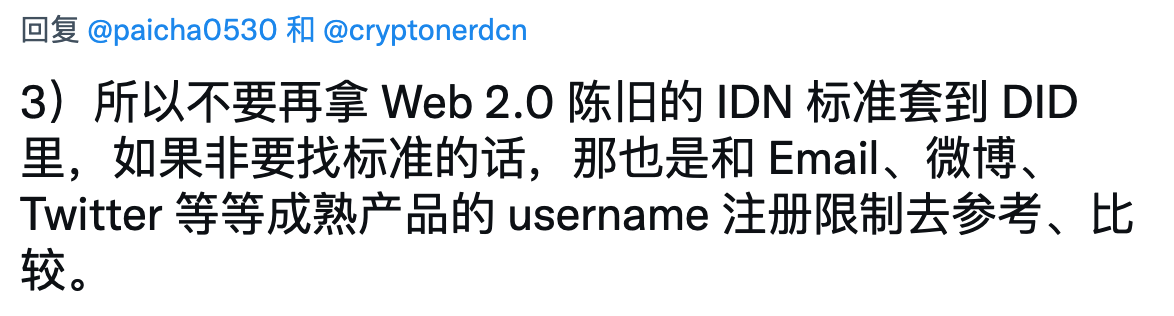
DAS does not discriminate against characters in any language. DAS focuses on how to reduce fraud as much as possible and how to ensure the reliability of the system. Setting up a whitelist of available characters and continuously expanding the whitelist is a security consideration, which is in line with the principle of least privilege in the security field.
secondary title
Idea 3: Fairness matters. We should be clear that there is no absolute result fairness, we should maximize the pursuit of process fairness
DAS is a Web3.0-oriented infrastructure, and DAS accounts are non-exclusive and competitive as defined in economics. Therefore, it is a typical public resource. How to achieve fairness in the distribution of public resources is a very important issue. But we should also be clear that there is no absolute result fairness, what we can do is to pursue process fairness. To this end, we have taken many measures to ensure the fairness of the process as much as possible.
1. Spread information as much as possible
We began to announce the official launch time of DAS about one month in advance. Through major media, social networks, and communities to spread the information about the upcoming launch of DAS. We have also released related product introductions and public beta environments. We also cooperate with major wallet partners to promote DAS in their channels in advance.
2. Give the development team no advantage
As a development team, we always have the greatest advantage, and we have the most complete information: we can know the specific launch time, whether the mainnet contract has been deployed, where it is deployed, and so on. To ensure a fair start, however, we must give up this advantage. We can promise that the development team cannot register a meaningful DAS account earlier than any user. We have implemented a registration switch inside the contract. When the team completes the deployment of the main network contract and completes the functional acceptance of the main network contract, this switch has been turned off. It will be opened at the agreed open registration time (2021-07-22 20:00 UTC+8). Therefore, both development team members and users can only start registration after the official open registration time.
In fact, this is not just a verbal promise, but an established fact. The blockchain is open and transparent, and anyone can verify that the development team has not registered a meaningful DAS account before 2021-07-22 20:00 UTC+8 by backtracking on-chain transactions. How to accurately understand "no meaningful DAS account has been registered", you can read:"Written Before DAS Goes Online" -- From DAS Team
3. Rhythmic Open Enrollment
Even though we started spreading the information a long time ago, we still don't think it's diffused enough. Even though DAS has been launched, it still takes time for more people to know about DAS. When DAS itself is not influential enough, it is unwise to directly open the registration of all accounts, and the process is unfair. Therefore, we have formulated a gradual release strategy, so that at least those who learn about DAS later will have the opportunity to participate in the competition, and those who have learned about DAS earlier will not lose the opportunity to participate in the competition. It's a value proposition. The latest release progress can be found atOpen Enrollment Rules - DASSee.
account registration time, bypublic algorithmCalculated, depending on the account name itself. You can search for an account on the registration page to see if an account is open for registration. Given the current open registration rules, you may find that your favorite account is always closed, which can become annoying. We hope that everyone can understand the original intention of this rule.
We have received feedback from some users: why the open registration rules are so strict, why the team is so stingy, the team does not open registration to keep valuable accounts for themselves! This feedback is fundamentally derived from the conflict between individual interests and collective interests. Everyone hopes to get a high-quality account, but each account will only belong to one person in the end, and there is no mechanism to satisfy everyone. On this, we need to state our position:
As the builders and maintainers of DAS, the DAS development team always prioritizes the overall interests of the DAS ecosystem. Process fairness is our value proposition on account allocation
Accounts not yet open for registration not belonging to anyone on the DAS team, and at the appropriate time, they will be open for registration to all users.
secondary title
Philosophy 4: Be responsible for the good of the whole, not the interests of the individual
DAS will only use the suffix .bit forever, and will not add any other suffixes. We think it's in the overall interest of everyone. DAS issuing multiple suffixes will undoubtedly increase the number of registrations and income of DAS, but it will bring confusion to the entire Web3.0 world, so this is not advisable.
DAS sets up a reserve account list. A reserved account refers to an account reserved for a well-known organization/individual. They need to claim it within a specified period, otherwise it will be open to everyone for registration. To be clear,These accounts do not belong to anyone on the DAS team.
Why set up a reserved account list, why should I reserve them, why can't I register twitter.bit? The reason for this is not because domain name systems like ENS have reserved lists. It is derived from our consistent value proposition that the overall interests of all DAS users are greater than personal interests. We believe that lowering the threshold for some well-known organizations/well-known individuals to adopt DAS will make speculators lose the opportunity to preempt famous accounts and sell them at high prices, but it will be more conducive to expanding the consensus of DAS.
secondary title
Idea 5: Open source
secondary title
Idea 6: DAS is an account, not a domain name
The name of a product is often a direct reflection of its product positioning. All kinds of xxNS position themselves as decentralized domain name systems, and the A in DAS stands for Account. The positioning of DAS is an account, which is fundamentally different from the DNS domain name system and other decentralized domain name systems.
Different positioning brings different focus of thinking. DAS does not consider how to subvert or replace or enhance the existing DNS system. Although it is also possible to use .bit to access a web page on IPFS/Arwave, that is just one of the many application scenarios of DAS.
Through DAS, the NFT Box of Instant App can display the NFT under its name according to the user's nickname; through DAS, users can have a decentralized Linktree; through DAS, users can have a unified username in each game/app; Through DAS, users can carry out end-to-end encrypted communication; through DAS, users can send assets more securely, and interact with contracts more securely; through DAS, users can aggregate their reputations on the chains of various public chains Together and so on, these are the points that DAS pays more attention to. And these scenarios are completely unrelated to domain names.
at last
at last
Attached:
Attached:
[1] DAS supports all public chains, but the support of each public chain requires certain development work. DAS currently supports EVM compatible chains, TRON and other public chain address registration, and the support of other public chains is under development.


