Comprehensively analyze Arweave from four points: business logic, product ecology, market competition and project valuation



Research Institution: Mint Ventures
Researcher: Xu Xiaopeng na

first level title
Research Report Highlights
Research Report Highlights
1.1. Core investment logic
The Arweave team has excellent business insights and has chosen a segmented cloud storage market with long-term value and not yet fierce competition—permanent storage, which has become the only leading project in this market and has benefited from the long-term business development of WEB3 for decentralization Compared with other decentralized cloud storage projects, its solution has the following advantages:
● Data is permanently stored, free to read, and users do not need to pay continuously
● Around its underlying storage service, a set of protocol ecology and SmartWeave smart contract ecology based on its always-on network has gradually been built, and it is developing towards the WEB3 full-stack protocol. There are obvious synergies between storage services, smart contracts and application layers
● It has been adopted by public chains, NFT projects and many Web3 applications (especially the creator economy). The demonstration effect of the leading project\celebrity selection is conducive to the adoption of Arweave by more similar projects in the future
● After important data is deposited on Arweave, users need to pay a high conversion cost if they want to migrate
● Compared with Filecoin, Arweave's mechanism is simpler in concept and technology, and it is less difficult to develop, implement, and adopt by users and miners
However, its positioning and mechanism also determine some restrictions on the business development of the project:
● The solution stored on the chain determines that the data cannot be changed once it is uploaded, resulting in high iteration cost of the program and insufficient mobility
● Data is public, sensitive data (such as key business data of enterprises) will not choose Arweave
1.2. Main risks

first level title
Basic information of the project
Basic information of the project
2.1. Project business scope
Arweave is a block network. The core service it currently provides is to provide distributed permanent storage for data. It is committed to becoming a data storage infrastructure in the Web3 era and can be classified as Layer0.
At present, most data storage solutions are centralized, such as cloud services, but centralized services have single-point risks such as service offline, privacy leakage, content review, and unclear data ownership.
Arweave has a wide range of user groups, including content creators who have concerns about the above risks, Web3 projects with data storage needs, and public chain base layers with large-scale data storage needs.
In addition to storage, on the underlying network of AR, there is also an application layer called permaweb and the Smartweave smart contract system, which can realize the operation of applications and smart contracts, and an ecology based entirely on Arweave has begun to emerge project.
2.2. Project History and Roadmap
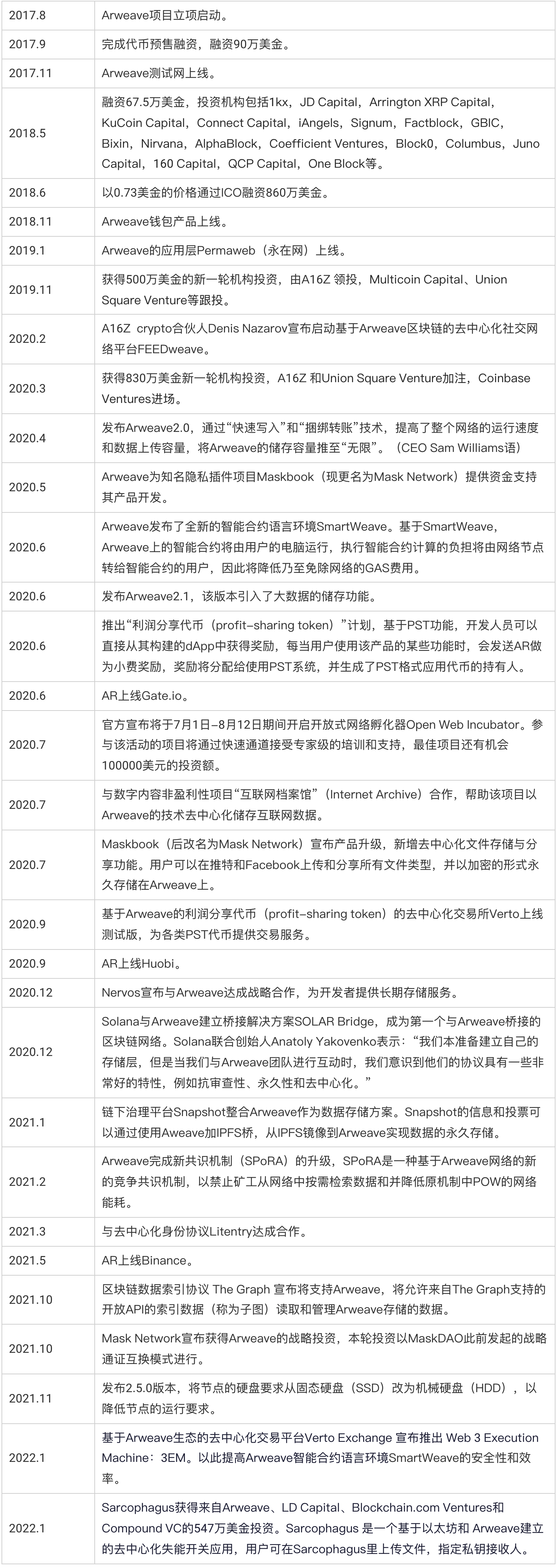
2.3. Business Details
text
2.3.1. Business logic
Before introducing the current business situation of Arweave, it is necessary to explain the network structure and consensus mechanism of Arweave for the convenience of readers.
Network Structure and Consensus Mechanism
Arweave realizes the function of permanent storage of information through Blockweave data structure and SPoRA consensus mechanism.
The blocks of the traditional blockchain are connected one by one, thus forming a chain structure. On this basis, Arweave's block also points to a random previous recall chunk, thus forming a spinning block structure.
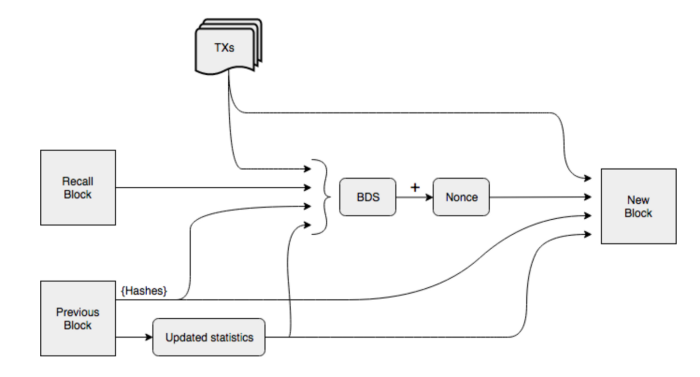
image description
Arweave’s block structure, source: Arweave Yellow Paper
The most important thing about the design of Block Square is to serve Arweave's consensus mechanism - SPoRA (Succinct Proofs of Random Access).
SPoRA consensus mechanism
Before using the SPoRA consensus mechanism, Arweave used the PoA+PoW mechanism. Everyone is familiar with PoW, so I won’t explain it here.
And PoA stands for Proof of Access: Proof of Access. Under this mechanism, Arweave requires each miner node in the network to access a random memory block locally if it wants to generate a new block and get rewards. If he does not store the block, there is no way Generate new blocks.
In this case, if a miner wants to obtain as high a mining income as possible, he will choose to store all blocks, because each next block will point to the current block and a random block before it, storing The more blocks there are, the more eligible to produce blocks and receive rewards. PoA encourages miners to store more Arweave blocks, and this also encourages miners to store some blocks that are less stored by everyone to increase the probability of satisfying PoA.
However, under the independent PoA mechanism, if all miners have stored all the blocks, then everyone has exactly the same probability of generating blocks. Therefore, in addition to PoA, Arweave introduced the PoW mechanism to enrich the competition dimension of block generation.
Wildfire
Arweave upgraded PoA+POW to SPoRA in February last year. The pure PoA+PoW mechanism guarantees the permanent storage of data, but does not guarantee the speed of data access, and PoW also has the environmental protection problem of power consumption. The SPoRA mechanism reduces the weight of PoW in the previous probability of miners producing blocks, and adds the dimension of data access speed. In addition, SPoRA allows miners to focus more on maintaining their own local hardware and nodes, preventing miners from storing data in the same low-rate data center, which facilitates the diversification of node locations and improves the decentralization of the entire network. degree of transformation.
BlockShadow
Node verification does not need to verify the entire storage file. When a node generates a block, it does not submit the entire storage file to other nodes for review, but puts the storage content in the block, and only transmits a hash value and account list. This hash value represents this part of the content, and other nodes verify whether this hash value corresponds to the one in the file pool. This method speeds up the efficiency of verification and transfers part of the work to off-chain. Similarly, when calling, only BlockShadow is needed to locate the stored block and complete the calling.
network participant
network participant
Participants in the Arweave network are divided into two categories, miners and users. Users pay AR to add data to the network, and miners in the network charge AR to mine new blocks, which they need to store and provide data. The entire network coordinates and distributes rewards as a whole across the two.
Bundles
Bundles are a technique for combining many data transactions in Arweave into one transaction. It directly improves the scalability and usability of the Arweave system. In addition, it solves a problem that other blockchains have, where your transaction may be rejected when someone else submits a transaction that rewards the miner more. This function ensures that Arweave is still competent when a project needs to upload and store a large number of media files, such as a game project that needs to upload thousands of NFT pictures and audio. We found that after the official launch of Bundles in September 2021, Arweave's network data storage capacity began to soar.
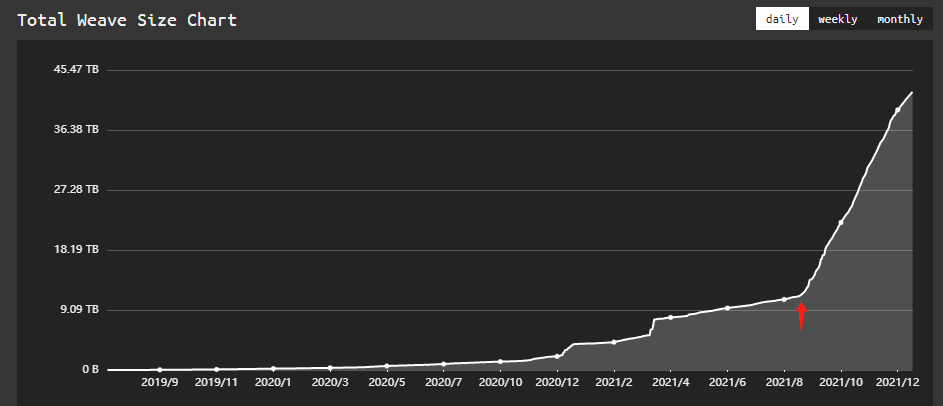
image description
SmartWeave
Arweave's Weave size trend, data source: https://viewblock.io/
SmartWeave, as Arweave's smart contract protocol, enables developers to build smart contract applications using JavaScript. The way it works is different from the contract execution method of Ethereum. In Ethereum, the entire network is called to verify transactions, which greatly increases the burden on the network. In SmartWeave, relying on smart contracts, users download contracts themselves on the local client Finish.
The Permaweb
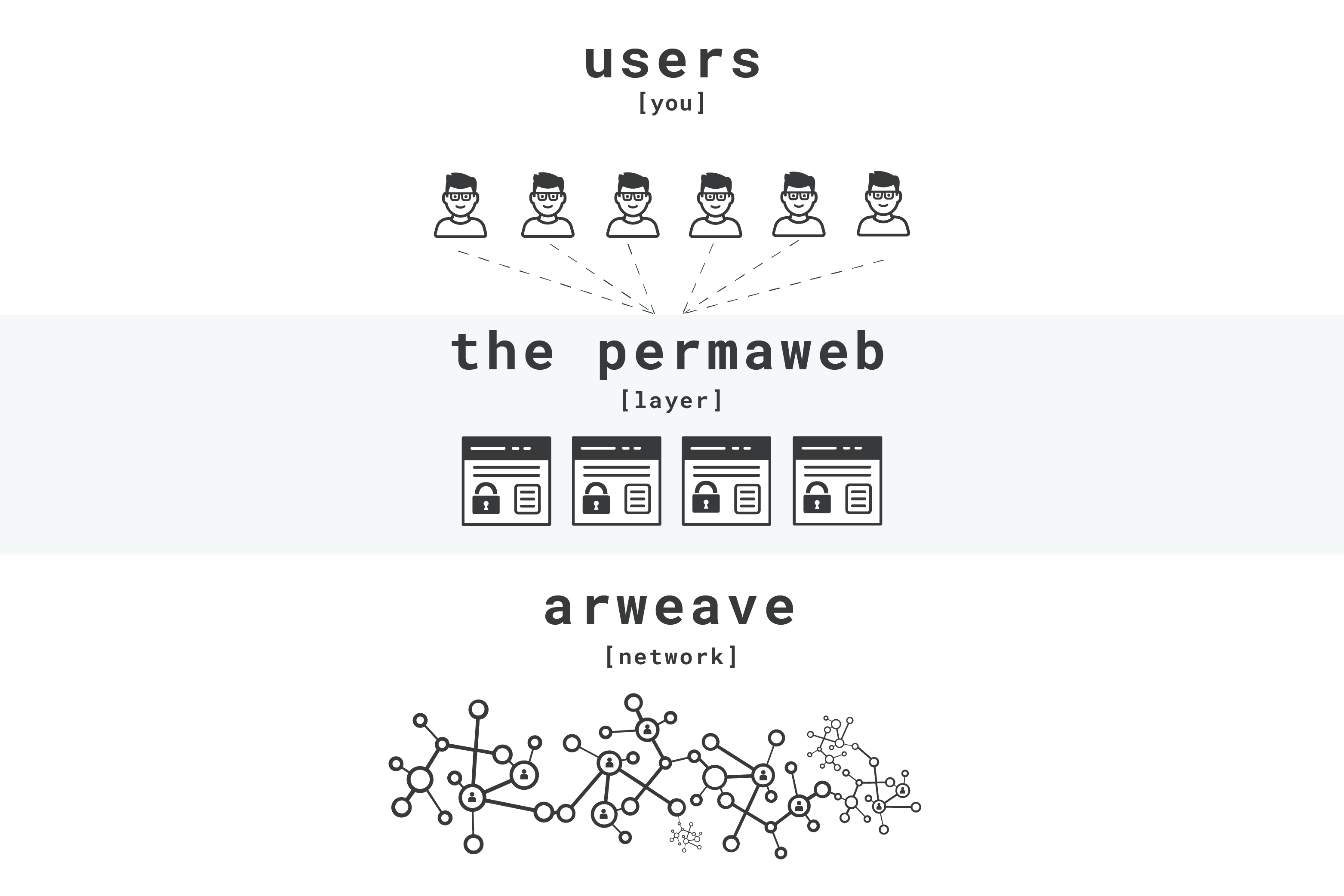
image description
Image credit: Arweave.org
On top of Arweave's core data storage layer, there is a permaweb, and the community's Chinese translation is quite vivid - Yongzaiwang. The Always On Web is a collection of interconnected files and applications, similar to Web2's network in this respect, but with one key difference: All content on the Always On Web is permanent. Always in the network can be used to store all kinds of information: from Wikipedia, to PDF, to video, and various dApps, such as Uniswap. Once included in the Arweave network, these files and information are like a permanent backup. As far as smart contracts are concerned, even if the original project goes offline, as long as the back-end smart contract code is still available, users can still use it on Arweave’s forever network. to access the app. In addition, once information is submitted to Always On, no one (including the original uploader of the file) can change it in any way.
2.3.2. Business data
The main network of Arweave was launched in June 2018. Although it has won the support of some public chain parties before 2021, it is used as the main solution for main chain data storage (such as Solana and Nervos have already adopted Arweave as their main chain in 2020). data storage solutions), but before the outbreak of the NFT track in 2021, Arweave's storage business has always been in a state of gradual linear growth.
Until 2021, the demand for data storage in various aspects has opened up the storage capacity of the Arweave network to skyrocket, as shown in the figure below:
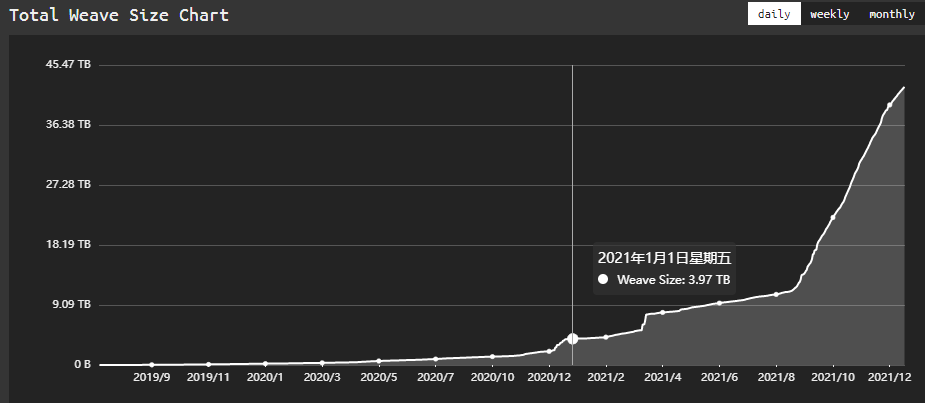
image description
Data: https://viewblock.io/arweave/stat/cumulativeWeaveSizeHistory
The Weave size of Arweave has increased by 10 times within one year, and the data storage capacity of the entire network has increased from 4T to 40T. In addition, according to Arweave's official disclosure in the [2021 Annual Report], the annual growth rate of its monthly data usage is 40 times, rising from 188.42G in January 21 to 7.58T in December.
At the same time, Arweave's 30-day direct network fee is also at the top of each Web3 infrastructure layer:
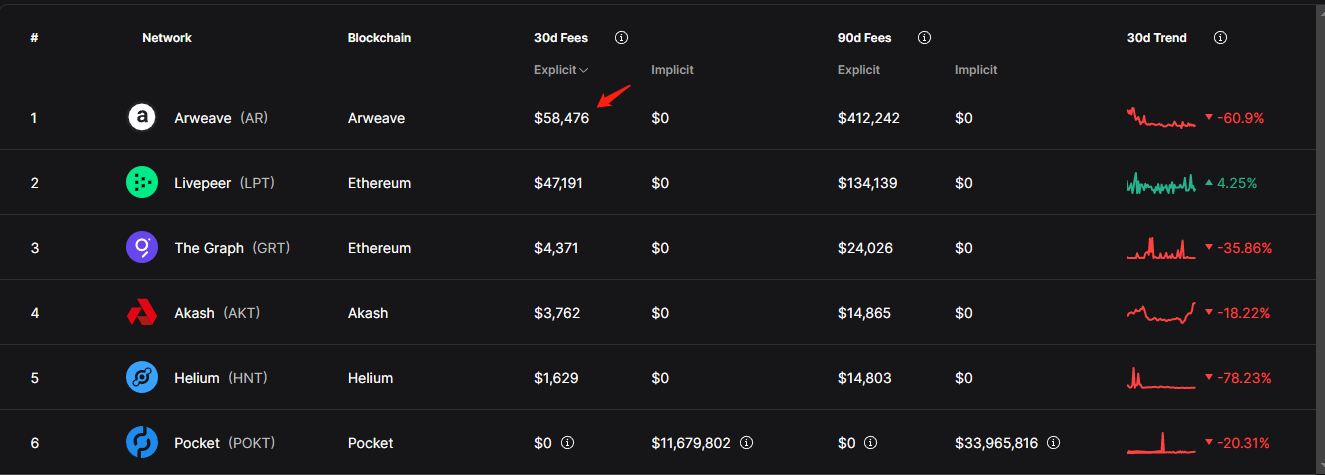
Data: https://web3index.org/
smart contract
In terms of smart contracts, the number of smart contracts of Arweave's SmartWeave has also increased rapidly:
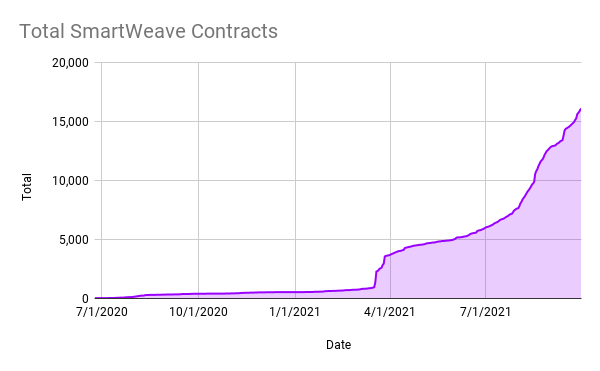
image description
Data source: https://arweave.news/arweave-annual-2021/
According to the data of ArweaveApps, the number of Arweave applications that have been included has reached 400+.
Source of Strong Business Growth
There are internal reasons for the rapid rise of Arweave business data this year, such as the advancement of basic tools and technologies. The launch of the data synthesis and packaging technology Bundles mentioned above is one of them. The gradual improvement of basic tools allows Arweave to more smoothly undertake data from Business traffic on the demand side.
Specifically, the main demand factors driving the rapid rise of Arweave business data this year may come from three aspects:
● NFT market explosion
● Public chains are flourishing
● Web3 applications, especially the prosperity of the creator economy
Let’s talk about NFT first:
The NFT market will explode from 2021. First, the legendary work "Every Day: The First 5,000 Days" by digital artist Beeple sold for a sky-high price of more than 69 million US dollars in March 2021, ranking third among the auction prices of works by living artists. Then there are NFT Crypto Punks for avatars, the popularity of BAYC and the fashion of traditional sports IP NBA TOP SHOTS, and then the debut of NFT for chain games. By the end of 2021, star IP projects represented by Jay Chou and Edison Chen will further expand the popularity and audience of the NFT market.
According to a survey of the top 22 NFT projects by Twitter KOL pencilflip in October 2021, 50% of projects store their files on centralized servers.
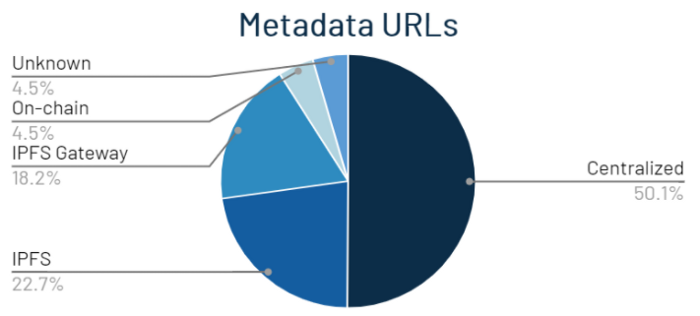
image description
Data source: pencilflip's twitter, drawing: Amber Group
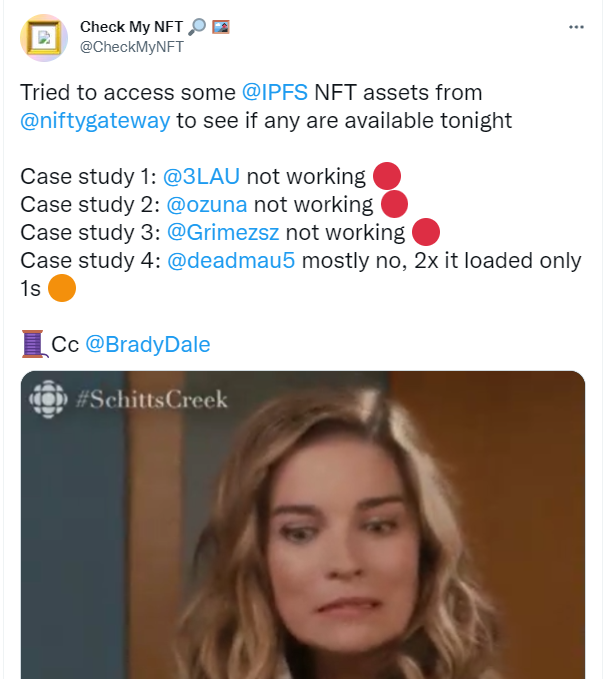
In fact, even IPFS, another decentralized storage project, cannot guarantee the permanence of NFTs. CheckMyNFT found some assets from blue-chip artists, including Grimes, Deadmau5, and Steve Aoki, temporarily taken offline despite being hosted on IPFS.
The fate of the expensive NFT is controlled by a centralized website, and the project party hosts it in a non-permanent storage space, which goes against people's intuition about the value of NFT. This also led to the direct demand for storing and publishing NFT data on Arweave, making Arweave the mainstream solution for NFT data storage.
Beeple, the NFT artist with the highest income in history, launched its NFT platform WE.NEW based on Arweave. Its website displays LV's 200th anniversary NFT and tennis star Murray's 2013 Wimbledon championship series NFT works.

image description
JAY-Z launched a re-creation NFT for its 25th anniversary album, and stored the animation on Arweave. The price of this work at Sotheby's is 138,600 US dollars.

image description
Image source: https://www.sothebys.com/
Pianity is a music NFT casting and trading platform, which can help creators to NFT their music works and sell them to generate continuous income. It does not use the ERC721 NFT format, but uses Arweave's NFT standard for NFT casting and storage.
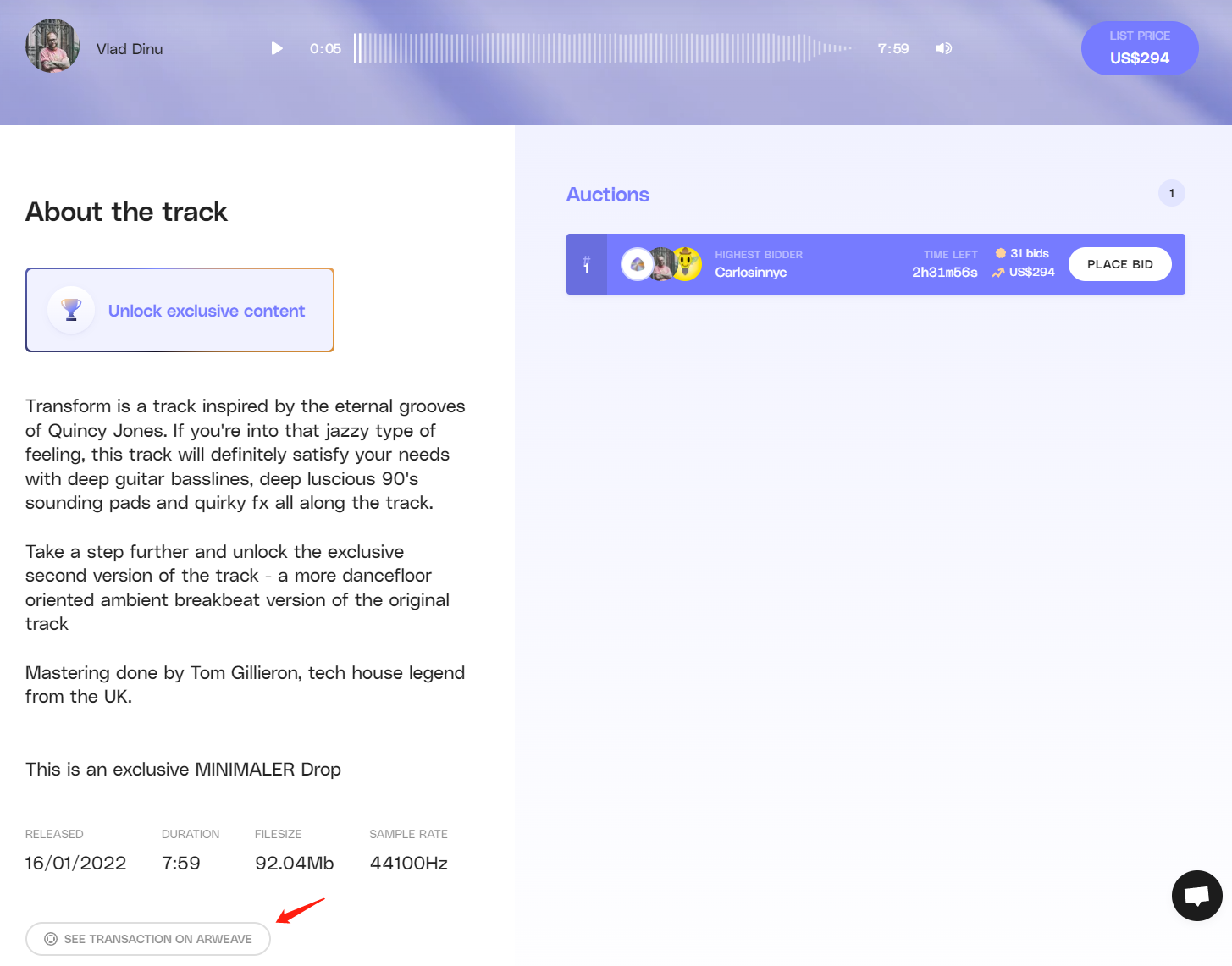
image description
A music NFT page on Pianity, image source: https://pianity.com/
At present, in addition to Solana and Nervos using Arweave as the default data storage layer, Arweave provides block data storage services for multiple public chains such as Avalanche, Celo, Near, and Cosoms through its storage middleware project KYVE to solve the problem of all nodes of the public chain. Insufficient, the problem of low data retrieval efficiency.
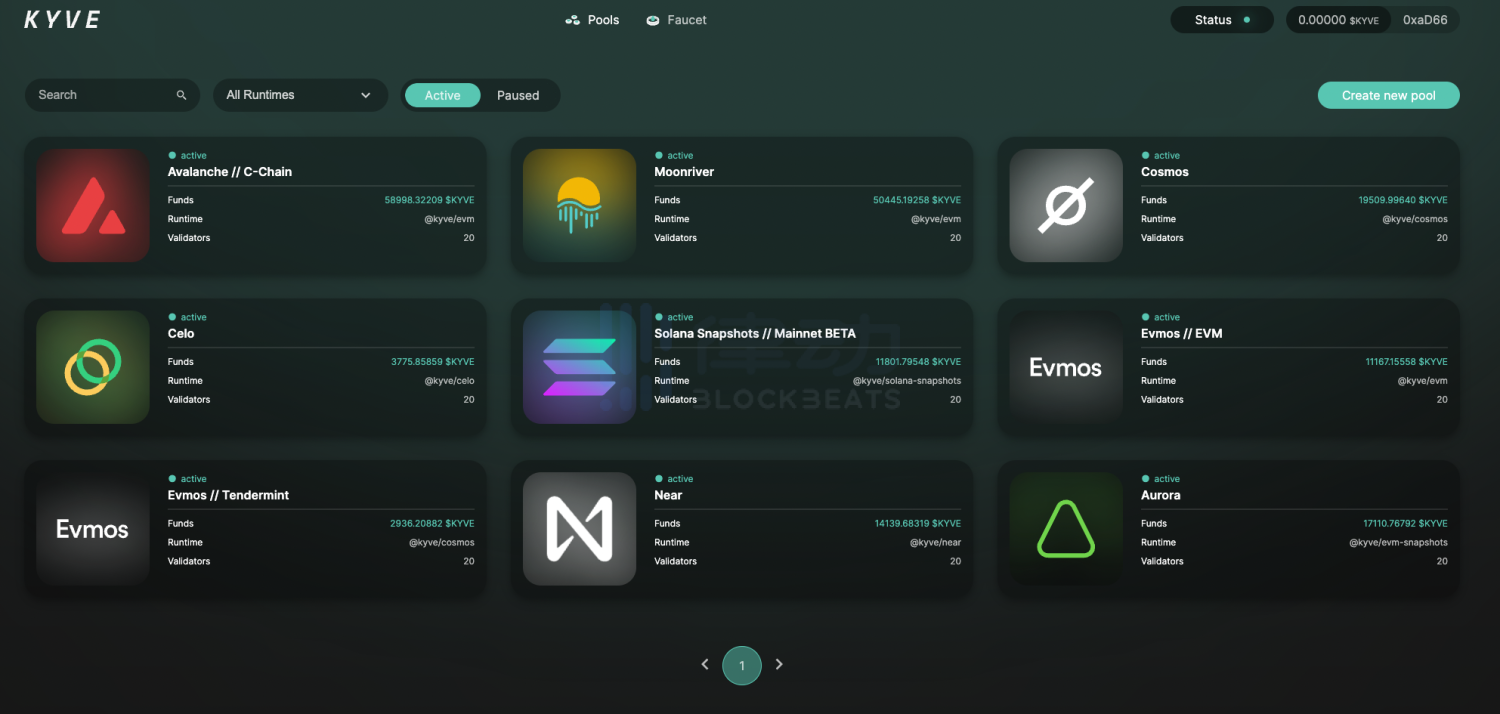
image description
Data: KYVE
Finally, other Web3 applications, especially in the field of creator economy:
Arweave has multiple values for data storage of Web3 applications:
● Permanent hosting and backup of the application front-end to prevent single-point risks and review risks from centralized cloud service providers
● Permanent hosting and backup of project asset data, such as pictures, audio and video data of NFT assets of chain game projects
● Permanent preservation of creative content, this category is the most abundant, in addition to the aforementioned Beeple, there are many well-known projects that use Arweave as a storage solution, such as Mirror, Mask Network, MYNFT and so on.
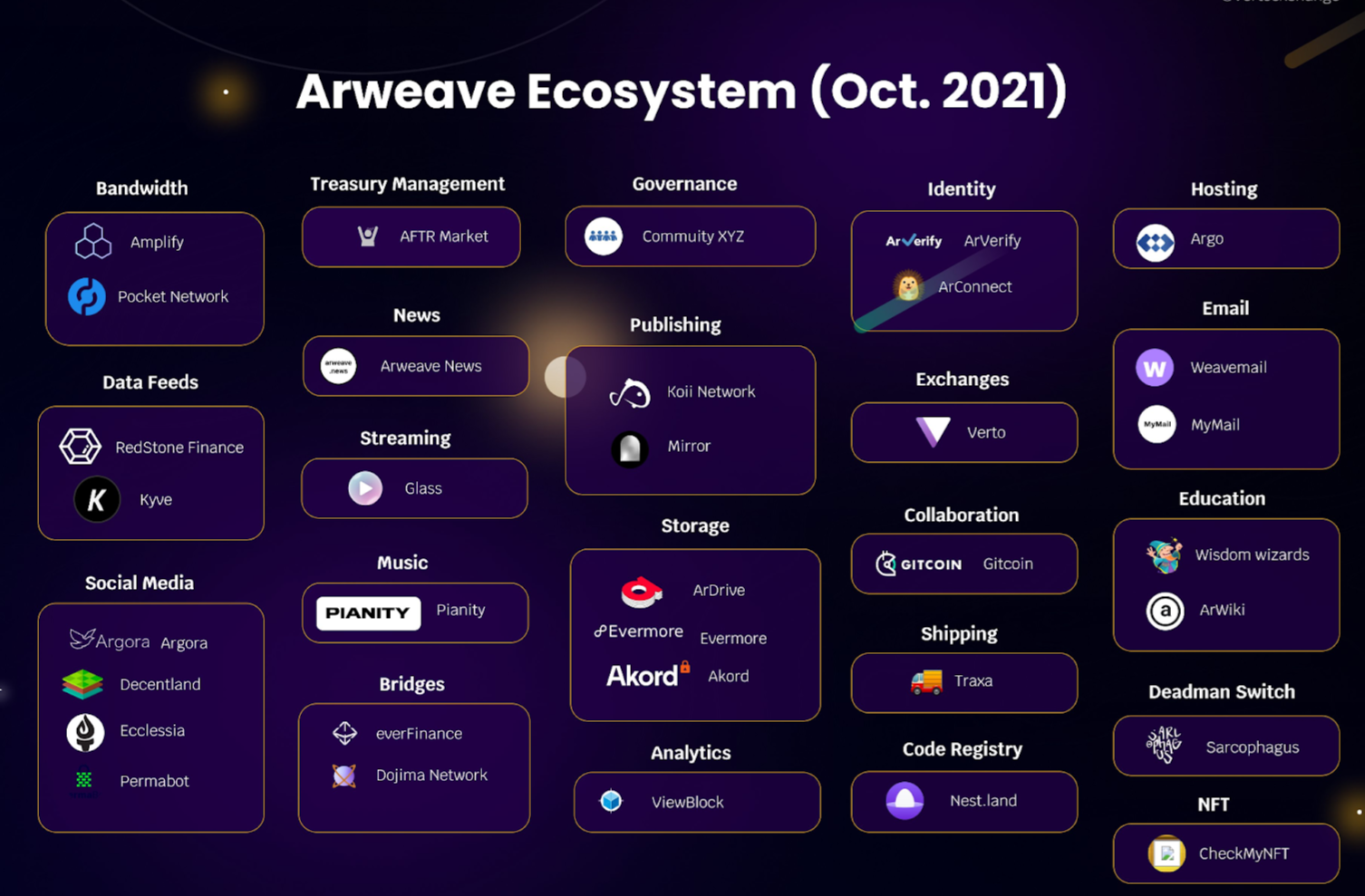
image description
The ecological map of the project using the Arweave storage solution, source: verto
In addition to encrypted business, Arweave also plays an important role in some social activities.

In 2020, the visual artist organization DADA Art Cooperative and DappHero founder Dennison Bertram launched the No Justice No Peace project, aiming to publish the names and portraits of policemen who killed black people in the United States. The project uses OpenSea and Arweave, and uses Arweave's blockchain to create a wallet for each person killed and hold the information tokens of the police officers associated with it. According to the project's information on Arweave, between 2013 and 2019, 99 percent of police killings in the United States went unpunished. Photos of the victims circulated widely in the media, but the police who committed the brutality were unable to track them down.
In the long run, whether it is NFT, public chain data or WEB3 application data, their demand for Arweave is on the rise, and there is still a lot of room for growth.
Among them, the field of NFT and creator economy may be the focus of Arweave's data business growth in the short term, because NFT has high requirements for the sustainable preservation of information, and creators have high requirements for content anti-censorship, sustainability, and data storage costs , and their data storage business is often large, which can provide a steady stream of business needs.
In theory, Arweave's data business backup volume has a very high upper limit. According to the official statement, Arweave's storage target is the volume of "the entire Internet data". In fact, Arweave has cooperated with the digital content non-profit project "Internet Archive" (Internet Archive) as early as 2020 to help the project decentralize the storage of Internet data with Arweave's technology.
2.4. Team situation
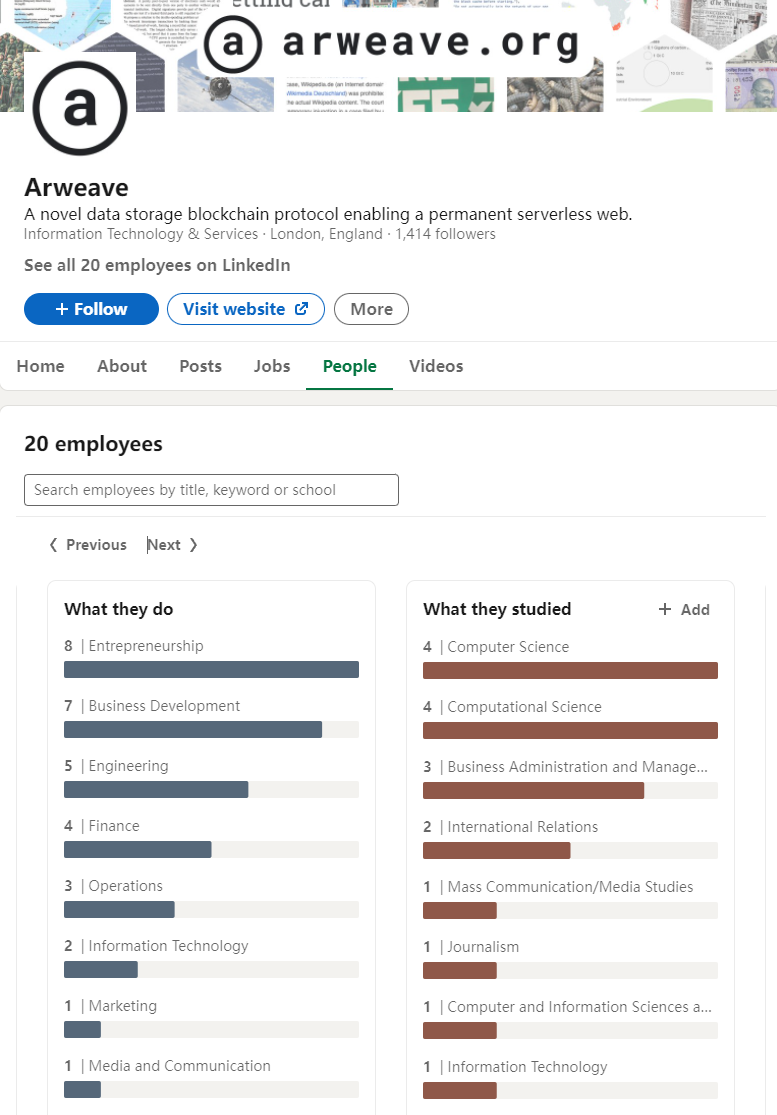
According to Arweave's Linkedin, the team currently has 20 people, which is a very streamlined team size in the industry. Most of the team members are located in Berlin, Europe, and BD accounts for the highest proportion of positions, followed by engineers.

Sam Williams
The core members of the Arweave team include:

India Raybould
Project CEO and founder, who studied in Nottingham from 2011 to 2014 and received a Bachelor of Computing Honors. He is also a Ph.D. in computer science at the University of Kent, and served as an assistant lecturer at the University of Kent from 2014 to 2017. Since 2017, he has successively founded Minimum Spanning Technologies and Arweave. Since 2018, he has worked as a consultant for the blockchain company Minespider, and since 2019 as a mentor for Techstars (an entrepreneur training institution), and as a voter for the LAG Fund, a non-profit organization dedicated to protecting privacy.
Chief Coordinator. After graduating from the University of Manchester in 2014, he worked as an administrator at Canterbury Christian University. In 2017, he joined Arweave as the chief coordinator and was responsible for the front-end design of the website.
Arweave used to have two CTOs, but they left in 2018 and 2021 respectively, and the current technical leader is unknown.
2.5. Industry Analysis
According to public information, Arweave has raised about $23 million in total. Fundraising rounds and amounts are as follows:
● September 2017 pre-sale round: $900,000.
● Round of financing in May 2018: USD 675,0003, investment institutions: 1kx, JD Capital, Arrington XRP Capital, KuCoin Capital, Connect Capital, iAngels, Signum, Factblock, GBIC, Bixin, Nirvana, AlphaBlock, Coefficient Ventures, Block0 , Columbus, Juno Capital, 160 Capital, QCP Capital, One Block, Chain Fund Capital, etc.
● June 2018 ICO: $8.6 million.
● Institutional round of financing in November 2019: US$5 million, led by A16Z, followed by Multicoin Capital and Union Square Venture.
● Fundraising on March 6, 2020: $8.3 million, with additional investment from A16Z and Union Square Venture, and newcomer Coinbase Venture.
Combining the above financing and the AR tokens in the hands of the team, it is expected that the current team has relatively sufficient funds.
2.6. Partners
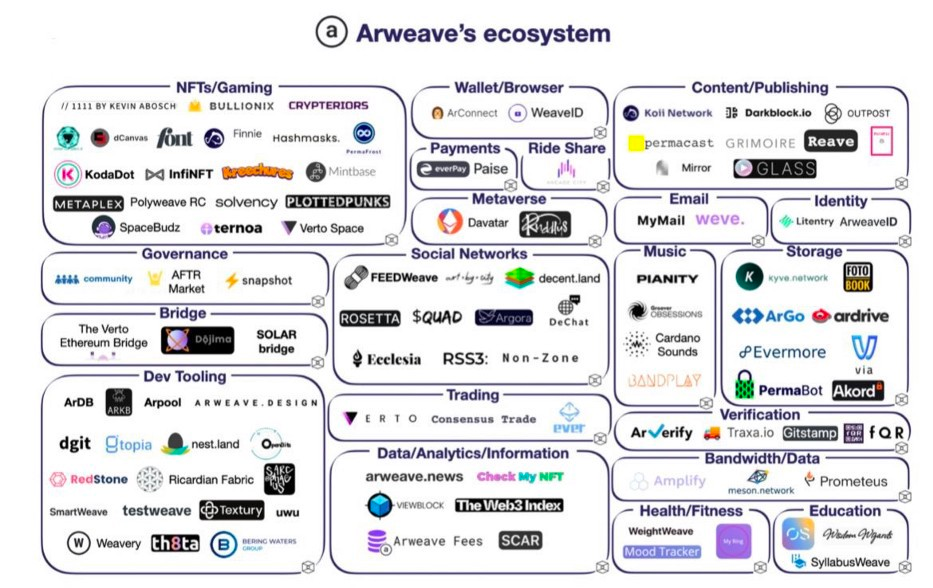
Arweave has many partners, and the ecology has begun to take shape.
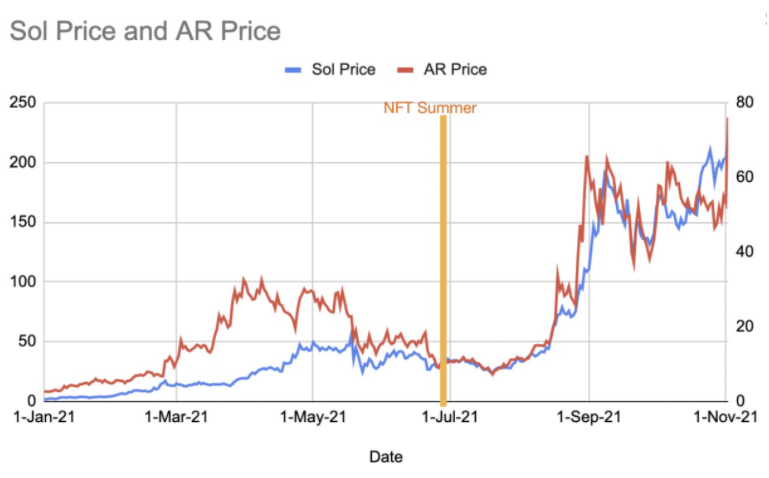
Among them, Solana has the closest cooperation with Arweave. The NFT business in its ecology has contributed a lot of demand to Arweave, and the token trends of the two have also been highly correlated:

business analysis
business analysis
secondary title
3.1. Track Overview
As far as its current core business is concerned, Arweave belongs to the decentralized cloud storage (Decentralized cloud storage) track, which is a subdivision of the cloud storage track. Cloud storage is a cloud computing model that stores data on the Internet through a cloud computing provider. Its feature is that it can provide storage space on demand and in a timely manner, without the need for users to purchase and manage data storage infrastructure by themselves. As a result, users can achieve agility, global scale and durability, and "anytime, anywhere" access to data.
The cloud storage market has maintained a rapid growth rate for only a few years, behind which is the onlineization of everything and the onlineization of the entire business process of commerce. According to the report data of the commercial market research company Fortune Business Insights, the global scale of the cloud storage market in 2021 will be 76.43 billion US dollars, and the compound growth rate in the next 8 years is expected to remain at around 26.2%, which will reach the overall market of 390 billion US dollars in 2028 scale.
The current cloud storage market is mainly controlled by centralized giants, and the market concentration is high. The top cloud storage service providers include Amazon's AWS, Microsoft's Azure, and Alibaba's Aliyun, etc.
However, with the development of the Web3 wave, and Web3 users put forward new requirements for data privacy, data decentralization and sustainability, and anti-censorship, the demand for decentralized cloud storage has emerged.
Different from the "distributed cloud storage" concept proposed by centralized cloud storage service providers, decentralized cloud storage services are essentially provided by individual nodes. Cloud storage providers are extremely open, and anyone who meets After the node conditions, you can become a server instead of a specific company. The "distributed cloud storage" proposed by centralized enterprises is more geographically dispersed to avoid single-point risks caused by too centralized and single data centers.
Currently players in the decentralized cloud storage track include Filecoin, Arweave, Storj, Swarm, etc. However, despite belonging to the same decentralized cloud storage track, Arweave has a very different positioning from Filecoin and Storj. Their product mechanisms, services provided, and charging methods are quite different.
secondary title
3.2. Project competition pattern
The Library of Alexandria was built by Ptolemy I (c. 367-283 BC) and is one of the oldest libraries in the world. The museum collects manuscripts from 400 BC to 300 BC, and has the richest collection of ancient books, which can be described as the crystallization of human social knowledge. It is a pity that this world-famous ancient cultural center was completely engulfed by war at the end of the 3rd century, and all the precious ancient books and scrolls in the collection were burned. How much knowledge has been interrupted here, no one knows.
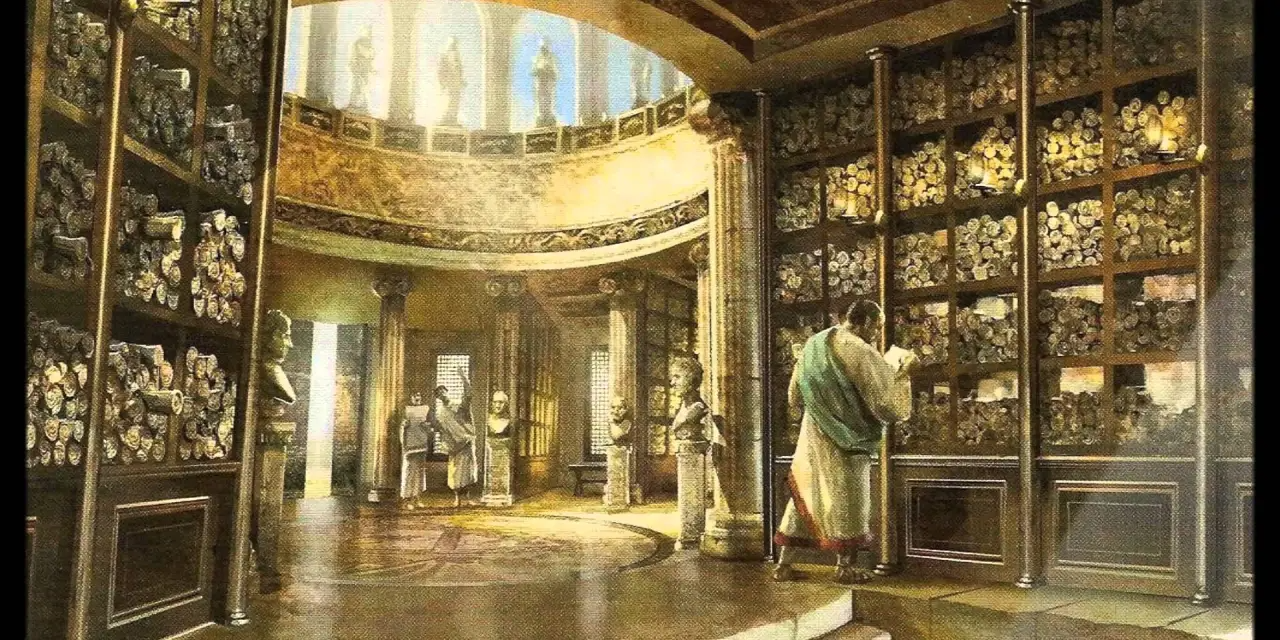
image description
Library of Alexandria, image source: Google
In terms of vision, Arweave wants to completely store the knowledge and history of all mankind through its own system. The goal of Filecoin/IPFS is to subvert the monopoly of centralized cloud service providers on the storage market and provide a more open cloud storage supply market. Although there is competition between the two in some specific scenarios, such as the storage of an NFT image information, in the long run, they are solving two different "big problems", and their solutions are even complementary.
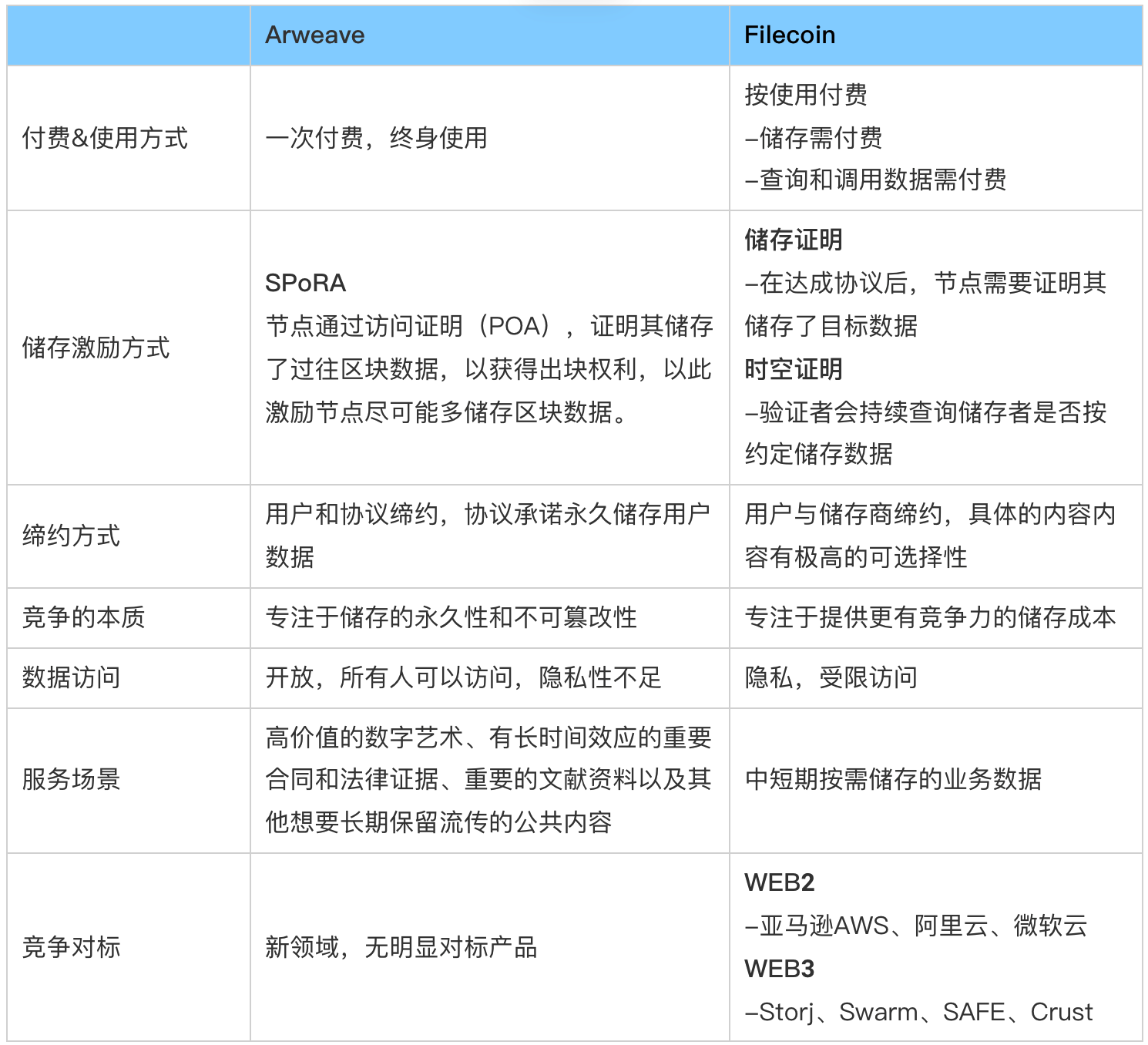
We can also compare the similarities and differences between the two projects in terms of product and project mechanism, competition nature, service scenarios, competition benchmarking and other dimensions:
Although Arweave has obvious similarities to Filecoin, as both are storage solutions based on decentralized blockchain technology, they are trying to solve fundamentally different problems.
Filecoin is looking to disrupt the current storage market by offering a better low-cost decentralized storage solution than Amazon or Alibaba.
Arweave is looking to provide solutions for long-term data storage and enable a new wave of permanent applications to be built on top of it.
Other decentralized storage service providers, such as Storj, Sia, etc., although the technical mechanism and token mechanism behind them are different from Filecoin, they are essentially contract-specific services, that is, users and miners sign contracts through agreements, and users pay for contracts. For the specified fee, the miner undertakes the obligations stipulated in the contract, and the agreement (or user) checks (challenges) the performance of the miner.
In general, Arweave has the following advantages over decentralized cloud storage projects such as Filecoin:
● Data is permanently stored, free to read, and users do not need to pay continuously
● Around its underlying storage service, a set of protocol ecology and SmartWeave smart contract ecology based on its always-on network has gradually been built, and it is developing towards the WEB3 full-stack protocol. There are obvious synergies between storage services, smart contracts and application layers
● It has already been adopted by public chains, NFT projects and many Web3 (especially the creator economy). The demonstration effect of the leading project\celebrity selection is conducive to the adoption of Arweave by more similar projects in the future
● After important data is deposited on Arweave, users need to pay a high conversion cost if they want to migrate
● Compared with Filecoin, Arweave's mechanism is simpler in concept and technology, and it is less difficult to develop, implement, and adopt by users and miners
Its disadvantages are:
● Data is public, sensitive data (such as key business data of enterprises) will not choose Arweave
3.3. Token Analysis
text
After the launch of the Arweave mainnet, 55 million AR tokens were supplied in the genesis block, and the total maximum circulation of tokens is 66 million AR tokens.
text
3.3.2. Token distribution and early token unlocking plan
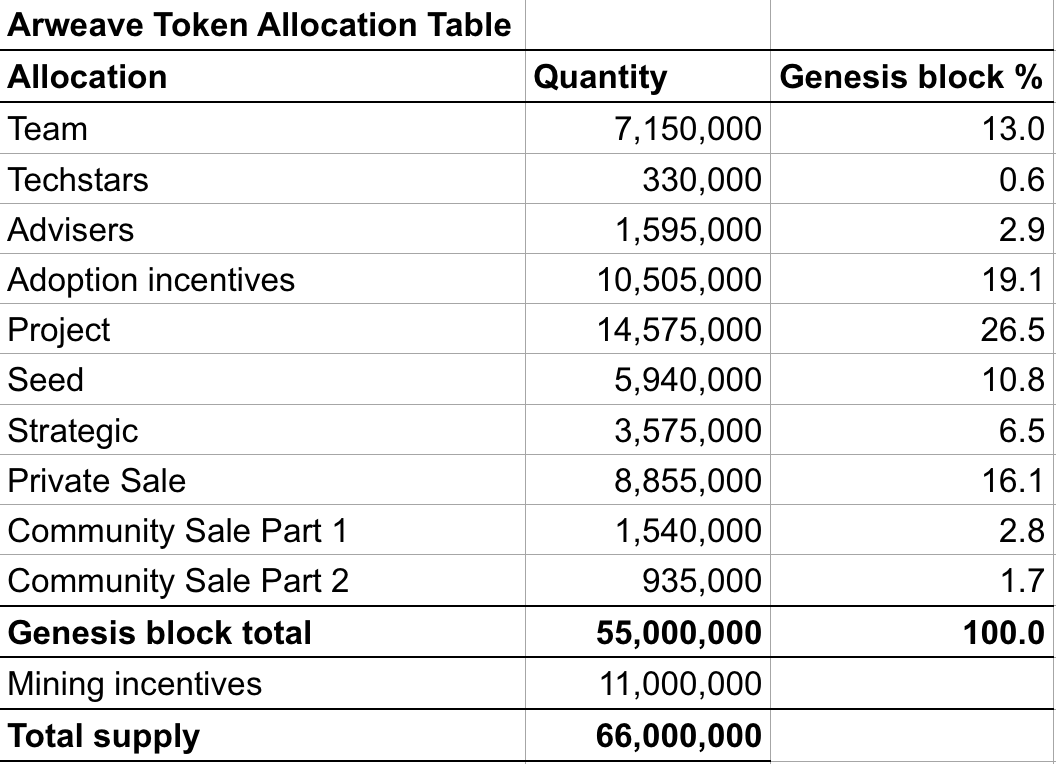
38.5% of the AR tokens in the genesis block are used for sales, totaling 21,175,000, without a lock-up period; 13% are allocated to the project team, totaling 7,150,000, with a 5-year lock-up period, and 20% are unlocked each year; 26.5% are allocated to future Projects, a total of 14,575,000, with a 5-year lock-up period, unlocking 20% each year.
text
3.3.3. Token output
The output of this part of AR tokens is similar to the Bitcoin model, in which the issued tokens are halved every year, and each block (average 2 minutes per block) rewards about 29 AR in the first year. The output has dropped to around 3, as follows:
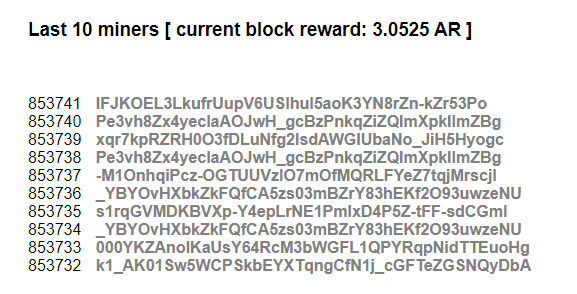
Data: https://chronobot.io/arweave/
text
3.3.4. Current Token Circulation Ratio
The following is the Amber Group’s token supply schedule for Arweave based on the Yellow Paper:
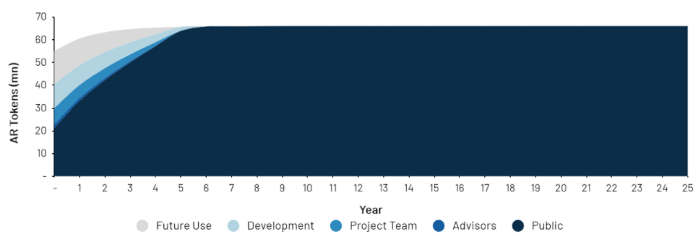
image description
As can be seen from the figure, unlike most tokens, most of AR tokens have been minted and are in circulation, and their current output inflation rate is only about 3%.
text
3.3.5. Token usage scenarios
The main usage scenario of AR is to purchase permanent storage services. Unlike centralized cloud services and IPFS that pay for the number of times and storage time, Arweave promises one-time payment and permanent storage.
Based on this mechanism, the AR token usage model is also very special. Only about 14% of the AR tokens that users pay for storage each time will be paid to the node miners who completed the block generation, and the other 86% will enter the donation pool.
First, Arweave calculated and deduced the long-term cost of data storage. The team calculated the future data based on the current price of 1GB of data stored on the hard disk, plus an annual storage cost reduction of 0.5% (in fact, this assumption is very conservative, and the storage cost declines much faster than this). Storage costs. Based on this calculation, Arweave can provide users with a storage period of 200 years. If the storage cost drops by more than 0.5%, the storage period it can provide users will be even higher.
The donation pool is to ensure that when the block rewards of AR tokens are not enough to support the mining and data storage costs of miners, corresponding storage subsidies will be provided to miners to ensure the long-term and continuation of the network, and to achieve the same with AR Changes in token prices are hedged. However, the current output of tokens is sufficient to support the cost of miners, and the donation pool is still in a state of savings accumulation.
As the demand for storage on the Arweave protocol increases, the value of the AR token is expected to increase. In addition, as most of the transaction fees are sent to Arweave’s donation pool, tokens will continue to withdraw from circulation, increasing the demand for AR.
text
3.3.6. Token Model Summary
The design of the Arweave token model can be summarized as:
● Users pay enough fees for storage services, most of which enter the donation pool to ensure financial support for long-term storage in the future;
● The income of miners exceeds the cost, maintaining a basic and roughly fixed profit rate, and unable to obtain huge profits;
In general, Arweave's token model is more friendly to token holders, whether in terms of token circulation, output, or value distribution.
3.4. Risks
text
As almost the only explorer in the field of [permanent storage] in the decentralized cloud storage track, the advantage is that there are few direct competitors, and it can become the absolute leader in the segmented track, and accumulate first-mover advantages through business and ecology. But the corresponding problem is that the business logic of this track is more vague than that of the WEB3 version of AWS, and the certainty of its profitability and business expansion remains to be seen. Although Arweave's ambition is to "record the entire Internet" and become the "Alexander Library" of human civilization in the Web3 era, how much is the permanent storage demand for this kind of information in the long run? What percentage of the entire decentralized storage market can it account for? This is still an unknown. In addition, if a large amount of pornography, violence, politics, and content that violates human ethics or global regulatory guidelines are stored on the network, how the project handles such contradictions also needs to be observed.
text
Arweave is a Layer 0 underlying protocol. Although there are currently many projects using Arweave storage services, there are still few projects developed entirely based on Arweave. On the other hand, although Arweave launched the SmartWeave smart contract protocol, due to structural reasons, it is impossible to limit the standards of tokens and contracts. Unlike Ethereum and other public chains with unified standards, the protocols are easy to combine. The above may cause the development ecology of Arweave to be too loose to be unified to form an ecological synergy.
text
Solana is the public chain with the strongest support for Arweave and the deepest business binding. It directly brings a large amount of business traffic to Arweave, and the price linkage of the two project tokens is also obvious. However, since late November, the TVL of the Solana ecosystem has dropped significantly, and the popularity of NFT, which was once very hot, has also tended to cool down compared with Ethereum. If the development of Solana's ecology stalls, it may have a direct impact on Arweave's short-to-medium term business indicators.

Preliminary Valuation
Preliminary Valuation
4.1. Five core issues
text
Arweave is in the early stage of the project, and the PMF (Product Market Fit) of its products has been initially verified, but the demand for permanent data storage of WEB3 is in its infancy, and there are high uncertainties in terms of market size and business form .
text
4.1.2. Does the project have a solid competitive advantage? Where does this competitive advantage come from?
This competitive advantage currently mainly comes from the project's accurate market positioning, as well as the first-mover advantage in data storage and adoption.
text
The medium and long-term investment logic of the project is relatively clear, and it is committed to providing decentralized permanent storage services for human society. Its services have very distinctive characteristics, whether compared with traditional centralized manufacturers or decentralized agreements. Seeing will benefit from Web3 applications' requirements for data storage persistence, distribution, and anti-censorship.
text
4.1.4. What are the main variable factors in the operation of the project? Is this factor easy to quantify and measure?
The main variable factor is whether the expansion of the adoption of Arweave by Web3 applications continues. We can observe through the following indicators:
● Weave size: the data storage capacity of the entire network
● Actual data usage
● Indicators of SmartWeave smart contract (please check the source)
Also, focus on representative projects or events that may trigger further mass adoption of Arweave.
text
Currently, in the core governance of the project, Arweave has not yet introduced the DAO mechanism, which is mainly based on core team decisions.
secondary title
4.2. Valuation
As a Layer0 storage infrastructure project, Arweave's basic disk is storage business, and the upper limit of development is the Web3 full-stack protocol that can challenge other public chain ecology. The upper limit of its valuation has a lot of room for imagination, and the lower limit is also supported by the actual storage business, and the team has gone through a bull-bear cycle, with good development and operational resilience, and the possibility of zeroing is less.
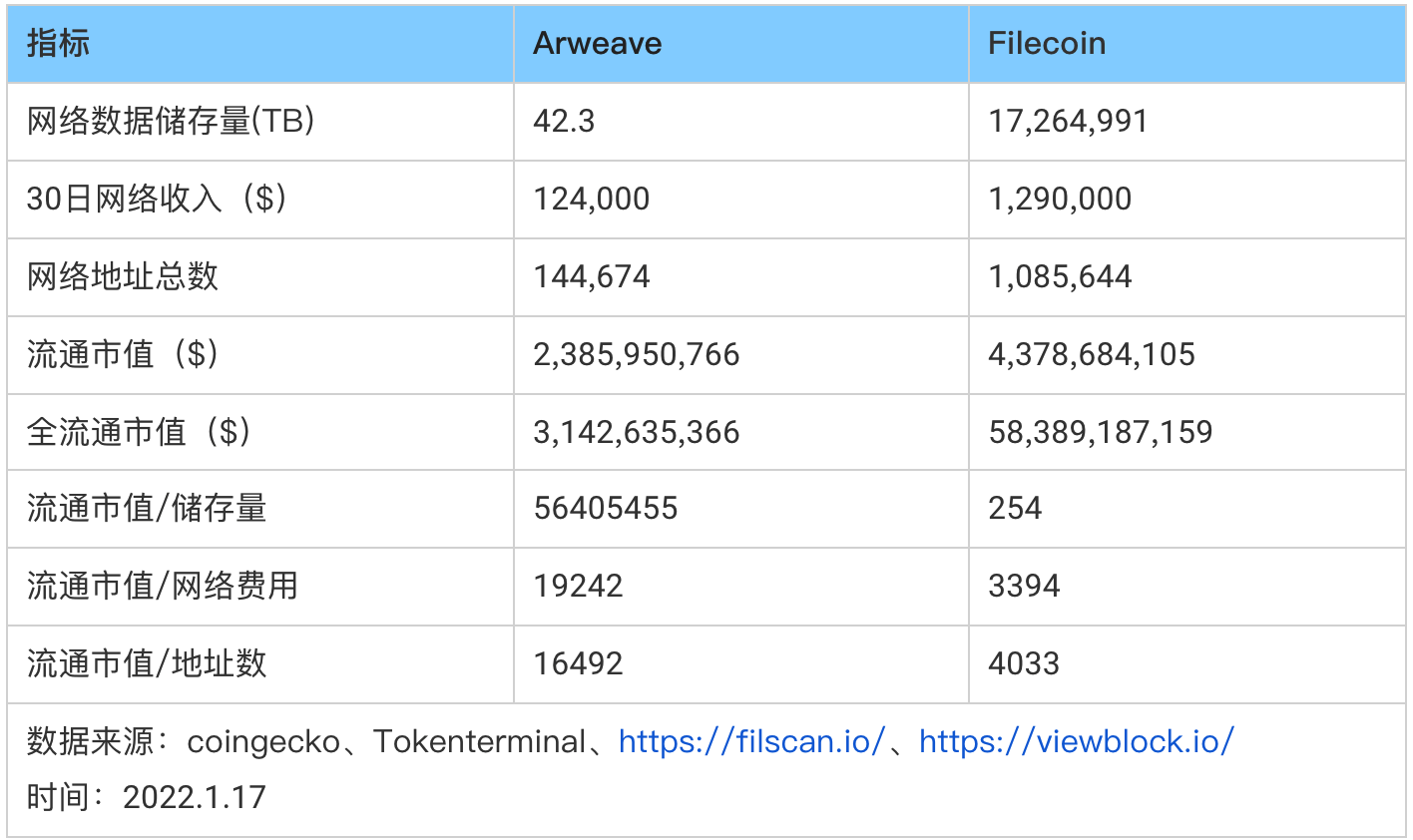
In the entire encryption market, the project most similar to Arweave in terms of positioning, vision, and development space is still Filecoin. Here we try to use Filecoin's business indicators and market value as the anchor of Arweave's valuation to try to make a comparison.
As far as the two projects are concerned, Arweave's ecological development and adoption rate are better, and the competition on the track is relatively less intense, and has the potential to challenge the public chain; Filecoin's business data is more eye-catching, but due to the complexity of the mechanism and The development progress and smart contract functions have not yet been released, and its actual ecological development is relatively slow, and it is also facing more intense competition with Web2 and other Web3 cloud storage service providers in terms of cost.
secondary title
4.3. Summary of value evaluation
The project party has excellent business insights and has chosen a segmented cloud storage market with long-term value and not yet fierce competition, becoming the only leading project in this market and benefiting from the long-term benefits of WEB3 business development for decentralized cloud storage Demand expansion. Compared with other decentralized cloud storage projects, its solution has the following advantages:
● Data is permanently stored, free to read, and users do not need to pay continuously
● Around its underlying storage service, a set of protocol ecology and SmartWeave smart contract ecology based on its always-on network has gradually been built, and it is developing towards the WEB3 full-stack protocol. There are obvious synergies between storage services, smart contracts and application layers
● It has already been adopted by public chains, NFT projects and many Web3 (especially the creator economy). The demonstration effect of the leading project\celebrity selection is conducive to the adoption of Arweave by more similar projects in the future
● After important data is deposited on Arweave, users need to pay a high conversion cost if they want to migrate
● Compared with Filecoin, Arweave's mechanism is simpler in concept and technology, and it is less difficult to develop, implement, and adopt by users and miners
However, its positioning and mechanism also determine some restrictions on the business development of the project:
● The solution stored on the chain determines that the data cannot be changed once it is uploaded, resulting in high iteration cost of the program and insufficient mobility
● Data is public, sensitive data (such as key business data of enterprises) will not choose Arweave
On the whole, Arweave has a grand vision, a down-to-earth team with the experience of crossing bulls and bears, and is on a basic track with long slopes and thick snow. Coupled with the potential space of its WEB3 full stack, its future development is worthy of long-term observation and expectation .
risk warning
There may be facts and data errors in this research report, or biased opinions. If you find any, please leave a message to correct and communicate. The above is written for internal research purposes and is not intended as investment or financial advice.

first level title
References and Acknowledgments
References and Acknowledgments
Research Reports & Articles
Amber Group:Arweave: Enabling the Permaweb
Foresight Ventures: Understand Arweave, the key infrastructure of Web3.0
Cloud Storage Market Size, Share & COVID-19 Impact Analysis
Liu Yi: The potential of Arweave is to revive the Alexandria Library, not a Filecoin alternative
Arweave: An experiment in permanent storage
The Arweave Ecosystem Annual Report 2021
Arweave Is Layer 0
project information
project information
Network data: https://viewblock.io/arweave; https://chronobot.io/
Ecological application: ArweaveApps
WIKI:https://arwiki.wiki/
Project content station: https://arweave.news/
Yellow Paper: https://www.arweave.org/yellow-paper.pdf
Filecoin Information Station: https://www.filscout.com/
Network income: https://www.tokenterminal.com/
Token Market Cap: https://www.coingecko.com/
*If there are obvious facts, understandings or data errors in the above content, please give me feedback, and I will correct the research report.
https://mirror.xyz/mintventures.eth