






Airbnb CEO: Encrypted payments will be the number one user request in 2022


This article comes fromDecrypt, original author: Andrew Asmakov
Odaily Translator | Nian Yin Si Tang

, original author: Andrew AsmakovtweetsOdaily Translator | Nian Yin Si Tang
On January 2nd, Airbnb co-founder and CEO Brian Chesky posted a
tweets
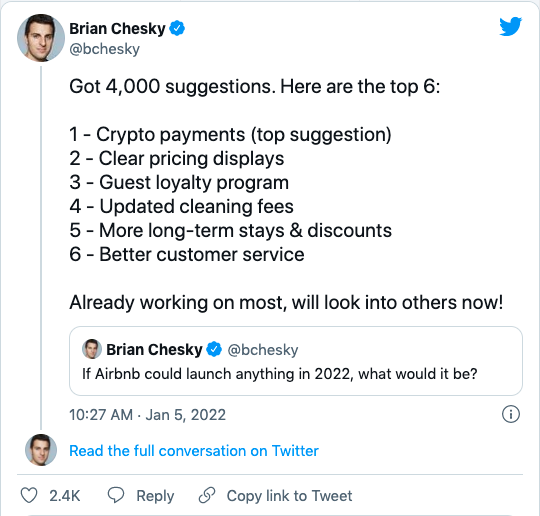
, asking his Twitter followers for their thoughts on new services the vacation rental platform might launch in 2022.
After sifting through about 4,000 suggestions, he reported that users were most interested in integrating crypto payments for Airbnb.
According to Chesky, Airbnb is "already working on some of these new products" and "will now be working on others."
Talking further about the possibility of adding support for crypto payments, Chesky detailed that the proposal includes “a variety of token ideas.”
Airbnb has made $336 billion in payments since 2013, Chesky added.
Airbnb wary of innovationthe interviewThis isn't the first time Chesky has talked about cryptocurrencies.
Accepted to Fox Business in September 2021
the interviewAt the time, he said customers have asked Airbnb to add crypto payments within a few years.At the time, Chesky also reminded that before launching Coinbase, the largest U.S. crypto exchange, its CEO Brian Armstrong worked for Airbnb, adding that “we are genuinely proud of their (Coinbase) success.”
Airbnb went public in December 2020, at its
IPO prospectus
Cryptocurrencies and their underlying blockchain technology are also mentioned.
“Our future success will also depend on our ability to adapt to emerging technologies such as tokenisation, cryptocurrencies, new authentication technologies such as biometrics, distributed ledger and blockchain technologies, artificial intelligence, virtual and augmented reality as well as cloud technology," the document reads.
However, the company acknowledged that "these efforts may be more costly than anticipated and may not be successful."
Among other things, Airbnb pointed to possible loopholes and glitches when implementing major technological innovations, all of which can lead to "loss of business, damage to brand or reputation, consumer complaints, and other adverse consequences."


