Delta Fund: What other tracks are worthy of attention in the future of multi-chain?



Original compilation: PANews
Original compilation: PANews
Blockchain development is actually the same as urban planning and design. Although you can build taller and taller skyscrapers to continuously expand the size of the city, eventually, the land will be used up, just like the block size in the blockchain will be used up. all the same. People may give up further "renovation of the old city", but choose a "new city" with better living environment and development. For the blockchain industry, the future belongs to multiple chains.
Editor’s note: Delta Fund is an early strategic blockchain fund founded by Kavita Gupta, the former head of Consensys Ventures. It has recently successfully raised more than $50 million in funds. The fund is also one of the few blockchain industry venture capital led by female CEOs one of the items. At present, Delta Fund mainly focuses on DeFi, chain games and NFT fields, and has invested in some NFT projects (such as Swap Kiwi and Taker) and other encryption projects (such as Nahmii, Monster Hunt, Metaverse AI and FODL).
In the blockchain world, Layer 1 is like cities, and Layer 2 is like skyscrapers in the city. They need to be interconnected to achieve faster growth. In this blockchain world, we have seen many new cities emerge, but public transportation infrastructure such as bridges still leaves a lot to be desired. In this new era, the interoperability between different blockchains will define the blockchain revolution, and with the continuous improvement of cross-chain ease of use, it will undoubtedly promote the mass adoption of blockchain technology.
image description
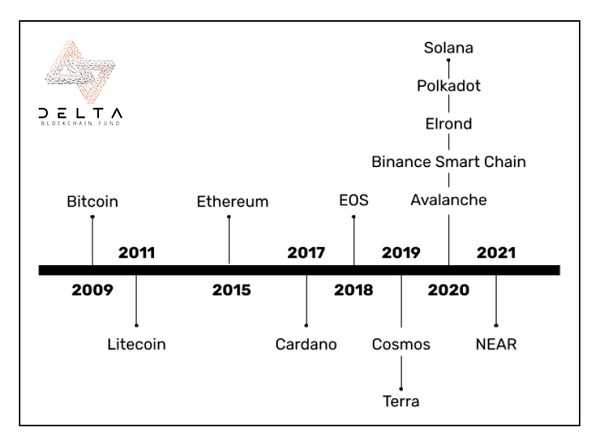
Above: Timeline of a Layer 1 blockchain
The emergence of "new blockchain network" also brings technical improvements. For example, some blockchains will choose the Proof of Stake (Proof of Stake) consensus mechanism, and some blockchains will introduce a new transaction execution engine (Solana) and Supports parallel transaction processing. But at the same time, some “new blockchains” are actually just copies of existing blockchains to increase overall transaction capacity, such as Binance Smart Chain (BSC), which is basically a clone of Ethereum.
For the long-term growth and development of the blockchain, two things are critical and positive:
First, the optimization and upgrading of new technologies;
Second, increase supply.
image description
now,
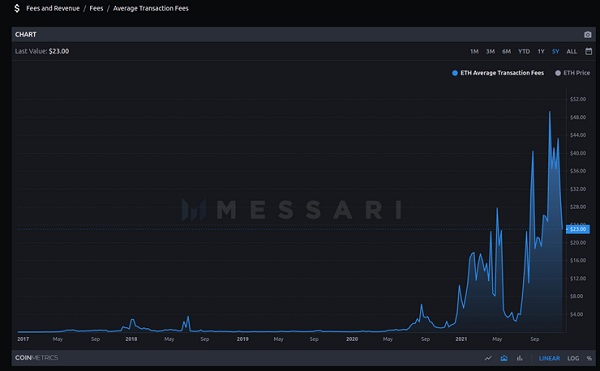
now,A plethora of blockchains like Binance Smart Chain (BSC) have popped up in the crypto market, but they don’t bring innovation to the industry, only more “supply” (aka block space).It is precisely because these blockchains increase the "supply", which leads to lower transaction fee prices, which in turn drives more adoption. In simple terms, these blockchains are a better short-term solution and therefore good for the blockchain industry as a whole, but in the long run, we need more scalable solutions.
Blockchain development is open, and all different blockchains can learn from each other, with the purpose of promoting the development and growth of the entire industry. However, this situation will make the functions provided by most blockchains very similar. Although some blockchains are better realized, it is not beneficial to the entire industry, just like cities in some countries do in certain aspects. Better than cities in other countries, like Zurich is well planned in terms of urban design, while Bangalore is a bit out of control.Blockchain development is actually the same as urban planning and design. Although you can build taller and taller skyscrapers to continuously expand the size of the city, eventually, the land will be used up, just like the block size in the blockchain will be used up. all the same.In fact, other parts of the urban system, like sewage, start clogging even before you run out of land. In the end, people may give up further "renovation of the old city", but choose a "new city" with better living environment and development.
In technical terms, the practice of scaling a single blockchain can be thought of as "vertical" scaling, while the practice of scaling the entire system by adding new blockchains can be thought of as "horizontal" scaling. Generally speaking, scaling vertically is easier and the results are more immediate, but scaling horizontally is more effective in the long run because this solution provides higher scalability.
We live in a world where there are many cities, and if different cities need to be connected with each other, then roads, railways and bridges are very important, becauseThese infrastructures can facilitate intercity transportsecondary title
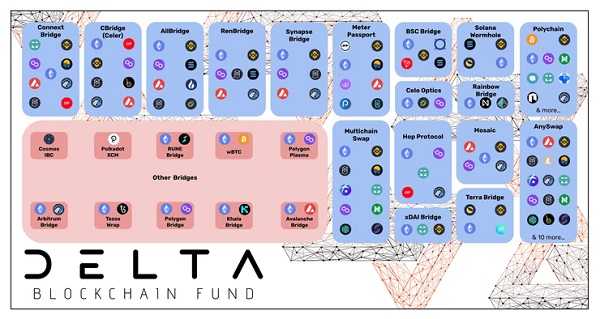
Cross-Blockchain Bridges
image description
at present,
at present,Token bridges have two main use cases:
1. Let assets move between different blockchain networks (such as Bitcoin and Ethereum);
2. Let assets move between a parent blockchain and its child chains (sidechains), which either operate under different consensus rules or inherit security from the parent blockchain (e.g., built on Ethereum Rollup).
There are two main types of token mechanisms in Token Bridge:
1. Mint/Burn (casting/destruction) strategy;
2. Liquidity strategy.
There are three main security models for token bridges:
1. Centralized
2. PoS (Proof of Stake)
3. Decentralized
token mechanism
token mechanism
1. Mint-and-Burn strategy:Most cross-chain bridges follow the Mint-and-Burn/stake mechanism, but may differ in their approach. For example: bridge between chain A and chain B: to transfer funds from chain A to chain B, we can mint new tokens on chain B or unlock existing locked tokens on chain B, and at the same time Destroy/lock tokens on A. Similarly, to transfer funds from chain B to chain A, we can mint new tokens on chain A or unlock existing locked tokens on chain A, while burning/staking tokens on chain A.
The Mint-and-Burn strategy is similar to teleportation in science fiction series such as Star Trek: To "teleport" a person, their body (token information) is at the destination (the token in chain B) and the starting location ( Tokens in chain A) are destroyed/frozen. Problems arise when the body is not copied at the destination (tokens in chain B are not generated) or the original body is intact/unfrozen (tokens in chain A are still accessible), otherwise in teleportation (transaction) At the end, there may be 2 bodies (funds gained) or 0 bodies left (funds lost). Therefore, there is usually a mapping relationship between the tokens on chain A and chain B to ensure that they represent the same token information. Arbitrum Bridge and Anyswap Bridge are typical examples of such cross-chain bridges.
2. Liquidity strategy:secondary title
safe mode
1. Centralized bridge
Example:Avalanche Bridge,Advantage:
Advantage:Disadvantages:
Disadvantages:Highly centralized and dependent on a single or group of authority controls, can be maliciously attacked/hacked, resulting in loss of funds/revenue; runs counter to the true vision of Web 3; often specific to certain platforms.
2. Proof-of-Stake (POS) bridge
Example:Advantage:
Advantage:Disadvantages:
Disadvantages:From the centralized bridge, if the verifier is a malicious attacker or hacker, it may cause loss of funds or loss of income; the speed is slower than the centralized bridge; the current mechanism to motivate the verifier not to do evil is not yet clear.
3. Decentralized Bridge
Example:Advantage:
Advantage:Disadvantages:
Disadvantages:secondary title
text
In terms of user experience, cross-chain interoperability solutions currently on the market leave a lot to be desired. Quite frankly, UI/UX has been one of the biggest pain points in the blockchain ecosystem since the beginning, but in this new multi-chain world, the cracks have started to show and are becoming more and more obvious. In fact, using multiple blockchains feels like you are communicating between different Odaily rather than cities, and you will find that there seems to be no connection between different blockchains at all, as if they are isolated in different worlds, if not Using multiple applications is not possible without manually switching back and forth between different RPC endpoints.
For bridge tokens, there is another problem: almost every bridge based on the Mint-and-Burn mechanism will deploy its own bridge token on the secondary blockchain. That is, we will see multiple copies of the original token on the secondary chain. Eventually, one of the bridge tokens gains most of the adoption, while the others become useless. However, in the early stages of bridge token development, deciding which bridge to use to get the "correct" bridge token can be really confusing.
Bridging NFTs is more cumbersome, and in most cases impossible.final thoughts
final thoughts
What is a revolutionary invention? Going from a feature phone to a smartphone is a revolutionary invention, but the variants of different smartphones are not a revolutionary invention, as if you can make an Android call from an iPhone without any hassle, even though iPhone and Android offer unique features.
For the blockchain industry, the future belongs to multiple chains.
Accepting multiple chains will push BUIDLers to innovate in interoperability and their blockchain standards.
on the other hand,
on the other hand,Blockchain user experience is also often overlooked, but it is also an important part that needs to be paid attention to.In order for blockchain to gain widespread adoption, we need simpler interoperability solutions, not simple imaginary UX/UI. Just like people don’t need to know how 5G works to enjoy a smooth internet experience, people don’t need to know how cross-chain bridges work to easily use multiple blockchains. in this regard,Might be where multi-chain wallets come in.secondary title
multi-chain wallet
We hope to realize the following multi-chain wallet functions in the future:
1. For supported blockchains, provide an aggregated view of all cross-chain portfolios.
2. Bridge assets on demand, without requiring users to visit suspicious websites and bridge tokens manually.
3. Summarize the quotations of all cross-chain bridges.
4. When the bridge is complete, submit all queued transactions.
5. Allow applications to access multiple networks through a single API.
6. Application API can obtain summary balance and other cross-chain data.
7. Cross-chain Swap can obtain the best transaction price/exchange rate for large transactions.
In addition to interoperability, there are some common features that we consider essential:
1. Decode transaction data to reveal and confirm what is being signed.
2. Simulate the transaction to show the problem of "remaining" of the transaction.
3. Ability to directly connect to multi-signatures such as Gnosis Safe and propose transactions.
4. Support NFT related data display and NFT transactions.
5. Issue warnings to users before they sign suspicious transactions, and use machine learning to prevent loopholes.
6. A fallback/load balancer that supports blockchain APIs (RPC endpoints).
Last but not least, we believe that a multi-chain wallet with the above types of functionality will be a game-changer for the industry and will drive more adoption of blockchain technology.