Analyzing Composability in a Web3 World


Original Author: Aragon
Original Author: Aragon
Contributor: Dewei-DAOrayaki
What is composability?
Composability is the general ability of a system's components to recombine into larger structures and use the output of one as the input of another. In simple terms, the best example is Lego, where every part of Lego can be connected to every other part.
In crypto, composability is the ability of decentralized applications (dApps) and DAOs to efficiently clone and integrate each other (syntactic composability), and to make software components such as tokens and messages interoperable between them (morphological composability) capabilities.
syntactic composability
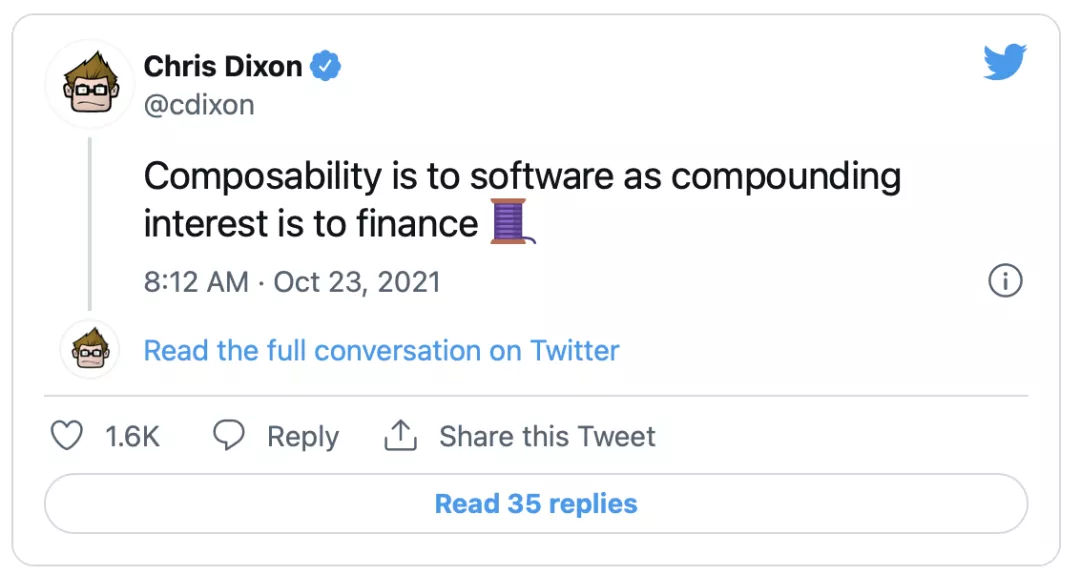
Being able to reuse open source components is a superpower that makes building in Web3 extremely efficient. Teams can use large amounts of existing, solid code and focus only on building the missing components of the project. This exponentially increases the speed of experimentation and innovation. Not having to reinvent the wheel (or worry about being sued by regulators and patent trolls) every time you build a business makes Web3 more efficient than Web2 in allocating resources. It also calls the magic of composition:
secondary title
atomic composability
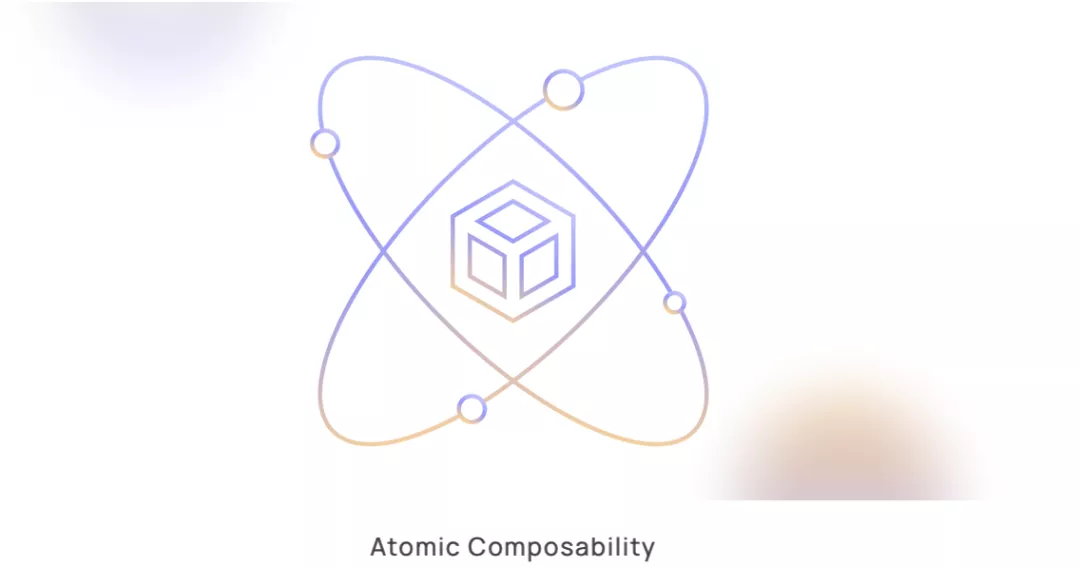
Importantly, Ethereum's Layer 1 (L1) allows for "atomic" composability, where multiple operations across multiple dApps can be bundled into a single transaction and executed together. If one of these operations fails, the entire transaction fails. This makes it possible to split a transaction across multiple exchanges, or vote on multiple DAO proposals at once without the risk of partial failure.
Atomic composability is critical to decentralized finance (DeFi) as it allows for innovations such as "flash loans," where assets are borrowed, invested, and repaid in a single transaction.
form composability
Although Ethereum's architecture is designed to facilitate composability, this does not guarantee that the internal forms of dApps, such as functions and interfaces, will automatically be compatible with each other. This requires cooperation. To this end, a number of application-level standards, known as Ethereum Request for Comments (ERC), have been agreed upon for elements such as tokens, name registries, and wallet formats. The most famous of these is ERC20, which defines the characteristics of fungible tokens within Ethereum.
From a Web2 perspective, the implications of morphological composability are exciting: it is already possible for DAO token holders to vote on a Snapshot and use Zodiac Reality to trigger a transaction from the DAO's treasury to acquire tokens borrowed from MakerDAO. Out $DAI, pool $DAI on Curve, then deposit the generated LP tokens into Convex to earn transaction fees as well as $CRV and $CVX tokens. Such composability is possible due to interoperability of tools and standardized definition of tokens.
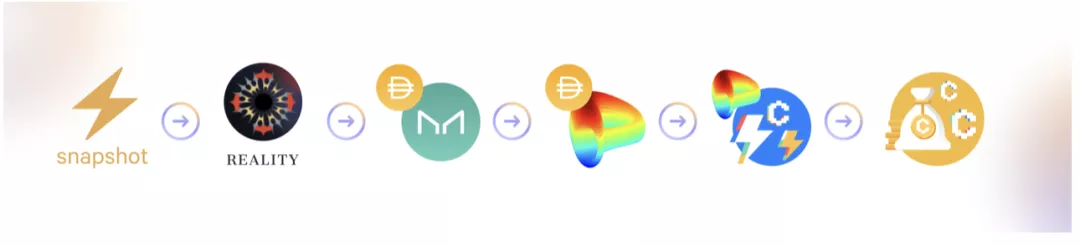 Web3 composability
Snapshot Voting → Zodiac Reality → Borrow $DAI @ MakerDAO → Pool $DAI @ Curve → Deposit Curve LP Tokens @ Convex → Earn Transaction Fees + $CRV + $CRX
Beyond finance, characters or movable assets from Web3 games like Axie Infinity or Guild of Guardians are instances of Non-Fungible Tokens (NFTs) - unique digital properties, standardized in ERC721. Because they are effectively owned by the user, they can be freely transferred between different games, sold on the secondary market, and even used as collateral for loans.
Achieving equivalence in Web2 means somehow convincing Nintendo to share databases with Sony, Microsoft; having eTrade execute trades on Robinhood. The chances of this happening are essentially zero: even if the Web2 companies aren't all competing with each other, they're built on incompatible tech stacks that will prevent them from reusing each other's software.
In addition to digital assets, Web3 also allows users to transfer their identities and reputations between dApps. Instead of logging in via username and password, users use their Web3 wallets to provide selective read-only access to their ERC20 address, which acts as a unique identifier and reputation indicator. A verifiable "resume" with token transaction history, dApp interactions, and DAO memberships has produced a "Degen(erate) score" as a ranking of Web3 literacy, but this is already included in Web3 job applications by sincere applicants. In this way, identity and reputation can be seen as currencies backed by Web3 activity. Like any currency, on-chain identities can be exchanged and traded (with all the chaos it brings), as well as form part of an abstract social network that will form digital communities, workgroups, and new kinds of "nations."

DAO Morphology
Currently, there is no ERC to standardize the structure, functions and interfaces of DAOs, but the industry is moving in this direction. DAOstar One is a roundtable working to standardize the definition and minimum parameters of a DAO. The group’s current focus is on experimentation — and thus not limiting innovation — but once implemented, ERC will bring LEGO composability to the DAO ecosystem, meaning Aragon’s financial dApps could be used with Moloch v2, or Openzeppelin governance contracts Can be integrated with Gnosis safe and with Compound governance contracts.
Even before the ERC agreement, Gnosis was developing a modular DAO tooling system based on the Zodiac open standard. Any DAO platform that implements its Iavatar interface will have access to a growing number of Zodiac-compatible tools, such as oracle modules that can trigger on-chain execution or bridge modules that enable cross-chain control of Gnosis Safe.
Other practices such as DAOhaus' Boost Foundry (itself built on Moloch v2) are part of a growing trend of DAO's dAppstores with DeFi protocol plugins and additional DAO features such as automated payment flows using Superfluid or gated functionality using Mintgate.
This last point is worth emphasizing. Web2 companies are notorious for building competitive "moats" to insulate themselves from the competition. These can take the form of favorable regulation, aggressive patent enforcement, high switching costs, data hoarding, and many other self-protection strategies. However, none of these strategies make sense in the open source, permissionless, transparent Web3 world. Instead, organizations must build on the assumption that their code will be reused by others and turn that into the vanguard of their growth strategy; composability turns a tail risk in Web2 into a core assumption and strategic goal in Web3. In such an environment, organizations must become experts in collaboration and symbiosis, which is why initiatives like DAOstar One and the Global Hackathon DAO have attracted so many participants to pursue DAO composability.
DAO tools

DAO tools
It's standard practice in Web2 that companies use each other's software for things like publishing and graphic design. DAOs are similar in that they use proprietary software like Discord to manage their communities. Furthermore, the Web3 infrastructure enables these tools to be integrated to such an extent that they become components of the DAO's governance, capable of arranging and executing transactions. This is achieved through a network of third parties called oracles, which are able to verify external data and embed it into on-chain smart contracts. It is already possible to use Witnet's decentralized oracle network to trigger on-chain execution on Aragon from emoji votes on Discord, and as previously mentioned, Gnosis Zodiac's Reality module integrates reality.eth as an oracle to trigger secure transactions to Respond to Snapshot proposals, Discord polls, or any other compatible data. For a more in-depth look at DAO tools, check out Incentive Design and Tools for DAOs and Organizational Lego: The State of DAO Tools.
Integrating real-world data into smart contracts opens up a world of data composability in Web3, which this article cannot cover, but explores in 77 smart contract use cases supported by 1st party Oracles and Chainlink with API3.
Web3 is talking
Monolithic architectures make sense in a few domains: supranational political structures tend to break down over time; the Internet owes its success to many nodes communicating via a common protocol; even the human brain is a modular system.
Over time, computing architectures have evolved from a monolithic stack to a proliferation of microservices that can be combined, upgraded, and swapped out as needed. Even though Web2 is built on such a backend, composable design is not embodied in the Web2 companies themselves: giant monopolies like Amazon, Facebook, and Google have little incentive to break themselves down into composable microservices. But in the end, this may be forced upon them by Web3: the logic of composability is destiny, if the testimony of technology and nature is to be believed.
There are several obstacles along the way before reaching this destiny
The first is a monolithic, Web2 mindset. Adoption of a paradigm that relegates the importance of individuals to mere components requires conviction and a shareholder vote. However, there are signs that composability has enough traction in Web3 to sell its benefits to the broader tech industry. We have certainly seen this in the adoption speed and metrics of various protocols such as assets under management (AUM). Web2 doesn't want to give up this growth for long, and in order to participate, they have to be composable.
The second hurdle is scaling. Composability works in theory, but the high fees we've seen recently on Ethereum are fatal for complex operations across multiple dApps. Bridging between Ethereum and new chains breaks atomic composability, and the proliferation of new chains will dilute security and liquidity resources until the industry finds a viable solution. This is a topic that needs to be explored in depth and will be discussed in greater depth in an upcoming article.