






Comprehensively analyze the encryption art museum and explore the NFT exhibition culture


Article translation: Block unicorn
Article translation: Block unicorn
first level title
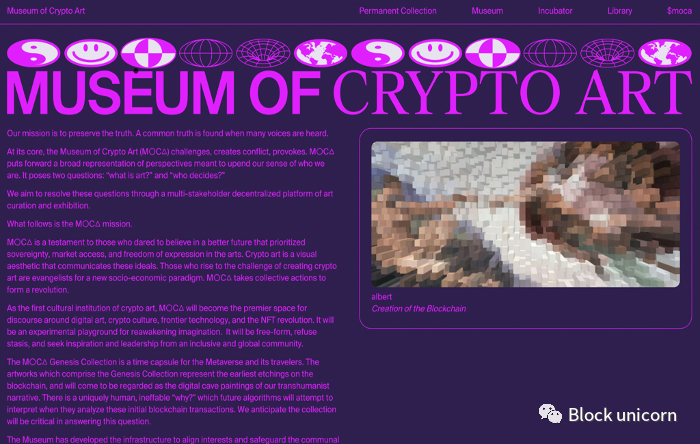
Introduction to MOCA
image description
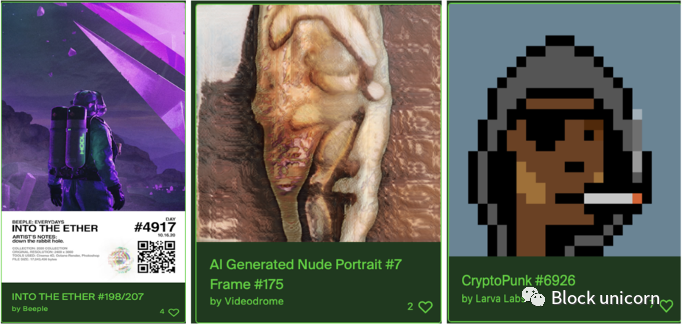
Just some of the more notable artworks in the permanent collection
secondary title
Tokenomics - distribution, utility, curation
$MOCA is a fixed-cap asset with a total supply of 10,000,000 tokens, and a recent upgrade could make the token deflationary. MOCA reserves 10% of the tokens for ecological funds, 5% for airdrops, 18% for the core team, and 8.1% for private investors. Finally, the majority of tokens are allocated to permanent collection acquisitions.
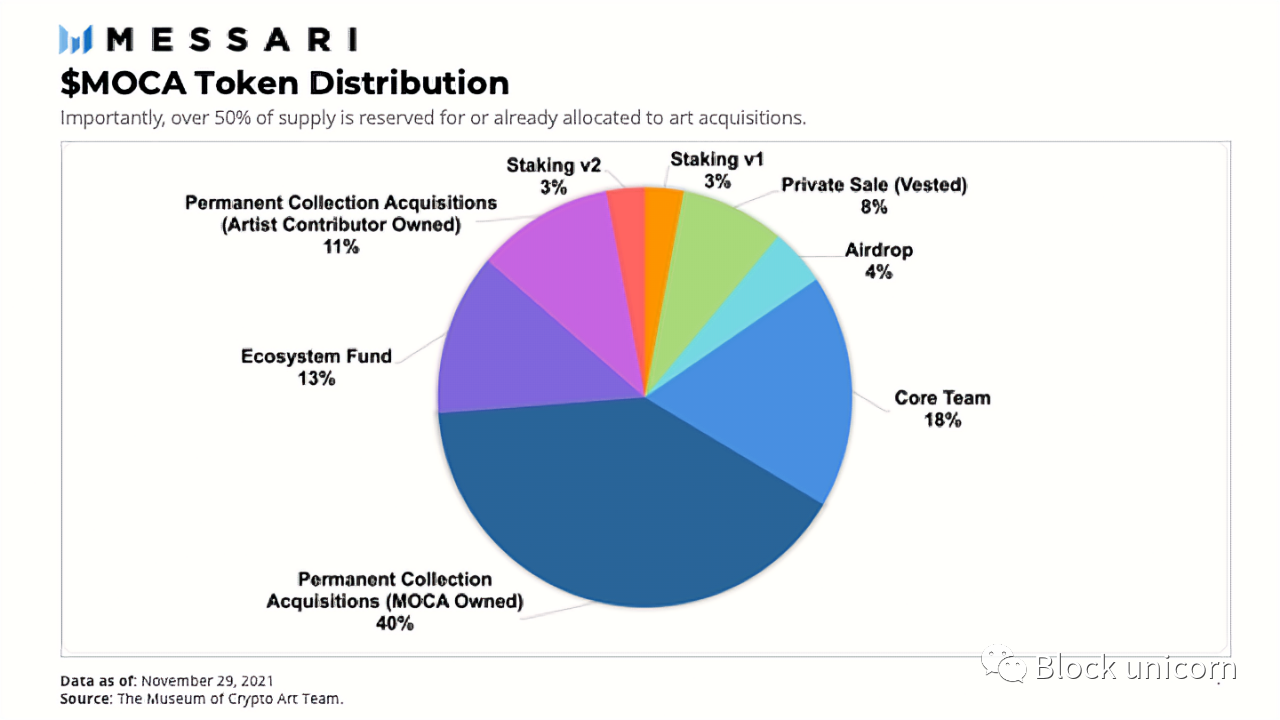
In addition to governance, the MOCA token is planned to provide further utility in two ways:Access and manage:
Access (Moca Points): The MOCA team plans to use token-gated Discord to bring more value to the token. Discord channels can be tiered and given exclusive access to museum members. Staking MOCA tokens will earn users "Moca Points" which can be used to unlock special Discord features.
secondary title
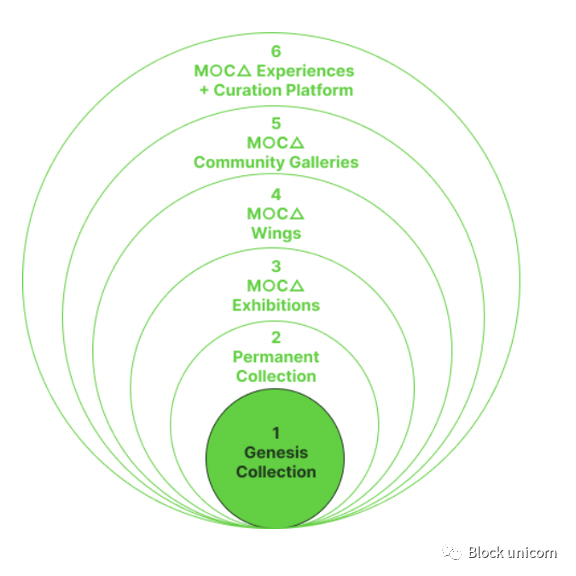
Distribution: "Proof of Art"
Central to the museum's shift to community-oriented programs is their "permanent collection." These are works of art that belong permanently to M○C△DAO. The novelty of the permanent collection is the allocation of $MOCA tokens to purchase these artworks - approximately 50% of the supply is reserved for permanent collection acquisitions. As a pseudo-proof of work, this "proof of art" is both a novel token distribution method and a means to grow the M○C△ community. Of course, artists can always sell their tokens, but as the collection grows and the utility of the $MOCA token increases, community retention should increase. Additionally, as a governance mechanism, artists may find it strategic to align themselves with various digital museums such as MOCA to ensure their artwork is surrounded by other high-quality works.
secondary title
A note about the community and the "gm" test
secondary title
Creating Utilities: Social Media Integration and Moca Points
A key node in the M○C△ roadmap is the aforementioned Discord integration. The team is building a feature that will allow Discord users to display personalized NFT selections that they can provably own. This feature is enabled through an integration with the Discord-ubiquitous Collab.land bot. Basically, this bot allows users to verify that a wallet holds a specified token. This is traditionally used to assign special roles, such as "holders" in a project, and to allow access to restricted channels that are only available to those who hold a certain amount and/or type of tokens.
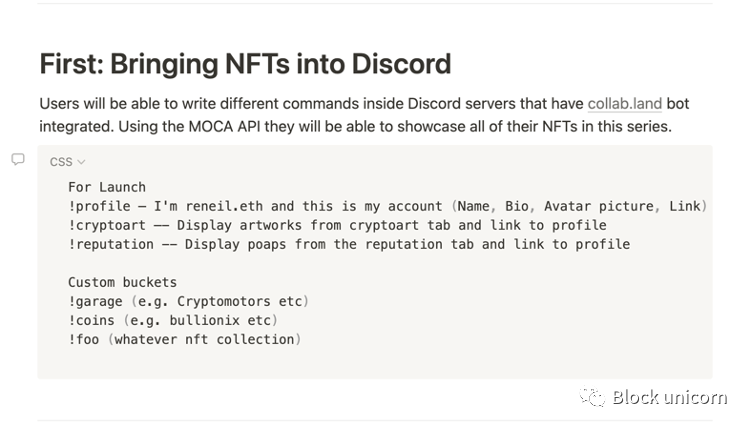
With the addition of M○C△'s Discord feature, users can invoke simple functions to show off their various collections pre-configured on the museum app. For example, someone who owns a CryptoPunk will be able to call !punk to instantly display a selection of one or more punks their wallet owns. Before this, the way most people in the NFT community displayed their collectibles/artwork was through a link on Opensea or a simple screenshot. Unless you've built a reputation linking your Discord account to the address/ENS that owns the NFT, no one can verify that you own what you say. Even if you do have this reputation, other users may impersonate you and your profile.
Basic functions will be free, and added functions will be provided to those who accumulate "MOCA Points", which can be obtained mainly by purchasing and staking $MOCA or by participating in the M○C△ application. The unlocked features and required points are listed below.
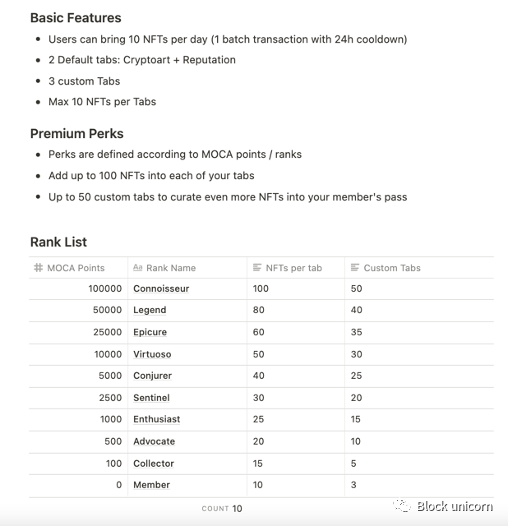
Considering that many people have collected more NFTs than they can display in their social media profile pictures and banner slots, the need to reveal other NFTs in a personal portfolio is likely to be high. This is especially true for NFTs that have some perceived impact, often due to high rarity and/or valuation. With the need for Moca Points to reveal more NFTs, the Discord integration has the potential to act as a utility (and potential demand) catalyst for the $MOCA token.
secondary title
deflationary supply
In order to take advantage of the functionality of the M○C△ platform, users must “activate” their NFT on the platform and pay a MOCA fee of $0.1 to do so. This fee is then burned by the protocol. Assuming no change in the fixed supply, this means a total of 100 million NFTs can be activated on the platform before each token is burned. For reference, 1.7 million NFTs were sold on OpenSea in September alone. (h/t rchen8).
secondary title
community curation
image description
competition analysis
competition analysis
secondary title
Distribution - Does Decentralization Really Matter?
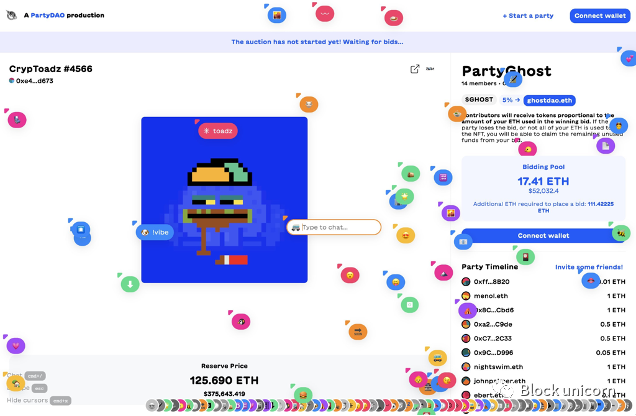
As previously stated, MOCA tokens do not confer any fractional ownership of the underlying assets. The arguments for sharding typically revolve around 1) taking high-value, illiquid assets and making them liquid, and 2) providing a financial advantage to those who can't or won't pay for a "full" NFT. A popular exception to this line of thinking is the Fingerprint DAO. Fingerprints is the largest holder of Autoglyphs and other culturally significant NFTs, and has incubated several NFT-centric DAOs. In this respect, Fingerprints is similar to a museum — a group of collectors trying to curate what they believe to be of value to the crypto art space.
image description
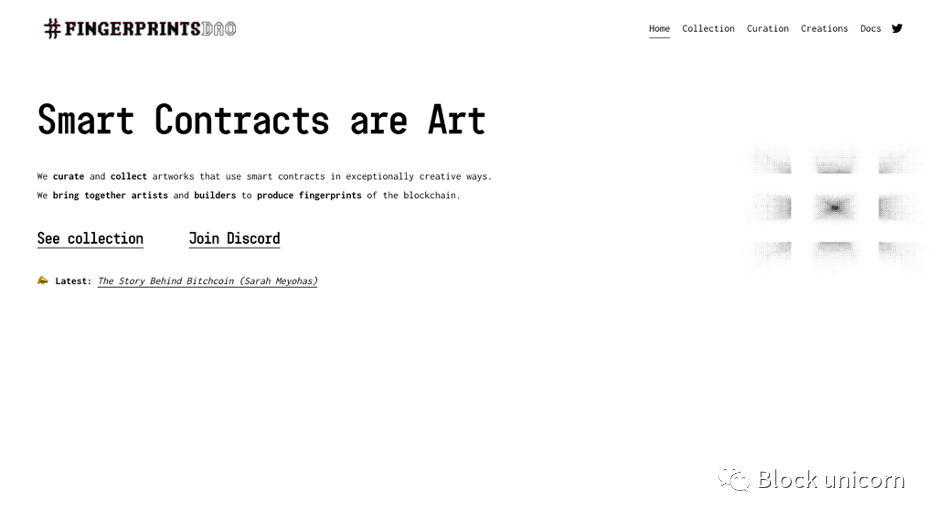
Fingerprints DAO website. 20 $ETH or more to join this Discord.
secondary title
Utilities in various forms
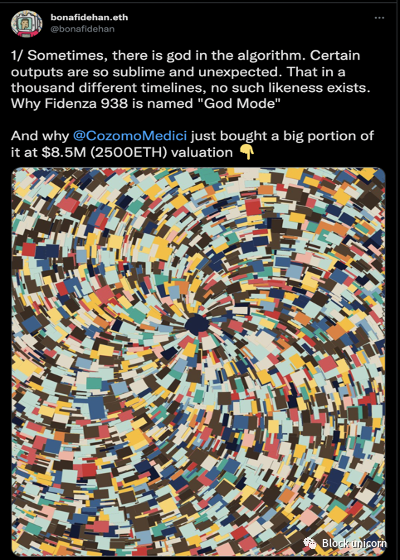
Many PFP or art NFT projects offer zero tangible utility, a notable exception being projects like gen.art, whose membership acts as a "minting pass" allowing owners to mint new collections, avoiding the need for gas wars. Projects like gen.art have "utility verticals" that provide utility to users within their suite of products. M○C△ has the unique advantage of "horizontal utility" by providing a service that any NFT holder can use - verifiable ownership. Since Discord integration requires users to burn and/or stake $MOCA tokens, this shows a clear path to utility for $MOCA tokens. As most other NFT projects either do not intend to provide utility or face significant execution risk (e.g. game developers raising funds before building games). The tangible utility of museums in terms of their Moca points, access, and administrative control over museum asset repositories is higher than in the field.
image description
secondary title
Community Curation Pt.2
secondary title
A Note on Web 2.0 Risks
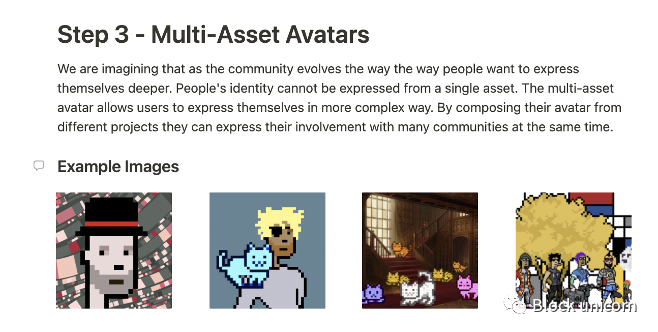
One of the main advantages I highlight is the utility of the $MOCA token for web2 social media integration. In a way, these features - summarized by Discord/Telegram commands and proven single and multi-asset avatars - act as a bridge between our favorite web2 platforms and our favorite web3 assets. So, if these companies build their 2.0<>What happens to 3.0 bridges? We've seen Twitter tease out support for verifying avatars and integrating Web3 wallets like MetaMask. Due to community backlash, Discord replaced the native web3 integration before pulling it out. Telegram could theoretically implement a custom NFT configuration file and launch it with a custom function. Furthermore, these networks can implement these functions for free, just like all other functions they provide to users.
secondary title
Final thoughts on MOCA
The Crypto Art Museum is a very unique project in the crypto art space. It’s optimized for long-term relevance, building a collection of extremely relevant and valuable artwork that largely avoids recent trends. If the project succeeds in decentralizing curation, the community will have an impressive collection to curate and a clear path to further acquisitions. Until then, the museum was in an awkward middle ground: run by a small, centralized group that couldn't guarantee the exclusivity that other small collector DAOs enjoyed. A near-term upgrade that provides utility to the token has the potential to bring new users to the M○C△ ecosystem, increasing demand for the token and potentially creating new long-term community members. If such a need arises, it is likely that the token economics will need to be updated,
Ultimately, the end goal of the museum seems feasible. They have a culturally relevant, valuable collectible and a token with several potential use cases in the near future. The missing piece is a vibrant community that gets the best of both worlds. The release of various features of the token over the next 3-6 months should change this considerably.


