






An article exploring the key use cases and sustainability of the Ethereum Name Service (ENS)


Written by: Mason Nystrom This article is compiled from Messari
The blockchain is essentially a great asset registry, and one of the largest digitally native assets is domain names. Domain names are digital assets that map IP addresses to more human-readable names, such as 13.57.64.34 to Messari.io. As one of the earliest native digital assets, domain names, it is not surprising that various projects have tried to bridge Internet domain names on the blockchain since the birth of Bitcoin.
ENS: Ethereum Naming Service
Ethereum Naming Service (ENS) is a domain registration protocol that maps a human-readable name (such as name.eth) to an Ethereum address.
1
The Meaning of Domain Names: The Advantages of ENS
ENS provides some key use cases:
Web3 identity/username
local payment
Enhanced domain name ownership
Functionality of decentralized websites
Web3 Identity
While ENS initially only created .eth domains on Ethereum, as of August 2021, ENS includes .eth domains and DNS domains (i.e. .com, .cash, .money). In fact, companies like Google could integrate their DNS domain name (Google.com) into ENS, allowing their domain name to act as a wallet, web3 username, and decentralized website.
So far, 447,623 ENS domains (.eth + DNS) have been created, 72% of which are (322,867) .eth domains.
Furthermore, just as Internet users are able to log into various websites using Google, Twitter or Facebook, ENS has the potential to become the "single sign-on" of Web3. Since ENS usernames are self-custodial, they remove the centralized middleman (such as Google) typically used to log into various platforms.
local payment
All ENS .eth or DNS integrated domains act as cryptocurrency native wallets that can accept various cryptocurrencies including BTC, ETH, DOGE and other integrated assets. With the connection to DNS, individuals can now send transactions to websites as payment instead of going through a payment intermediary.
Enhance domain name property rights
ENS is designed to integrate into our existing Domain Name System (DNS), which underpins the way the world navigates the Internet. However, unlike traditional .com registrars like Verisign or GoDaddy, ENS cannot revoke users' .eth addresses because users control their own domain names (unless they stop paying for them).
decentralized website
ENS addresses can be used in conjunction with IPFS (Interplanetary File System), Sia Skynet, and Arweave. By connecting an ENS or ENS-DNS domain name to IPFS, websites point to files (as stored on IPFS).
However, the ultimate advantage of ENS comes not from a single use case, but from a collection of potential uses. The potential of ENS as an identity protocol with native payments and potential censorship resistance is nascent. With the launch of the ENS DAO and its token, the future of ENS is getting more and more interesting. Let's take a deep dive into ENS DAO, its airdrop, and the current state of ENS.ENS DAO: Towards a full DAO
As part of the goal of decentralizing the ENS protocol, ENS launched its own token, which will now operate using the DAO.
2
ENS airdrop
The ENS airdrop was probably one of the fairer airdrops in recent memory. In contrast to DeFi airdrops that reward users based on injecting capital into the protocol, ENS does not reward those individuals who spend the most. Conversely, ENS's community token distribution is less centralized than most other retroactive airdrops. Liquidity is arguably the most important added value in a DeFi protocol, so retroactive airdrops typically reward users proportionally to the capital deployed into the protocol. However, while ENS also derives value from money spent, it decides that capital should not be the ultimate factor in community contributions.
ENS also chose to add a multiplier for active users, the standard being Ethereum accounts set up with the main ENS domain name (formerly known as a reverse record). For these accounts, the airdrop adds a 2x multiplier. Because it's an indicator that someone is an active user.
The distribution of ENS tokens is as follows:
25% to .ETH holders (>137k accounts)
25% to ENS contributors (>100 individuals and organizations, plus >450 active Discord users)
50% allocated to the DAO community treasury
There are 137,689 wallets eligible for the airdrop and have until May 4, 2022 to claim their tokens. The median airdrop was 180 ENS tokens, which equates to about $10,000 at today’s prices. While more than 60% of the 25 million ENS tokens have been claimed, 40% remain unclaimed, and with such a large airdrop there is the potential for negative price pressure on sales.
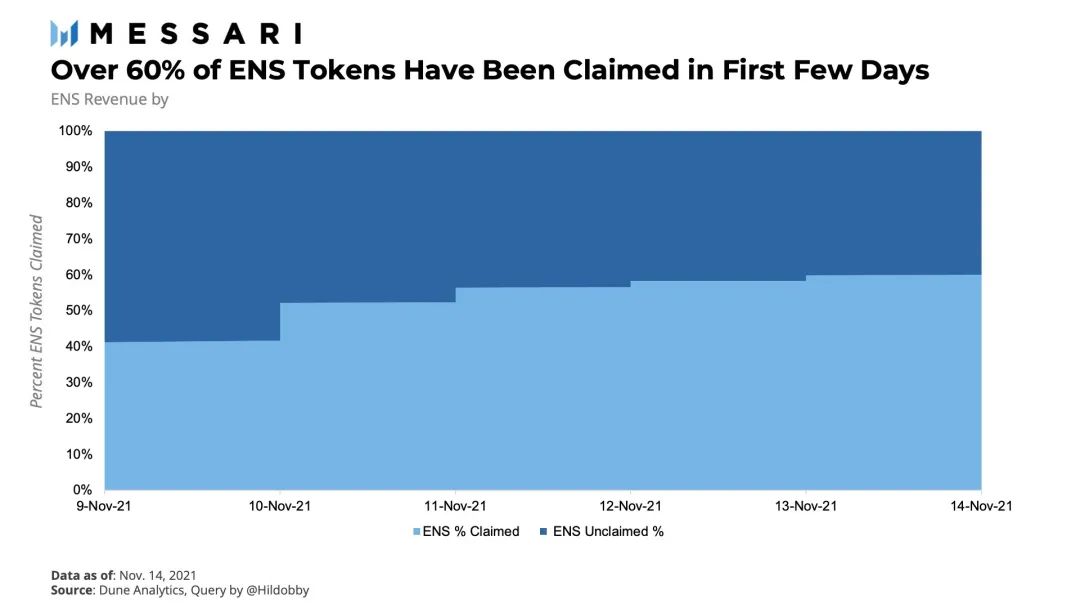
While the ENS airdrop is one of the better designed ones, it still may have allocated too many tokens to participants who have been idle in the ENS ecosystem in the past.
ENS governance
Outlined in the announcement, ENS token holders must first formally request the ability to govern protocol parameters (i.e. domain pricing, price oracles, etc.) and control funds from the existing community to ENS root key holders.
In addition, ENS also established the ENS Foundation (in the Cayman Islands) for a number of reasons, including legally representing the DAO, taking any necessary real-world actions, and electing or firing directors.
Perhaps most importantly, ENS token holders are required to sign the ENS Charter when claiming their tokens. Basically, the constitution outlines several key principles, including that ENS governance must respect ENS property rights, avoid rent-seeking behavior, avoid supporting competing agreements, and integrate with a global naming domain.
I don't think most people fully understand the importance of this last aspect. Therefore, I would like to try to briefly explain its importance.
3
Brief TLDR about DNS and ENS integration
The DNS service has a root (centralized) domain name registry called ICAAN. This is useful as it ensures there are no conflicts (e.g. there are no two types of Messari.io domain names so they both "resolve" (point to) one IP address/website. ENS is integrated into the existing ICAAN domain name registry, meaning This means they don't have any conflicts. Someone with an ENS address can resolve/point to an ICAAN-like registered website. This is unlike other domain name resolutions that may not be registered with ICAAN and/or have potential conflicts with existing DNS structures.
As a contrasting example, HNS attempted to replace ICAAN by creating a new root registry. They already reserve top-level domains (like Google.com) for top-level IP addresses to prevent conflicts and let existing companies port over. However, if HNS's domain name conflicts with ICAAN, this would be potentially harmful and would prevent integration. So the goal of HNS is essentially to create a new DNS system (which has its merits, but is beyond the scope of this article). At the same time, the goal of ENS is to increase the functions of Ethereum (programmability, native payment, etc.), and the domain name can be used as a wallet/domain name, but it is easily integrated into the existing DNS architecture. ENS' decision to integrate into the DNS was a strategic decision by the team to create a naming system and registry that could be adopted worldwide.
4
Sustainability of ENS
ENS domain names are created using the ENS registrar, and there are registration (creation of the domain name) and renewal (maintenance of the domain name) fees. ENS fees are an anti-squatting mechanism designed to ensure that no one holds onto domains forever.
Therefore, the price of an ENS domain name varies by length:
$5 per year for domain names longer than 5 characters
$160 per year for 4 characters
$640 per year for 3 characters
ENS does not charge for importing DNS domain names because DNS domain names already have fees from DNS providers such as GoDaddy. While ENS makes money from registrations and renewals, the vast majority of its revenue comes from registrations.
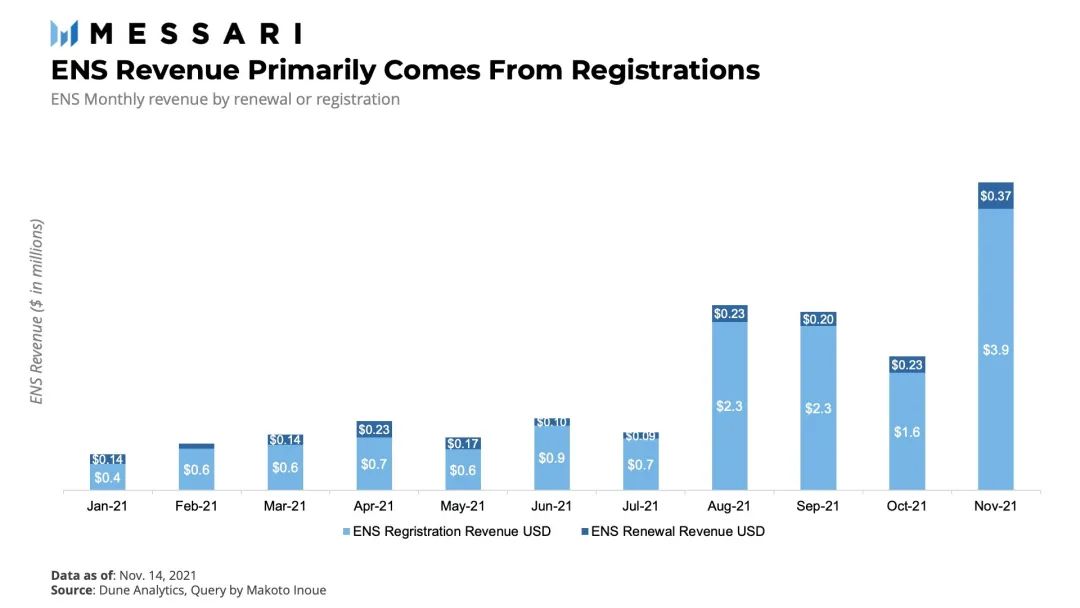
ENS has generated nearly $20 million in revenue from renewals and registration revenue. ENS' revenue has grown significantly over the past few months, surpassing $2 million in three of the past four months. Nearly 90% of ENS' cumulative revenue ($16.6 million) was generated in 2021, a positive sign for revenue growth. The key question remains, is this sustainable? Time will tell, though I expect ENS revenue to decline from ATH by the end of November.
Interestingly, the highest registration and renewal fees in November may be individuals trying to join the airdrop announced on November 1st. However, the snapshot for token distribution is October 31, 2021, so all November transactions were omitted when evaluating token distribution eligibility.
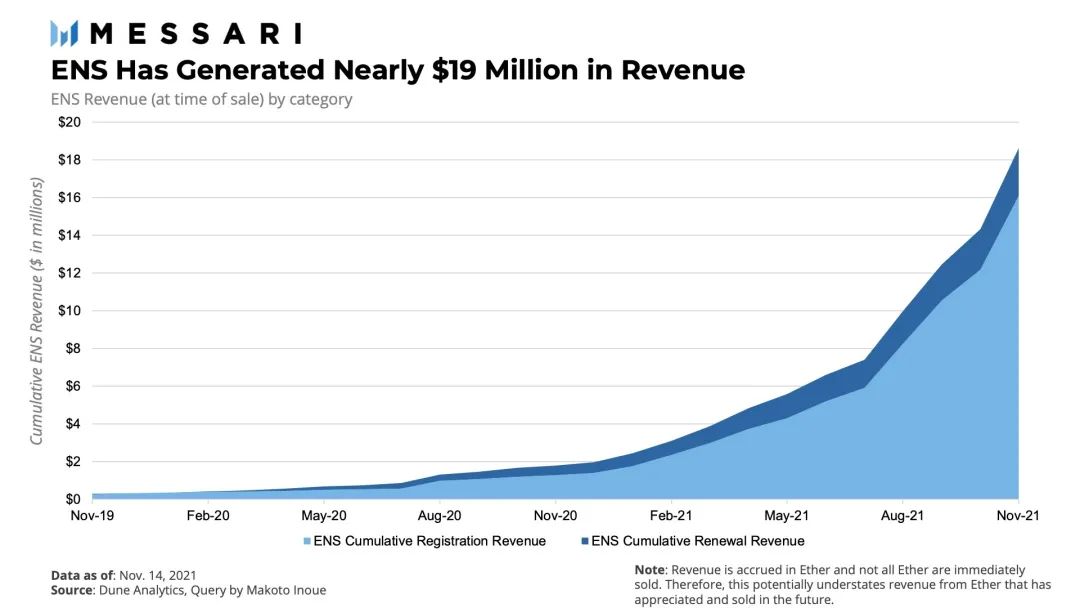
The chart above doesn't tell the whole story, as ENS has accumulated fees in Ethereum and, over time, may have held a sizable portion. Since launch, ENS has amassed nearly 13,000 ETH in revenue, with approximately $2.5 million in renewal fees and 10,000 ETH in registration fees.
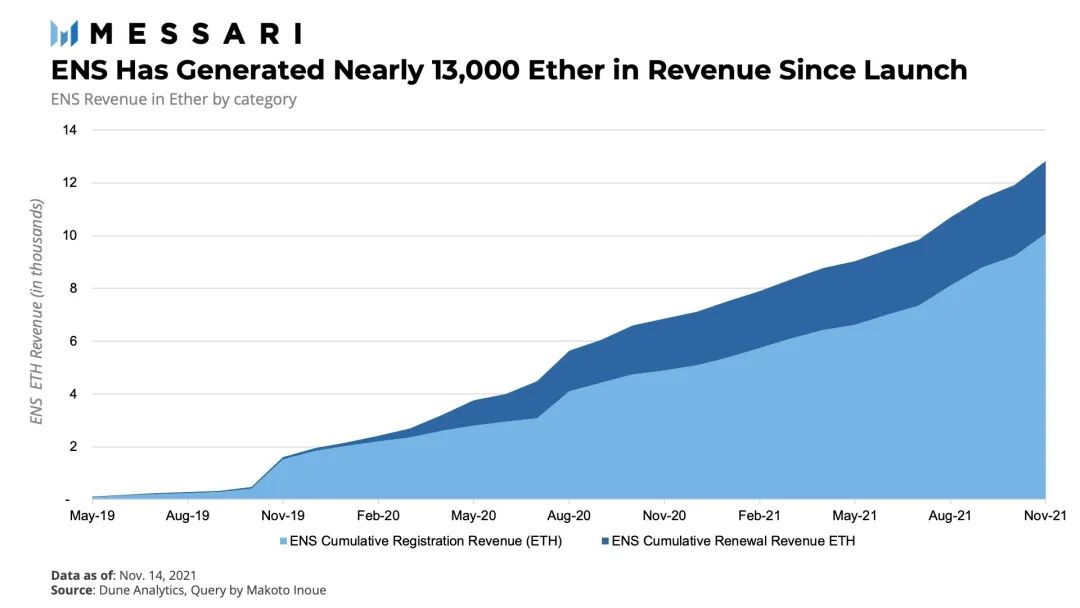
As part of decentralization, funds from the ENS treasury will be distributed to the DAO. Currently, the ENS registrar holds over 4,000 ETH (~$20 million).
ENS, which governs the ENS protocol, is now trading at $55 per token for a fully diluted valuation of $5.5 billion ($1 billion in circulation). Year-to-date revenue of $16 million implies a price-to-sales multiple of 334. Importantly, ENS is a new protocol with a very short time to start trading. The market is determining value.
5
The future of ENS
ENS is not the only contender in this space, but building a protocol that integrates with our existing world creates a clear path to adoption. As more and more individuals and companies use ENS, the fee income of ENS is likely to increase significantly. Furthermore, ENS, as a naming protocol, has the ability to support other protocols, blockchains, and domain names, which means its development is not limited to Ethereum.
This article comes from Tao of Yuan Universe, reproduced with authorization.
This article comes from Tao of Yuan Universe, reproduced with authorization.


