From Korean celadon to red wine, to donations, NFT is rapidly gaining popularity in all aspects


Foreword:
Foreword:
In South Korea, Non-Fungible Token (NFT) technology is rapidly spreading into various fields, from cultural heritage to the wine industry to donations. NFTs based on cultural heritage, donations, wine and other characteristic elements such as Goryeo celadon and "Hunmin Jeongeum Jieben" have appeared one after another. Unlike token virtual assets such as Bitcoin and Ethereum, NFT can be linked to real things, and the flexible issuance of all valuable data is the basis of the NFT boom.
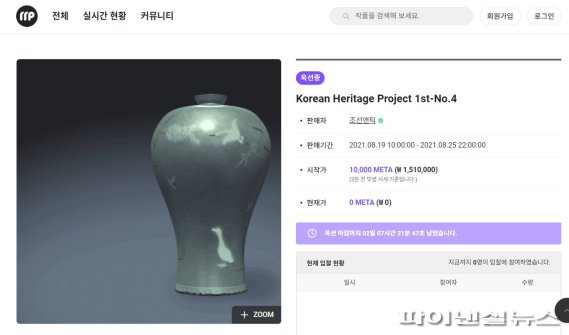
image description
Screenshot of Goryeo Celadon NFT sale on Metapie
NFTs based on Goryeo celadon, ancient calligraphy and paintings, etc. have been listed one after another
Chosun Antique is an art company specializing in antique art. It has made celadon vases representing the Goryeo period into NFTs, which are currently being auctioned on the NFT trading platform Metapie. This NFT also offers an HD video of the 3D modeling. A person in charge of Chosun Antique said, "In the celadon, the original inlay technology developed in Korea is vividly expressed, and the porcelain bottle has a beautiful curve.""The person in charge also introduced NFTs produced using national treasure-level cultural heritage. Art Center Butterfly is working with Jiansong Art Museum to promote the "Me.Duck" project, which uses collected cultural relics to make NFT picture cards, releases and sells the crane pattern symbolizing longevity in celadon plum vases, and Shin Shimdang's painting "Ink Grapes" The pattern of grapes, which symbolizes prosperity, was created by the 31st king of Goryeo."Eryangtu
There are 38 kinds of NFT picture cards including the blessing sheep pattern in the middle."The Jiansong Art Museum previously held a limited sale of 100 NFTs of the No. 70 World Documentary Cultural Heritage "Hunmin Jeongeum Interpretation Example Book", each priced at 100 million won (about 90,000 U.S. dollars). Jiansong Art Museum once said:"
Our goal is to permanently preserve the "Hunmin Jeongyin Interpretation Example Edition" as a digital asset, and raise funds for the preservation of cultural heritage and the operation and management of the museum.
The wine industry is also blowing the wind of NFT, looking forward to the modernization of production and distribution
In the wine industry, NFT is also very popular. According to foreign media reports, Cultwine, a senior wine investment company, and Chateau Angelus, a Bordeaux winery, jointly released an NFT last month, a 3D animation made to commemorate the launch of the 2020 wine "Bodro en Primur". Also included is ownership of a barrel (158.9 liters) of wine, a 2021 grape harvest experience, and an invitation to a virtual wine tasting with CEO Chateau Ancelus. The NFT was sold for about 110,000 U.S. dollars (129.06 million won) at an auction on Opensea, an NFT trading platform. Red wine takes a long time from viticulture to wine fermentation, so a project to reduce the risk that wineries have to bear through NFT is underway. The WiV project launched in London, England uses smart contracts, wine producers, distributors and sellers cooperate to NFT the wine produced throughout the year. The modernization of wine production and distribution is also expected to be achieved as a result.
Issuing donation certificate NFT
In some cases, NFTs are issued to incentivize donations. Ground X, a blockchain subsidiary of Kakao, joined hands with NGO Good Neighbors last month to conduct a charitable donation to support children vulnerable to the new coronavirus in Zambia, Africa. Good Neighbors and Ground X distributed NFT donation certification cards officially issued by Good Neighbors to all participants while the virtual asset wallet service Klip was collecting donations. The NFT card will be permanently stored on the blockchain platform Klaytn and can be viewed at any time. Junseon Eo, CEO of Coinplug, said, “Because there is a clear point that it can be connected with real objects, NFTs that are not purely for collection but for the purpose of use are also attracting a lot of attention. NFT is a content asset that has no value until now. technology, so many creators are interested in it."
Conclusion:
Conclusion:
Recently, NFT has become popular, and NFT is sweeping games, sports, fashion, entertainment, art, music and other fields with great momentum. The Korean Art Museum also tried to make cultural relics into NFT, making NFT a way to inherit traditional culture. The nature of NFT linked to physical objects also allows NFT to be more and more combined with traditional industries. I believe that as the darling of the industry, the future market prospect of NFT must be bright!