Estuary, Web3 storage and NFT.storage, how to choose three decentralized storage methods?



The Filecoin mainnet has been online for nearly a year, and it has become the blockchain ecosystem with the fastest growing applications. Filecoin is the first distributed storage network that greatly reduces storage prices and provides the same services as centralized storage based on objective conditions. Through the cost-effectiveness and meaning of Filecoin and the related technical architecture, it subverts the traditional data storage model. Today, we will introduce three applications that store data on Filecoin.
Filecoin is a decentralized storage backup, but where does the data stored on the Filecoin blockchain come from? The first thing to do is to add data to an IPFS node, which allows negotiating with storage providers to store information on Filecoin.
IPFS is a distributed system for storing and accessing files, data and applications. If you know how file systems generally work, you know that they access data based on its organization. The FAT file system uses allocation tables to look up data, the NTFS file system uses hard links and data streams, and IPFS uses content identification (CID). When developers need to access applications or data stored on the IPFS network, they only need to have a copy of the CID.
However, since IPFS is not natively supported in browsers, intermediary gateways are the only way to obtain this data, and IPFS gateways provide this functionality for developers and users. Any user with a CID can access data stored on the IPFS network, and CID also plays an important role after data recovery.
For example, if a node goes down for some reason, that information is available on other nodes as a backup. An IPFS gateway can simply load data from another backup node, eventually gaining access to it using the CID.
We can think of Filecoin as a leasing system. Developers or users rent long-term file storage space from Filecoin and pay for storing data. The blockchain is just a transaction intermediary and guarantee mechanism. Storage providers provide their own storage For developers and users to fulfill these agreements by keeping their IPFS data on-chain, thus making it available long-term.
With an understanding of how Filecoin and IPFS work together, we can start to look at the differences between the three gateway systems, Estuary, Web3.storage, and NFT.storage.
Why are there three different storage systems?
In fact, the three gateways do similar things. They act as an intermediary, accepting data for storage on the IPFS system, allowing for the collection of CIDs, and providing a way for users to create contracts to store their data on the Filecoin chain.
But some users also ask: "Why do we need three if they all perform the same function?" Each solution is designed for a specific purpose and a specific audience, in order to really feel them. Their respective roles, we need to understand them in detail.
· Estuary
Estuary is a way for developers to automate their storage to the IPFS network and the Filecoin network. It is a simple IPFS node that integrates a Filecoin library, allowing easier access to the IPFS and Filecoin blockchains. Function. Estuary is focused on enabling massive storage transactions to the Filecoin network while making the process easier and more efficient.
Estuary is designed for customers with large data storage needs, and its feature set currently supports six hundred transactions per hour, and the storage capacity of each Estuary node pushes the upper limit that exists in the ecosystem.
You risk going through the hassle of accessing an IPFS node, negotiating storage, and then doing the same with the storage provider to manually store it on the Filecoin blockchain. However, doing this can be tedious, especially if you have a lot of files to store. Estuary gives a straightforward way to store your files and negotiate your contract as a developer, making creating things much simpler.
Estuary's front end allows users to log in and upload files to IPFS with a few clicks. Estuary will contact storage vendors and negotiate verified deals with six of them. You can choose to check your information for transactions directly on Estuary. If the data size is below 3.57GiB, your data will be temporarily held in a staging area, and negotiation of the transaction will be processed within a few hours, adding the data (along with other packets) to the network as a block.
Once the transaction is created, the user will be given a link with a CID. You can use this CID in your application or website to retrieve your data from any public IPFS gateway, which means your data can be accessed from a globally distributed network. Even if your data has not been backed up to Filecoin and is still accessible on Estuary, you can still retrieve the CID from any IPFS gateway, allowing you to develop seamlessly without worrying about whether the data has been added to the Filecoin ecosystem.
Estuary uses IPFS to pin the standard, so it's easy to switch from other existing solutions. Estuary is a very good choice for those who have large file storage needs. Using Estuary is very simple, it does not require a specific programming language and can be used in the way that feels most natural to you. Due to its intuitive interface and operation, the user experience of applications and web pages is also simplified.
Web3.storage

Web3.storage is another iteration of the gateway for interacting with the IPFS network and the Filecoin blockchain. Similar to Estuary, this service provides a way to store data on the IPFS system. It provides users with an opportunity to access the IPFS network, store data, and retrieve that data for free.
While integrating IPFS and Estuary requires some preparation, Web3.storage provides an opportunity for users to jump right into application development using the IPFS network and Filecoin's storage without delving into the integration.
Just like Estuary, you'll need an API key to access the system, but it's a simple matter of opening a free account and uploading a file. Once you have that file, you can use the API key to access it via curl or directly through your browser.
To make it easier to build a web application, there is a direct JavaScript interface to use IPFS from your code in just a few lines. The script to build an IPFS node requires an API key to work, but it can be copy-pasted from the documentation on the website.
You can access files directly by their CID and start minifying your JavaScript applications to use data stored on the IPFS network. The simplicity of use makes it an ideal storage solution for developers building JavaScript-based applications who want to use Web3.storage to directly upload and retrieve their files.
NFT.storge

Although NFTs have become one of the hottest assets on the internet today, storing NFTs online still requires some cumbersome operations for many users. NFT.storage is a dedicated interface for storing NFTs on the IPFS network and automatically copying them to the Filecoin blockchain.
NFT.storage is unique from the aforementioned gateways in that it preserves the metadata necessary to buy and sell NFTs. Since NFTs are works of art or collectible cards in a blockchain environment, metadata is critical to determining who owns these digital assets and who has previously owned them. NFT needs to have the ability to be stored forever, and a decentralized storage system like IPFS can provide NFT storage for free.
NFT.storage uses many of the same storage details as Estuary and Web3.storage. It provides CIDs for uploaded data and allows users to check the status of their storage transactions on the Filecoin blockchain. Any NFT stored via NFT.storage can be accessed via any IPFS gateway with the help of its content ID. The API and integration with the development environment make NFT.storage ideal for NFT creators to upload their work to the blockchain quickly and easily.
Most of the well-known NFT trading markets have used IPFS and Filecoin to provide technical support for their networks, and two well-known names in this field, Palm and VideoCoin, use IFPS to store and retrieve content. NFT.storage provides a way for users to interact with the network without going through a centralized service provider. It empowers NFT creators and provides them with powerful storage elasticity and decentralized storage networks like IPFS.
Which storage app should I use?
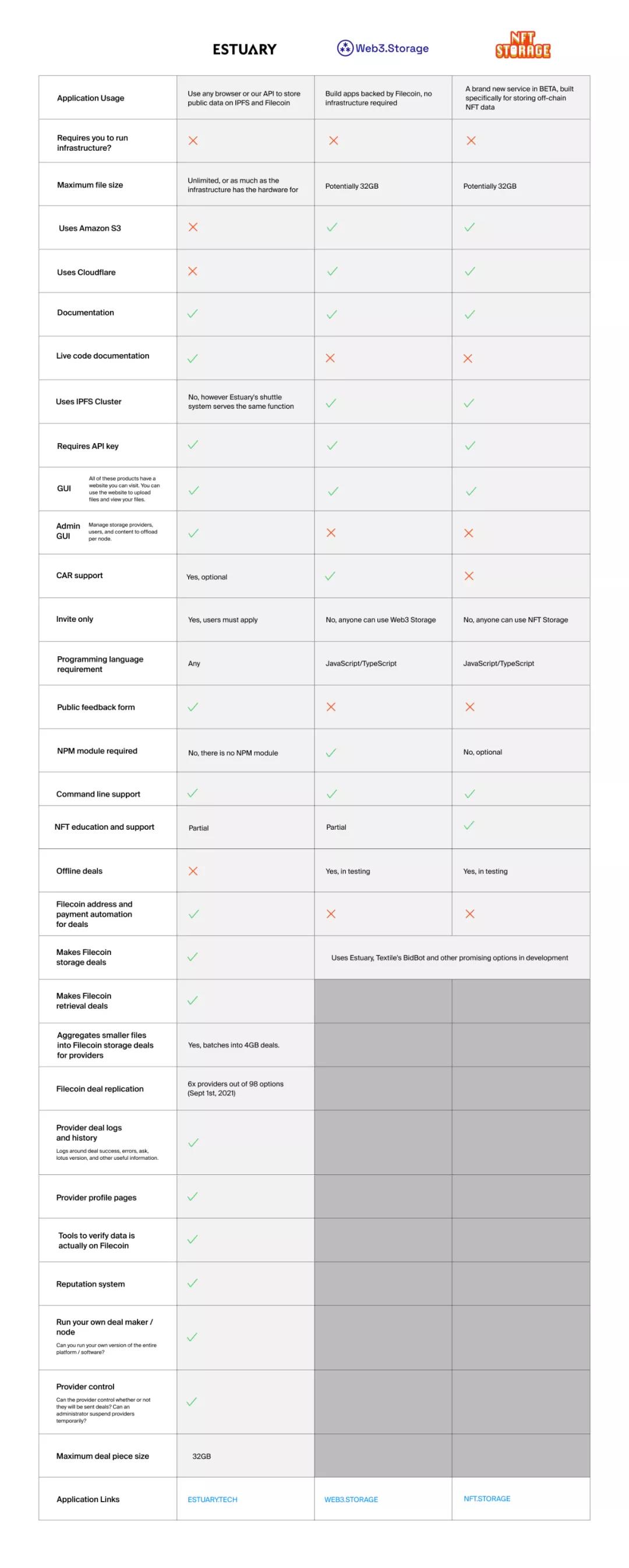
This question mostly depends on what application are you developing? As a web developer with roots in JavaScript, you may find that Web3.storage is easier to use and better suited to your development needs. But suppose you're developing a distributed application and want to have more control over how your data is stored. In this case, Estuary is your best choice, although it may be a little complicated on the back end.
If you're an NFT creator looking to have more control over your uploaded creations, then NFT.storage might be the tool you need. Although many of the operations performed by these three tools are the same, each is suitable for specific use cases. Whichever tool you decide to use, do your research and have fun!