South Korean university's eco-friendly toilet turns excrement into energy and digital currency


Foreword:
Foreword:
This article is translated and organized from the news network Sputniknews, Yahoo News, and introduces a kind of environmentally friendly toilet in Korea University that can turn excrement into energy to power the teaching building, and use digital currency to reward people who use this environmentally friendly toilet. (This article has a total of 1186 words, and the reading time is about 3 minutes)
Cho Jae-weon, a professor of environmental engineering at the Ulsan National Institute of Science and Technology (UNIST) in South Korea, has designed a device that uses human waste to generate energy and rewards people who use it with digital currency. People's excrement is used to power a building, and the digital currency obtained by going to the bathroom can be used to buy goods in the school supermarket.
The toilet is called "BeeVi", a portmanteau of the words "bee" (bee) and "vision" (vision). "BeeVi" uses a vacuum pump to pump excrement into an underground tank, reducing water usage. There, microbes break down waste into methane, which becomes the building's energy source, powering a gas furnace, hot water boiler and solid oxide fuel cells.
Professor Cho Jae-weon, the founder of "BeeVi", said, "If we break the rules, we will find that excrement has valuable value to generate energy. We want to put this value into the ecological cycle. This is the basic of the BeeVi system. concept." The professor also introduced that an average person defecates about 500 grams per day, which can be converted into 50 liters of methane gas. The gas can generate 0.5 kilowatt-hours of electricity, or be used to drive a car for about 1.2 kilometers (0.75 miles).
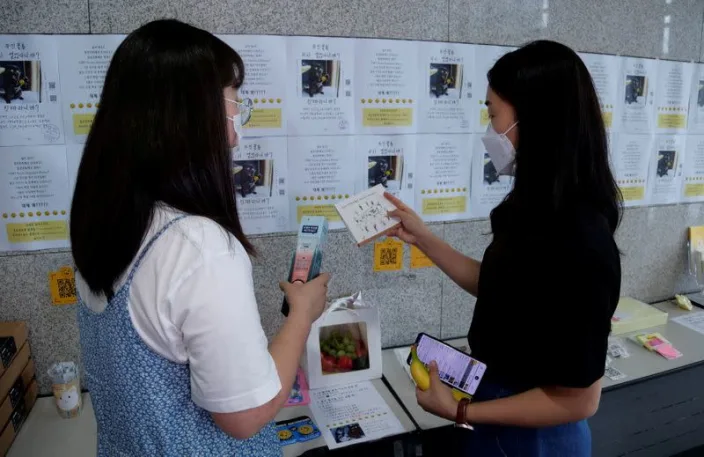
Professor Cho Jae-weon also designed a digital currency called Ggool, which means honey in Korean. Everyone who uses this eco-friendly toilet can earn 10 Ggools per day. Students can use these digital currencies to buy goods on campus, from freshly brewed coffee to snacks, fruits, books, students can pick the goods they want in the store, and then scan the QR code to pay with Ggool.
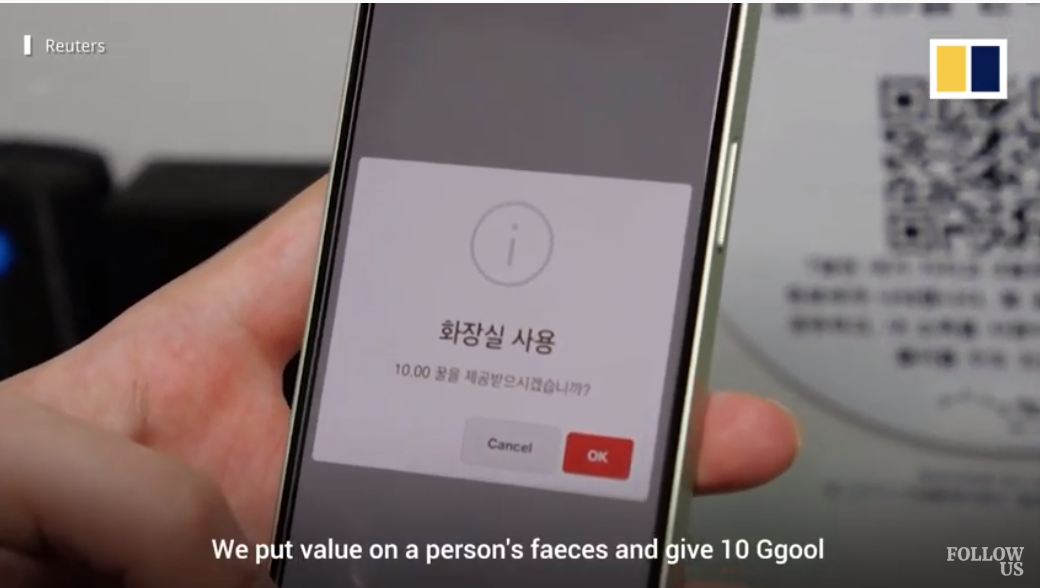
There is a QR code posted on the inner wall of the toilet. After flushing the toilet, the user can scan the QR code on the wall, and the system will automatically reward 10 digital currency Ggool. (The content of the Korean prompt in the picture above is that the toilet has been used, whether to accept 10 digital currency Ggool)
A student at the Ulsan National Institute of Science and Technology said, "I used to think excrement was dirty, but now it is a precious asset to me. I even talk about excrement with friends during meals to earn money. I bought the books I wanted to buy with the digital currency I got, and talking about excrement even became a very interesting topic.” Another student said, “After going to the toilet at home, I just flush the toilet and flush all the waste away. But going to this kind of toilet can not only earn pocket money, but also contribute to the protection of the environment, which feels very meaningful.” Conclusion: