Understand MobiFi, a new species of blockchain in one article



Original link:https://medium.com/mobifi/the-transportation-ux-of-the-future-9fcf48302b63
From Medium, original author: MobiFi
Original link:
From Medium, original author: MobiFi
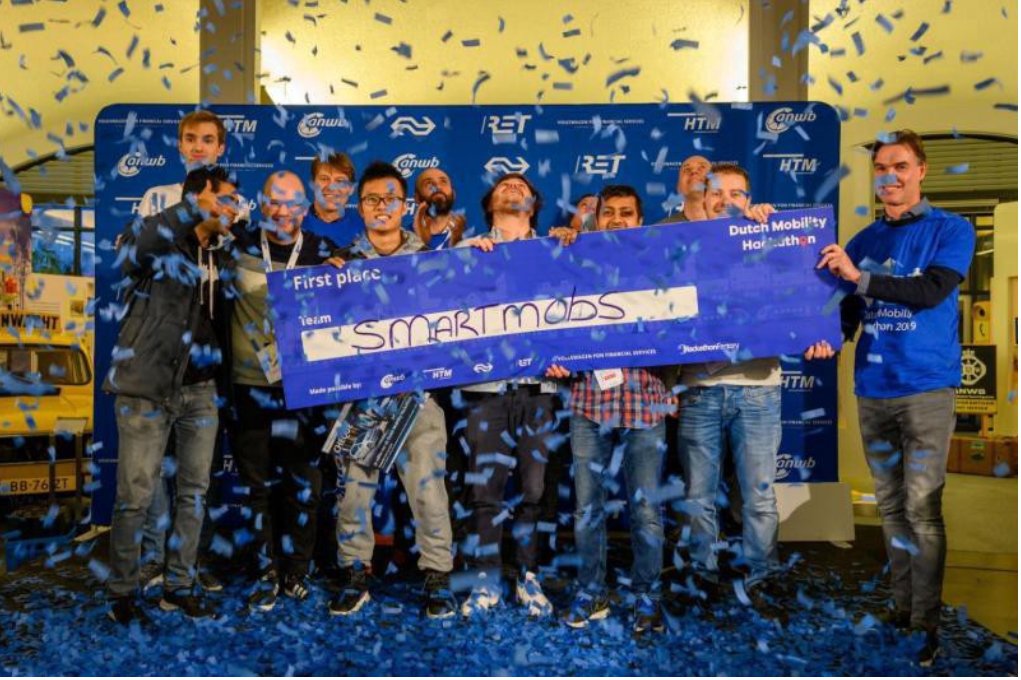
In 2019, the SmartMob team won the "Transportation Marathon" competition in the Netherlands. They hope to fill the gap in the use of public transportation and private cars in the existing travel infrastructure-and this is the prototype of MobiFi.
The idea of the SmartMob team is to simplify the park and ride experience and combine more services into one app. After the "Transportation Marathon" competition ended, some team members did not give up on this project. They hoped to dig deeper and studied how to use blockchain technology to help solve urban transportation challenges. A year later, MobiFi was born.
secondary title
Transportation issues in modern society
Most people are familiar with the mobility issues inherent in modern cities such as: congestion, safety, queues, underserved, pollution, and more. Although many places have reduced the concentration of commuters during the COVID-19 pandemic, people still need to travel. So far, almost no big city can really effectively solve the problem of traffic travel. There was a time when the idea of reducing private car use was popular, but years of experience (and data) have shown that trying to force people not to drive doesn't make roads less burdensome.
People who want to drive will continue to choose to travel by car, mainly for the following reasons:
1) People who sometimes choose to drive to work do so because they need to drive for many other things, such as driving their children to school, running errands, etc.
2) Habits are hard to change, and many people have a fixed schedule, in which case, getting around by car is the easiest option.
3) In some parts of the world, owning a car is an important status symbol and confers a high degree of personal autonomy on the user.
4) Surveys show that many seniors are reluctant to give up driving because they believe not driving will limit their mobility.
Working closely with experts, MobiFi has discovered that the main thing preventing people from continuing to travel in an efficient manner is actually the many problems with a fragmented, rigid and disjointed transportation system. People want to find a simple and flexible way to travel. Although there are ride-sharing applications, vehicle sharing platforms, and many mapping applications on the market, and even driverless cars are on the road, in many cases However, the current market environment is still unable to meet people's needs.
However, this conundrum may now have a solution, and the answer is – Mobility as a Service (MaaS) solutions. The concept of Mobility-as-a-Service is to provide travel services on-demand using a single app, allowing users to access and purchase various modes of transportation in and around cities. Today, new modes of transportation such as shared cars, micro-mobility, and existing public transportation systems have been combined to accelerate user awareness of sustainability and environmental protection. But, according to data scientist and researcher Evgeny Klochikhin, urban mobility is still "irrational". In this case, public transportation and shared mobility have not lived up to expectations. Furthermore, experience has shown that while many cities and businesses have attempted to implement mobility-as-a-service (MaaS) solutions, the results have been surprising. To realize its full potential, mobility-as-a-service (MaaS) solutions face four key challenges that must be addressed.
1. Commercial Barriers
Looking at today's transportation business model, we have found many problems, including:
* Multiple subsidies
* Competitive contracts
* The contract period is inconsistent
* Inappropriate risk allocation
These issues have led to a fragmented mobility services industry and reinforced local protectionist stances in most cities.
2. Technical obstacles
To provide seamlessly integrated multimodal transportation services using mobility-as-a-service (MaaS) solutions requires extensive access to source data from many service providers. Aggregating such a large data set was a huge engineering challenge, and getting all transport operators to agree to share their data was difficult.
3. Regulatory Barriers
4. People with behavioral disorders
Changing travel habits is a complex process that can take a long time -- longer than many people choose investment products. And there is little point in building a full-fledged Mobility-as-a-Service (MaaS) network if consumers do not adopt new mobility modes.
secondary title
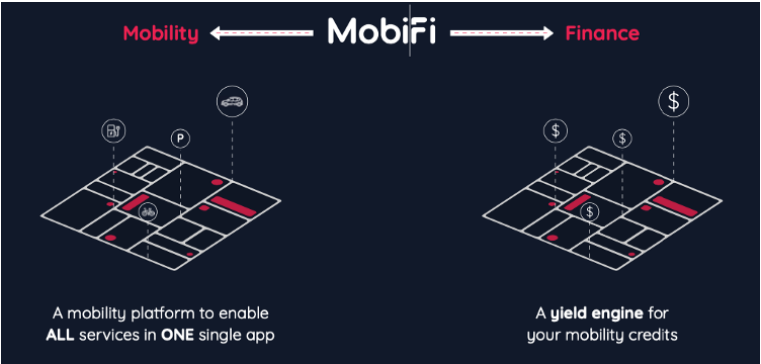
With these challenges in mind, MobiFi is working hard to link all mobility applications, with the goal of providing everyone with flexibility and ease of use in transactional mobility services, while also layering unique features and incentives onto the user experience.
MobiFi has two core components: the first component is the mobility-as-a-service (MaaS) transportation platform, which can connect all transportation applications and provide consumers with simplified travel experience services. The second component is a financial mechanism designed to incentivize people to use the MobiFi app, thereby changing the way they travel. MobiFi also makes it easier for users to invest their idle funds, turning a transit card into a revenue engine.
How to connect the two core components of MobiFi?
The key elements connecting the Mobility-as-a-Service (MaaS) transportation platform and financial platform are: MobiFi tokenized mobility credit, which is a blockchain-connected token based on As a trusted transaction channel inside and outside the transportation ecosystem, it is also a typical solution to complex multi-party problems. Therefore, blockchain, or more specifically, distributed ledger (DLT) technology, is an integral part of the MobiFi solution.
secondary title
MobiFi Mobility as a Service (MaaS) Transportation Platform
Many projects try to build their own hybrid blockchains to meet the needs of corporate customers and community members, and MobiFi chose to build services on two blockchains, Corda and Ethereum. On the one hand, MobiFi utilizes Ethereum to participate in the DeFi ecosystem instead of having its own set of verification nodes (so that there is no need to build infrastructure from scratch), while also providing users with opportunities to invest and exit in fiat currencies and other stablecoins; On the one hand, MobiFi uses tokens on Corda to power high-frequency applications and serve enterprise customers.
This dual-token system is designed to better support enterprise-level mobility solutions. Enterprise users can easily integrate MobiFi's Mobility-as-a-Service (MaaS) solution, while providing high-quality mobility services to ordinary consumers. Another benefit of MobiFi's Mobility-as-a-Service (MaaS) solution is that mobility credit tokens are not affected by the volatility of the crypto market. Corda will use an internal token system, the SMiles token. In the middle, MobiFi was looking for ways to build a Corda bridge. If successful in the future, it may be possible to directly connect MobiFi tokens with the Ethereum network, and even the wider encrypted world.
MobiFi Financial Platform
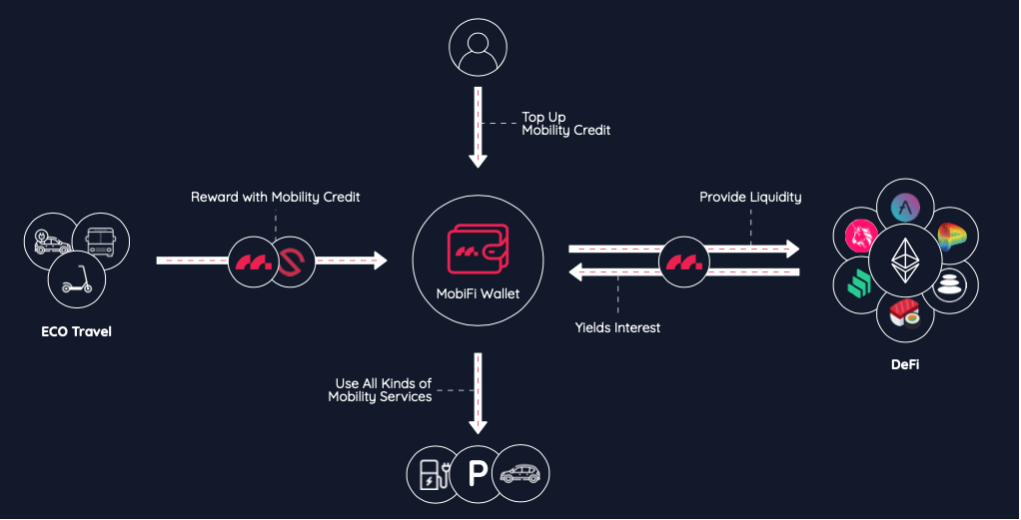
Every user can access the MobiFi system just like using Google Maps or Uber, and with one click, they can enable financial services functionality, connecting their Smiles tokens to MobiFi tokens on the Ethereum network. With a built-in wallet, MobiFi also enables users to access DeFi services and provide liquidity directly to the DeFi projects of their choice.
image description
Above: MobiFi turns your daily travel points into a revenue engine
Today, there are billions of dollars worth of credit on transit cards, but the fare is largely difficult to circulate. Users usually cannot withdraw directly, nor can they use it elsewhere, and a lot of opportunity costs are thus locked - this is actually a socioeconomic issue, generally speaking, people who do not have much social resources often choose to take public transportation , their own social status is not high, and now there are so many "welfare" that cannot be used, which puts them in a more disadvantaged position.
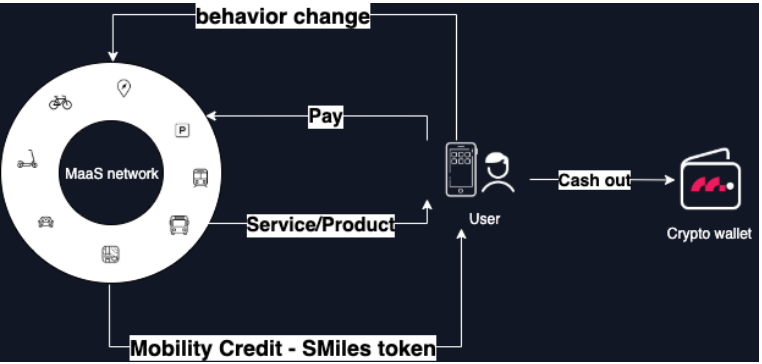
However, by digitizing travel credits and connecting them to the Ethereum network, we can explore many new possibilities. MobiFi enables users to turn this "hidden" huge cash reserve into a real-time income engine, and all transactions are transparent and immutable. In fact, the transportation market has a lot of credit points, which is an underutilized area, and it can also save users a lot of money.
Of course, there is another thorny issue, which is "human behavior". When it comes to transportation, people tend to take the path of least resistance, even if that path is less than ideal in many ways, and MobiFi's solution is to use a new set of economic incentives to attract more people to use.
The MobiFi system will reward users who travel responsibly, mainly including:
drive less
Use electric vehicles, etc.
Use electric vehicles, etc.
These behaviors can allow users to develop (better) traffic travel habits. If incentives are combined, it is expected that many users will be able to quickly change bad travel habits. In this way, MobiFi creates a feedback loop that benefits both individual and group mobility.
secondary title
what to expect in the future