Analysis of the Four Revenue Models of Filecoin Miners and the Trend of Revenue Change


first level title
1. Four revenue models for miners
secondary title
SGD distribution income
secondary title
Block packaging income
secondary title
Storage Market Earnings
secondary title
Retrieve market returns
Miners obtain transaction tokens by providing data retrieval services, and what miners sell is their own traffic.
To sum up, it can be seen that in the entire Filecoin system, there are four kinds of income for miners: new currency issuance income, block packaging income, storage market income and retrieval market income. Retrieval miners only have one kind of income, that is, retrieval income, while the other three incomes are only eligible for storage miners.
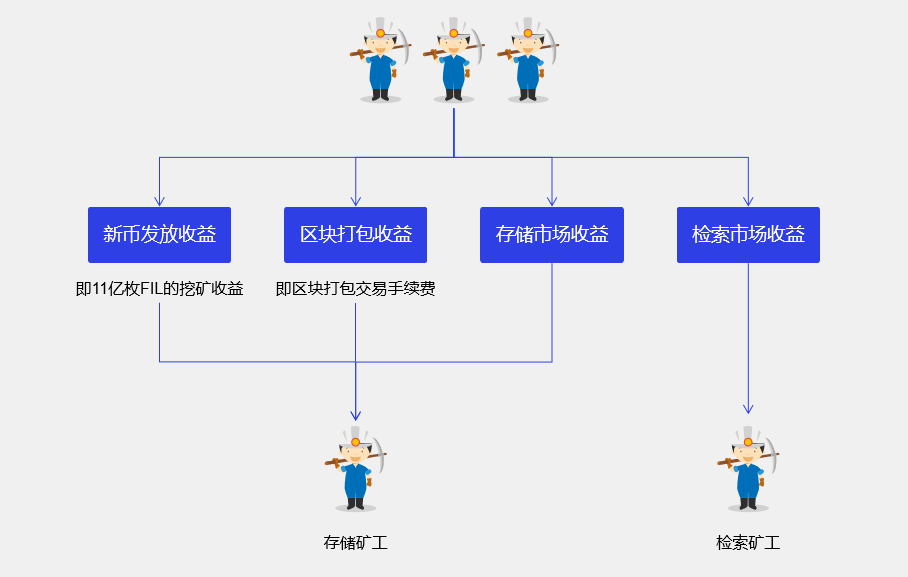
Some miners expressed doubts. Since there are so many types of income for miners, it should be a lot of income for miners, but in fact it is not the case. Why?
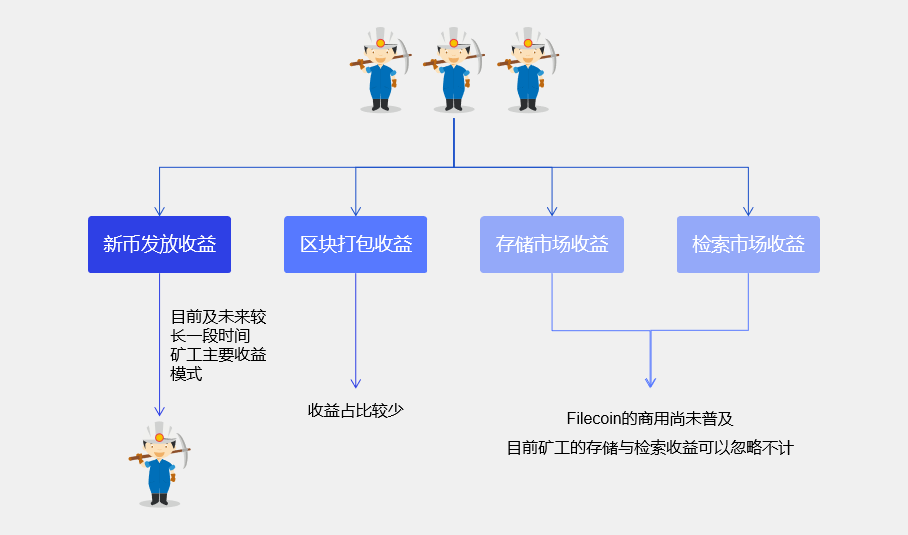
1) Since the commercial popularization of Filecoin will take a certain amount of time, the demand for storage orders and retrieval orders in the market is still relatively small. Therefore, at the current stage, miners rely on market storage orders and retrieval orders to obtain storage and retrieval benefits, which are almost negligible.
2) In addition, the Filecoin main chain needs strong computing power to ensure the security of the entire network, and powerful computing power requires effective storage. Therefore, most miners use technical means to increase effective storage and improve their effective storage in the entire network. Increase the effective computing power of the entire network to increase the block explosion rate, so as to obtain more block rewards (that is, mining income).
3) Block packaging income (that is, block packaging transaction fees) is also one of the sources of income for miners, but it accounts for a relatively small proportion of income sources.
first level title
2. Change trend of miners' income
Miners' income is not static.
In the early stage of the project, the revenue of new currency distribution is the highest. Because the income distribution of miners mining is fixed, so in the early stage of the project, the number of nodes participating in mining is the least, the price of mining machines is the cheapest, the cost of mining is the lowest, and the release rate of tokens is the highest, and the efficiency of mining income is the largest. Therefore, in the project For a long period of time, the income issued in new coins will account for the main part of the entire miners' income.
However, with the development of the Filecoin network, the proportion of storage revenue and retrieval revenue obtained by miners will gradually increase, because when the development of the Filecoin network increases, the revenue of new currency issuance for the entire network will remain unchanged, so the reward for unit computing power will inevitably However, the benefits of storage and retrieval increase with the increase of computing power (that is, the effective data storage capacity of the entire network). Therefore, when the Filecoin network reaches a certain scale, the income of these two parts will be higher than the income of new currency distribution. It can be seen that for Filecoin miners, the earlier they participate in the Filecoin project, the better. And today is always earlier than tomorrow.
Even so, some miners still have doubts: Will miners obtain storage market revenue and retrieval market revenue at the same time in addition to new currency distribution revenue in the later stage of the Filecoin project?
Not! Just like miners get mining income (new currency issuance income) by investing in mining machines, because there is a sector encapsulation period for mining with mining machines, and when the sector expires, if:
1) When the sector is renewed, the renewed sector will continue to pack computing power and obtain mining income through computing power.
2) If the sector is not renewed, the miners will not be able to obtain mining income through the encapsulation of the sector. However, if the sector is not renewed, miners will have idle storage space. At this time, miners can obtain storage market benefits by providing idle storage space. Taking Didi Taxi as an example, many car owners will drive out their own cars to provide taxi service. Passengers pay for taxis, and car owners can grab orders on the Didi platform and get paid for car rental services. Similarly, in the Filecoin network, everyone shares their idle hard disk storage space to provide users with network storage services. Users pay FIL as a fee, and miners provide storage services and receive FIL for remuneration.
Under the above circumstances, the miners who obtain new currency issuance income by investing in storage equipment, either continue to renew sectors for mining to obtain mining income, or do not renew sectors but provide network storage services by sharing idle hard disk storage space Gain storage market revenue. In this mode, it is like "one radish and one pit", and only the benefits corresponding to the "radish pit" can be obtained. It is worth noting that, according to the Filecoin economic model, the mining output is released linearly, that is to say, after all 1.1 billion FIL is released, the "radish pit" of mining income will no longer produce new coins, and the sector will reach There will be no renewal issues after the period, and with the expansion of the Filecoin ecosystem and the popularity of commercial use, these miners may switch roles to become storage miners or retrieval miners, or both, to earn more FIL income.
As a comprehensive solution service provider focusing on Filecoin mining, Shensuan Mining Pool is a community of interests with Filecoin miners and project parties. Only when the Filecoin network develops better and better, everyone's income will be higher and higher. In the future, Shensuan Mining Pool will continue to improve technology, consolidate brand, improve service quality, continuously create value for customers, and contribute to the prosperity and development of the Filecoin network.