This article is about 3372 words, reading the full article takes about 5 minutes
Retail movement and DeFi.
Retail movement and DeFi.
image description
GameStop's offline storesIn the traditional financial market, the focus of the topic these days is undoubtedly the retail investors of GameStop (hereinafter referred to as GME) and Wall Street Bets (hereinafter referred to as WSB).When various institutions were bearish on GME, an old-fashioned physical game seller, retail investors used the WSB forum as a position to buy a large number of GME stocks in an organized manner, causing GME's stock price to soar all the way, with an increase of more than 1600% this year. In just one day, the stock price rose by 68%. Several major short-term funds that entered the market first were forced to close their positions one after another. They suffered huge losses and had to borrow a lot of funds to maintain their operations. They were very embarrassed.When the enthusiasm of retail investors was high and institutions were struggling to fight the fire, brokerages entered the market. Last Thursday, Robinhood, a brokerage app used by a large number of retail investors, restricted retail investors from buying stocks such as GME and could only sell them. Several other brokerages They also followed suit.In addition, WSB, the original base of retail investors, was banned by Reddit for "spreading hate speech", and the discussion group they used on Discord was also banned by Discord, causing an uproar. Last Friday, Robinhood was under pressure to develop stock purchases such as GME, but it was limited to only 2 shares at a time, and later extended to other 36 stocks except GME; at the same time, institutional trading did not subject to any restrictions.On January 29, the Dow plummeted 600 points and lost 30,000 points, but at the same time GME's stock skyrocketed, returning to around $325. The sharp changes in stock prices have attracted the attention of regulators. The US Securities Regulatory Commission (SEC) commented that they will pay close attention to the large changes in stock prices and will also check the relevant behavior of securities companies.image description
GME tumbled last Thursday when brokerages like Robinhood banned buying GME sharesWhen retail investors were excited by "retail investors beating Wall Street", some people also raised different opinions. Someone picked out that the well-known institution Blackstone Fund had invested in GME in December last year. This victory was actually a showdown between institutions, and the group sentiment of retail investors was just a cover.Some people also pointed out that among the participants of WSB, there are many former Wall Street analysts who are very clear about Wall Street; there are also retail investors with strong net worth who are not afraid of losing money. fetched. Some long-term institutions do hide behind retail investors and make a fortune silently, but the scale effect of retail investors themselves cannot be ignored.Considering the number of "small investors" it becomes more interesting to look at the whole thing from a social science perspective than a simple financial movement. In a group, emotions are the most primitive driving force, and extreme negative emotions are more effective. Some bloggers concluded that these retail investors all have the same emotion: anger.When the economy is hit, the lives of the middle and lower classes of the society are more affected, and dissatisfaction accumulates; for a long time, Wall Street elites have not only monopolized wealth, but also monopolized the right to speak. But the elite is always a minority, and the number of people who are exploited in a disguised form is large.People's admiration and sympathy for similar stories, and even their personal participation, is the embodiment of the willingness to speak out as a retail investor.Individual group members have their own social circle. When participating in activities, there is a certain probability of attracting members in the social circle to join the group. Coupled with the hype of the news, more people on the Internet can find resonance in this group emotion. People join the carnival. And when the group affected by this emotion has a certain scale, the structural problems in the existing society and system can be deduced through the birth of the group. For the GME incident, it is the anger of ordinary people against Wall Street's "rich men".image description
A retail investor's Twitter statementAnd the response behavior of the elites: unplugging the network cable, restricting transactions, tearing down the fig leaf to show the most naked power, these behaviors themselves can be regarded as "meta rules above the rules", and the behavior of breaking the server is not advisable in the integrity contract. However, because the server is centralized, the centralized platform can freely and conveniently change the rules according to its own interests, which is technically feasible, and users who rely on the functions provided by the platform have no power to fight back. ——The fact that retail investors can move to other brokerages and other platforms this time may not only be a commercial competition, but may also involve more complicated issues of national interests, which is not listed here for the time being.In short, in a large group, a large number of people and a small number of elites cannot compete in traditional resource allocation. Since the elites control the rules of resource allocation, it is doomed that it is impossible for the majority of the people to enjoy the same benefits. . However, in the contemporary age with highly developed networks, more people have received education and acquired knowledge, which enables them to have the will to control their own property disposal rights and also possess certain abilities. In the past, Wall Street institutions almost monopolized the possibility of such reinvestment and charged high commissions from it. The rise of Robinhood, a brokerage trading platform that is supposed to be friendly to retail investors, has taken advantage of retail investors’ eagerness to get rid of institutions to a certain extent. However, at the critical moment of the long-short confrontation, it is unreasonable to directly change the rules, which is worthy of reflection by "retail investors": on the premise that the rules are defined by centralized institutions, is the free market a truly "free" market?If there is a difference, only DeFi.image description
(Image source: https://www.blocksocial.com/ethereum-defi-platforms/)Once we shift the focus of financial behavior from a single elite capital to retail investors, the topic of financial decentralization is inevitable, and the realization form of decentralized finance is DeFi. The transaction logic of DeFi is based on the smart contract of the blockchain. Once the smart contract is deployed on the chain, it cannot be changed unless a new contract is created and the user is willing to migrate their assets to the new contract. Due to the openness and transparency of its transaction logic, if there is a loophole, everyone can take advantage of it, which puts forward higher requirements for writing contracts, and it is also a guarantee for user rights. ——There is no black-box operation that violates the existing rules of the transaction. The blockchain itself is decentralized, and all nodes jointly maintain the state of a chain. If the nodes are sufficiently dispersed, most of the nodes in the entire network are honest, and there will be no "centralized company that controls the server to change at will". Permissions".The existence of blockchain and DeFi, ideally, has created a trading market where "everyone is equal" that has never existed before. In the DeFi market, strategy is the most fundamental factor in determining profitability, rather than capital and insider trading. This strategy includes short-term high-frequency arbitrage operations, as well as accurate prediction of long-term prices. DeFi does not discriminate against small-amount transactions, nor will it provide additional better quotations for large-amount transactions—in fact, in the most common AMM trading model in DeFi, large-amount operations are often constrained by high slippage , such a design is beneficial to small traders.That is beneficial to retail investors.Both Ethereum and its users are actively seeking a solution. The solution initially thought of by the Ethereum community is Layer 2, which refers to transferring some transfers or smart contract operations off the chain, and the chain is only responsible for verifying the results. Currently, there are several specific applications of Layer 2, such as side chains, op -rollup, zk-rollup, each has its own application scenarios, and each has its own shortcomings. Moreover, various rollup schemes are not fully compatible. Or the chain itself is directly converted from PoW of ordinary nodes to PoS with super nodes, such as Ethereum 2.0. Or maybe, choose a PoW chain, which not only retains the decentralized structure of PoW, but also confirms fast enough without encountering congestion. It can be said that what kind of solution to choose to solve the problems of congestion and high gas fees at the same time is an unavoidable problem in the development of DeFi. Only by solving these two problems at the same time can DeFi become the DeFi in the "ideal sense" mentioned above, decentralization, and everyone is equal.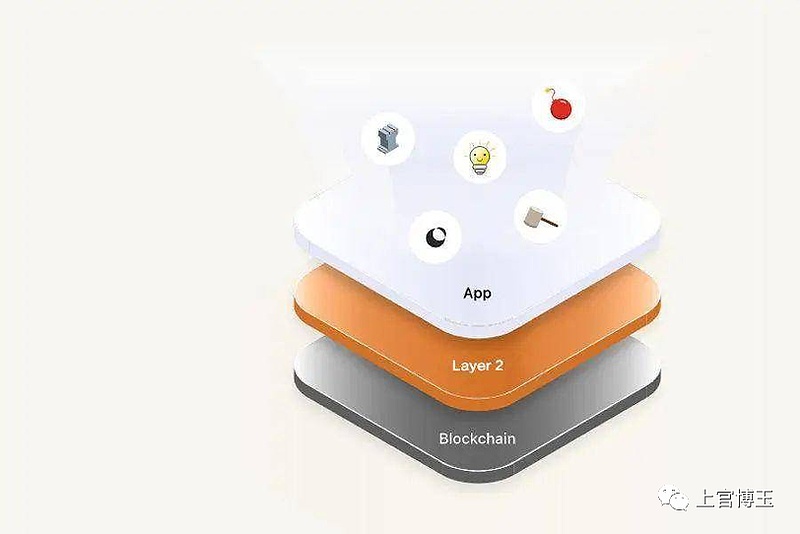
image description
(Image source: https://www.chainnews.com/articles/007101233152.htm)Welcome to Join Odaily Official Community





