Flashbots: Race against the MEV crisis



Editor's Note: This article comes fromEthereum enthusiasts (ID: ethfans)Editor's Note: This article comes from
Ethereum enthusiasts (ID: ethfans)
Ethereum enthusiasts (ID: ethfans)
, author: thegostep, translation: A Jian, reprinted by Odaily with authorization.
Flashbots is a research and development organization founded to alleviate the negative externalities and survival risks brought about by "miner-extractable value (MEV)" to smart contract platform blockchains. We propose to design a trustless, transparent and fair ecosystem for the collection of MEV to defend the concept of Ethereum.
The explosion of Ethereum usage over the past few months has exposed some of the negative externalities posed by MEV, including network congestion (i.e., increased burden on the peer-to-peer network) and chain congestion (i.e., tight block space): our preliminary The evaluation shows that Ethereum’s throughput can be increased by at least 2.4% by eliminating the inefficient MEV pumping process. Furthermore, the current incentive system for MEV pumping poses an existential risk to consensus security in Ethereum, as it creates incentives to initiate chain reorgs in order to obtain MEV for past blocks (e.g., via time-bandit attack 14 ), also gives people an incentive to centralize the routing of transactions for the benefits of privacy, low latency, and ordering control. We believe these incentives are harmful because they undermine Ethereum’s admission-free and finality.
While these existential risks and negative externalities have always existed, a series of events over the past six months have shown that the usage of the network has reached a tipping point. We have observed that many people are actively developing exclusive transaction routing facilities, and are worried about all this, because it has the potential to erode the neutrality, transparency, decentralization and fairness of Ethereum today. These events also show that the aforementioned existential crisis and negative externalities tend to intensify.
In this article, we explain the details of the Flashbots organization and the starter projects of our research roadmap, MEV-Inspect and MEV-Geth. Further discussion on the background and motivation of our project can be found here.
MEV-Inspect: Eliminating Information Asymmetry
The first step in understanding the problems posed by current means of MEV collection is to quantify their impact. Previously there were pages, such as frontrun.me27, and some industry metrics sites, that included MEV-related metrics, but we found that there needed to be a standardized and scalable way to leverage this data produced by Ethereum and other blockchains. class data.
How MEV-Inspect works
MEV-Inspect is a blockchain crawler that scans the Ethereum blockchain and identifies MEV pumping activity. The crawler traverses the blockchain, analyzing transaction by transaction, examining known actions that occurred within a transaction, and deducing from these combined actions what might have occurred in a transaction. Once categorized, statistical data is tagged with important tags (supplier, transaction type, success or failure) and put into a database for tabulation and analysis. Preliminary analysis obtained from MEV-Inspect revealed the following:
Of the 443,000 blocks analyzed, at least 10,000 were wasted in inefficient MEV extraction
At least 18.7% of the MEV obtained by the robot has been turned into gas fee and handed over to the miners, which accounts for 3.7% of all transaction fees
Without work like MEV-Inspect to help us better understand MEV, it would be even harder for Ethereum users to understand MEV. As more and more security-critical infrastructure moves off-chain, and on-chain state and data grow in size, it becomes increasingly difficult for ordinary people to gain access to one of the original visions of cryptocurrencies: transparency. Maintaining a transparent dashboard for our users is the best way we can objectively assess the current state of MEV and examine the impact of Flashbots activity. Therefore, we are committed to maintaining such a dashboard for as long as funding and our organization's resources allow.
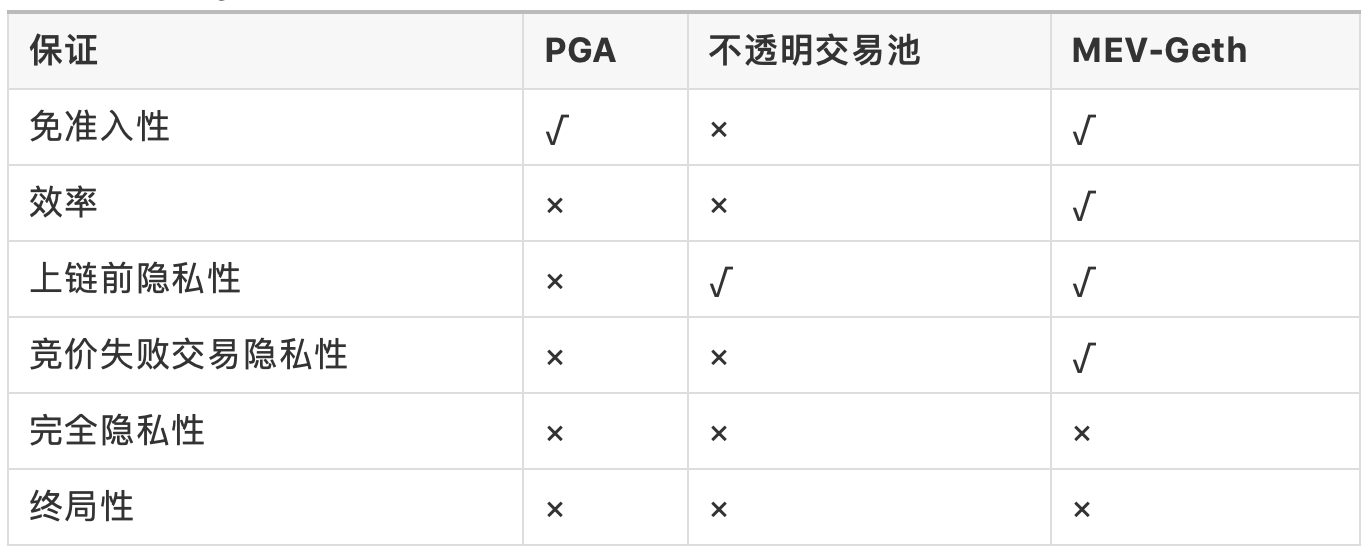
It is not easy to understand the MEV activities on the chain through MEV-Inspect. It requires a best effort to analyze the behavior of a wide variety of bots and develop heuristics to classify bots' use of smart contracts. These classifications may never be perfect, but our goal is to provide useful assessments and track the evolution of metric values. The modular architecture of MEV-Inspect is designed precisely to allow community participation, with which we can continuously improve the coverage and accuracy of the tool. See the Github repository for MEV-Inspect.
Design goals
Why develop MEV-Geth? We believe that if a neutral, open, and open-source infrastructure is not used to achieve access-free MEV extraction, MEV may become an insider's house. As an organization, we are committed to providing a reference implementation of a fair, ethical, and politically neutral MEV extraction method. We also hope that by doing this, we can prevent Ethereum from being eroded by trust-based dark pools or dedicated channels, which are weak points in security. We launched MEV-Geth with a dual goal. On the one hand, we hope to create an ecosystem for the extraction of MEV that can protect the characteristics of Ethereum. On the other hand, the system can start a dialogue with the community around our research and development roadmap. Design goals Access-free: no intermediary capable of vetting transactions Efficient: The extraction process of MEV will not cause unnecessary network congestion and chain congestion Privacy before going to the chain: that is, the transaction will only become known to everyone when it is packaged into the block. Note that this privacy does not preclude prior informed actors such as transaction aggregators/gateways/miners.
Finality: Once the transaction is packaged on the chain, the extraction of MEV is irreversible. Used to prevent time-bandit chain reorganization attacks.
How does MEV-Geth work?
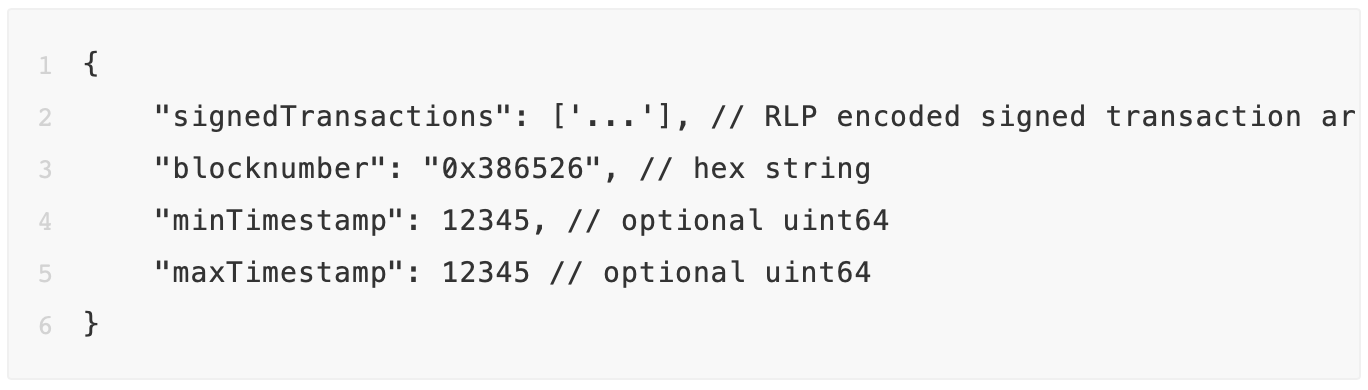
minTimestamp and maxTimestamp are two optional conditions, which are used to further limit the valid time range of the transaction package.
Miners can simply run MEV-Geth to mine MEV blocks, or implement their own spec-compliant fork.
MEV-Geth is maintained by the Flashbots core developer team and the source code can be found here.
Flashbots: Our Organization Flashbots originated from the MEV Pi-rate Ship, an interdisciplinary research group that is neutral and unbiased towards the chain, supporting theoretical and empirical research related to MEV.
Our research work will be maintained for a long time. We will use research to define and update our roadmap, defining stages of organizational development and associated milestones;
Our research requires open, transparent, and iterative collective creation, drawing inspiration from academic and applied research, and using the Ethereum Upgrade Proposal (EIP) process as a template. Research can be supported financially by the MEV Investigator Program. public commitment As an open research organization, we pledge that, henceforth, we will: Use our creation to protect the core values of Ethereum: openness, non-accessibility, decentralization, and meet the crisis caused by MEV;
Open source our research and the code for Flashbots core infrastructure so that all in the community can participate and benefit from it;
Research objectives Our big goal—to resolve the MEV crisis—can be broken down into three parts: demystification, democratization, and distribution. For each section, we list the questions we try to answer: Uncover the Dark Forest
How to quantify the harm to users due to the MEV extraction method and provide developers with tools to reduce the impact of the application? How can more transparency be introduced into the MEV space so that the community can develop social norms for MEV extraction? How can market mechanisms that lead to concentration of power be avoided?
How can the MEV extraction process be efficient and free of entry barriers? How can MEV opportunities be made equally accessible to all? profit distribution
How can a sustainable incentive compatibility model be established among miners, traders, DeFi developers, etc.?
We split the research roadmap into different phases, allowing subsequent research to build on previous successes and conclusions. Phase I consists of two studies: Paper 1: Flashbots Architecture Summary: Describe the architecture and design tradeoffs of the infrastructure we are developing
Will these mechanisms perform differently in PoW/PoS/leaderless algorithms and rollup contracts with transaction ordering auctions? Paper 2: The Ethics of Flashbots Abstract: Discusses the ethical issues associated with MEVs and the infrastructure we develop Should we develop a "good" auction mechanism for communicating transaction ordering preferences? How to minimize the damage to consensus and users caused by bribery incentives for competing for priority?
What level of transparency should be allowed in MEV extraction?
How is MEV characterized in jurisprudence? What kind of industry self-regulation should be formed?
Call for Feedback and Contributions
Contribute to MEV-Research
- We welcome you to check out our MEV-Research Github repository to learn about the MEV Fellowship program. Start contributing by opening an issue and/or writing a Flashbots Research Proposal (FRP), or join our discussion on the MEV-Research discord channel.