


The cheapest hedge against an AI bubble may point to Tokyo: Goldman Sachs suggests watching short USD/JPY


- Core View: Goldman Sachs believes that if a cooling AI investment cycle weakens U.S. growth expectations and rate advantages, the repatriation of Japanese capital could drive the yen stronger, making short USD/JPY a potentially effective way to hedge AI bubble risk.
- Key Elements:
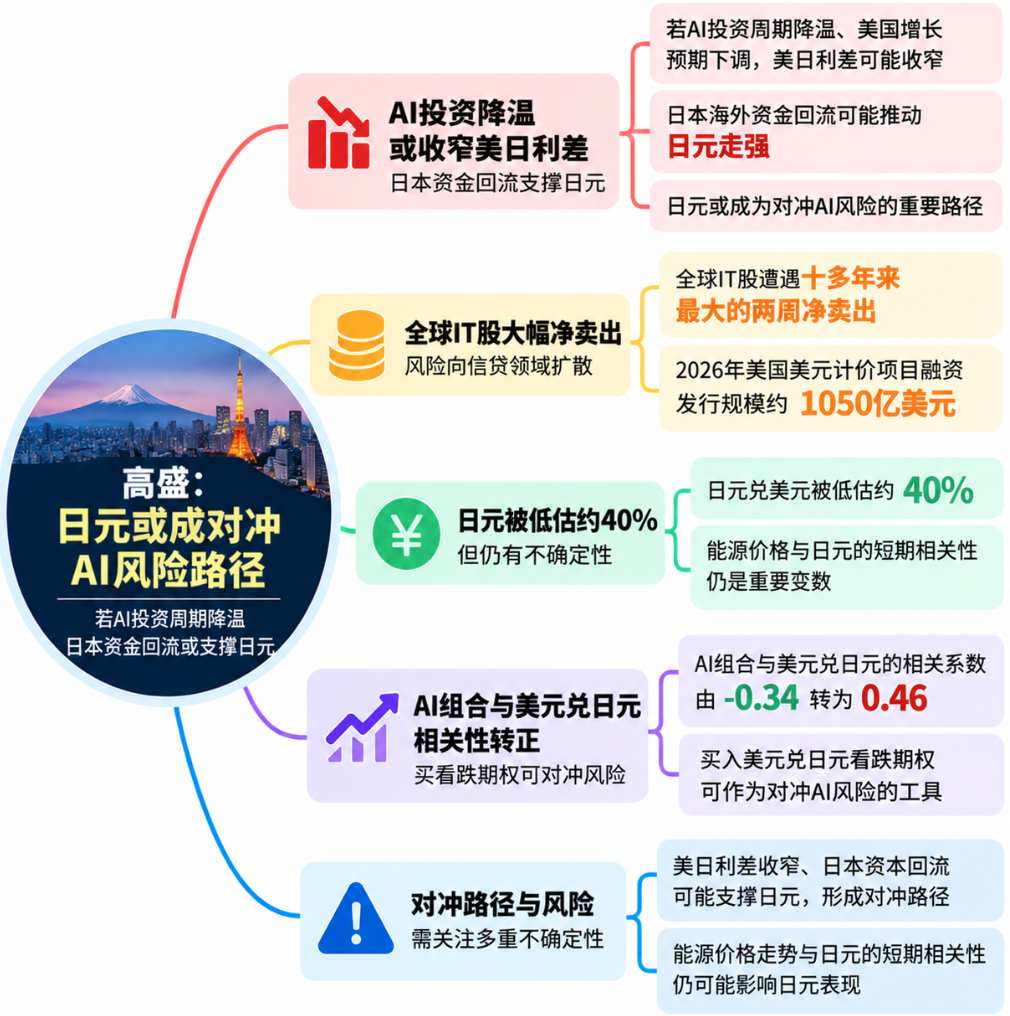
- Global information technology stocks saw net selling over the past two weeks reach the largest scale in more than a decade, with hedge fund short leverage near the 99th percentile of the five-year distribution.
- U.S. dollar-denominated project finance issuance in 2026 is about $105 billion, mainly for data centers and computing infrastructure, roughly four times the historical peak before the AI boom.
- Goldman Sachs' valuation model GSDEER shows the yen is undervalued by about 40% against the dollar, making it the most undervalued currency.
- The correlation coefficient between the AI leaders basket and USD/JPY shifted from -0.34 to +0.46, while its correlation with the S&P 500 rose from 0.73 to 0.91.
- The two-year at-the-money implied volatility for USD/JPY is about 9.9, significantly below the 20-year average of 13.8 and close to the historical low of 8.4, making put option hedging relatively cheap.
- The Bank of Japan is gradually tightening monetary policy, combined with a possible narrowing of the U.S.-Japan rate differential, providing policy and rate support for a stronger yen.
Original source: Jin10 Data
If AI bubble shows signs of bursting, the hedge worth watching may not only be in the Nasdaq options market, but could also be hidden in the yen exchange rate.
For decades, Japan's accumulated savings have continued to flow overseas, especially into U.S. bonds and equities, providing an important source of funding for the prosperity of U.S. asset markets. But if investors begin to lower their expectations for U.S. economic growth, this massive capital flow could change direction, and the pressure for Japanese capital to repatriate could rise accordingly.
Jonathon Chryssafis of Goldman Sachs' Fixed Income, Currency and Commodities (FICC) division is examining the links between the AI investment cycle, U.S. interest rates, and Japanese capital flows. The resulting cross-asset trade logic points in one direction: the yen may strengthen.
For FX traders, this offers an approach different from directly shorting tech stocks. As the cost of hedging tech stocks changes, shorting USD/JPY could become an option worth studying. The logic rests not only on the yen being undervalued, but also on the possibility that some of the forces that previously supported the dollar may weaken as the U.S. growth outlook changes.
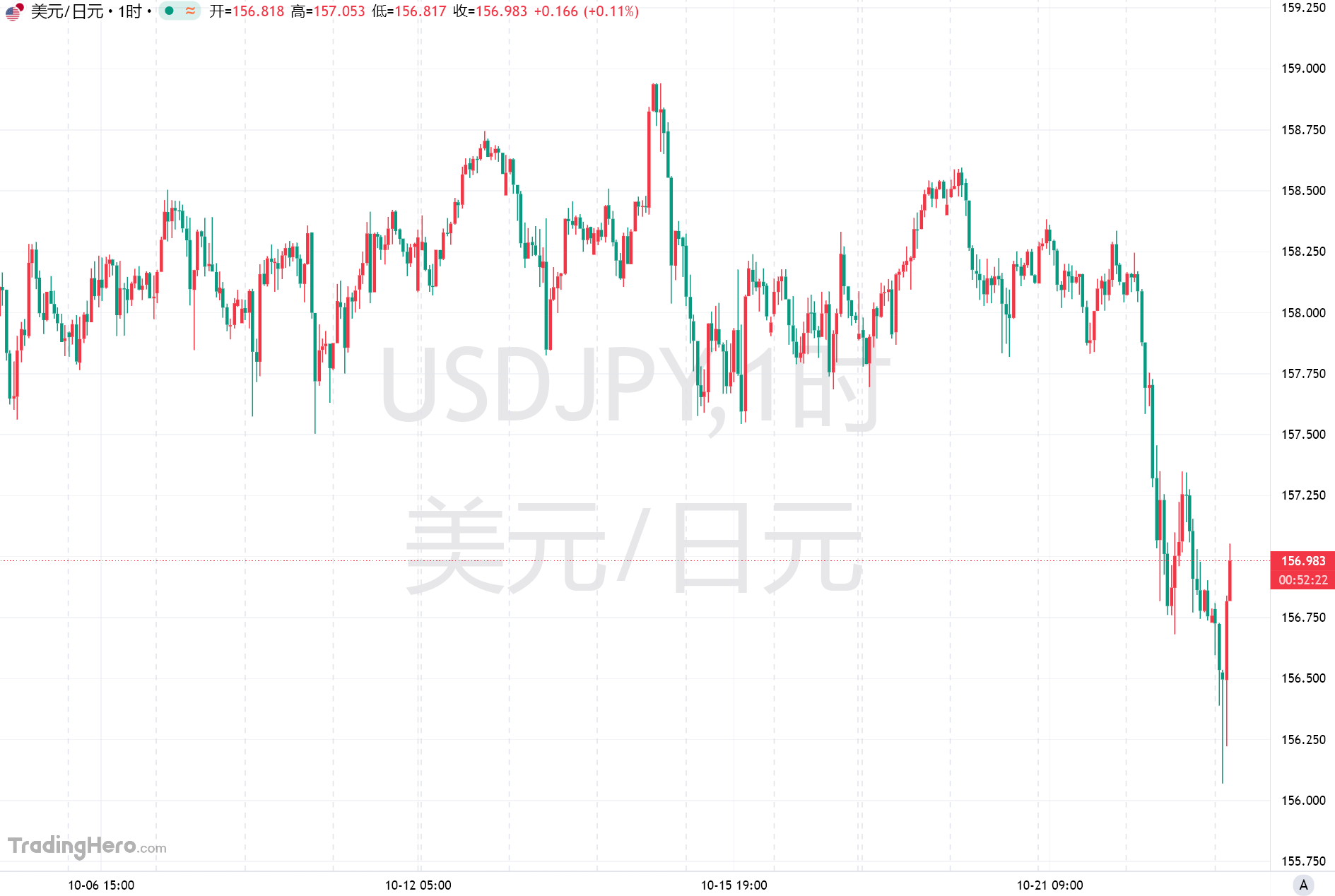
As of the time of publication, the yen's rally had extended to its strongest level in more than a month, as a tech stock selloff intensified and prompted investors to turn to traditional safe-haven assets including the Japanese currency, Japanese government bonds, and U.S. Treasuries.
AI Financing Pressure Mounts as Risk Spreads from Equities to Credit Markets
The environment facing AI-related assets is changing. According to a Goldman Sachs report, based on observations from its prime brokerage business, global information technology stocks recently saw their largest two-week net selling in more than a decade, with the move reaching 3.3 standard deviations. Meanwhile, hedge fund short leverage levels have approached the 99th percentile of the historical distribution over the past five years.
Beyond pressure in the equity market, the AI financing chain is also coming under greater scrutiny.
Goldman Sachs credit strategists have become increasingly cautious on investment-grade technology corporate debt and warned that in the high-yield bond market, clear divergence may emerge among different AI infrastructure financing entities.
The scale of financing reflects the size of this investment boom. Goldman Sachs data shows that as of October 13, 2026, U.S. dollar-denominated project finance issuance in the United States had reached approximately $105 billion in 2026, the vast majority of which was used for data centers and computing infrastructure. That is about four times the previous record high issuance level before the AI boom.
The problem is that contracted demand for computing power does not necessarily mean the companies involved have the financial strength to deliver that computing power.
As financing costs and energy expenses rise, investors are becoming more selective. Financing projects that rely on a small number of customers, or that make optimistic assumptions about future equipment utilization, are facing stricter scrutiny in particular.
Geopolitical risk adds further complexity. Even if the situation in the Middle East escalates again and potentially pushes oil prices higher, the U.S. Treasury market is still attracting buyers.
Goldman Sachs' commodities team believes that in a scenario of severe supply disruption in the Gulf region, Brent crude prices could exceed $140 per barrel. This means the inflation threat has not disappeared.
But Chryssafis noted that U.S. Treasuries continue to receive inflows. This may indicate that, compared with the latest geopolitical news, investors are more focused on the longer-term growth implications of a reassessment of the AI spending outlook.
This distinction is crucial. If AI investment growth slows, future corporate borrowing demand may decline, and competition among companies for capital may ease, ultimately lowering the yield advantage that had previously supported the dollar.
The impact of this adjustment could then transmit further to the yen.
The Yen's Appeal Goes Beyond Being Undervalued
For a long time, Japanese investors have allocated large amounts of savings to overseas assets, especially U.S. bonds and equities. These capital flows have not only provided a massive source of funding for U.S. financial markets, but have also supported the dollar to some extent.
Goldman Sachs' analysis argues that if the AI investment outlook deteriorates materially, the assumptions supporting continued capital flows into the United States could also be shaken.
If U.S. economic growth expectations weaken and the U.S.-Japan rate differential narrows accordingly, the appeal for Japanese investors to continue holding large overseas asset exposures may decline. At that point, the likelihood of capital returning to Japan may increase, providing support for the yen.
From a valuation perspective, there is also clear potential for the yen to recover.
Goldman Sachs' Global Economics-Driven Exchange Rate Valuation model (GSDEER) estimates that the yen is undervalued by about 40% against the dollar. According to the model's valuation range, the yen is the most undervalued currency, especially cheap relative to the dollar.
However, being cheap does not mean the exchange rate is about to reverse. In recent years, the yen has repeatedly demonstrated that even when an asset looks very cheap, prices can still move lower as long as rate differentials, carry trade demand, and capital outflows continue to work against it.
Therefore, the point of this trade is not simply to bet on the yen being undervalued, but to focus on whether the forces driving USD/JPY higher may reverse.
Japan's policy environment also provides some support for this logic. Japanese authorities continue to express interest in a stronger yen; Sanae Takaichi encourages increased domestic investment; and the Bank of Japan remains on a path of gradual monetary policy tightening.
At the same time, if AI-related risks prompt the market to lower expectations for U.S. economic growth, U.S. Treasury yields could come under downward pressure, and the U.S.-Japan rate differential could narrow as a result. The yield advantage that had previously encouraged investors to buy dollars and sell yen could then diminish.
This forms the key transmission mechanism highlighted by Goldman Sachs: cooling AI investment affects U.S. growth and financing demand, which in turn changes rate expectations and cross-border capital allocation, ultimately transmitting to the USD/JPY exchange rate.
Options market pricing is also worth noting. Goldman Sachs pointed out that the two-year at-the-money implied volatility for USD/JPY is currently about 9.9, significantly below the 20-year average of 13.8 and relatively close to the historical low of 8.4.
Lower implied volatility means the market is pricing relatively modest future exchange rate fluctuations. On this basis, Goldman Sachs considers buying USD/JPY put options an attractive hedge.
Put options allow investors to profit when USD/JPY falls while limiting the usual maximum loss to the premium paid. For traders who want to express a direct directional view, shorting USD/JPY is also an option, but the risk structures of the two are not the same: directly shorting spot FX also involves financing costs and may produce larger losses if the exchange rate moves in the opposite direction.
The Link Between AI Stocks and the Yen Is Strengthening
Recent cross-asset correlation data has also changed, suggesting that the connection between the AI trade and the FX market may be strengthening.
Since October 14, the sensitivity of Goldman Sachs' AI leaders basket to the broader equity market, U.S. Treasury yields, and the USD/JPY exchange rate has risen markedly.
The basket's correlation with the S&P 500 has risen from 0.73 to 0.91; its correlation with changes in 10-year U.S. Treasury yields has shifted from negative 0.13 to positive 0.19.
More notably, the correlation between the AI basket and the USD/JPY exchange rate has shifted from negative 0.34 to positive 0.46.
These changes indicate that the linkage between AI-related stocks and the exchange rate is shifting. If this relationship persists, AI stocks weakening, U.S. Treasury yields falling, and the yen strengthening against the dollar could occur simultaneously, creating a market environment favorable for shorting USD/JPY.
However, these changes are still at an early stage, and short-term correlations may reverse quickly and should not be directly treated as a stable trading rule.
The energy market is a major variable. If energy supply is disrupted again, inflation expectations and U.S. Treasury yields could still rise even if stocks fall, making the above transmission mechanism more complicated.
Japan's dependence on imported energy is also a factor investors cannot ignore. Therefore, not every global risk-off episode should be seen as a signal that the yen will necessarily appreciate. A surge in oil prices could both reinforce market concerns about economic growth and push up inflation pressure, thereby affecting rate and exchange rate trends.
For investors seeking to hedge AI-related risk, the yen offers a trading path different from directly shorting tech stocks. Goldman Sachs' proposed USD/JPY put option idea, as well as directional short strategies, deserve further evaluation in conjunction with rate differentials, capital flows, and volatility pricing.
When Wall Street focuses on the next stage of the AI trade, the answer may not only be written in Silicon Valley's tech stock valuations, but also in Tokyo's capital flows.





