Why Are You Getting Counter-Rekt by Papertrade?


- Core Viewpoint: By linking traders' actual losses to PAPER token issuance, Papertrade converts trading losses into rights to future cash flow distribution from the protocol. In the short term, this has generated astonishing protocol revenue, but the model relies on incentive-driven trading, and its long-term sustainability is questionable.
- Key Elements:
- Protocol revenue over the past 7 days reached $42.24 million, ranking third across the industry, behind only Tether and Circle, and surpassing Pump.fun and Hyperliquid.
- It adopts a pooled-fund trading mechanism and an asymmetric profit-and-loss design, where gains are deducted while losses are borne in full, and even wash trading between longs and shorts still produces net losses.
- PAPER uses a fair launch: every $1 of loss initially mints 100 tokens, and issuance efficiency decays along a curve as the protocol grows, creating an obvious first-mover advantage.
- A case shows that one trader generated $2.84 billion in notional trading volume, lost $1.71 million, received 136 million PAPER and $1.07 million in staking rewards, for a net loss of about $637,000.
- About 86% of the revenue structure comes from excess returns distributed from LP pools to stakers rather than traditional fees, a significantly different nature from traditional Perp DEXs.
- In the first 8 hours after launch, stakers received about $23.9 million, while in the following 37 hours they received only about $2.4 million, with returns highly concentrated in the early window.
- Under 1000x leverage, about 75.3% of addresses have experienced liquidation, and the project team has raised the LP dividend threshold from $5 million to $10 million to strengthen risk control.
On-chain derivatives trading platform Papertrade is one of the hottest projects recently.
According to DefiLlama data, Papertrade's protocol revenue over the past 7 days reached $42.24 million, ranking third on the industry-wide protocol revenue leaderboard, behind only Tether and Circle. This result even surpassed Pump.fun's $16.06 million and Hyperliquid's $14.56 million.
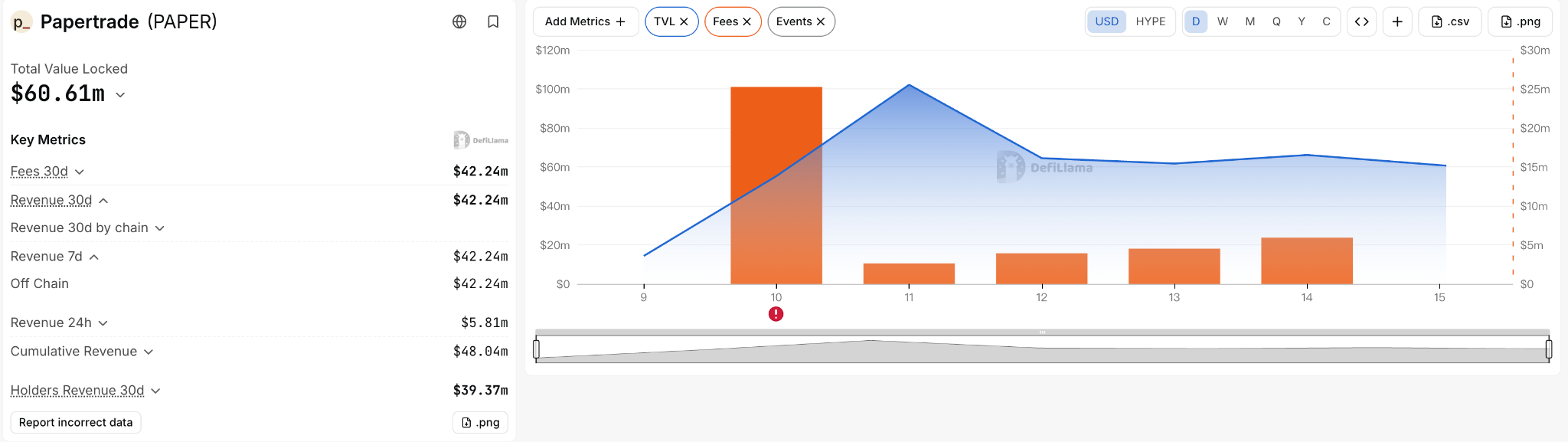
https://defillama.com/protocol/papertrade
A trading platform that launched not long ago, relying on a highly aggressive incentive model, managed to surpass in just a few days the revenue of many leading protocols that have been operating maturely for years.
But behind Papertrade's explosive growth lies the very real, trade-by-trade losses incurred by traders.
On October 13, according to Lookonchain monitoring, a trader generated a nominal trading volume of as much as $2.84 billion on Papertrade, with trading losses reaching approximately $1.71 million. Although he received about $1.07 million in USDC staking rewards and 136 million PAPER tokens, after deducting staking rewards, his net cash loss still amounted to approximately $637,000.
These two seemingly contradictory phenomena stem from Papertrade's highly aggressive and unusual economic model, which directly ties traders' actual losses to PAPER token issuance, and then, through a staking dividend mechanism, allows token holders to share in the revenue generated by the protocol. In other words, participants can exchange real trading losses for the right to future revenue distribution from the protocol.
So why are people willing to voluntarily take on trading losses to obtain PAPER? Why can some early whales earn substantial returns while latecomers may lose more the more they farm? How exactly is Papertrade's astonishing protocol revenue generated, and can this model be sustained over the long term?
This article will start with Papertrade's trading mechanism, token economic model, and the distribution of interests among participants, attempting to break down this unusual economic model and analyze the operational logic and economic game behind it.
Papertrade's economic model turns trading losses into future revenue rights
Papertrade is a synthetic perpetual contract trading platform built on Hyperliquid's HyperEVM ecosystem, and it officially opened for trading on October 10, 2026. Initially, it mainly supports BTC and ETH, offering leverage of up to 1000x.
From a product perspective, it is actually not much different from Perp DEXs such as Hyperliquid and Aster. Users can likewise go long or short and profit by judging the direction of asset prices.
But in terms of underlying operating mechanism, Papertrade adopts a completely different design.
The core of a traditional order book exchange is matching buy and sell orders.
For example, if you open a long position on BTC, the exchange needs to find a counterparty willing to take the corresponding short exposure.
Papertrade, however, does not rely on its own order book for matching. It uses a liquidity pool trading mechanism similar to GMX's early model.
The user's counterparty is the protocol's own liquidity pool, and all profits and losses generated by trades must be settled against this pool.
For example, if you open a BTC long position worth $100,000 on Papertrade: if BTC rises, your position generates a profit, and the protocol liquidity pool needs to pay you the corresponding profit; conversely, if BTC falls, your position incurs a loss, and the funds flow into the protocol liquidity pool.
Papertrade itself directly reads the midpoint of the best bid and ask quotes in Hyperliquid's order book as the trading reference price, so it actually does not need to execute a corresponding perpetual contract trade on Hyperliquid.
This enables it to offer a trading experience with zero order book slippage and no traditional funding rates.
However, Papertrade is not entirely without trading costs.
It introduces a special asymmetric profit and loss mechanism, which they call Asymmetric PnL. That is, when traders are profitable, they must bear a certain percentage deduction from profits, while when they incur losses, they do not receive an equivalent reduction.
For example, if a trade originally generates $100 in profit, after asymmetric PnL adjustment and related settlement fees, the trader may actually receive noticeably less than $100 in profit.
But if the trade loses $100, the trader still has to bear the corresponding loss. Of course, the specific deduction ratio is determined by the magnitude of price movement, the trading asset, and protocol parameters.
In other words, even if the profits and losses of longs and shorts in terms of price direction can offset each other, traders as a whole may still incur net attrition due to profit deductions, and this attrition also constitutes an important source of income for the protocol liquidity pool.
PAPER issuance mechanism: trading losses can also earn tokens
PAPER is Papertrade's native token, and it adopts a so-called fair launch model, meaning the initial supply is zero, with no team pre-mine, no VC allocation, and no traditional airdrop share.
The main way to obtain PAPER tokens is for users to trade on the platform and generate actual losses that meet the minting conditions.
According to the project's publicly disclosed issuance rules, when the LP scale tracked by the protocol is below $2 million, every $1 of qualifying losses can mint 100 PAPER.
This means that in the initial stage, if you lose $100 in trading, you can theoretically obtain about 10,000 PAPER. If you lose $1,000, you can obtain about 100,000 PAPER.
The issuance efficiency of PAPER tokens is not always fixed; it uses a dynamic decay curve.
When the LP scale exceeds $2 million, as the protocol's cumulative revenue grows, the number of PAPER that can be minted per dollar of qualifying losses will gradually decrease.
Its issuance curve can be simplified as:
Minting quantity per dollar of loss = 100 × [120 million / (120 million + H)]²
Here, H is the cumulative growth indicator recorded by the protocol's issuance curve, not the current LP balance. For example, when H reaches $120 million, the PAPER obtained per dollar of loss will drop to 25, equivalent to only one quarter of the initial issuance efficiency.
This mechanism actually creates a very obvious first-mover advantage.
For the same $10,000 trading loss, early participants and later participants may end up with a several-fold difference in the amount of PAPER received.
So the question is: since PAPER can only be obtained through losses, why are so many people still willing to participate?
The answer lies in PAPER's revenue distribution mechanism.
Papertrade adopts a special bootstrapped liquidity model.
Unlike traditional DeFi protocols that build liquidity through external LP deposits, Papertrade's protocol trading liquidity pool starts from zero and gradually accumulates funds mainly through traders' actual losses.
If traders are profitable and the liquidity pool temporarily does not have enough funds to pay profits, the protocol also sets up a queued payment mechanism, settling after subsequent funds flow in.
Meanwhile, the PAPER that traders obtain through losses can be staked into the protocol to share future USDC revenue.
Currently, staking revenue mainly comes from two parts.
The first is trading settlement fees. The protocol charges a 2% fee on qualifying realized profits and losses as well as liquidation losses, half of which is distributed to PAPER stakers and the other half to the development fee recipient.
The second is excess returns from the LP liquidity pool. When the LP funds tracked by the protocol exceed the $5 million dividend threshold, qualifying excess funds can be further distributed to PAPER stakers.
Therefore, PAPER actually has the function of sharing the protocol's future cash flows.
We can summarize this set of economic relationships as follows:
Traders generate actual losses → the protocol LP receives funds → loss-making traders receive PAPER → PAPER holders stake tokens → share the distributable revenue generated by the protocol in the future.
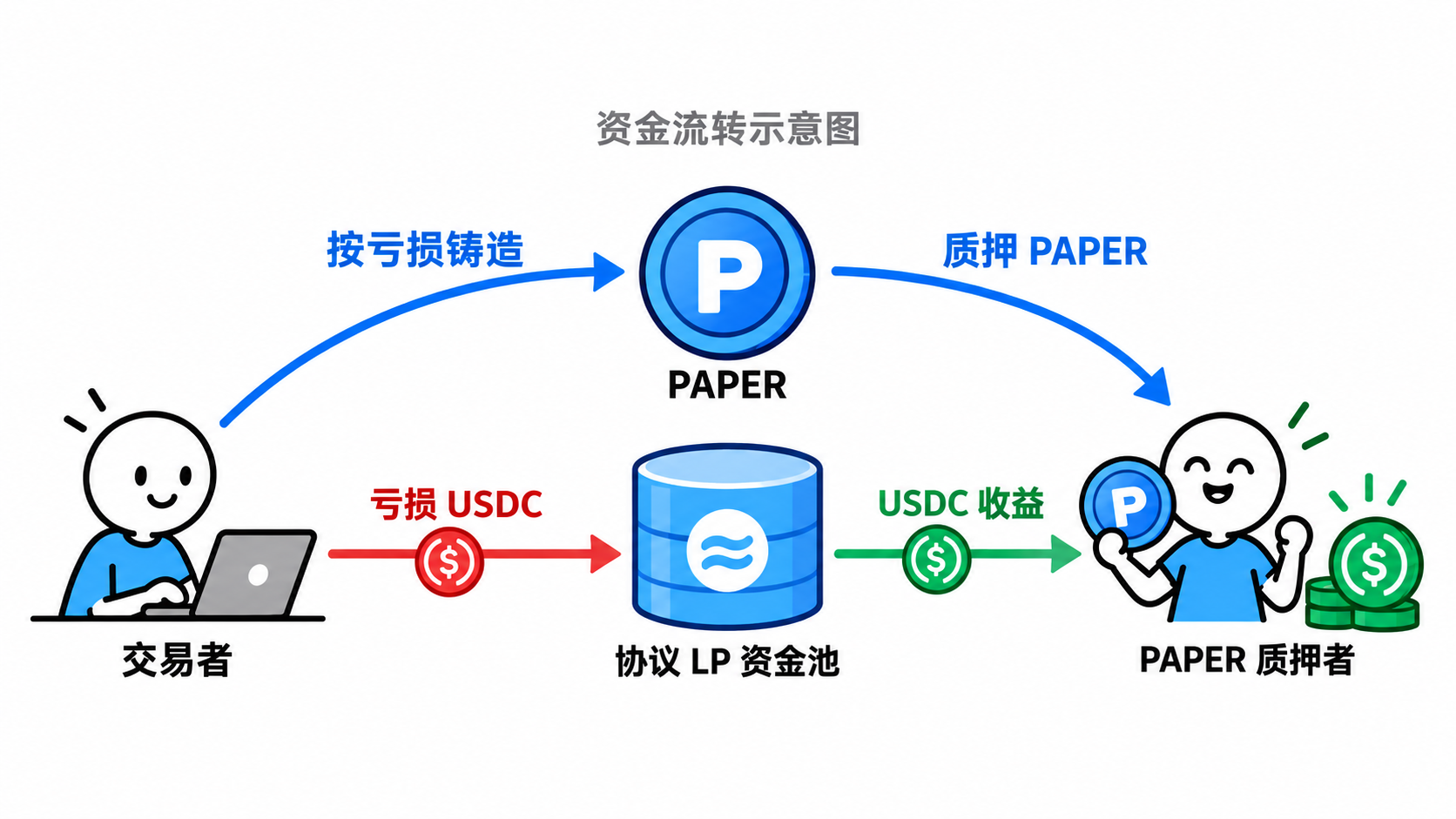
From the perspective of the economic model, Papertrade actually converts part of the real losses borne by traders into a cost for obtaining the right to share in the protocol's future cash flow distribution.
Farming volume on Papertrade may lead to ever-greater losses
In traditional Perp DEX trading incentive campaigns, long-short hedging is a relatively common way to farm volume. For example, we can separately establish equal-sized BTC long and short positions, use the profits and losses of the two positions to offset each other, minimize directional risk as much as possible, and then obtain points or token rewards through continuous trading.
But on Papertrade, this method does not seem able to achieve lossless volume farming.
As mentioned earlier, Papertrade adopts an asymmetric PnL mechanism, where the profitable side must bear a deduction from profits, while the losing side must bear the full trading loss.
We can understand this through a simple example.
Suppose a trader simultaneously opens two BTC positions, one long and one short, each with a nominal value of $100,000, using low enough leverage to avoid liquidation in this example.
When the BTC price rises by 0.1%:
- The long position theoretically profits $100.
- The short position theoretically loses $100.
Ignoring trading fees, under ideal conditions, the profits and losses of the two positions exactly offset each other, and the trader neither makes nor loses money.
But on Papertrade, the situation is different.
According to the BTC asymmetric PnL parameters announced at the project's launch, after accounting for the 0.2 basis point adjustment on the profit side, the profit discount, and the 2% profit settlement fee, the long position that originally profited $100 can actually receive only about $72.4.
Meanwhile, the losing short position still has to bear the full $100 loss.
Ultimately, the two positions together lose about $27.6.
In other words, without considering other execution costs, even after fully offsetting BTC's price direction risk, the trader still has to bear an actual attrition of about $27.6.

On the other hand, Papertrade's profit deduction ratio is actually not fixed, but related to the magnitude of price movement.
When the price changes only slightly, the profit deduction ratio tends to be higher; as the profit magnitude expands, the deduction ratio gradually decreases, but it does not disappear completely.
This means that through the asymmetric PnL mechanism, Papertrade effectively sets a cost for long-short wash trading that cannot be simply eliminated through hedging.
Although the loss-making position will also receive corresponding PAPER tokens, this amounts to converting actual attrition into the cost of acquiring PAPER.
1000x leverage further amplifies traders' loss risk
In addition to the asymmetric PnL mechanism, Papertrade also offers leverage of up to 1000x, which partly explains why the platform can rapidly accumulate such enormous nominal trading volume.
Suppose you use $100 in margin with 1000x leverage to open a BTC position worth $100,000.
Theoretically, BTC only needs to move 0.1% in an unfavorable direction to wipe out the entire initial margin.
And according to Papertrade's liquidation mechanism, a 1000x leveraged position may be liquidated under an unfavorable price movement of about 0.05%.
This means that even a very ordinary short-term fluctuation in BTC price is enough to cause high-leverage traders to lose their entire margin.
According to on-chain statistics by TradingBeats during Papertrade's early launch period, among 5,836 addresses that used 1000x leverage, 4,395 addresses experienced at least one liquidation, accounting for 75.3%.
During the same period, 1000x leveraged positions were liquidated a total of 12,657 times, involving approximately $20.08 million in isolated margin losses.
Although these data cannot directly prove that all participants ultimately lost money, I think they are already enough to reflect the risks faced by high-leverage traders.
And for participants whose purpose is to farm PAPER, there is also a contradiction here.
Increasing leverage can use less margin to create enormous nominal trading volume, but it cannot reduce the actual attrition caused by asymmetric PnL; instead, it may make positions more vulnerable to liquidation.
In addition, although Papertrade has no traditional order book slippage or funding rates, on-chain trading still involves gas costs, transaction confirmation delays, and the risk that long and short positions cannot be executed in perfect sync.
Therefore, with high leverage, high-frequency trading, and the asymmetric PnL mechanism stacked together, strategies that rely purely on mechanical volume farming to obtain PAPER can easily continue to generate real losses.
The actual cost of acquiring PAPER is the key to profitability
Farming volume on Papertrade itself has a cost. The reason some whales are still willing to spend hundreds of thousands or even millions of dollars to obtain PAPER is that they are not entirely pursuing profits from trading itself, but rather calculating the cost of acquiring PAPER and whether future staking revenue can cover these costs.
Here it is necessary to establish a return calculation method different from traditional trading.
Comprehensive return from participating in Papertrade = realized trading PnL + USDC staking rewards already received + the value at which PAPER can actually be cashed out − other costs.
Let us still take the whale mentioned in the introduction as an example.
According to Lookonchain's monitoring data on October 13, this trader generated a cumulative nominal trading volume of $2.84 billion, incurred about $1.71 million in trading losses, and at the same time obtained 136 million PAPER and about $1.07 million in USDC staking rewards.
Of that, about $943,000 in rewards had been claimed, with about $130,000 not yet claimed.
If both claimed and unclaimed rewards are included, his net loss is about $637,000.
But in fact, there is still a very important potential asset that has not been included, namely the 136 million PAPER he holds.
If PAPER can be freely traded in the future, then disregarding market impact, additional fees, and subsequent dividends, as long as these tokens can all be cashed out at an average price of about $0.00468, there is a chance to cover the aforementioned net loss of $637,000.
In other words, he actually used part of the trading losses that had already occurred to exchange for a large amount of PAPER whose final value is still uncertain, along with the corresponding right to future revenue distribution.
For ordinary traders, the most direct goal is to make money by judging the price direction of BTC and ETH; but for some participants whose purpose is to obtain PAPER, trading losses themselves have become a kind of input for acquiring tokens. They actually need to calculate how much actual cost is required for each PAPER obtained, and how much return can be recovered from each token in the future.
However, as PAPER's issuance efficiency continues to change, participants entering the market at different times may need to bear completely different costs to obtain the same number of tokens.
Early whales have more advantages
Papertrade's token issuance mechanism naturally has a certain first-mover advantage.
As mentioned earlier, when the LP scale tracked by the protocol is below $2 million, every $1 of qualifying trading losses can mint 100 PAPER.
But as the protocol's cumulative revenue grows, token issuance efficiency will gradually decline according to the established curve.
We can make a simple comparison.
Suppose two traders enter Papertrade at different stages, each bearing $10,000 in qualifying trading losses.
Early participant A, under the initial minting rate, can obtain 1 million PAPER.
Later participant B, if the H indicator in the issuance curve has already reached $120 million when he enters, can only obtain 25 PAPER per dollar of loss, so with the same $10,000 loss, he can ultimately obtain only 250,000 PAPER.
The two bear exactly the same loss but receive a fourfold difference in the number of tokens.
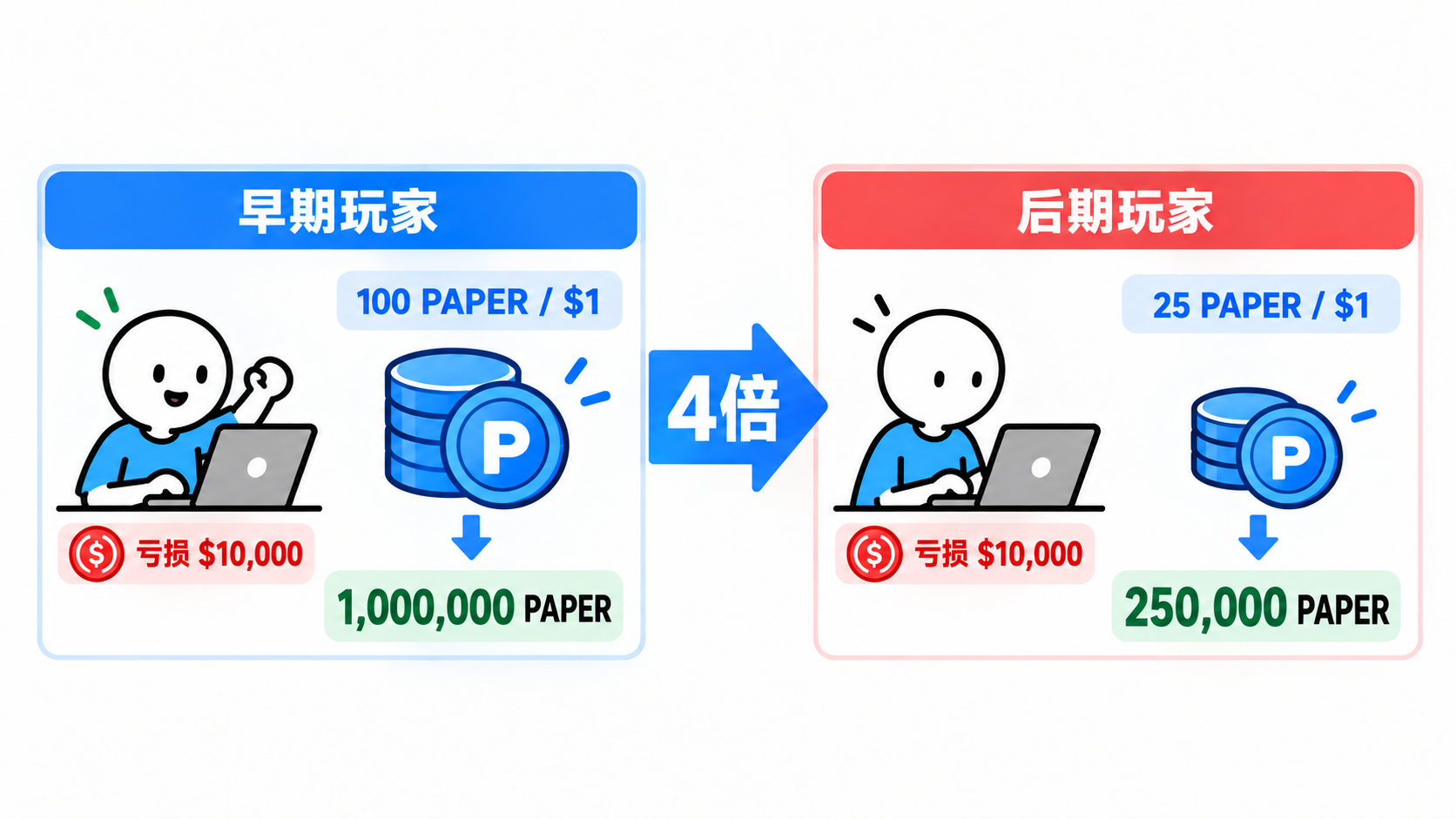
But in the normal issuance decay phase, early participants may indeed be able to obtain large amounts of PAPER at lower cost.
PAPER itself has the function of participating in the protocol's revenue distribution, which means that early participants who obtain large amounts of PAPER through relatively low trading attrition actually obtain in advance a larger share of future revenue distribution rights.
Later entrants who want to obtain the same scale of revenue rights may need to bear higher actual losses.
In addition to acquisition cost, Papertrade also faces another problem, namely the continued issuance of PAPER.
PAPER does not have a fixed hard supply cap in the traditional sense. As long as qualifying trading losses