LD Macro Weekly Report: China’s pessimism is expected to bottom out, who are the long-term beneficiaries of AI?


Risk asset markets stabilized over the past week, but tangles rose, with conflicting moves across asset markets showing a surge in artificial intelligence themes, better-than-expected earnings and speculation that the Federal Reserve will shift to lower interest rates once the economy cools. After a sharp run up, investors now have little reason to be further optimistic. Investor sentiment has taken a significant pullback recently, but thats a positive sign, plus the level of pessimism about Chinas economic outlook appears to have bottomed out in July, with odds rising. NVDAs financial report greatly exceeded expectations, but funds chose to leave the market. As a short-term beneficiary of AI, it has already risen. So which stocks of long-term beneficiary companies should be bought? Goldman Sachs did a quantitative analysis.
US market
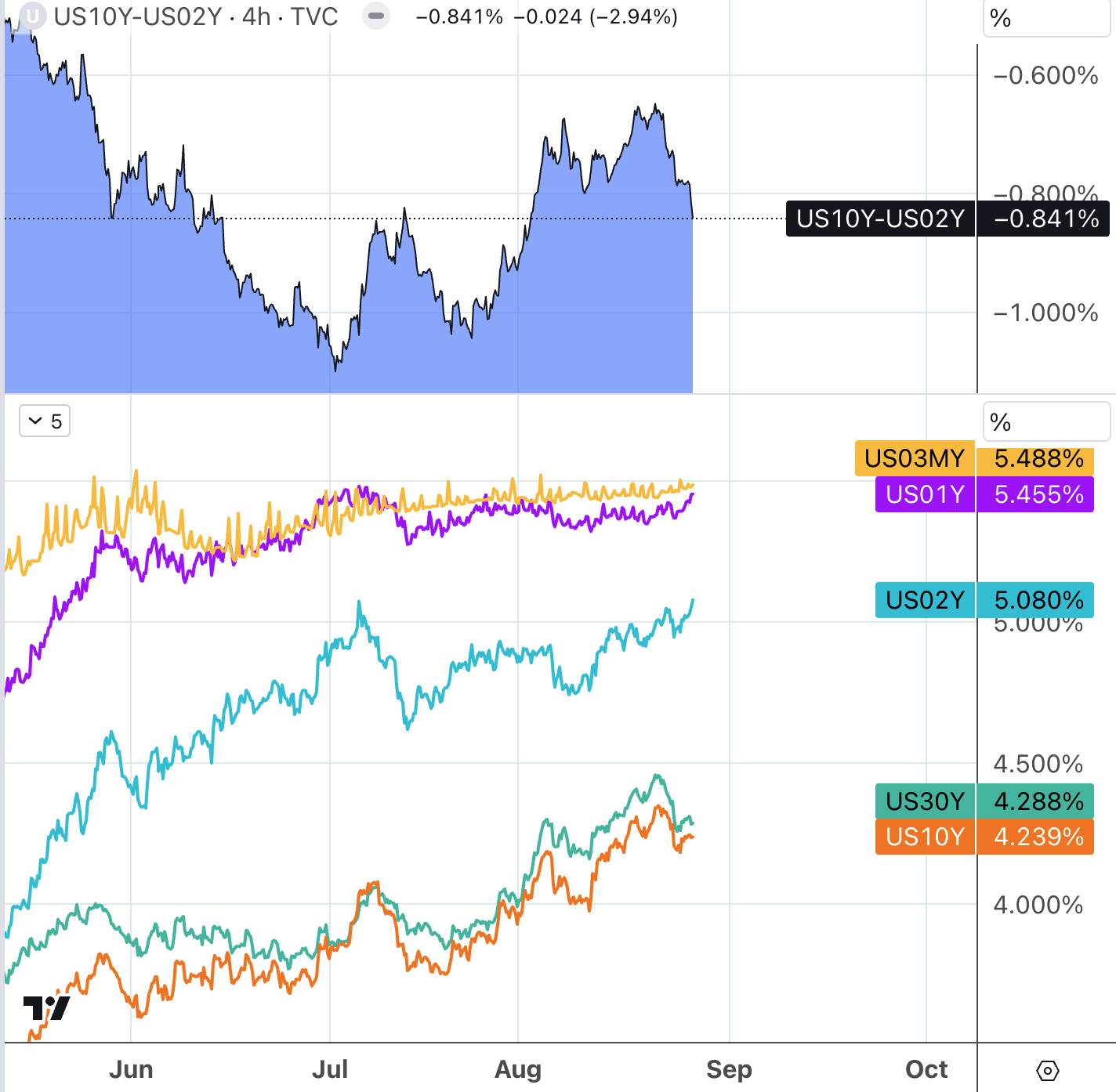
The rise in long-term interest rates in the interest rate market paused last week, while short-term interest rates caught up. Especially after Powells hawkish speech on Friday, the 2-year Treasury yield hit its highest level since March.
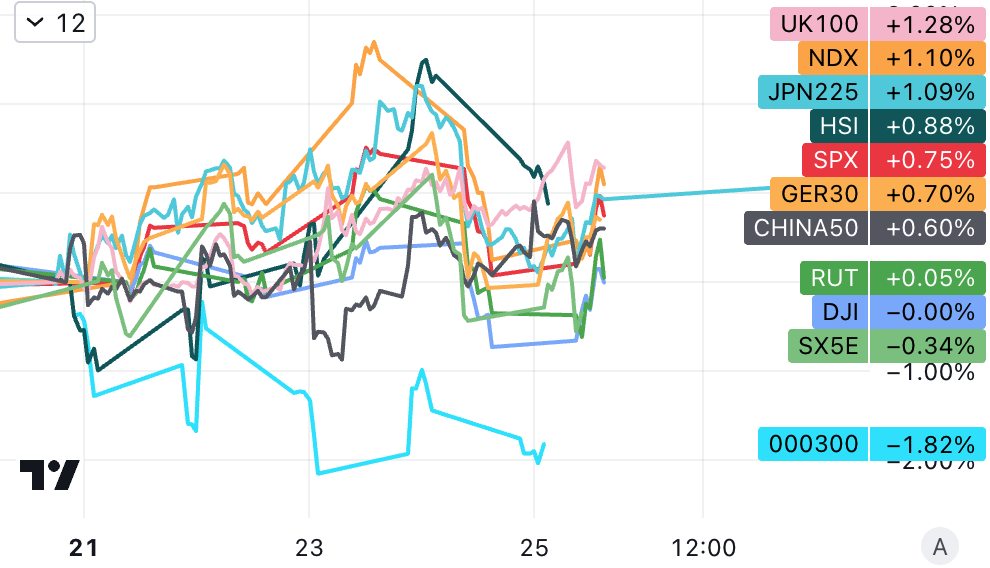
The major U.S. stock indexes closed up last week, with wide fluctuations during Powell’s speech and finally closed up:
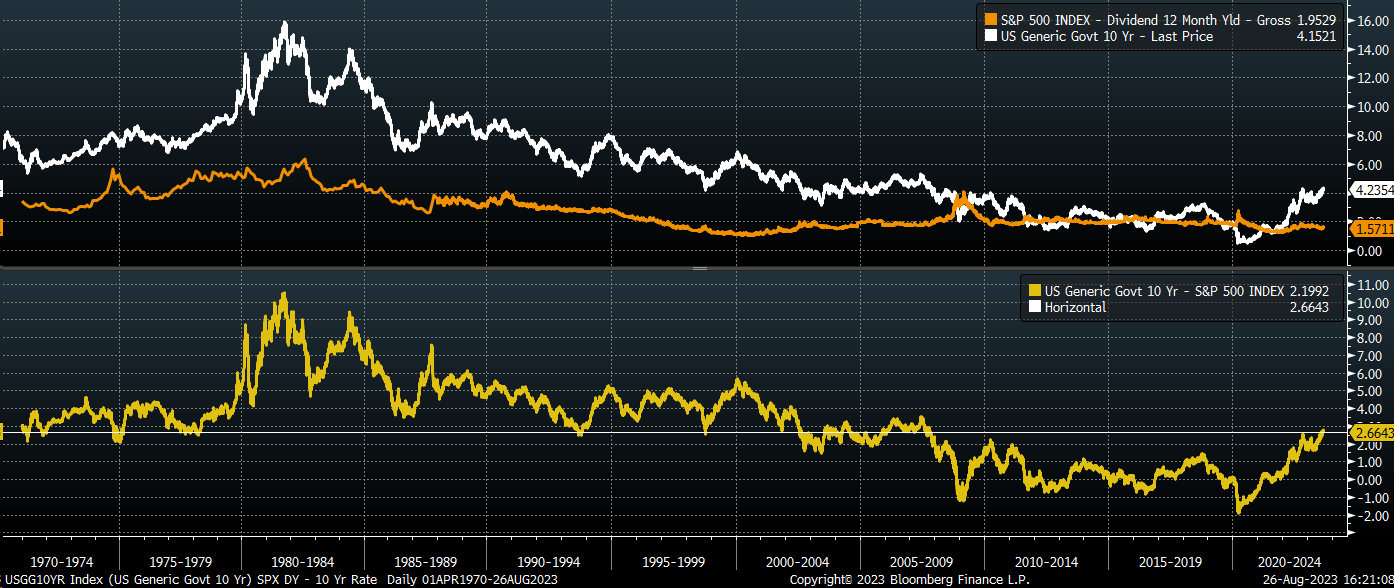
With the yield gap between stocks and bonds reaching multi-decade extremes, money may be growing more cautious, as evidenced by:
The SP 500s current dividend yield is about 1.58%, while the 10-year bond rate is about 4.25%. The gap between the two is 2.66%, the widest since 2007.
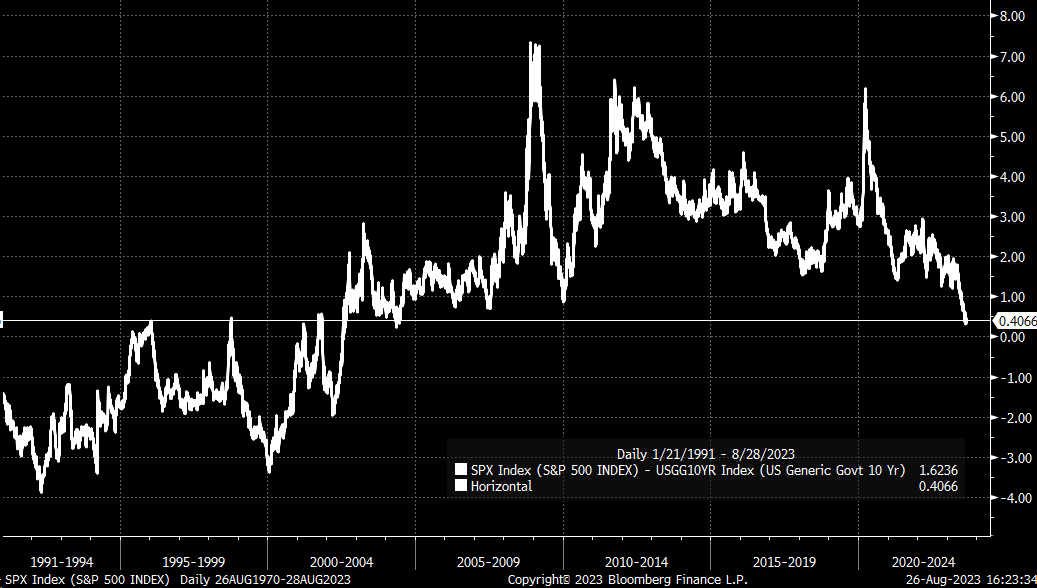
The gap between the SP 500s current earnings yield and the 10-year bond rate is just 40 basis points, the smallest gap since 2004.
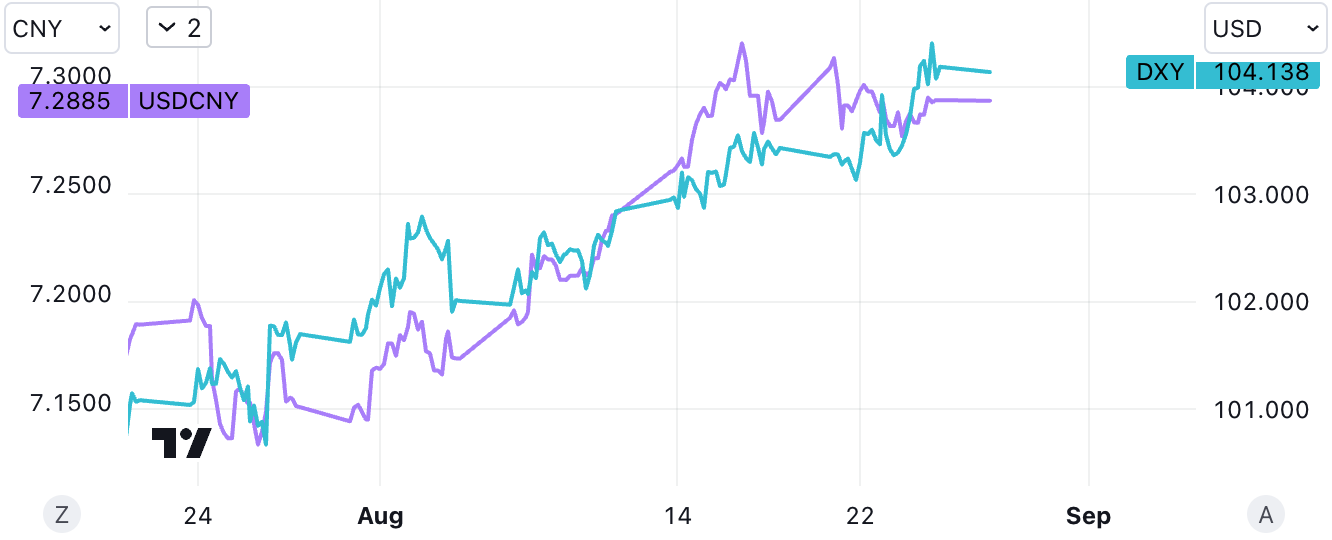
The U.S. dollar index hit an intraday low of 103.75 as Powell spoke. As soon as his speech was over, the dollar index rebounded to 104.45, its highest since June 1; but the yuan stabilized last week, closing at 7.288 on Friday and failing to break below the important 7.3 mark.
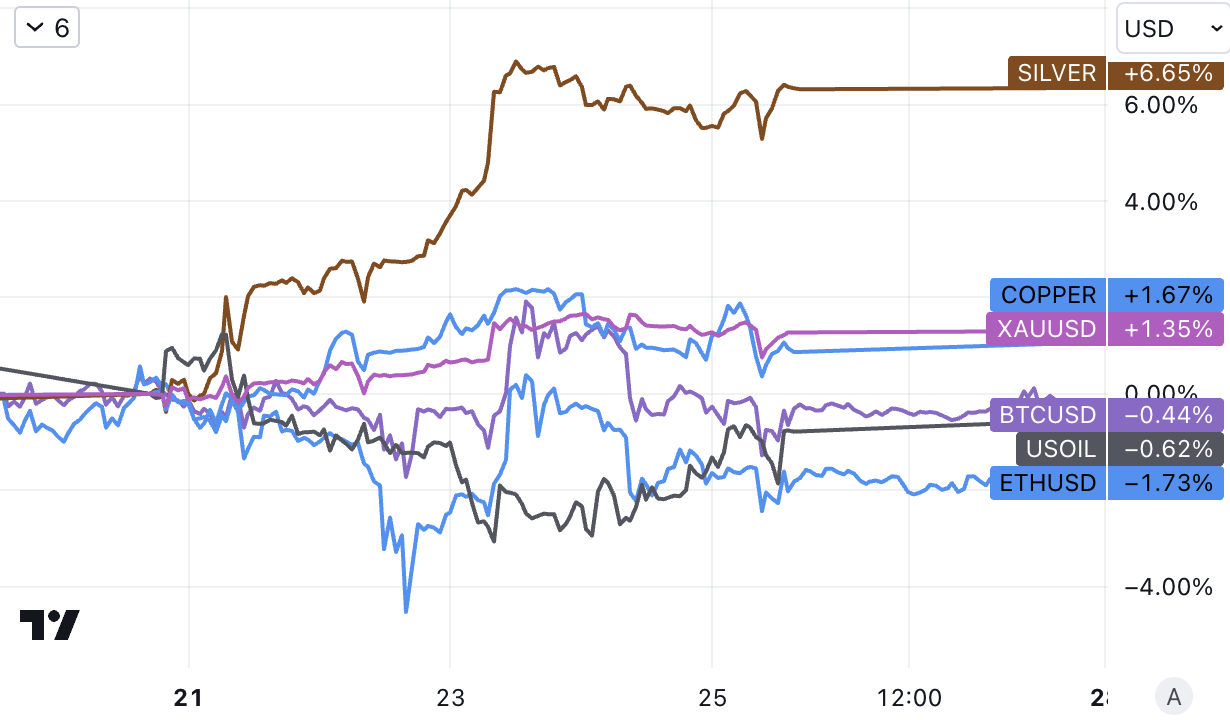
Crude oil closed slightly lower, gold, silver and copper closed higher across the board, and cryptocurrencies fell slightly. Gold had its best week since mid-July, supported by a pullback in long-term U.S. bond yields ahead of Powells speech at Jackson Hole.
Fed Chair Jerome Powells speech at Jackson Hole in 2023 had three main points, but little new information: First, the Fed remains committed to its 2% inflation target, refuting speculation about tolerating or raising it. Second, officials are prepared to raise rates further if necessary and will keep borrowing costs high until inflation is convincingly close to target, meaning rates are likely to stay higher for longer. Finally, the Fed is now in a phase where it is cautious about the risks of overtightening, after having raised interest rates aggressively since 2022, and will be wary of future rate hikes, not necessarily influenced by continued economic resilience. In addition, no clear guidance was given on the neutral interest rate that has been the core concern of the market recently, so this speech has little effect on solving the current market uncertainty.
Investors in the interest rate futures market have 50-50 expectations on whether the Fed will raise interest rates once this year or remain unchanged. On Thursday, the probability of raising interest rates once this year was about 46%. After Powell’s speech on Friday, the bet rose slightly to 53% % , little changed this week but significantly higher than last weeks 32%; by next June, traders see a 62% chance the Fed will cut rates from current levels, down from the 83% they forecast a week earlier.
Combined with the contradictory performance of the stock market rising, short-term bonds plummeting/long-term bonds flattening/junk bonds even rising slightly, and the market performance of gold and digital currencies fluctuating and eventually flattening, it can be seen that the current investors opinions are quite different , long and short are stuck.
In terms of market commentary, Old Bond King Bill Gross said when talking about Powells speech on Friday that he believed that the 10-year U.S. Treasury bond interest rate may rise to 4.5% in the future, and short-term interest rates will remain relatively stable. He felt that Powells The subtext is higher longer. Former U.S. Treasury Secretary Summers believes that Powells speech means that the Fed may need to raise interest rates at least one more time, or even more. Summers believes that Powells comments indicate that the Fed is open to the possibility that the neutral interest rate may be higher than in the past.
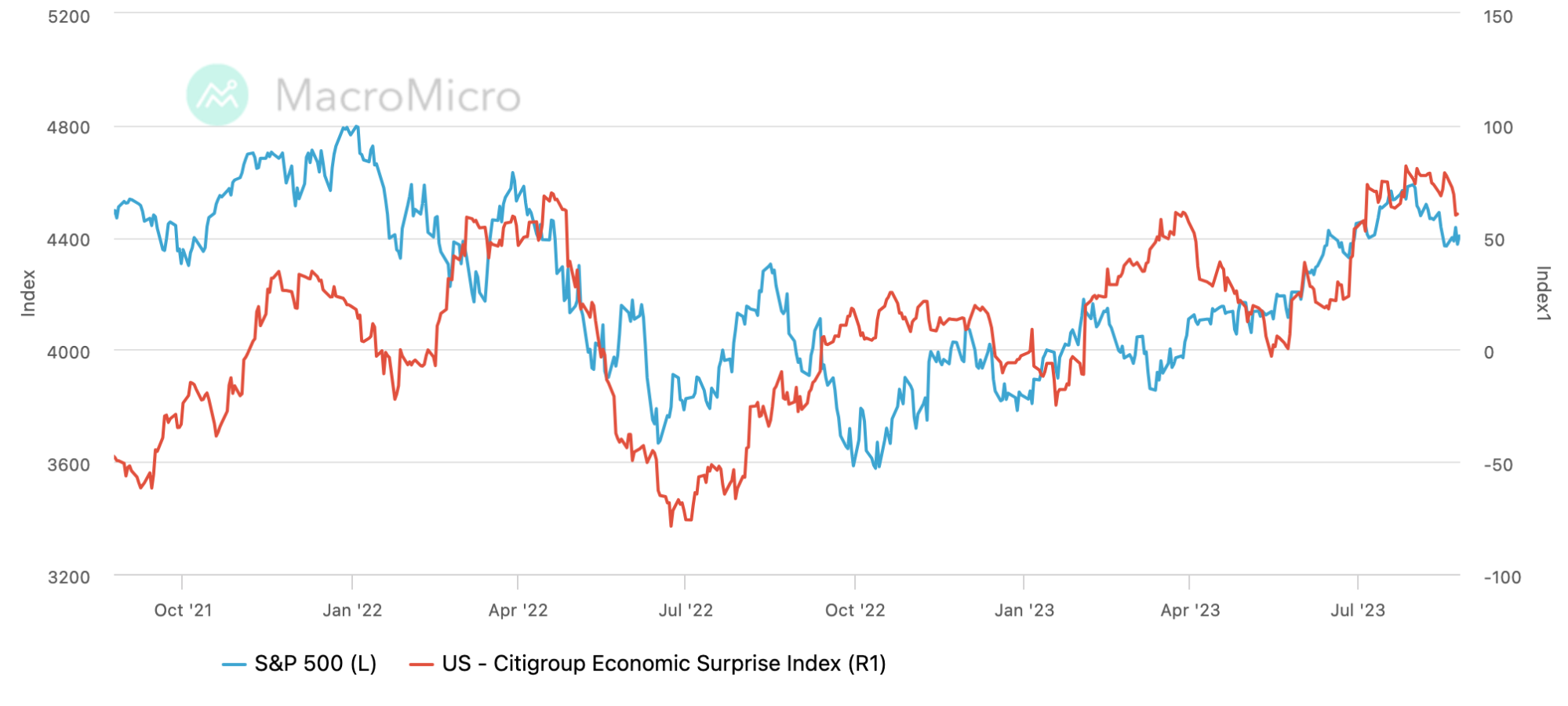
The U.S. economic surprise index fell slightly last week and is still at its highest level since April last year:
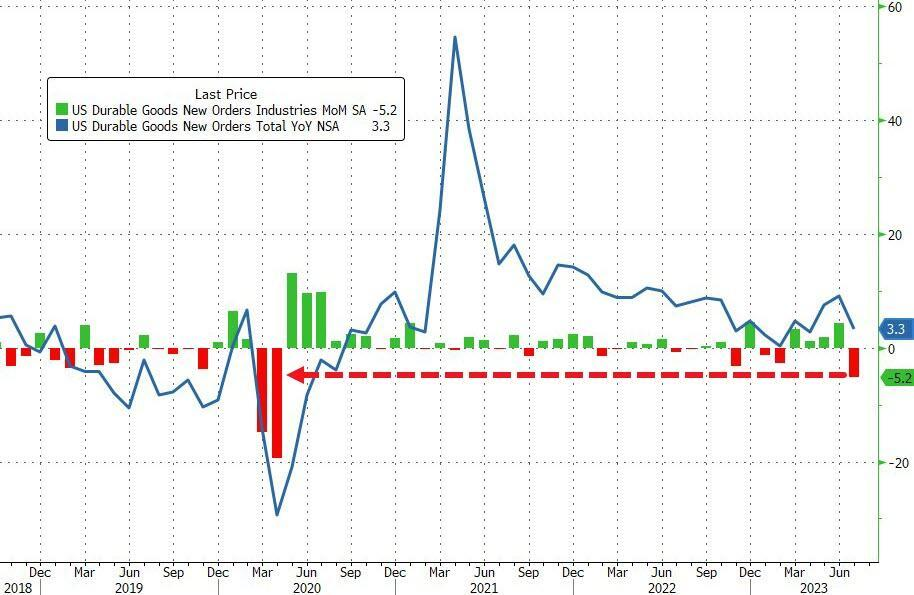
U.S. durable goods orders fell 5.2% in July from the initial value, the largest drop since the outbreak, mainly due to a sharp drop of nearly 44% in non-defense aircraft orders after surging the previous month.
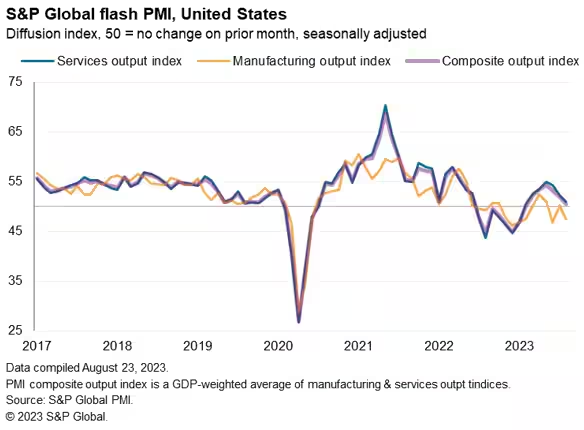
The initial value of the Markit Manufacturing PMI in the United States in August was 47, a new low since February this year; the initial value of the services PMI was 51, a two-month low; the initial value of the Composite PMI was 50.4, a new low since February this year. Analysts said consumer demand was weak and business activity nearly came to a standstill in August, raising doubts about the strength of U.S. economic growth in the third quarter.
Outside the United States
Europes pan-Stoxx 600 index closed flat. Most of Chinas stock indexes fell, but the real estate sector rose due to the introduction of policy support measures such as recognizing a house without having to subscribe for a loan for first-home loans and tax rebates for improved housing sales. In addition, the stock market received a combination of policy support this past weekend, including halving stamp duty, optimizing IPO and refinancing supervision, further standardizing shareholding reduction behavior, lowering the financing margin ratio, etc. Many analysts predict that A-shares may decline this week. A clear rebound. In addition, there is also news in the Hong Kong stock market that stamp duty may be abolished.
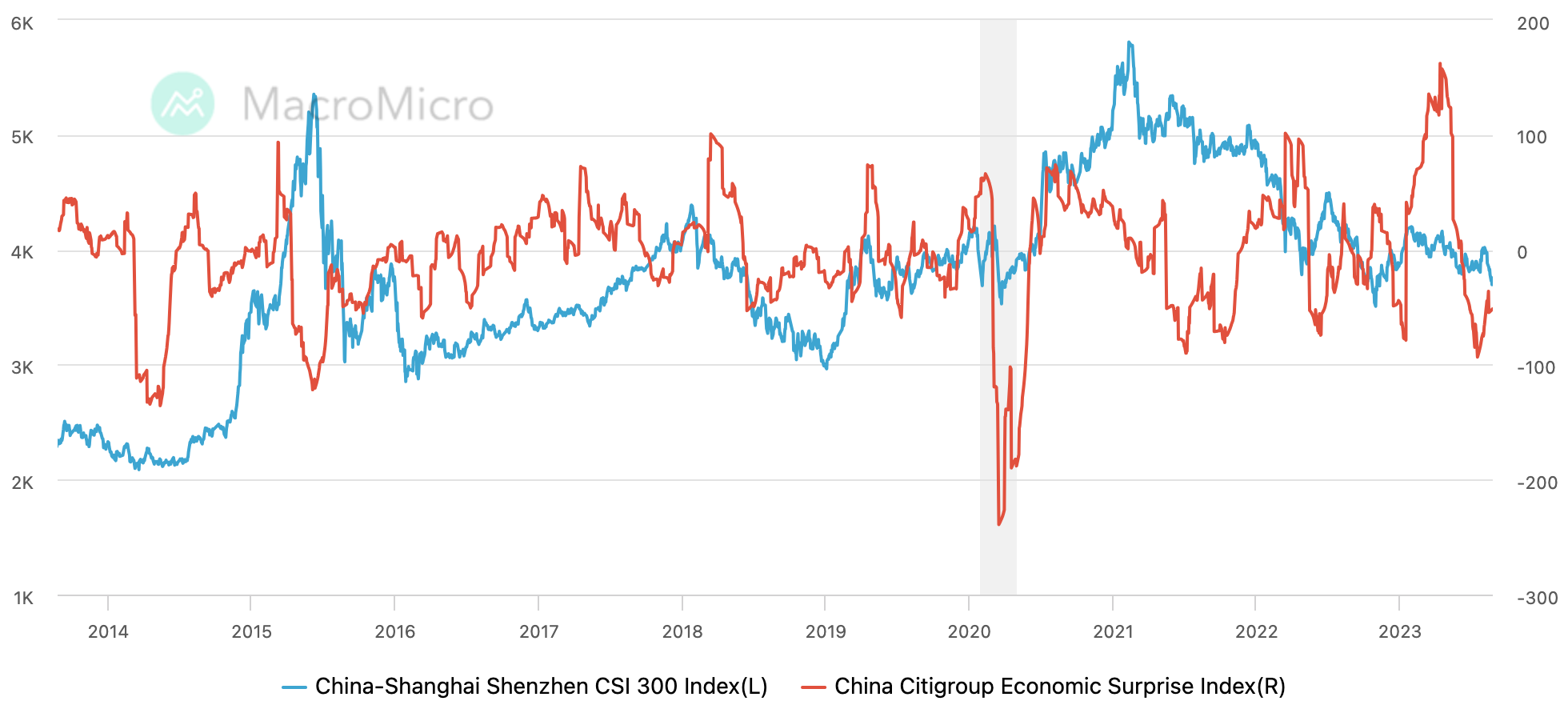
The pessimism of Chinas economic expectations seems to have bottomed out in July. In addition to the extraordinary period brought about by the Covid epidemic after 2020, which lasted for nearly three years, Chinas economic surprise index has been so low since 2015, which coincides with the United States in terms of cycles. Two extremes:
In the Chinese market, investors were active in July this year. The scale of public funds once again hit a new high, with a monthly increase of more than 1 trillion yuan. Among them, the net asset value of stock funds increased by 127.777 billion yuan compared with the end of June, climbing to 2.83 trillion yuan. Hybrid funds The net asset value of funds dropped slightly by 41.431 billion yuan from the previous month to 4.59 trillion yuan. The net asset value of bond funds increased by 178.69 billion yuan from the end of June to 4.94 trillion yuan. In addition, affected by the profit-making effect of overseas markets, the net asset value of QDII funds increased significantly by 42.498 billion yuan in July, and the scale increased to 401.302 billion yuan.
Fund flows and positions
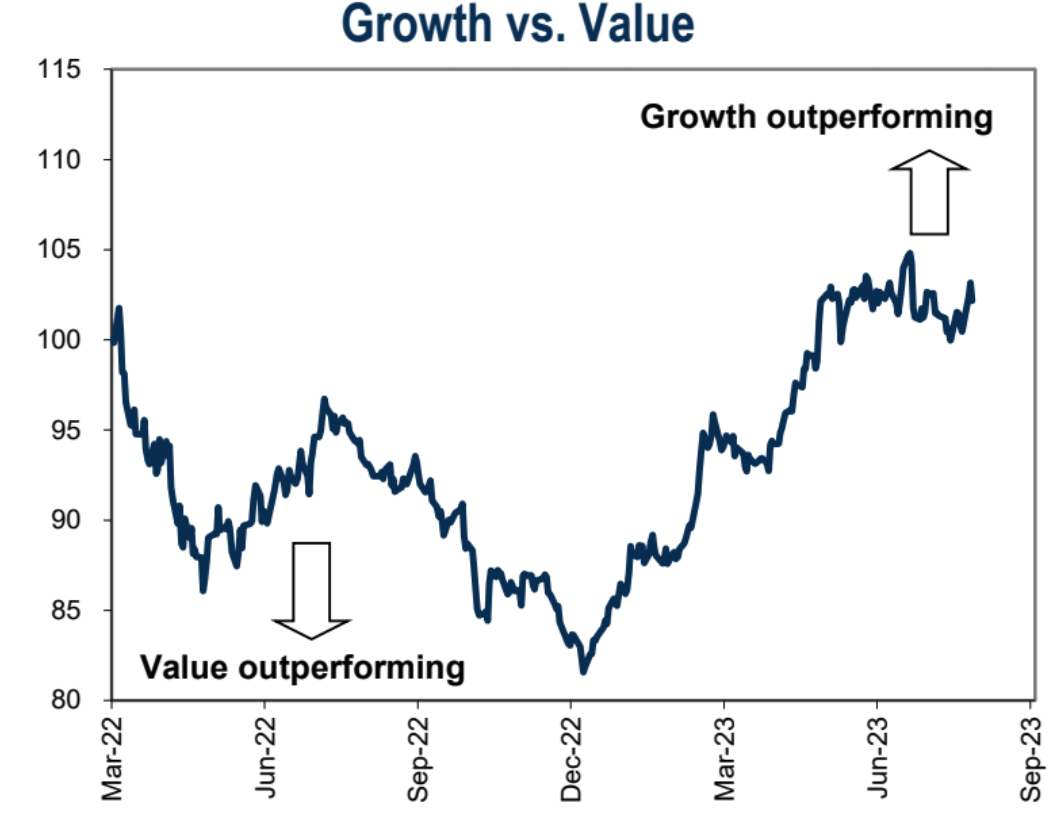
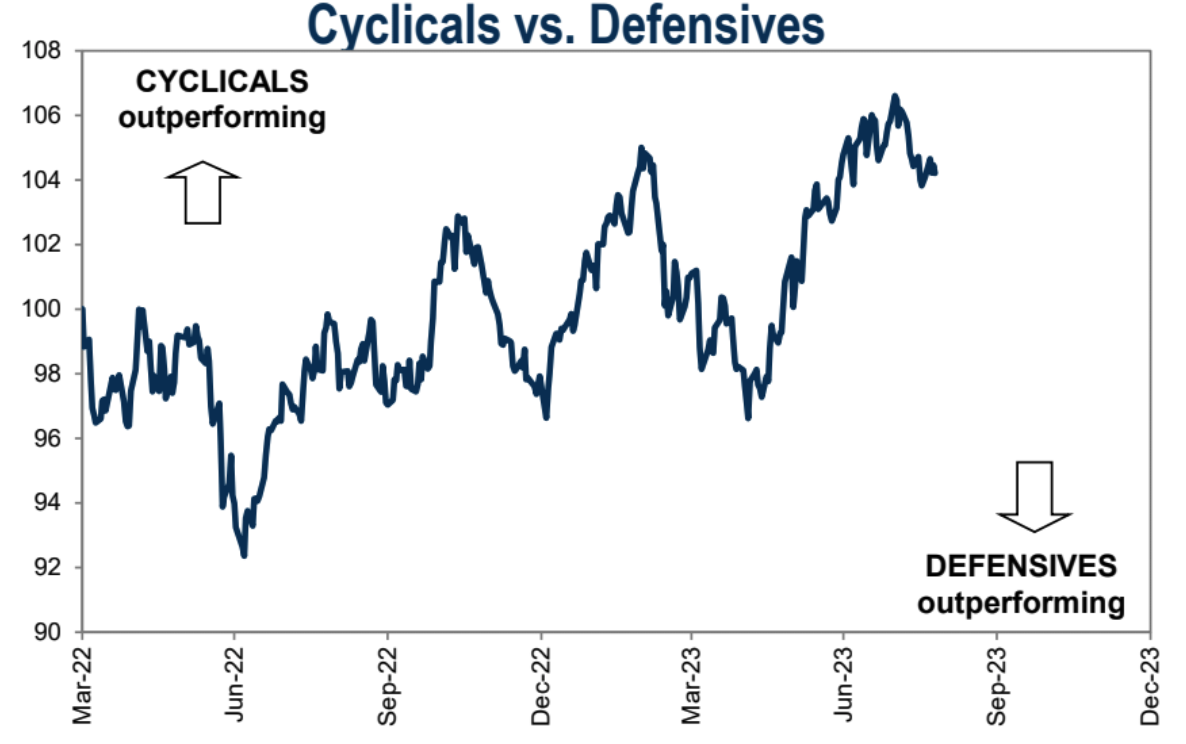
The market was in a stalemate last week, and there was no obvious difference in the performance of defensive and cyclical stocks:
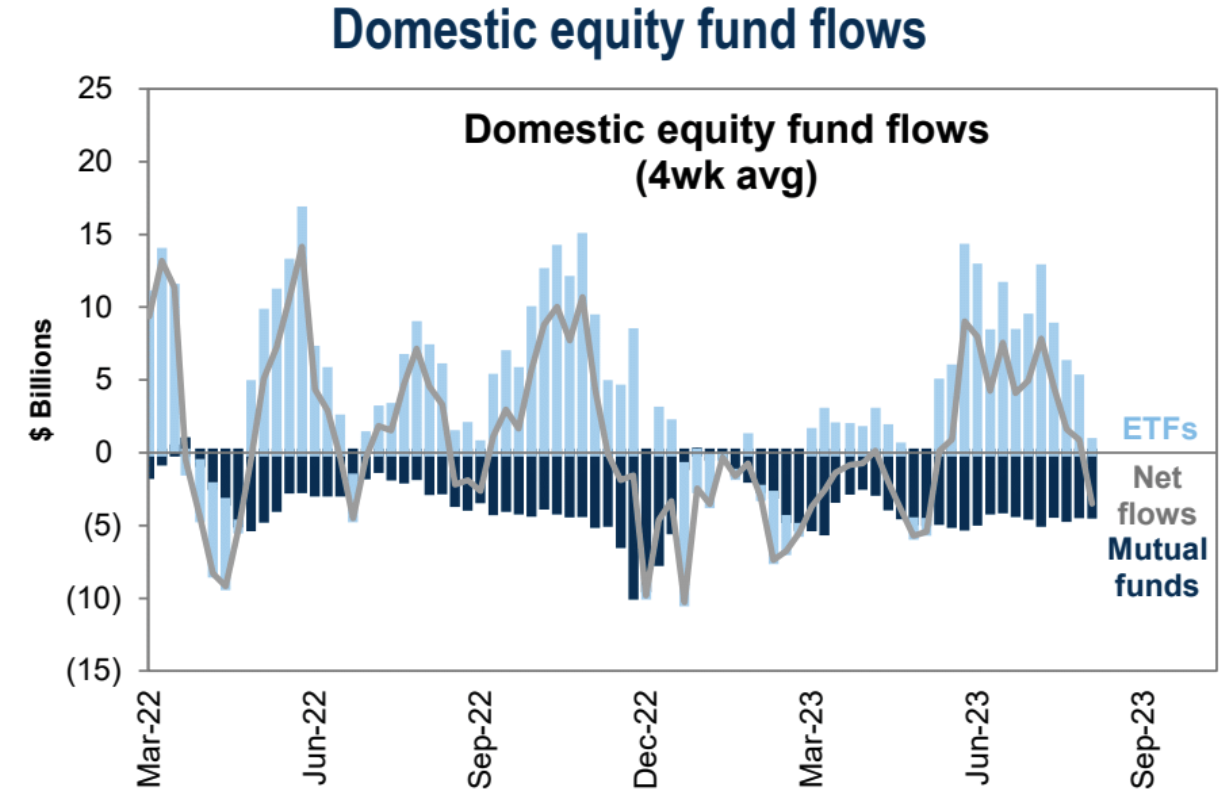
U.S. stock mutual funds saw a net outflow of $4.3 billion last week, the first time in 12 weeks:
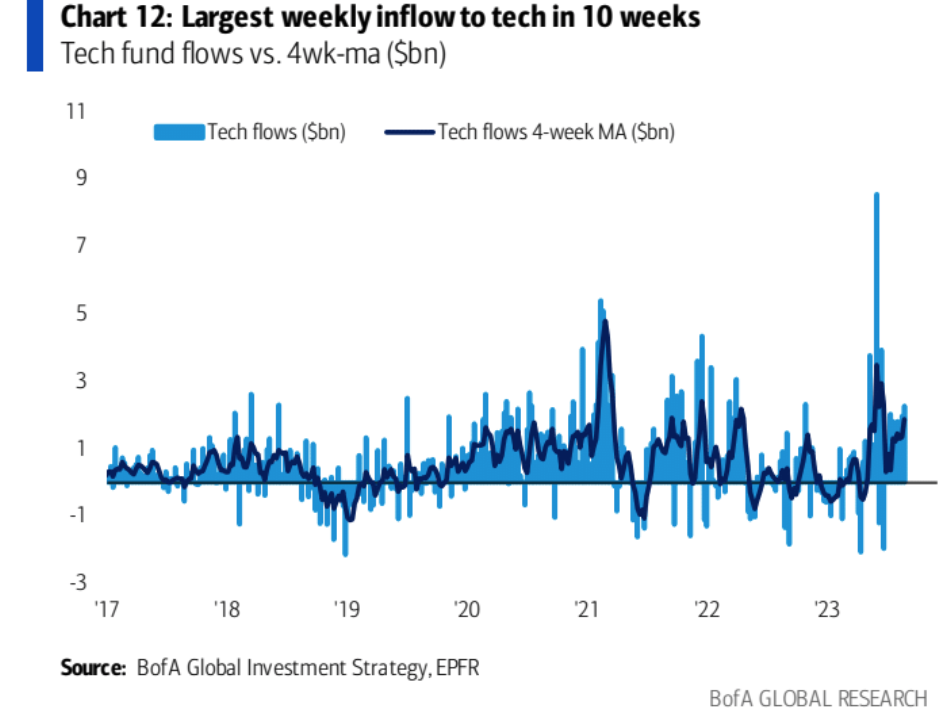
But technology sector funds posted their largest net inflows in 10 weeks last week:
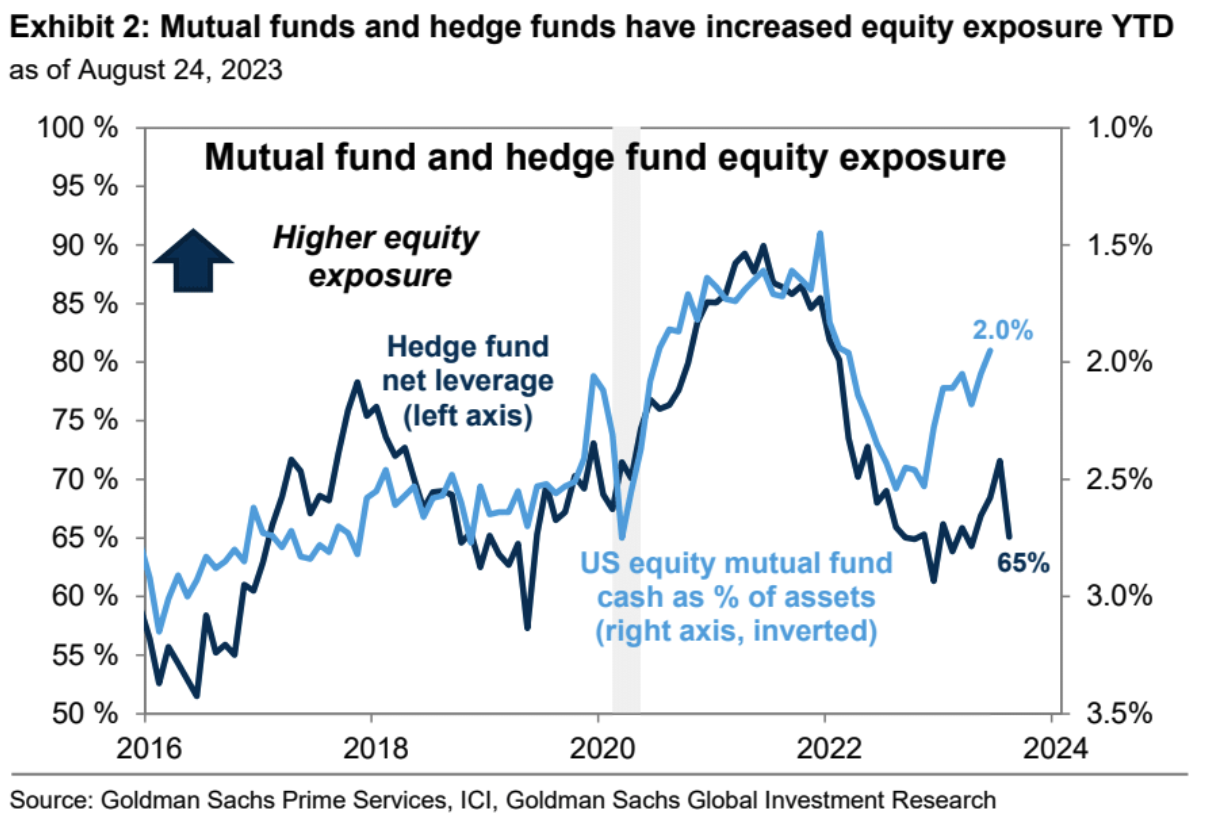
The net leverage of U.S. stock hedge funds rose to a high of 70% in the second quarter, but dropped to 65% last week, which is lower than the 50th percentile in historical data over the past five years. This means that the current hedge fund positions are not high and have increased. Warehouse space:
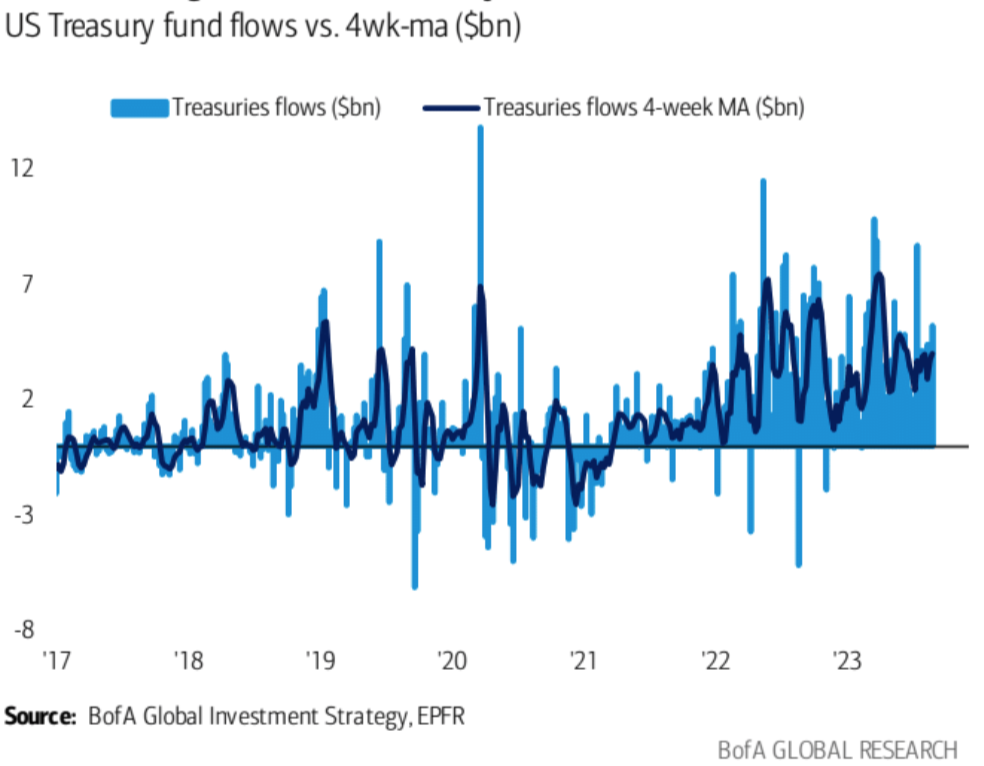
U.S. bond funds posted 28 consecutive weeks of net inflows (+$5.2 billion), the longest streak since 2010:
sentiment indicator
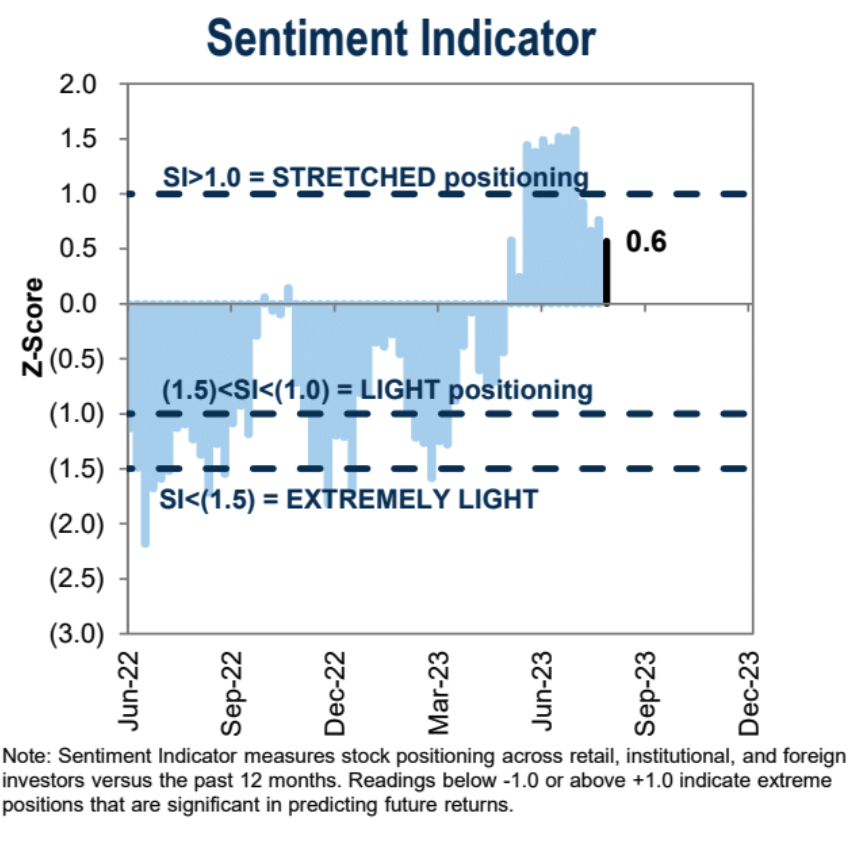
Goldman Sachs U.S. stock sentiment indicator fell to 0.6 last week from 0.8 the previous week, still in the neutral range:
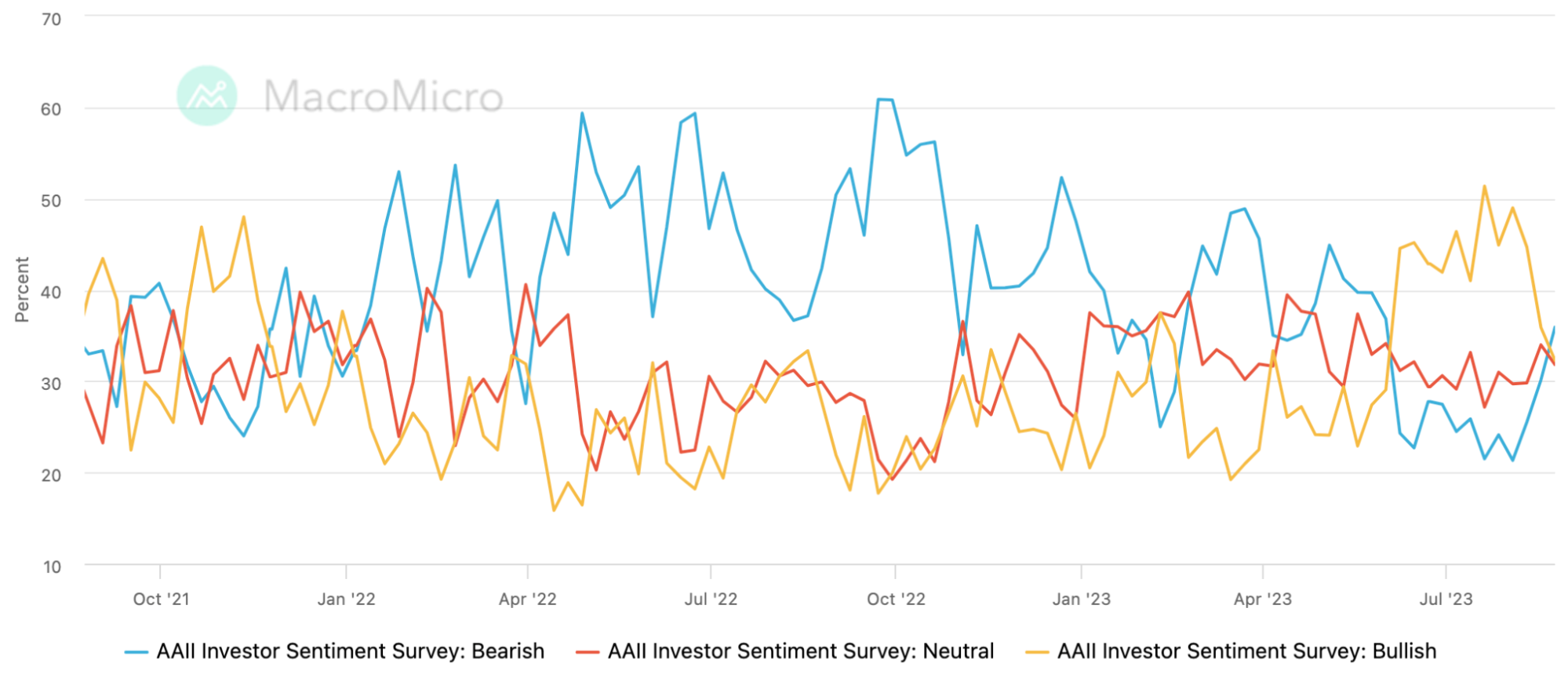
 The AAII investor survey saw a sharp fall in the bull position and a significant increase in the proportion of short positions. For the first time since the beginning of June, the two ratios were more pessimistic than optimistic. Such an adjustment is benign. The previous level of optimism was too high:
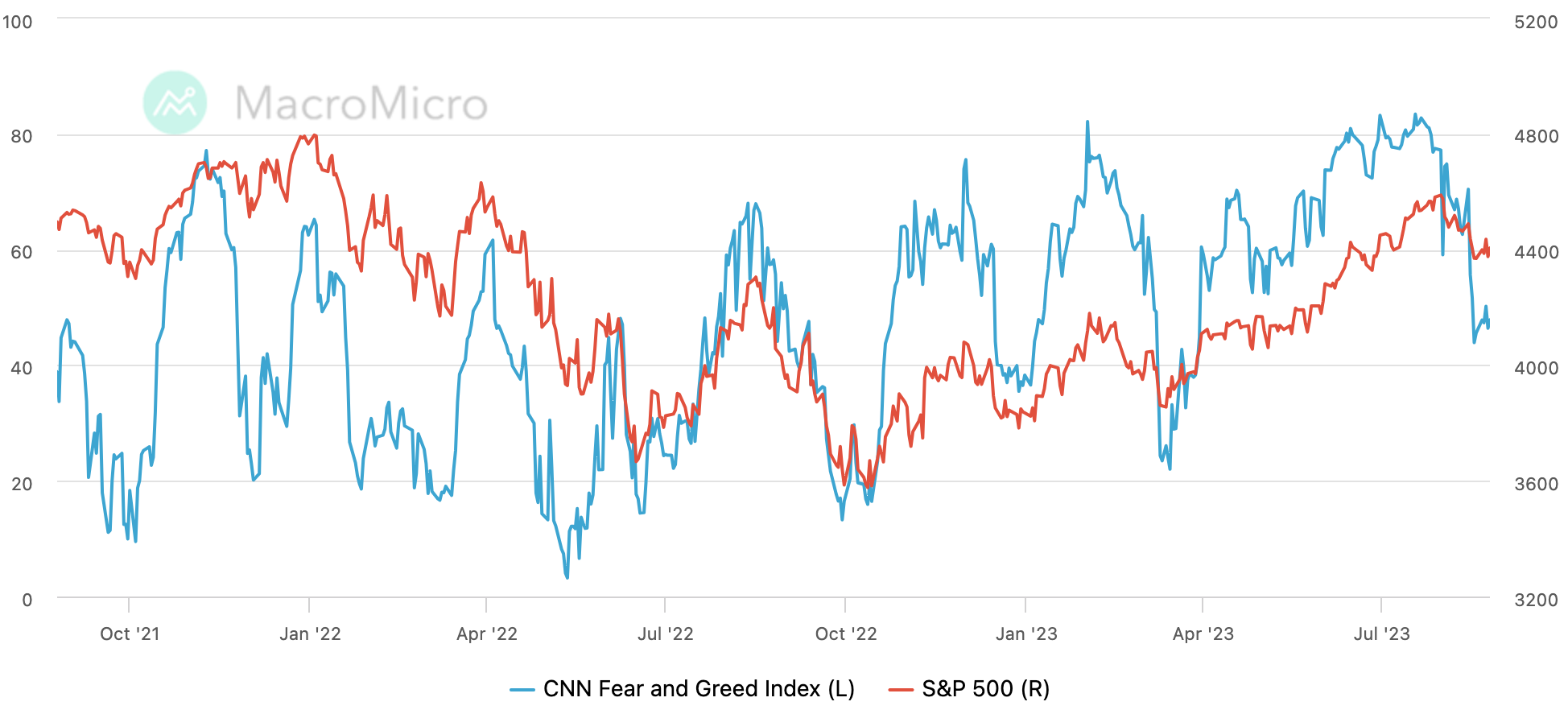
The CNN Greed Index was basically flat last week after experiencing a sharp drop the previous week:
cryptocurrency
IRS Discloses Stricter Tax Requirements
The U.S. Treasury Department and Internal Revenue Service (IRS) have proposed new rules that would require cryptocurrency trading platforms such as Coinbase and Kraken to report details of customer transactions such as customers’ capital gains and losses starting in 2026 — similar to Existing requirements for stock and bond brokers. The measure aims to combat tax evasion related to cryptocurrencies and increase transparency.
This news is obviously a big negative for the digital currency industry in the medium term, as it will further reduce potential investment returns, but since the implementation will not be until January of the following year, the market may not be sensitive to this yet. But the long-term outlook is good for the industry as it will help bring more compliant application scenarios.
Stablecoin flow
According to Glassnode statistics, the balance of stablecoins in centralized exchanges has almost remained unchanged, with a small outflow of US$4.4 million:
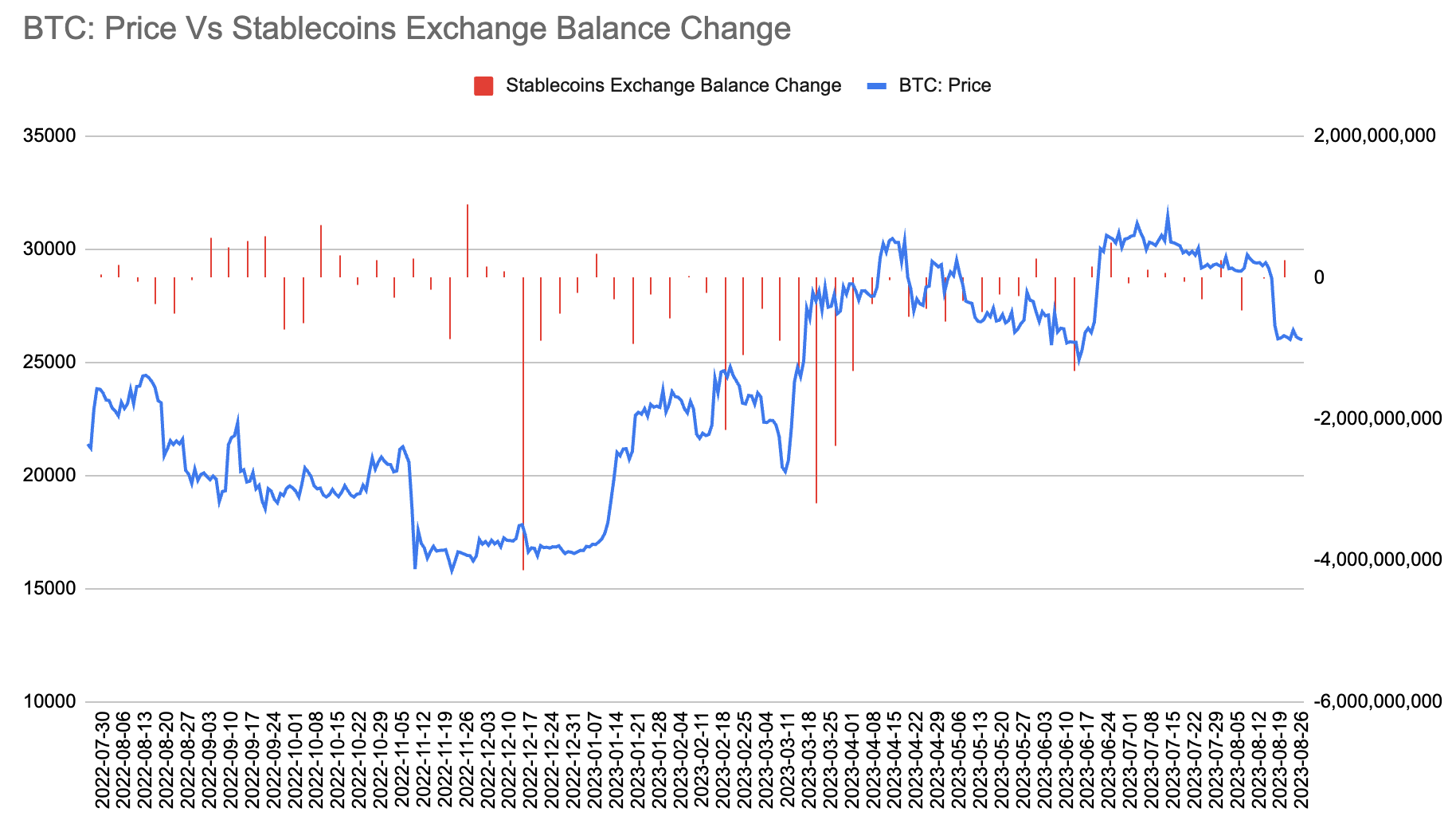
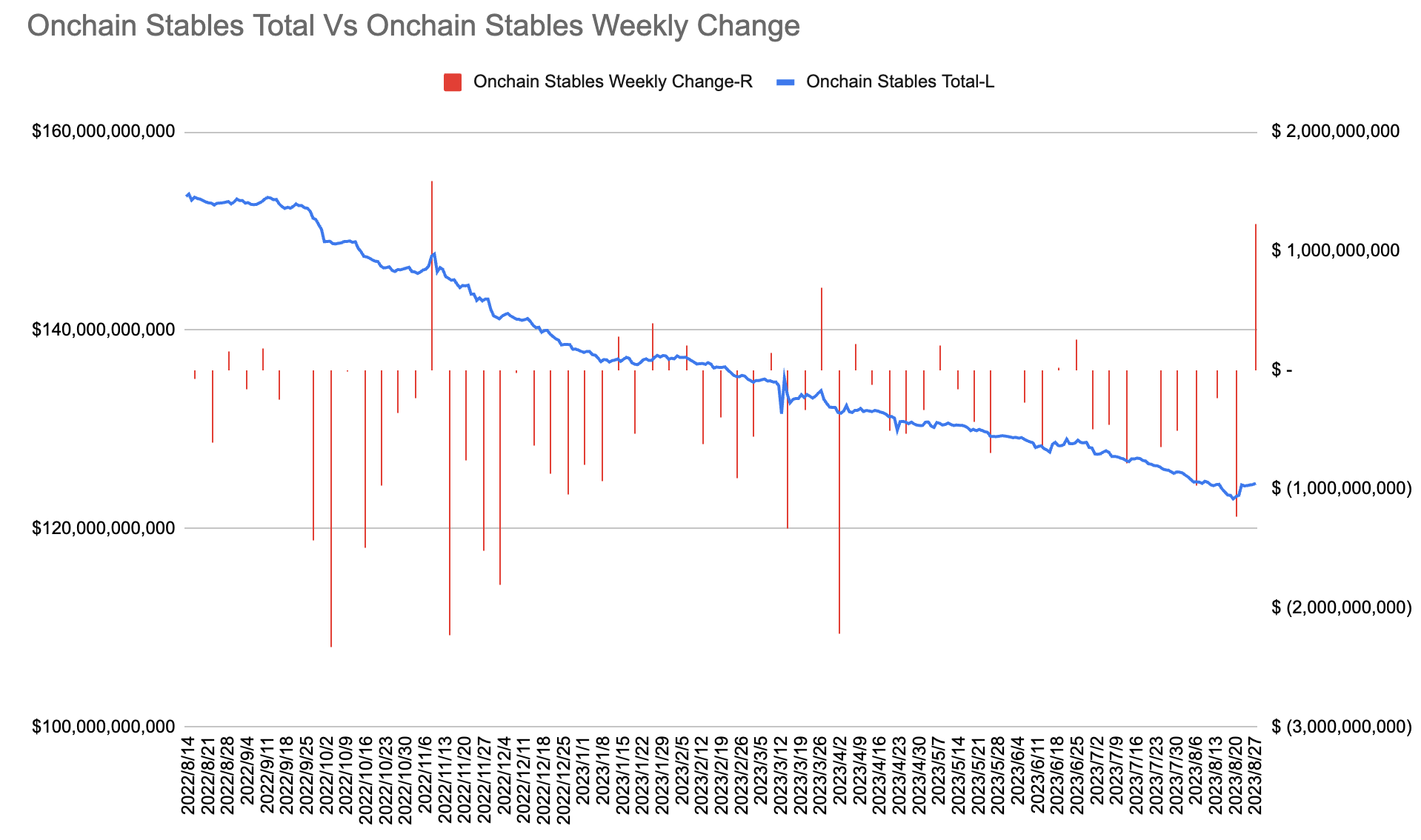
The total stablecoin balance on the chain increased significantly by US$1.22 billion, the largest increase in ten months, but almost all of it was contributed by DAI, and the impact on market liquidity was limited:
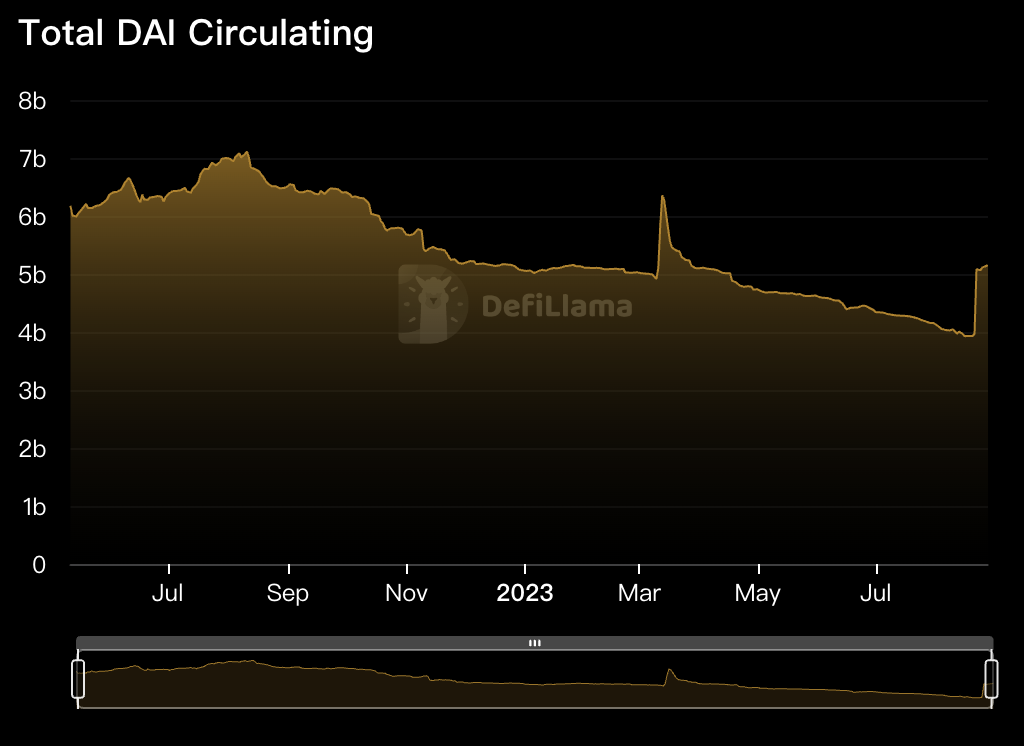
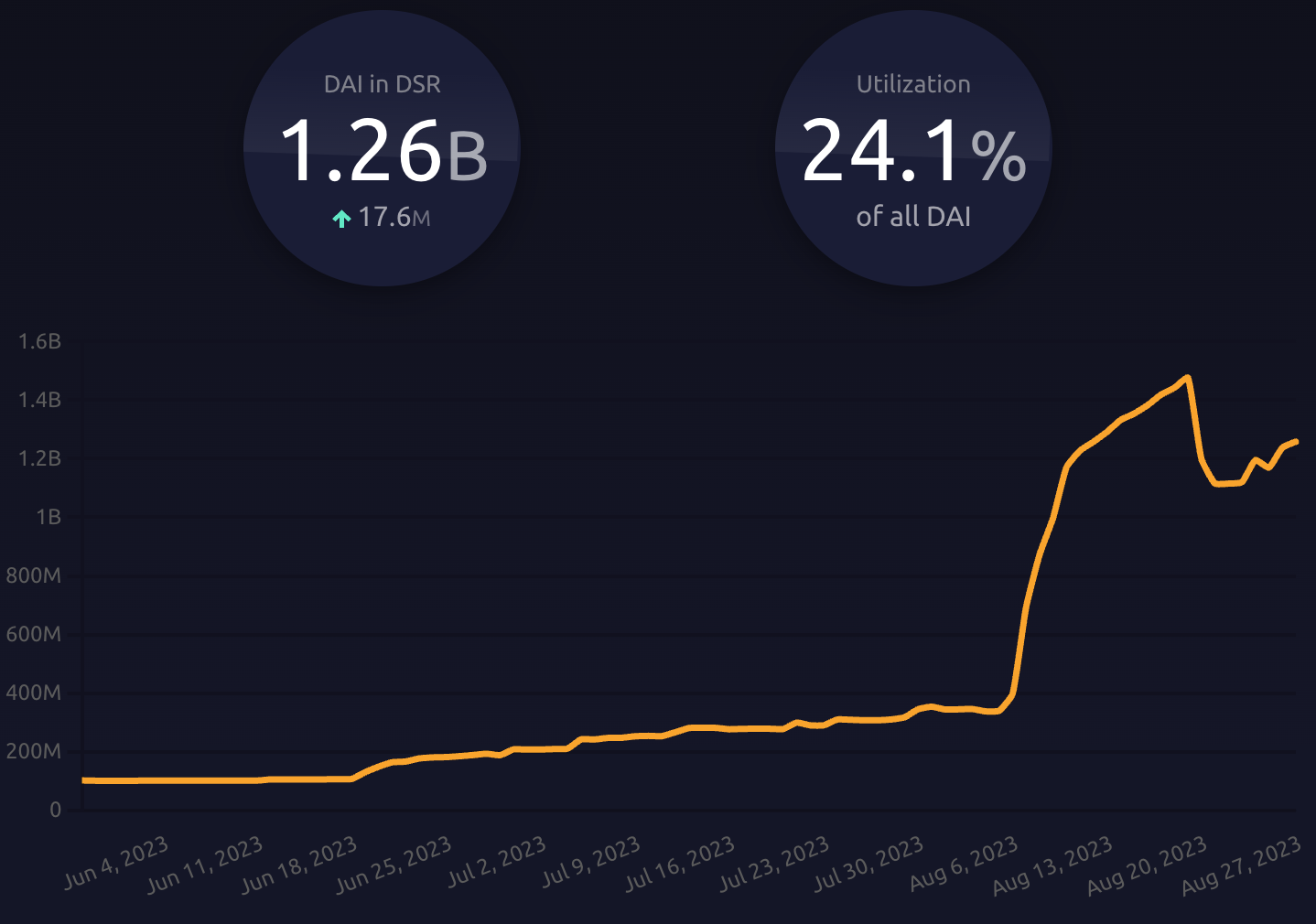
The financial management pool of the MakerDao system has locked 1.26 billion DAI in the past month, corresponding to 24% of DAI locked, so the growth of DAI is almost all due to the financial pool:
Focus on AI leader NVDA
Nvidia’s data center revenue announced last Wednesday exceeded expectations:
- Nvidias second-quarter revenue of $13.5 billion exceeded the companys guidance of $11 billion.
- Of particular note is the companys data center revenue, which surged 171% year over year, with cloud service providers accounting for 50% of revenue, up from 40% in the previous quarter.
- US customers saw the strongest growth, while China contributed 20-25% of total revenue.
- The surge in demand allows Nvidia to charge higher prices for the chips it sells. The companys second-quarter gross margin was 70.1%, up from 43.5% a year earlier.
- For the third quarter, Nvidia provided revenue guidance of $16 billion, which dispelled some market concerns about possible bottlenecks in the supply chain. Nvidia assured that even in the face of potential U.S. export restrictions, the companys supply will still increase every quarter for the next year.
Markets were briefly excited by another $25 billion in share buybacks, the fifth-largest buyback announcement by a US company this year. Although the amount is staggering, the repurchase amount only accounts for 2.1% of its nearly $1.2 trillion market value, which is even lower than the 2.58% repurchase return rate in the history of the entire SP 500 index.
At the same time, several other large technology and growth companies announced reference repurchases for this year: Apple repurchased US$90 billion, Alphabet repurchased US$70 billion, and Meta repurchased US$40 billion.
Nvidia CEO Huang Renxun said that it is estimated that about US$1 trillion will be spent on AI data center upgrades in the next four years, including GPU upgrades. According to Huang, most of the fees will be paid by cloud service providers and other large technology companies including: Amazon, Microsoft, Google, Meta and others. These companies are aggressively advancing generative artificial intelligence.
However, some analysts pointed out that Jen-Hsun Huang’s pie is too large, because the current cash and cash equivalents of Amazon, Microsoft, Google and Meta companies combined are only 334 billion US dollars. Even if the new cash flow generated every year in the future is added, Nvidia will be 4 years away from 1 The trillion-dollar estimate is far off.
Nvidia shares had been rising in the days leading up to the report, rising more than 6% on Thursday and hitting a record high intraday, but the gains fell back at the close and fell 2.4% the following day. But it still recorded a 3.4% gain for the week.
Wall Street analysts collectively raised their price targets for Nvidia following the report. The stock currently has a price target of $640.71, according to FactSet. The stock closed Friday at $460.18.
Well-known investor Cathie Wood was not impressed by Nvidias bright earnings report. She sold nearly $3 million in Nvidia stock before and after the earnings report was released, saying that the valuation had been reflected and she insisted on selling on highs. She said: I believe that in the next five years, Nvidia, which can provide the basic tools required for AI, will be in a very good position. However, everyone knows this, and Nvidias value has been assessed accordingly.
We mentioned last week that the market placed a lot of hope on Nvidias performance to boost sentiment, but even Wednesdays release of historical results and future guidance that exceeded expectations ultimately failed to maintain market sentiment. Some analysts point to this as a sign that this year’s rally has “exhausted” momentum, pointing to more losses to come.
Morgan Stanley strategist Michael Wilson said that despite Nvidias impressive earnings report, Thursdays decline in U.S. stocks means that the markets upward momentum this year has been exhausted and indicates that it will go lower in the future. The market reaction on Thursday was a perfect sign of a peak. Wilson explained, The market peaks on good news and bottoms on bad news. I cant think of any better news than Nvidia. The failure of Nvidias earnings report to boost the market is a negative sign that the overall market rally has exhausted Technical signals. Now we need a new story to get the market excited, but I dont know what that is.
Bank of America strategist Michael Hartnett echoed Wilsons view. He believes that as interest rates remain high for longer and the impact of the Feds weakening liquidity becomes more obvious, the boost from artificial intelligence to U.S. stocks will fade in the second half of this year, and U.S. technology stocks are expected to be in trouble.
Hartnett expects the second half of the year to be a time of trouble, not new AI rules. The rationale is that the correlation between Fed liquidity and technology stocks, with the Nasdaq near an all-time high while the Feds balance sheet is declining significantly, is incongruous.
institutional perspective
The short-term beneficiaries of AI have already risen, so which stocks of long-term beneficiaries should buy?
Goldman Sachs economists calculated the share of 1,000 companies payroll bills facing AI automation. They used task content data from the ONET database for more than 900 U.S. occupations to estimate the total workload facing labor-saving automation by occupation and assumed that AI would be able to complete tasks on the ONET tier scale of difficulty up to 4.
They then took an importance- and complexity-weighted average of each occupations essential job tasks and estimated the proportion of each occupations total workload that AI has the potential to replace, based on the companys global headcount and the median employee reported in its annual statement. Salary estimate expenses calculate each companys labor costs as a percentage of total revenue. Combining these two indicators, we then calculate the potential revenue improvement under the two assumptions of keeping profit margins stable and keeping revenue stable.
Figure: Valuation logic
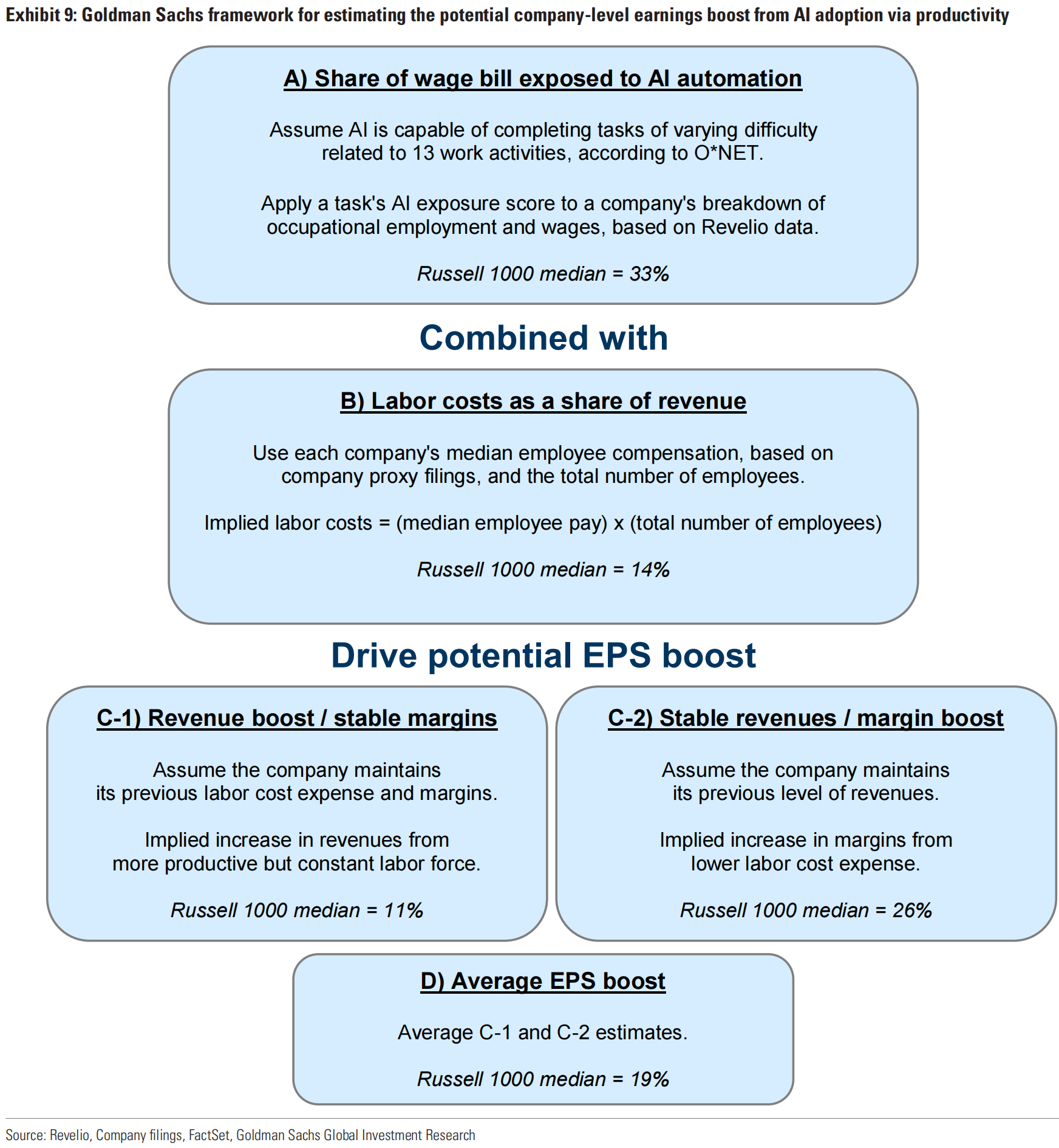
Finally, the two Wealth Password tables are obtained as follows. Of course, we have always advocated focusing on logic and conclusions. Interested people can conduct more detailed analysis or improvements based on their logic:
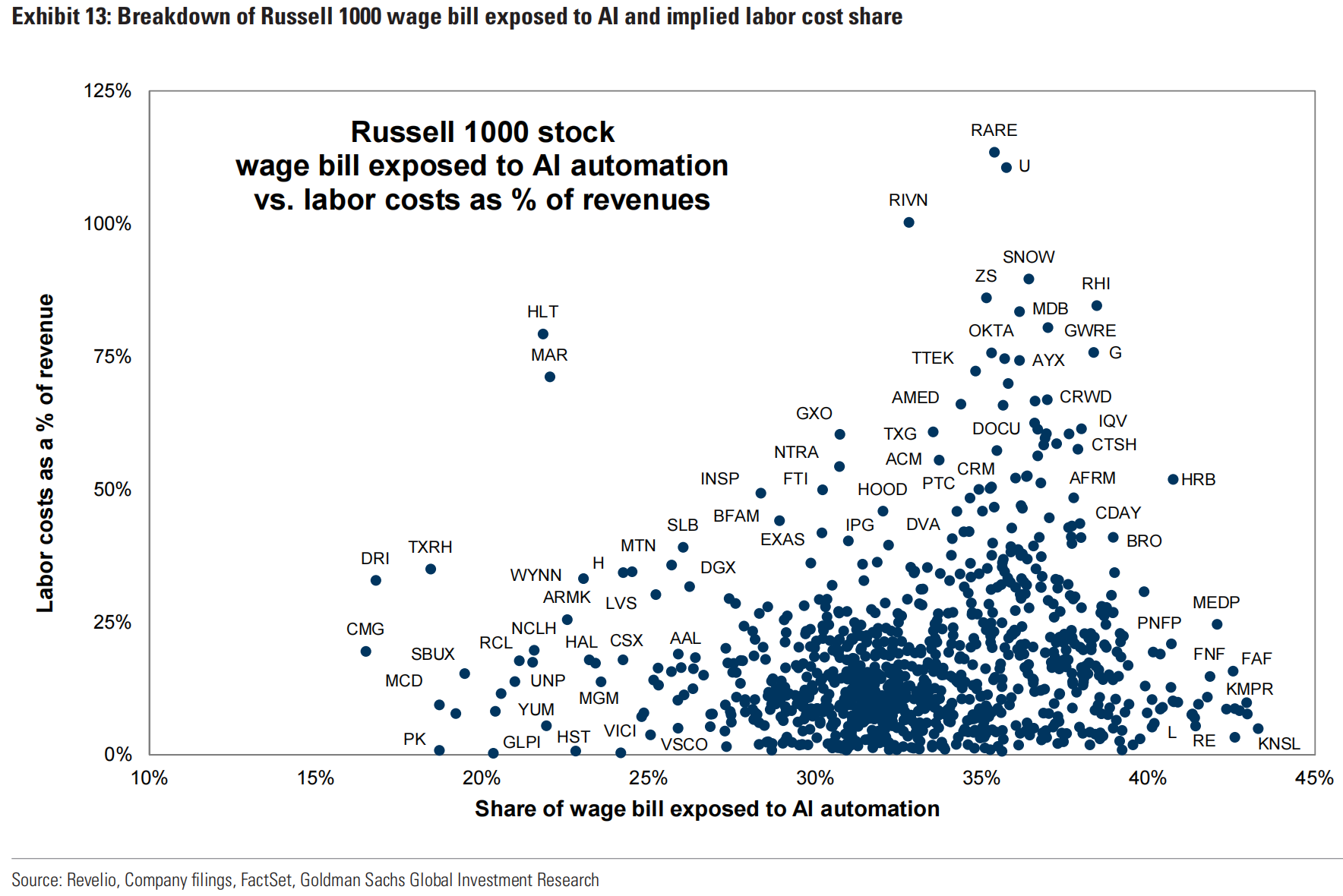
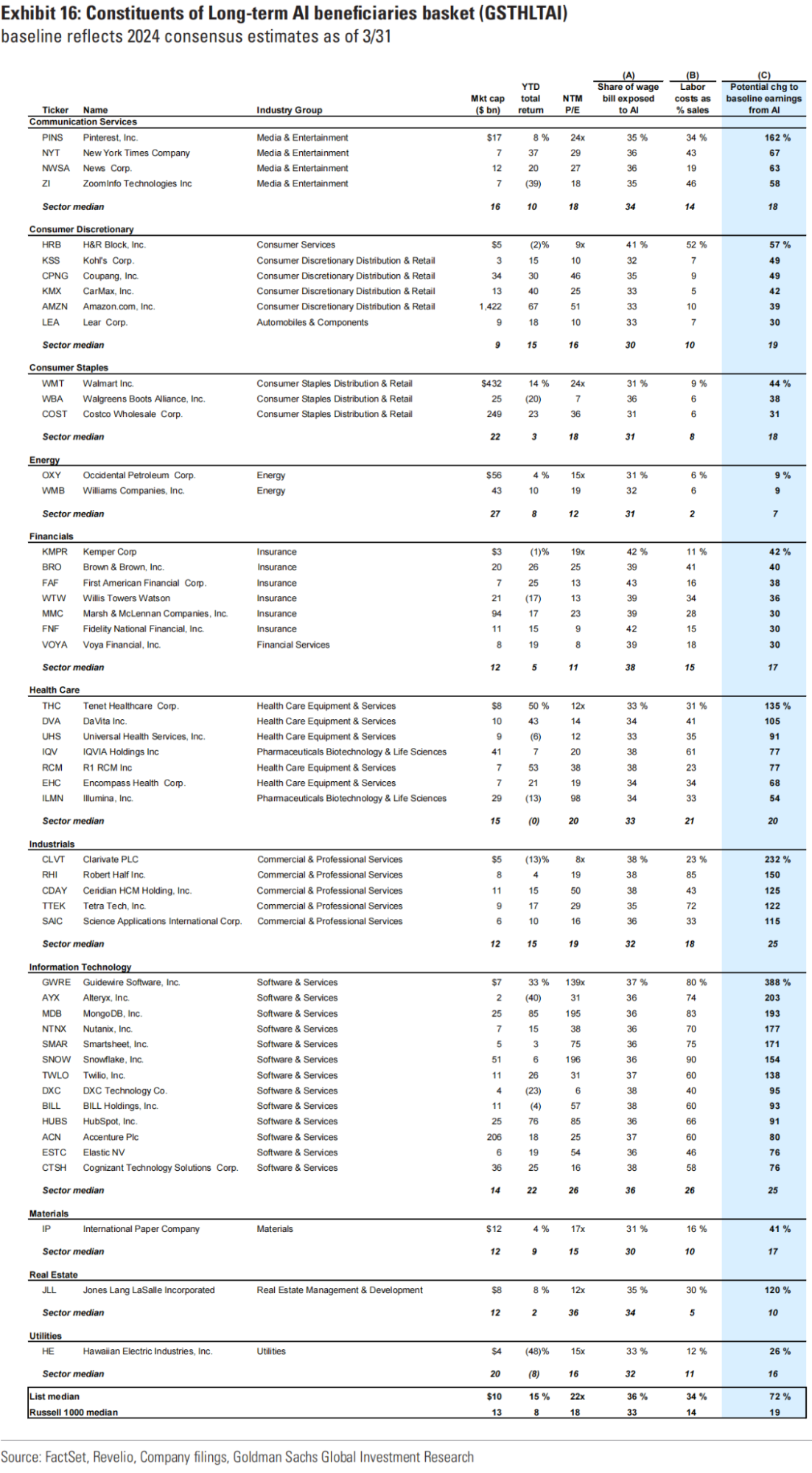
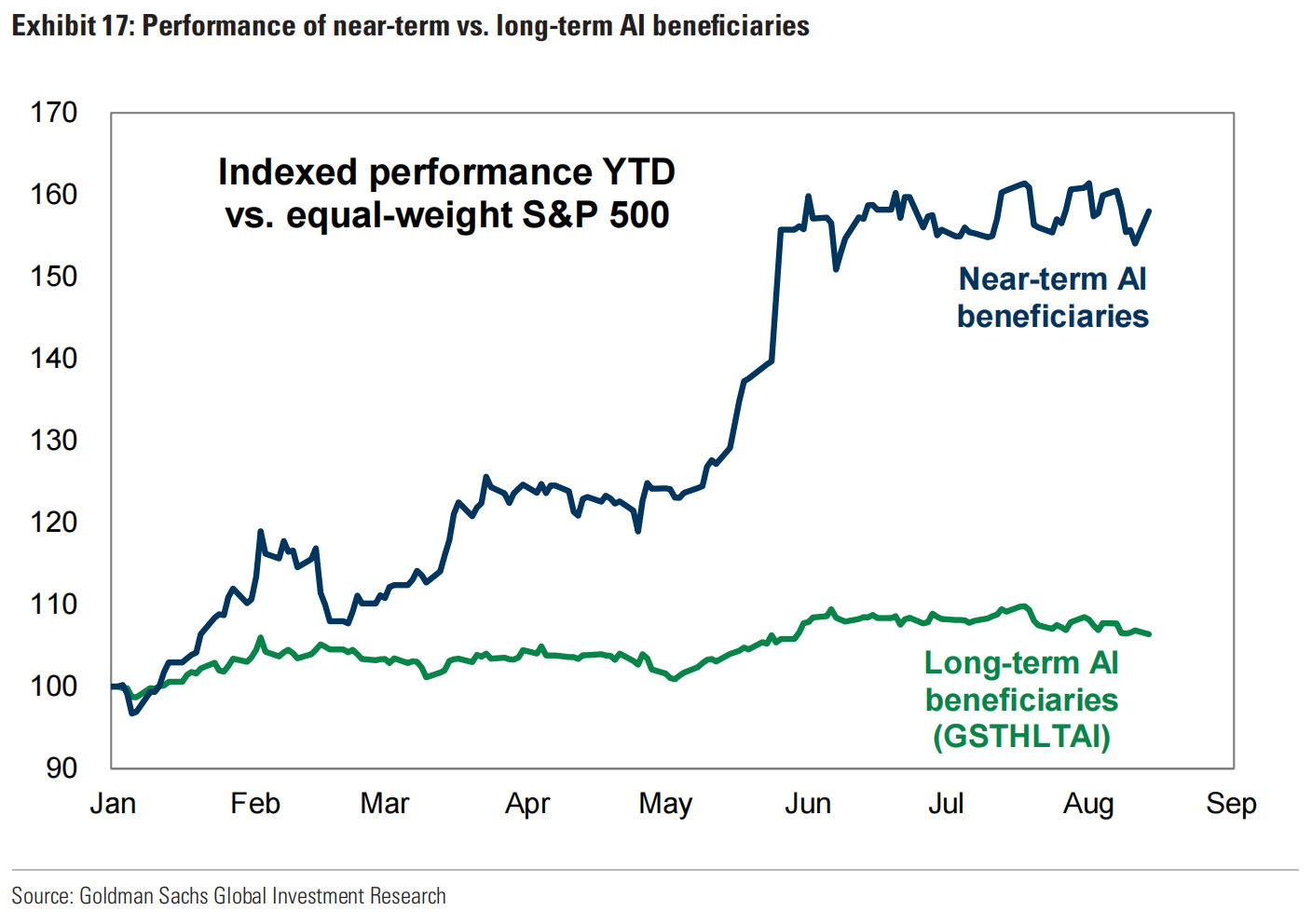
The stocks in this basket selected by Goldman Sachs expect that after widespread adoption of artificial intelligence, the median EPS may be 72% higher than market expectations. The basket of stocks has outperformed the SP 500 by just 6 percentage points this year, well below those short-term beneficiary stocks, suggesting that most potential productivity gains have yet to be priced in. By this logic, the improvement in profit margins may not be permanent, but investors may hype the possibility.
follow this week
The U.S. non-farm payrolls report in August, July PCE, the progress of the U.S. Congress’s budget agreement for the new fiscal year, the U.S. Treasury Secretary’s visit to China, China, the U.S. and Europe PMI, the Eurozone’s initial CPI value in August, etc.
The U.S. stock market has historically been mediocre in September, with the SP 500 down an average of 0.7% in September since 1945, making it the worst month of the year.