






ETH Weekly Report | 7 Companies Submit Ethereum Futures ETF Applications; Vyper Compiler Vulnerability Affects Multiple DeFi Protocols (July 31 - August 6)


1. Overview
The Vyper programming language for Ethereum has released a post-incident analysis report on last week's vulnerability event. On July 30th, multiple Curve liquidity pools were attacked due to a potential vulnerability in the Vyper compiler. The vulnerability itself was an improperly implemented reentrancy protection. The affected Vyper versions are v 0.2.15, v 0.2.16, and v 0.3.0. The vulnerability has been fixed and tested in v 0.3.1, and versions V 0.3.1 and above are secure. However, the impact on valid contracts was not realized at the time, and downstream protocols were not notified. Vyper has stated that several steps will be taken in the future to improve the correctness of smart contracts compiled using Vyper.
Currently, there are 7 companies applying for Ethereum futures ETFs. Following Volatility Shares' submission of an Ethereum futures ETF application on July 28th, Bitwise, Roundhill, VanEck, Proshares, and Grayscale all followed suit on August 1st. They respectively introduced Bitwise Ethereum Strategy ETF, Roundhill Ether Strategy ETF, Ethereum Strategy ETF, Proshares Short Ether Strategy ETF, and Grayscale Ethereum Futures ETF (ETHG). On August 3rd, ETF issuer Direxion submitted a Bitcoin and Ethereum futures ETF application to the US SEC. This product is named "Direxion Bitcoin Ether Strategy ETF" and will invest in Bitcoin and Ethereum futures contracts, as well as other futures-oriented ETFs.
In the secondary market, the short-term price of ETH may continue to consolidate, with support at $1850 and resistance at $1900.
Second, the secondary market
1. Spot market
According to OKX market data, last week ETH rebounded to $1879 and closed the week at $1829, a decrease of 2.5% compared to the previous period.
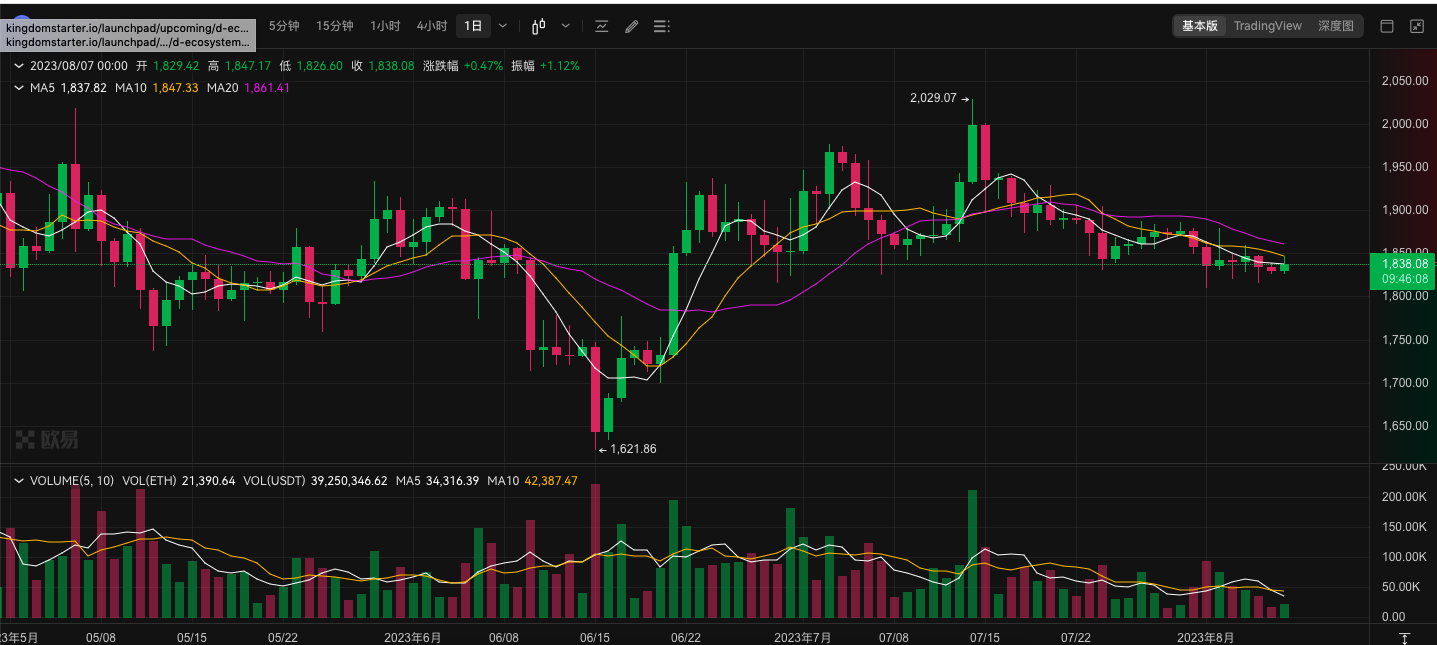
ETH daily chart, from OKX
The daily chart shows that the price is currently consolidating around $1850, with support at $1800 below. If it falls below, it may further decline to $1750. The resistance above is $1850.
2. Network operation
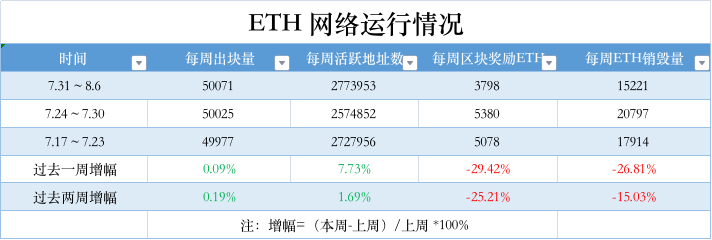
Etherscan data shows that the number of blocks produced on the Ethereum network in the past week was 50071, an increase of 0.1% compared to the previous week; the number of active addresses per week was 2773953, an increase of 7.7% compared to the previous week; block reward income was 3798 ETH, a decrease of 29.5% compared to the previous week; the weekly ETH burn reached 15221, a decrease of 26.8% compared to the previous week.
3. Significant Changes
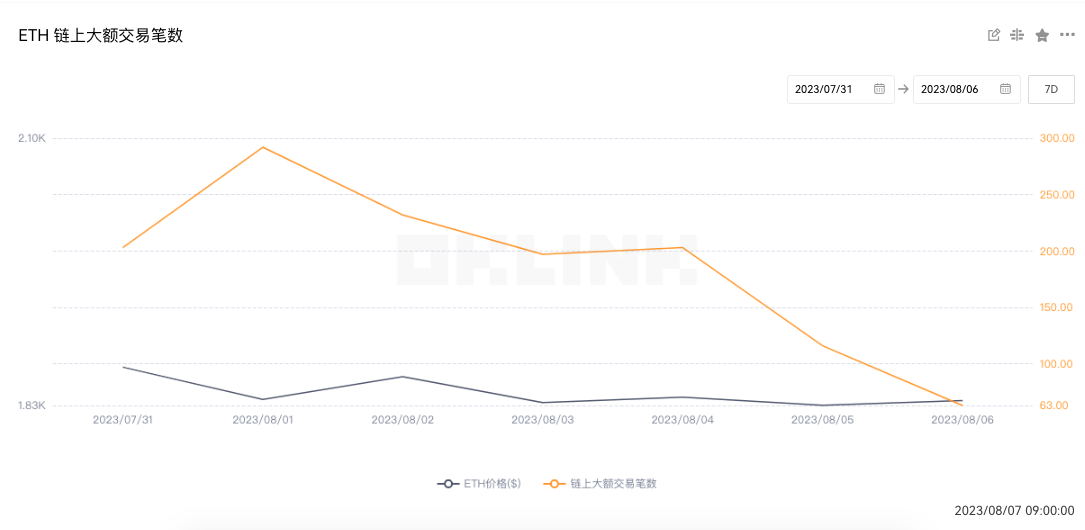
OKLink data shows that the number of high-value transactions on the chain reached 1309 last week, an increase of 14.1% compared to the previous week (1147), indicating a slight increase in whale trading enthusiasm.
4. Rich List Addresses
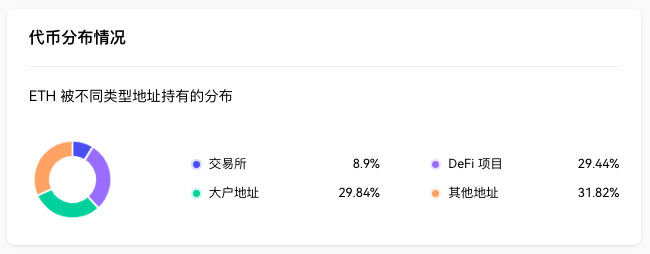
OKLink data shows that in terms of the distribution of ETH holding addresses, exchanges account for 8.9%, an increase of 0.12% compared to the previous period; DeFi projects account for 29.44%, an increase of 0.17% compared to the previous period; large account addresses (the top 1000 addresses excluding exchanges and DeFi projects) account for 29.84%, an increase of 0.03% compared to the previous period; other addresses account for 31.82%, a decrease of 0.08% compared to the previous period.
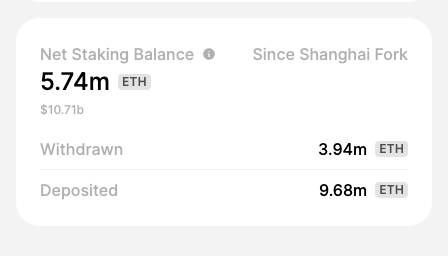
token.unlocks shows that the total amount of ETH staked in the entire network is 22.81 million ETH, with a staking rate of 18.72%; since the upgrade in Shanghai, the cumulative deposit amount is 9.68 million ETH, with last week's data being 9.47 million, an increase of 210,000 in the past week; a total of 3.94 million have been withdrawn, with last week's data being 3.86 million; the total net staking amount has increased by 5.74 million, compared to the previous week's data of 5.61 million, an increase of 130,000 in the past week.
5. Lock-up Data
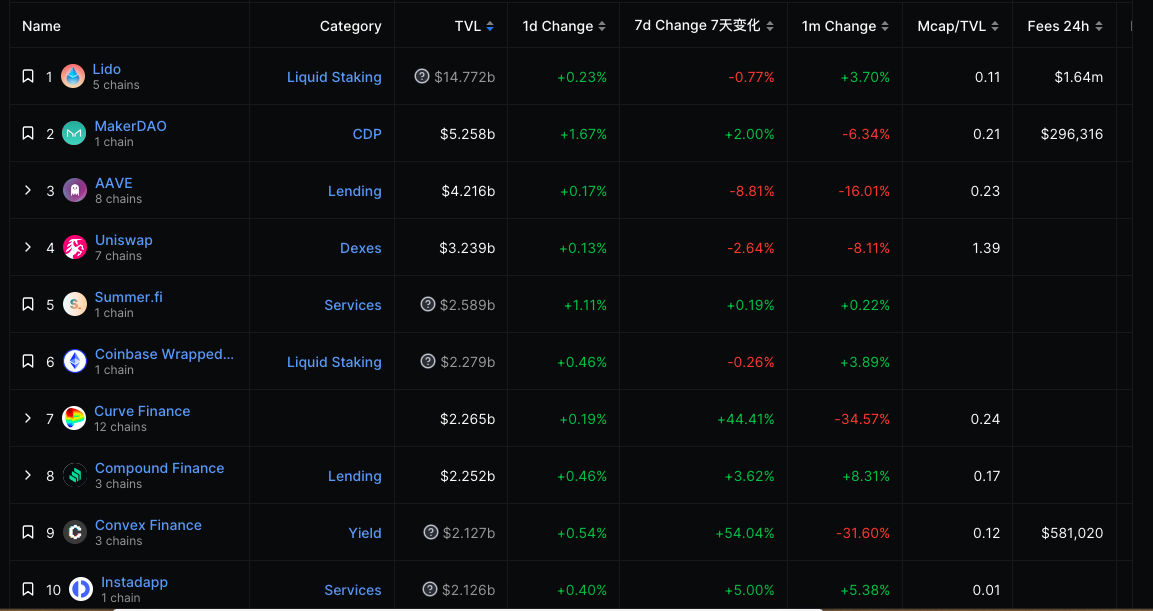
DeFiLlama data shows that the value of on-chain locked collateral increased from 23.07 billion US dollars to 23.37 billion US dollars last week, an increase of 1.3% compared to the previous period. In terms of individual projects, the top three in terms of locked value are: Lido with 14.77 billion US dollars; MakerDAO with 5.25 billion US dollars; Aave with 4.21 billion US dollars;
III. Ecology and Technology
1. Technological Progress
Ethereum Core Developer Tim Beiko summarized the latest Ethereum Core Developer's Meeting in Discord. Among them, developers agreed to continue using regular contracts with system write-in transactions instead of precompiled contracts. Before the test call on Monday, developers will try to: (1) agree on a deployment plan (as part of the fork or manually deployed before the fork); (2) agree on the first contract implementation to be used; (3) submit a PR reflecting this situation to the 4788 specification. Once developers reach a consensus on the contract, the audit/ formal verification process will be initiated;
This meeting has decided to postpone the release of Devnet #8 until the new 4788 specification is implemented; regarding EIP-6780, the "addition of explanations for EIP-6780" will continue to be merged; as for the Engine API, it has been agreed to add blobGasUsed and blobGasPrice to the receipts of transactions in 4844. Developers will also modify this PR to mention that Dencun upgrades must use forkChoiceUpdateV3, and then merge it into "clarifying early API handling of Cancun payloads; reordering check #426". Regarding the large validator testnet, the EF development team has launched a development network with 2.1 million validators, similar to the distribution of the mainnet. They will work with client teams to check and fix finalization and block gossip issues before Holesky launches. Holesky is planned to have approximately 1.5 million validators.
In addition, developers introduced and discussed two account abstraction EIP proposals, namely EIP 5806 and 7377. Guillaume Ballet and josh rudolf presented the latest updates on Verkle.
2. Community Voice
Viewpoint: Developers' interest in Arbitrum and Optimism has significantly increased
Experts point out that developers' interest in Ethereum L2 solutions Arbitrum and Optimism has significantly increased. The market share of Arbitrum has risen from 0.9% to 4.5%, while the market share of Optimism has risen from 1.2% to 1.5%. The proportion of verified smart contracts on the Fantom network has decreased from 3.3% to 1.4%. At the industry level, the Polygon and Avalanche blockchains are developing, with market shares fluctuating between 10%-12% and 2.2%-2.7% respectively. (Forklog)
3. Project Trends
The Ethereum programming language Vyper has released a post-analysis report on the vulnerability incident that occurred last week. On July 30th, multiple Curve liquidity pools were attacked due to a potential vulnerability in the Vyper compiler. The vulnerability itself was an improperly implemented reentrancy protection. The affected Vyper versions are v0.2.15, v0.2.16, and v0.3.0. The vulnerability has been fixed and tested in v0.3.1, and versions v0.3.1 and higher are secure. However, at the time, the impact on valid contracts was not realized, and downstream protocols were not notified.
Vyper states that several steps will be taken in the future to improve the correctness of smart contracts compiled with Vyper:
-Improving the testing of the compiler, including increasing coverage, comparing compiler output with language specifications, and using formal verification (FV) tools for compiling bytecode verification.
-Providing developers with tools to make it easier for them to test their code using various approaches, including source code and bytecode-level testing.
-Enhancing the strict bidirectional feedback using the Vyper protocol.
Vyper points out that looking ahead, the ultimate goal is to learn from recent events and ensure that Vyper becomes a stable and secure smart contract language and compiler project. To achieve these goals, a range of new security-related measures will be taken, including:
-Collaborating with Codehawks for a short-term competitive audit of the latest version of Vyper.
-Partnering with Immunefi for short-term and long-term bug bounty programs for all versions of the Vyper compiler.
-Vyper Security Alliance, which is a coordinated multi-protocol bug bounty program aimed at helping discover vulnerabilities in current and older versions of the compiler that impact the real-time Total Value Locked (TVL) for Vyper.
-Working with audit firms such as ChainSecurity, OtterSec, Statemind, and Certora to review older versions of Vyper and continue auditing the compiler in the future.
-Expanding the team size, including a dedicated security engineer position to improve security tools for Vyper, both internal and user-facing.
-Collaborating with existing security toolkits provided by Solidity, which will greatly benefit the Vyper ecosystem.
-Designing language specifications that will aid in formal verification and help test the compiler itself.
(2) Lyra V2 Option Protocol Open for Waiting List Application
The options protocol Lyra recently introduced its V2 version, allowing users to join the waiting list for early access to the product. Lyra V2 is a spot, perpetual, and options trading platform designed to be secure, high-performance, and user-friendly. New features of Lyra V2 include combination margin for options, cross-margin shared collateral between options and perpetual contracts, and support for multiple asset collateral types.
(3) Term Labs launches fixed-rate lending protocol Term Finance on Ethereum
Term Labs has launched the fixed-rate lending protocol Term Finance on Ethereum, which matches borrowers and lenders who set predetermined interest rates. During the auction period (i.e., the loan term), collateral will be locked in a smart contract. (decrypt) Earlier news stated that Term Labs announced the completion of a $2.5 million new financing round, led by Electric Capital, with participation from Circle Ventures, MEXC Ventures, Coinbase Ventures, and others. The new funding will be used to build fixed-rate DeFi products.
(4) Non-profit organization Glo launches compliant USD stablecoin Glo Dollar
Non-profit organization Glo announced the launch of the regulated stablecoin Glo Dollar on August 2nd. Glo Dollar is backed by fiat currency and low-risk securities, including U.S. government bonds, and is pegged 1:1 with the U.S. dollar, similar to models of other major stablecoins like USDC and USDT. Co-founder Jasper Driessens stated that Glo Dollar will "first be paired with USDC on Polygon's Uniswap and Ethereum," and plans to expand to more chains and platforms over time, with the ultimate goal of making Glo Dollar a "universal stablecoin." Glo Dollar generates revenue from the interest earned from its supporting assets, which is then used for charitable work dedicated to alleviating extreme poverty. Driessens mentioned that in addition to the stablecoin, the organization is also testing various crypto debit cards. (Crypto Slate)
Nansen analysis shows that the fierce competition between the two major platforms, OpenSea and Blur, has a significant impact on royalty payments in the NFT market, leading to a sharp decline in royalty revenue this year, which is difficult to return to the market peak in 2019. According to the royalty revenue data of NFTs on the Ethereum blockchain released by Nansen, Yuga Labs accounts for 9.35% of the total royalty revenue of NFTs on the current Ethereum blockchain, Azuki accounts for 3.34%, and CloneX accounts for 2.82%.
(6)Trader Joe has been deployed on the Ethereum mainnet
Trader Joe, a decentralized exchange that supports centralized liquidity market making, has been deployed on the Ethereum mainnet. Previously, Trader Joe has been launched on networks such as Avalanche, Arbitrum, and BNB Chain.
(7)7 companies submit Ethereum futures ETF applications
According to Eric Balchunas, a senior analyst at Bloomberg ETF, currently there are 7 companies applying for Ethereum futures ETF. Following the submission of the Ethereum futures ETF application by Volatility Shares on July 28, Bitwise, Roundhill, VanEck, Proshares, and Grayscale followed suit on August 1, with their respective ETFs named Bitwise Ethereum Strategy ETF, Roundhill Ether Strategy ETF, Ethereum Strategy ETF, Proshares Short Ether Strategy ETF, and Grayscale Ethereum Futures ETF (ETHG). The deadline for the SEC's decision on Volatility Shares' application is October 11, and the deadlines for the other five applications are all October 16.
On August 3, ETF issuer Direxion submitted a Bitcoin and Ethereum futures ETF application to the US SEC. The product is called "Direxion Bitcoin Ether Strategy ETF" and will invest in Bitcoin and Ethereum futures contracts, as well as other ETFs with exposure to futures products.
Two sources revealed that the US SEC has indicated its readiness to consider Ethereum futures ETF products publicly. However, one source added that the SEC is willing to weigh the Ethereum futures ETF, but there is no guarantee that such applications will be approved. Bloomberg Intelligence analyst Henry Jim said, "From a product perspective, all ETF issuers may think that if Ethereum (ETF) applications are approved, even if it is introduced in futures form, it should not take on the risk of falling behind."
In the past year, due to the 12-fold increase in the deployment of smart contracts on Ethereum and related blockchains, Alchemy analyst Blake Tandowsky believes that Layer 2 blockchains allow developers to deploy smart contracts "at a faster pace than ever before." Meanwhile, due to Ethereum's upgrade in March, the number of active users of new smart contract-based wallets exceeded 29,000, with 22,000 active users in June. In addition, Alchemy states that while the number of developers has decreased, the remaining developers are developing more smart contracts than ever before.
CryptoSlam data shows that NFT sales in July totaled approximately $492 million. Among them, Ethereum-based NFT sales exceeded $270 million, accounting for 55%; the second-ranked chain is Bitcoin, reaching $64.92 million; followed by Solana ($37.61 million), BNB ($24.58 million), and Polygon ($23.43 million).
CCData data shows that the trading volume of CME cryptocurrency options increased by 24% in July, reaching $940 million, the first increase in four months. The trading volume of Bitcoin options increased by 16.6% to $734 million. The trading volume of Ethereum options increased by 60% to $207 million. In addition, according to CCData, CME's futures trading volume decreased by 17.6% to $39.1 billion, while the total trading volume of derivatives (futures and options) decreased by 17.0% to $40.1 billion. The report from CCData indicates that the increase in trading volume of Bitcoin options on CME indicates that institutions may use options to hedge positions due to ongoing market uncertainty. (CoinDesk)





