






ETH Weekly | Ethereum's genesis block has been generated for 8 years; PGN, an L2 network based on OP Stack, officially launches on the mainnet (7.24-7.30)


1. Overview
Ethereum was officially launched on July 30, 2015. The genesis block with a block height of 0 was created at 03:26:13 UTC and provided a block reward of 5 ETH. The Ethereum mainnet has been running for 8 years. In the past 8 years, the Ethereum network has processed a total of 2.04 billion transactions and consumed approximately 16.5 billion USD in fees.
The Public Goods Network (PGN), a Layer 2 network based on OP Stack, has announced the official launch of its mainnet. After six months of network launch, PGN will assess and allocate fees based on accumulated data. PGN is a highly composable EVM-compatible Rollup that plans to use a majority of sequencer net revenue to support the Ethereum ecosystem and other public goods. After six months of mainnet launch, network alliances can join and collaborate to determine the allocation of sequencer fees based on accumulated impact data. PGN commits to at least two years of experimentation, allowing partners to run Dapps on PGN to support public goods funding.
2. In the secondary market, the short-term price of ETH may continue to consolidate, with support at $1850 and resistance at $1900.
2. Secondary market
1. Spot market
According to OKX market data, ETH traded in a narrow range last week and closed at $1876, with a week-on-week increase of less than 1%
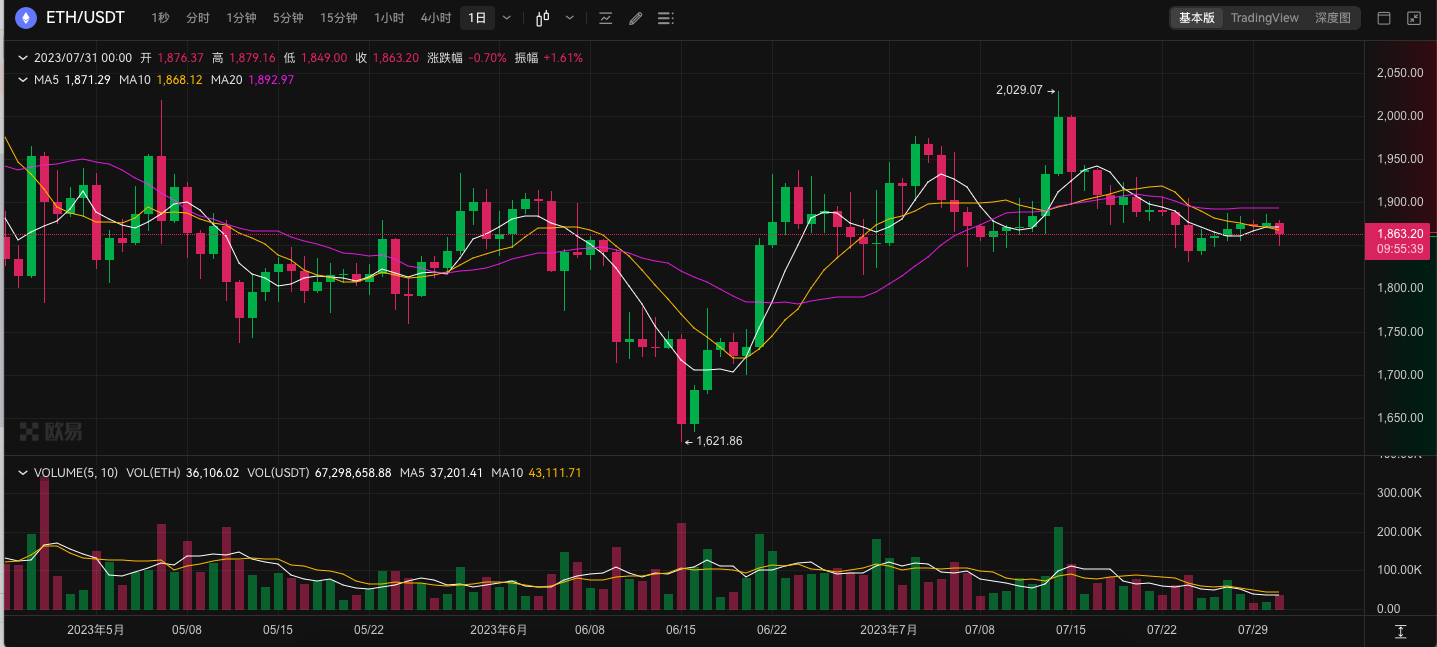
ETH daily chart, from OKX
The daily chart shows that the price is currently consolidating below $1900, with support at $1850. If it falls below, it may further decline to $1800; the resistance above is $1900.
2. Network Operation
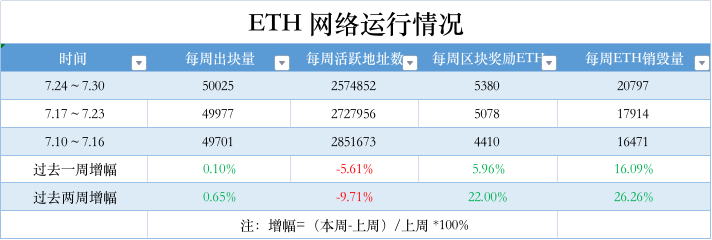
Etherscan data shows that the Ethereum network generated 50025 blocks in the past week, an increase of 0.1% compared to the previous period; the number of active addresses per week was 2574852, a decrease of 5.6% compared to the previous period; the block reward income was 5380 ETH, an increase of 6% compared to the previous period; and the weekly ETH burn reached 20797, an increase of 16% compared to the previous period.
3. Major Changes
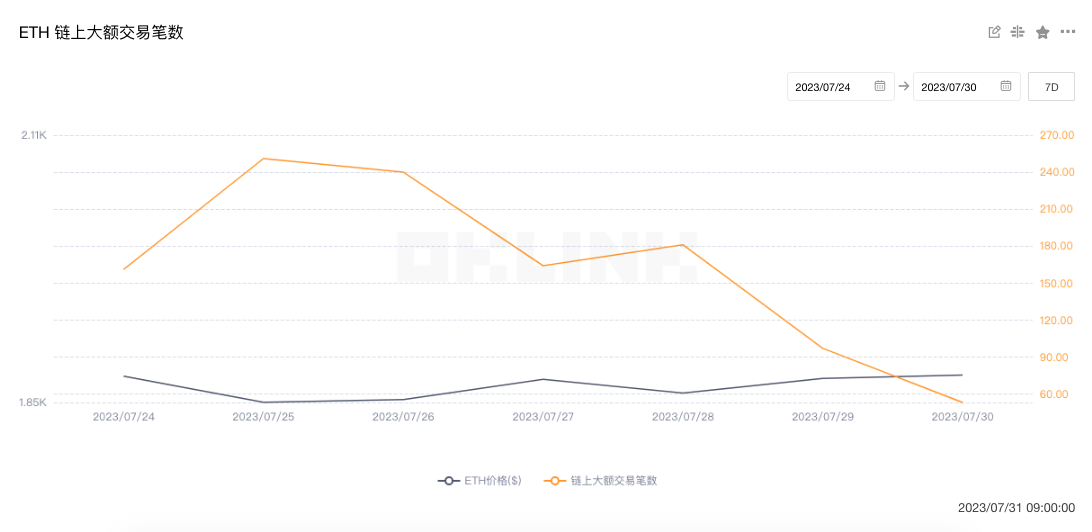
OKLink OKlink data shows that the number of large on-chain transactions reached 1147 last week, a decrease of 20% compared to the previous week (1446), indicating a significant decline in whale trading enthusiasm.
4. Rich List Addresses
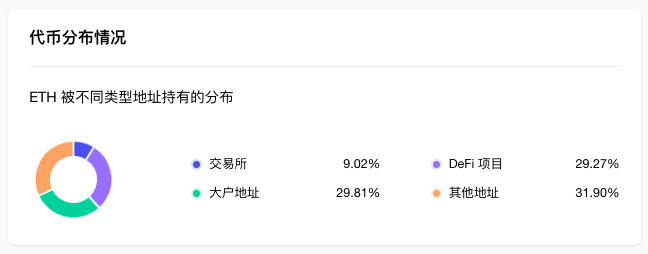
OKLink Data shows that, from the distribution of ETH holding addresses, exchanges account for 9.02%, an increase of 0.01% compared to the previous period; DeFi projects account for 29.27%, an increase of 0.27% compared to the previous period; large addresses (top 1000 addresses excluding exchanges and DeFi projects) account for 29.81%, a decrease of 0.18% compared to the previous period; other addresses account for 31.9%, a decrease of 0.1% compared to the previous period.
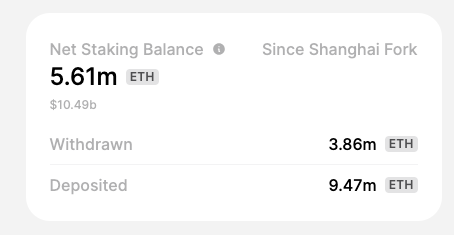
token.unlocks shows that the total amount of ETH staked on the entire network is currently 22.38 million ETH, with a staking rate of 18.36%; since the Shanghai upgrade, the cumulative deposit amount is 9.47 million ETH, last week's data was 8.99 million, an increase of 480,000 in the past week; the cumulative withdrawal is 3.86 million, last week's data was 3.79 million; the total net staking amount has increased by 5.61 million, with the previous week's data at 5.2 million, an increase of 410,000 in the past week.
5. Lock-up Data
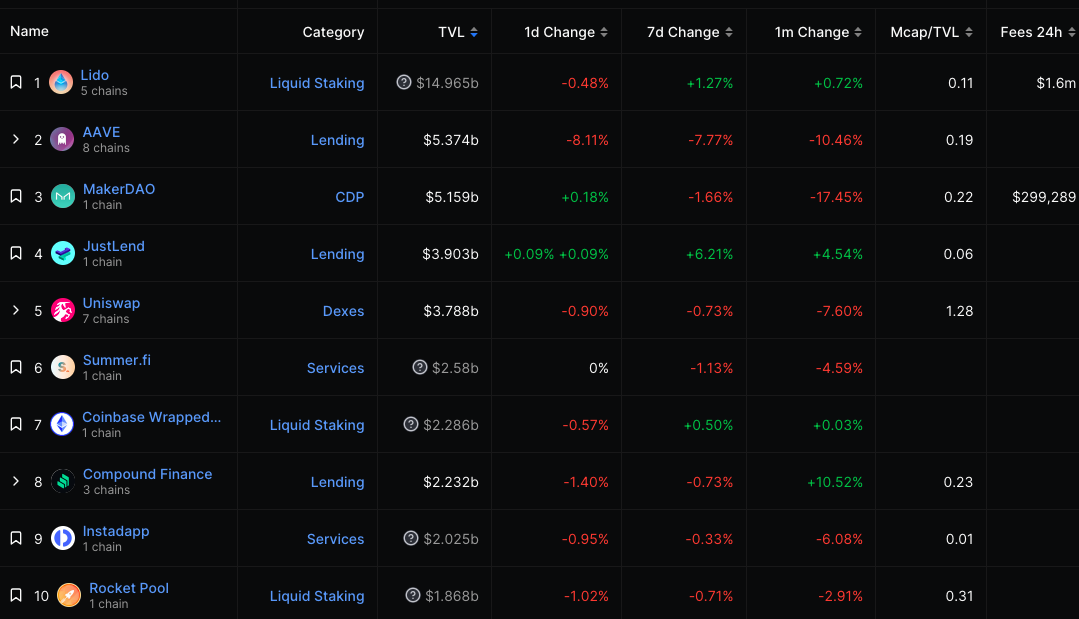
DeFiLlama data shows that the value of on-chain locked collateral decreased from $25.35 billion to $23.07 billion last week, a decrease of 9.8% compared to the previous period. The top three projects in terms of locked value are: Lido with $14.96 billion; Aave with $5.37 billion; and MakerDAO with $5.15 billion.
III. Ecosystem and Technology
1. Technological Progress
Christine Kim, Vice President of Galaxy Research, summarized the Ethereum All Core Developers Consensus (ACDC) meeting #114.
This meeting discussed the progress of the Deneb test. Devnet #8 is expected to be launched later next week or early the following week. Ethereum Foundation researcher Hsiao-Wei Wang is preparing a new version of the CL code specification for Devnet #8, which will be ready for client teams by July 31st. Due to the developers' expectation of having a dedicated testnet that includes all Deneb and Cancun-related EIPs, Danny Ryan emphasized the importance of testing MEV-Boost-related software as well as the CL and EL client versions.
Ethereum Foundation DevOps engineer Parithosh Jayanthi and another DevOps engineer are working on various Hive tests specifically designed for MEV-Boost. As of July 27th, the updates to the Builder specification have not yet been merged into the new version, which will be used for testing on Devnet #8 or other Cancun/Deneb testnets. Ethereum Foundation researcher Alex Stokes stated that the sooner the CL and EL specifications for the Cancun/Deneb upgrade are frozen, the sooner the new specifications for MEV-Boost software can be finalized.
Furthermore, the next Consensus Layer (CL) upgrade, Electra, may consider incorporating two EIPs. Among them, EIP-6914 introduces a code change that creates a method to reuse the validator index of validators who have completely exited the Beacon Chain to reduce the computational burden on CL nodes. EIP-6110 adds new validator deposits to EL blocks, allowing deposit handling and validation responsibilities to be carried out on EL instead of CL, thus increasing the security of validator deposits and optimizing the validator user experience.
2. Community Voice
Vitalik Buterin, co-founder of Ethereum, published an article titled "What do I think about biometric proof of personhood?" to explore his views on biometric proof of personhood.
Vitalik mentions that this is a valuable but complex tool that the Ethereum community has been trying to build. He also mentions some projects that attempt to address this issue, such as Proof of Humanity, BrightID, Idena, and Circles, as well as a larger and more ambitious identity verification project: Worldcoin. However, Worldcoin has faced criticism due to privacy and security issues with its "The Orb," design issues with its token, and ethical concerns regarding choices made by the company.
He concludes by stating that there is no ideal form of personhood proof, but there are at least three different method paradigms, each with its own unique advantages and disadvantages. The ideal approach is to view these three technologies as complementary and combine them together.
In principle, the concept of personhood proof seems to be of great value. Although various implementation methods have their risks, having no personhood proof at all also carries risks: a world without personhood proof seems more likely to be dominated by centralized identity solutions, money, small closed communities, or some combination of the three. Vitalik looks forward to seeing more progress on all types of personhood proof and hopes to see different methods eventually converge into a coherent whole.
3. Project Trends
Ethereum infrastructure service Flashbots has completed a Series B funding round of approximately $60 million at a $1 billion valuation. The funds raised in this round will be used to develop the MEV network SUAVE, a platform that allows users to transact on the blockchain more affordably and privately.
Flashbots confirmed in an email to The Block that the Series B funding round has been fully subscribed by "leading venture capital firms, Layer-2 networks," angel investors, decentralized exchanges and applications, as well as MEV supply chain participants. Additionally, a spokesperson for Flashbots confirmed to CoinDesk that Paradigm led the Series B funding round.
As previously reported, Flashbots sought to raise up to $50 million at a $1 billion valuation in January of this year. Sources revealed that crypto venture firm Paradigm has committed to leading the funding round. Data website Crunchbase lists Paradigm as the lead investor in Flashbots' seed funding round in 2020.
Linea tweets that since the launch of its mainnet Alpha version, over $20 million worth of assets have been bridged within a week, with 670,000 transactions completed, causing withdrawal times on Ethereum to temporarily increase. The team is working to expedite the bridging of assets from L2 to L1. Withdrawal times are expected to gradually decrease until they reach the target of 8-32 hours in the next few days, and all pending transactions will be processed. Linea explains that in order to carefully monitor transactions and protect user asset security, the team initially added a manual delay of at least 8 hours to the Linea Mainnet Alpha. The 8-hour delay will then be reduced to 4 hours, and further reductions will be made in the coming weeks, eventually eliminating the manual delay.
Ethereum Layer 2 ZK Rollup order book DEX ZigZag founder plans to raise $500,000 for their new Perp DEX Invisible with an estimated valuation of $10 million, through a round of public funding, with a minimum investment of $10,000. The funds raised will be used for audits, ZK proof providers, and initial operational costs. Invisible will be released as a standalone project, and a portion of the platform tokens (at least 20%) will eventually be unlocked and distributed to ZZ token holders. The exchange will collect fees and generate revenue from the beginning, and all fees will ultimately belong to token holders.
(4)OP Stack-based L2 network PGN officially launches on the mainnet
The Layer 2 network Public Goods Network (PGN), based on OP Stack, has announced the official launch of its mainnet. After six months of network launch, PGN will assess and allocate fees based on cumulative data. Gitcoin Grants 18 (GG 18) will run on PGN, and the donation round will take place from August 15th to August 29th, with applications opening on August 1st. As previously reported on July 7th, Gitcoin introduced the Layer 2 network Public Goods Network (PGN) based on OP Stack.
PGN is a highly composable EVM-compatible Rollup that plans to use the majority of sequencer revenue to support the Ethereum ecosystem and other public goods. After six months of mainnet launch, fees will be assessed and allocated based on cumulative impact data. Network alliances can be joined to collaborate on determining the distribution of sequencer fees. PGN commits to a minimum two-year experiment, allowing partners to run Dapps on PGN to support public goods funding. PGN's governance alliance includes Protocol Guild, Public Nouns, Clr.fund, Giveth, Hypercerts, Protocol Labs, Octant, Eco, Hedgey, Gitcoin, and others, who will oversee the distribution of sequencer fees to ensure growth and sustainability of public goods funding.
(5)Generative NFT art platform Highlight launches on Ethereum
Generative NFT art platform Highlight has launched on Ethereum. Highlight allows users to create, test, and mint computer-generated artworks as NFTs. It eliminates creator fees, enabling artists to retain 100% of the profits from their sales, while buyers only need to pay a small fee.
Highlight CEO Nathaniel Emodi said, "Highlight will be the first open platform for generative art on Ethereum, featuring zero creator fees, proprietary contracts, and open-source versions. We are collaborating with renowned generative artists, including Melissa Wiederrecht, James Merrill, Holger Lippmann, Leander Herzog, and more." (The Block)
In May last year, NFT platform Highlight, which focuses on community-building tools, completed a $11 million seed funding round. The round was led by Haun Ventures, founded by former a16z partner Katie Haun, with participation from 1kx, A_Capital, SciFi VC, Floodgate, Coinbase Ventures, 35 Ventures, Polygon Studios, Mischief VC, DAOJones, Offline Ventures, Gokul Rajaram, Lenny Rachitsky, WME, Method Management, and ThreeSixZero, among others.
(6) EigenLayer founder: EigenLayer aims to be part of the Ethereum staking layer
EigenLayer CEO and founder Sreeram Kannan said that ideally, EigenLayer will become part of the Ethereum staking layer, either through protocol upgrades or Ethereum Improvement Proposals (EIPs). Kannan explained that EigenLayer is not a new chain or a new Layer-1. Instead, it is a smart contract system that allows ETH stakers to "opt-in" and provide services to other systems, known as "active validator services". While the platform is currently going through an "initial governance process" and has been whitelisted for "cautious" purposes, it will eventually become a fully permissionless platform. (Blockworks)
(7) Ethereum dynamic storage expansion project EthStorage completes $7 million funding at a valuation of $100 million, led by dao5
EthStorage, the Ethereum Layer-2 network data storage solution project, has completed a $7 million seed round funding at a valuation of $100 million. dao5 led this funding round, with participation from SevenX Ventures, Foresight Venture, DragonRoark, Yunjiu Capital, Avant Blockchain Capital, Future Money Group, Gate Ventures, Vitalbridge, Galxe, GeekCartel, Rebase D. Ventures, W 3. Hitchhiker, and other angel investors.
EthStorage is a Layer-2 solution that provides programmable dynamic data storage based on Ethereum data availability technology. The team has received funding from the Ethereum Foundation's Ecosystem Support Program (ESP) twice, for research on data availability sampling and Layer-2 network dynamic data storage proofs. EthStorage also won first place in the "Super Demo" event at the Ethereum Community Development Conference (EDCON) held in Montenegro in 2023. All funding will be used to expand the team, support research, develop products, enhance the brand, and attract more ecosystem partners to use EthStorage.
(8) Ethereum scalability project AltLayer has deployed over 100,000 Flash Layers
Ethereum scaling project AltLayer announced that as part of the Altitude phase three, over 100,000 Flash Layers have been deployed. AltLayer collaborated with EigenLayer to enable stakers to launch Flash Layers within minutes.
(9) Ethereum Genesis Block has reached its 8th anniversary, with a total of 16.5 billion USD in fees consumed.
Ethereum was officially launched on July 30, 2015. The Genesis Block with block height 0 was created at 03:26:13 UTC time, providing a block reward of 5 ETH. The Ethereum mainnet has now been running for 8 years. Over the past 8 years, the Ethereum network has processed 2.04 billion transactions and consumed approximately 16.5 billion USD in fees.
Tom Wan, an on-chain analyst at 21 Shares' parent company 21co, tweeted that the total market value of stablecoins on the Ethereum blockchain has dropped from 100 billion USD to 76 billion USD since the beginning of the year, a decline of 24%. The decrease in total market value is mainly due to USDC and BUSD, with USDC decreasing from 41 billion USD to 24 billion USD (-40%) and BUSD decreasing from 16 billion USD to 3 billion USD (-77%).
USDC has become the biggest beneficiary, with its market dominance increasing from 32.3% to 51.5%. TUSD and DAI saw a slight increase in market share of 0.5%. GHO is currently priced at $0.982, experiencing a 1.8% decoupling. GHO was launched by Aave on July 15th. The decoupling might be due to its fixed borrowing interest rate of 1% to 1.5%, which could lead borrowers to sell it for higher-yielding stablecoins, causing significant selling pressure.
Euro stablecoins on Ethereum remain scarce, with a market dominance of only 0.8%. Despite a decrease in supply of Circle's US dollar stablecoin USDC, the Euro stablecoin EUROC has increased by 82% since the beginning of the year. However, Tether's EURT still holds a dominant position in the Ethereum-based Euro stablecoin market with a 70% market share.





