Reflections on Black Mountain EDCON2023 one month later: Infrastructure and Application Trends Outlook


Original Author: jessica shen
In 2013, Vitalik Buterin wrote the Ethereum whitepaper. 10 years later, in 2023, the EDCON (Community Ethereum Development Conference) was held in Podgorica, the capital of Montenegro. There were no grand celebrations or formalistic hustle and bustle. What I felt was that developers from around the world were working on solving the blockchain "impossible triangle" and improving decentralization, privacy protection, and scalability in their respective areas of expertise. They sought to find points of collision, resource exchange, and win-win cooperation through communication.
Although there were no new "wealth codes" or innovative ideas presented at the conference, making it seem like the Ethereum roadmap was nothing new, I deeply felt that the impact of AI transformation on blockchain is gradually spreading. The significance of holding EDCON annually is to allow developers in the ecosystem to once again clarify the direction of the Ethereum roadmap, review the progress of planned implementations, sort out the pressing problems that need to be solved, and engage in discussions about breaking the technological "boundaries" in their respective fields. For example, how to achieve better privacy protection and scalability, provide higher security and stability, and create better user experiences (UX) and user security (US) for future applications. Participants exchange innovative points of view, standing from a global perspective to understand the significance of various technological and cultural changes for the future of Ethereum.
I attended the EDCON 2023 conference and a series of side events in Montenegro, including the Community Day themed sessions, Super Demo presentations, the World Supercomputer Summit 2023, the DAO Montenegro Conference, and the Account Abstraction HackerHouse event organized by Antalpha Labs. Within the limited time in Montenegro, there were also other events that I wanted to attend but couldn't, such as the ZK Community Breakfast and the Zuzalu event. To make up for missing these events, I interviewed friends who participated in them to learn about their experiences and insights, and I have compiled them into this article to share with everyone.
Summary of Insights
The discussions at EDCON 2023 revolved around how to overcome the privacy, scalability, and decentralization challenges, known as the Scalability Trilemma, in infrastructure. Currently, the technologies of Zero-Knowledge (ZK), Account Abstraction, and Layer 2 are at a mature stage, providing a fertile ground for application innovation.
Zero-Knowledge Proof technology was widely discussed, including zkEVM, Zero Knowledge Machine Learning (ZKML), and the composability opportunities of ZK technology in various scenarios (Programmable Cryptography).
About On-chain Gaming, account abstraction, and LSD, there have been many discussions, but there is still a waiting for innovation in the application layer.
ZKML is on the eve of an explosion, and AI may inject new vitality into blockchain under the empowerment of ZK technology. The ZKML open-source community is worth looking forward to.
The account abstraction track is "flat, hot, and crowded," and capturing the value of the track is a challenge.
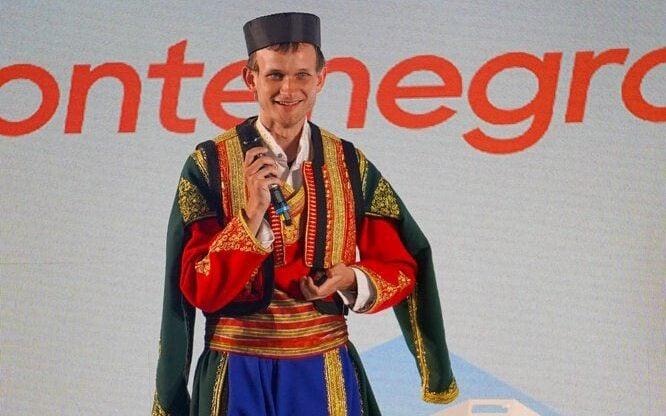
Vitalik Buterin speaks at EDCON 2023 conference
Source: UZMANCOIN.COM
Important Topics at EDCON 2023
The main topics at EDCON 2023 revolve around solving the blockchain trilemma—privacy, scalability, and decentralization. Vitalik Buterin's proposal of The Scalability Trilemma a few years ago has clearly defined the direction of Ethereum's technological development. In the past decade, there have been continuous updates and advancements in the infrastructure layer's technology, and innovation in the application layer keeps emerging. However, we still have a considerable distance to go to achieve the beautiful vision. Each area in the trilemma requires more breakthroughs.
The Scalability Trilemma
Image source: https://vitalik.ca/general/2021/04/07/sharding.html
The author has summarized their own gains in the industry segment and trends, divided into infrastructure level and application level. In the infrastructure field, Zero Knowledge Proof (ZKP) and Layer 2 network (L2) have received the most attention from speakers and attendees and are also one of the most discussed topics. The main topics in the development of DApp applications are On-Chain Gaming, Account Abstraction (AA), and LSD (Liquidity Staking Derivatives) tracks.
It is worth mentioning that in the ZKP field, the author has felt that EDCON 2023 and the surrounding conferences have shown many "ZK+" combinable trends in their discussions. Zero knowledge proof, as a means of privacy protection and scalability, is being tried in multiple areas on-chain and off-chain. Customized cryptography is usually used, while the demand for more emphasis on general-purpose "Programmable Cryptography" has been demonstrated repeatedly. In the application field, developers are more concerned about user experience (UX) and user security (US). Account abstraction improves UX, and accelerating blockchain "Mass Adoption" seems to have become a prerequisite for discussions on application innovation, which is also a joint effort by both infrastructure developers and application developers.
The development of things follows the law of "spiral rise in infrastructure and application fields". EDCON 2023 reviewed the current development status of the Ethereum ecosystem and trends in various fields, as developers are advancing infrastructure upgrades while waiting for the moment of application outbreak.
1. Infrastructure
At the infrastructure level, ZK technology's applications in blockchain and off-chain domains, including zkEVM (Layer 2 scaling solution), ZKML (Zero Knowledge Machine Learning), Programmable Cryptography, have undoubtedly been hot topics during the Black Mountain event and its peripheral activities. In Vitalik Buterin's presentation, he mentioned "ZK-SNARKs are going to be as important as blockchains in the next 10 years," which has also become a focal point of interest.
 Vitalik Buterin's presentation at EDCON 2023
Source: https://foresightnews.pro/article/detail/33488
1.1 There is no shortage of new players joining the competition, and the track will maintain a high level of heat
In the first half of 2023, we have seen many zkEVM projects go live on the mainnet, including Polygon zkEVM, zkSync Era, and Starknet. In the second half of 2023 to 2024, the industry may witness the launch of many zkEVM projects on the mainnet, including Scroll, Linea, Taiko, etc. Currently, these three projects are in the testnet phase, collecting developer feedback, and more. All these zkEVM projects have had high exposure and participation at EDCON 2023, frequently appearing in the speeches of Vitalik Buterin and other guests, including emerging projects. The developers of zkEVM are passionate about their ventures and have shared the recent progress and future goals of their projects with the attendees, expressing their expectations for technical advancements and product updates. The industry's healthy competition is evident to all. In the next 1-2 years, we will continue to see zkEVM's Layer 2 networks stand at the center stage of the Ethereum ecosystem.
Polygon zkEVM's Technical Lead Jordi Baylina shared the latest progress of the Polygon zkEVM project at the conference, including improvements to the Polynomial Identity Language 2 (PI L2) language, the implementation of a data compression solution to address data availability, and reiterated the support for account abstraction through ERC-4337 by Polygon zkEVM. He also shared his thoughts on the landscape of blockchain Layer 2 solutions. It caught my attention that Jordi mentioned various data compression solutions adopted by Polygon zkEVM and the formal approval of EIP-4844, both of which will further reduce costs and greatly enhance data availability on Polygon. According to Jordi, we will see more Layer 2 networks in the future, and the composability between the L2 solutions in the Polygon ecosystem will be achieved through Proof Aggregation. Proof Aggregation will help generate a single proof for all L2 chains in the Polygon ecosystem, increasing the composability between them.
Kakarot this zkEVM project also attracted attention during and after the meeting. Kakarot is a zkEVM project built on Starknet using the Cairo language, and recently announced its financing news, causing attention because Vitalik Buterin is one of the investors, and Starknet's co-founder and Starkware's official also participated in the investment. Kakarot's co-founder Elias Tazartes gave a public speech at the EDCON 2023 conference, showcasing Kakarot's mission and vision to the world. Vitalik Buterin also mentioned the Kakarot project in his speech. The highlight of the project is that it provides an environment of EVM for Starknet based on the Cairo language, allowing Solidity language developers to deploy applications directly to Starknet through Kakarot without the need to reprogram using the Cairo language. In other words, Kakarot creates an EVM-compatible platform on Starknet, so many excellent EVM projects can be quickly deployed to Starknet, reducing the effort and time for developers to maintain Cairo and Solidity code libraries. Kakarot sounds like it can be a standalone Layer 3 on Starknet, but the team will first focus on the Rollup-as-a-Service service in Q4 2023. In an interview with Blockbeats, Elias stated that the competition in the future Layer 2 track will be even more intense. As a zkEVM platform, Kakarot will actively cooperate with Starknet, Polygon, Linea, and others, and welcome Solidity language and Cairo language developers from China to join their efforts in this field.
1.2 The demand for Programmable Cryptography is revalidated
In addition to zkEVM, ZK technology is being used in more and more scenarios, creating a growing demand for Programmable Cryptography. Programmable Cryptography was officially proposed by 0xparc. With the emergence and updates of zk-SNARK and other cryptographic tools, more general-purpose cryptography can help developers quickly implement encryption in applications such as digital identity and reputation without the need to learn and develop privacy protection technologies from scratch. With more programmable cryptographic development tools, privacy encryption may be applied on a larger scale to blockchain applications and off-chain computing and models. In Jason Morton's "What Is Unlocked by Practical Zero-Knowledge Proofs?" presentation, he also mentioned that "ZKP is becoming more programmable." Programmable Cryptography was also mentioned multiple times by guests such as Vitalik Buterin in the ZK Panel discussing zero-knowledge proofs, demonstrating a great anticipation for this more general-purpose cryptographic application.
 Barry Whitehat at EDCON 2023 speech
Source: https://twitter.com/search?q=programmable%20cryptography&src=typed_query EDCON 2023 ZK Panel Roundtable Discussion
Source: https://twitter.com/madhavanmalolan/status/1660269927671156736
1.3 ZKML is in its early stages of development but has enormous potential
ZKML, which stands for Zero Knowledge Proof and Machine Learning, is a combination of the two technologies. It is well known that machine learning models have trust issues in many aspects, such as the confidentiality or openness of input and output data, algorithms, and model parameters. When trust issues exist, ML models face obstacles to achieving larger-scale applications. For example, when using personal information as raw data for training, there is a need for encryption of personal information; model parameters are often the core competitive advantage of the development team and need to be encrypted to maintain a competitive edge. Zero knowledge proof technology can provide proofs for many things other than smart contracts. Especially in the context of machine learning becoming more and more prevalent, ZKP can provide proofs for an AI model with millions of parameters, thereby enhancing security and privacy protection and helping to address various trust challenges in machine learning models. In addition, machine learning models require a large amount of computation. When ML models are integrated into blockchain applications, they can use ZK-SNARK to generate proofs, which helps alleviate the computational power requirements of ML and more efficiently incorporate AI into blockchain applications. As artificial intelligence and machine learning continue to disrupt our lives this year, ZKML is becoming increasingly well-known and recognized.
At EDCON 2023 and many other blockchain conferences this year, we can feel that many blockchain developers have already joined the field of ZKML (readers who need to learn about this concept can refer to the article about ZKML on WorldCoin's blog). As early as the second half of 2022, WorldCoin and some teams in the ZKML field created the ZKML Community, which introduced the concept, advantages, and future prospects of ZKML to people at public events such as ETH Denver in 2023. At the first World Supercomputer Summit 2023 held in Montenegro, most of the keynote speakers are engaged in ZKML-related initiatives. Cathie So, a core member of PSE (@drCathieSo_eth), introduced AIGC NFT EIP-7007, depicting the innovative sparks that the combination of ZK and ML can generate and further envisioning how the future World Super Computer Architecture will empower the implementation of ZKML. The PSE team is dedicated to integrating ZKP technology with the Ethereum ecosystem and actively participating in the research and projects of ZKML. In addition, Hyper Oracle (zkOracle project on Ethereum), Poseidon ZKP (ZK aggregation proof infrastructure), Modulus Labs (on-chain AI project development team), and WorldCoin's DCBuilder are all keynote speakers at the first WSC conference. Among them, Modulus Labs, as a pioneer in the ZKML field, has conducted many experiments in the application of ZKML, including the Rockefeller Bot for DeFi (the first AI trading bot for the entire chain) and the GameFi.nbsp;Leela vs the World (the first full-chain AI game) and NFT projects, etc. At EDCON 2023, Jason Morton, as a developer in the ZKML field, shared his observation that the number of floating-point operations per second (FLOPS) for ZKP has been rapidly increasing in the past few years [Note], but the proof per chain transaction is still at the level of tens of thousands. He predicts that a breakthrough will be achieved in the next 3 years when the proof per chain transaction further increases to the level of billions. He envisions the application scenarios of combining ZK with blockchain in the fields of chain games, supply chains, and payment transactions when the speed of proof per chain transaction reaches the level of hundreds of millions or even billions.
In many guest shares, it is mentioned that ZKML is still in the early stage of development. As one of the pioneers in the ZKML field, WorldCoin's ZKML community, which was recently established, has already attracted numerous developers and peers in the field. As more and more products are led by AI and more innovations come from AI and ML updates, ZK can serve as a means of privacy protection and accelerated computation, further empowering a society driven by AI. Although this demand is not currently very obvious, if we have already foreseen a world where AI is ubiquitous, then model and information encryption and improved computing speed will be the rigid requirements of the future. There are more and more programming tools in the market that can help developers create ZK proofs for AI models without the need to learn all the cryptographic skills related to ZKP. This will open up a huge market for more ZKP DApps. The significance of blockchain to AI or ML will also be multi-layered. Blockchain itself can provide tamper-proof and decentralized on-chain records, and cryptocurrencies themselves can become borderless currency systems in the coexistence of AI and humans.
[Note]: FLOPS, floating-point operations per second, is used to measure the speed of computer operations or estimate computer performance.
2.Application DApp
At the EDCON 2023 conference, we heard more discussions and exchanges about underlying technologies and fewer discussions about DApp applications. Among them, on-chain gaming, account abstraction, and the LSD track were the majority.
2.1 On-Chain Gaming Presents an AI Trend
For applications, there is still a high expectation for On-Chain Gaming. At the conference, when zkEVM public chain projects were asked about what on-chain applications they think have potential, most of the answers were on-chain games. When Danilo Kim shared his experience in Zuzalu during the conference, he mentioned the on-chain AI game projects Zuland and Zuzuland that were born during his time in Zuzalu. During Zuzalu and EDCON 2023, Small Brain Games' AI-based fully on-chain game Network State also attracted attention. It is a tabletop role-playing TRPG game inspired by Slobbovia. On-Chain Gaming is showing a trend toward AI.
Currently, the reason why On-Chain Gaming has become the main topic of application discussion is not because on-chain games already have traffic, but because the market lacks new narratives. After the DeFi summer, the horizontal competition among DEXs and vertical business expansion have made the network effects of the top players even more apparent. However, the top DeFi protocols have not created new hotspots for public chains. To lead the explosion of traffic, we cannot take the old route. The NFT boom happened on Ethereum, but even Ethereum-based NFT lacked innovative momentum during the bear market. NFTs that simply tell IP stories require a lot of operational energy and time, while NFTs with more GameFi elements and metaverse narratives require time to develop products. NFTs with utility types and membership types require the involvement of numerous traditional enterprises. Massive outbreaks also require preliminary user education and the long-term thinking and operation of traditional brand's own technical teams. On-Chain Gaming has received more expectations this year due to the introduction of more AI/ML elements, which have increased the flexibility and richness within on-chain games. For example, ZKML has brought Autonomous NPC or AI God roles, bringing some new inspiration to on-chain games. And since ZK is a hot topic, the On-Chain Gaming track naturally receives more anticipation. However, no matter which application track it is, leading the narrative and generating a large amount of traffic in a bear market face more challenges. Therefore, when it comes to discussing applications, the answer is always anticipation, but there is no very clear direction.
2.2 Account Abstraction: Fierce Competition and the Challenge of Value Capture
The concept of Account Abstraction (AA) has been around since the early days of Ethereum. In recent years, there have been advancements at the protocol standard level, particularly with the formal deployment of ERC-4337 in March 2023, which has once again attracted attention from the industry and sparked a surge in entrepreneurial and investment "enthusiasm". However, the current reality is that the Account Abstraction race has become quite "crowded" and fiercely competitive, with participants facing challenges in value capture and business models.
During EDCON 2023, Antalpha Labs held the HackerHouse event focused on the theme of account abstraction. They invited developers, investors, and researchers in the field of account abstraction to share insights and interact, including Compass DAO, Candide Wallet, Account Labs (Unipass and Keystone merged), as well as research teams supporting account abstraction like L2 Mantle Network, Compass DAO, and Mirana Ventures. I attended the HackerHouse event for a week and gained a lot from listening to the guest speakers, deepening my understanding of the current development status of the track. I would like to thank Antalpha Labs for organizing the HackerHouse event and opening it to the public, allowing participants to learn from each other in a relaxed communication environment.
 Account Abstraction HackerHouse by Antalpha Labs
Source: https://mp.weixin.qq.com/s/kYMkw1lhP0ywp6e35NRqvw
At the current stage, many wallet projects, underlying public chains, and emerging startup teams are actively implementing and implementing account abstraction-related businesses. During the hackathon, I participated in the Community Day event of EDCON 2023 and the Account Abstraction HackerHouse hosted by Antalpha Labs. After listening to the sharing of various account abstraction projects, I felt that the account abstraction track is "flat, hot, and crowded". "Flat" means that there is not much difference in the technical level and functionality of account abstraction SDKs and wallet projects, and there is no obvious leading team or product in the track. "Hot" means that investors and entrepreneurs have a high enthusiasm for account abstraction wallet projects in recent years. The atmosphere of various conferences and peripheral activities can feel that account abstraction is the trend, and more and more smart contracts will naturally be developed using AA SDKs. The built-in wallet supports account abstraction, and the public chain layer will also be more inclined to directly support account abstraction (such as Starknet, zkSync, etc.). "Crowded" means that there are many participants in the track, which has also led to extremely fierce competition in the track.
 SevenX about the project information of the account abstraction track.
Source: https://foresightnews.pro/article/detail/23205
Multiple wallet teams within the track have already developed excellent products, and in terms of technology and development progress, there are no projects in the track that are far ahead and difficult to catch up with. The competitors are almost all keeping up with each other. In terms of account abstraction SDK, there are already multiple SDK providers, such as Gnosis Safe, Biconomy, Alchemy, Web 3 Auth, Etherspot, and other teams. In recent years, almost all wallet projects are developed based on the ERC-4337 protocol, and they pay more attention to the B2B2C business model, focusing on the developer experience for B-side applications and the user experience for C-side. In terms of functionality, features such as social recovery, anti-censorship, non-custodial, privacy protection, and multi-chain are almost essential options. In addition to SDK providers, wallet projects have also made many attempts and efforts in exploring more applications of account abstraction. The underlying logic is that when account abstraction is more widely applied and implemented into smart contracts, capturing the smart contracts (B-side) with a large flow of C-side users can enable the wallet itself to achieve value capture. This is also the reason why wallet tracks have to vertically expand their business in the B2B2C business model. In addition to creating scenarios, some wallet projects are also making efforts to build infrastructure, including developing SDKs, to attract customers. However, in the value capture process, many SDKs are public goods, making it difficult to help SDK projects capture value. The Wallet-as-a-Service charging per use also makes it difficult to improve business scalability. MEV income also faces competition, and many leading wallet projects are exploring more possibilities in the value capture process.
With the official deployment of ERC-4337, account abstraction has also gradually been implemented in applications. The protocol implementation is an important link to improve on-chain UX and US, and it will be an important tool to bring about mass adoption. Currently, the account abstraction track is fiercely competitive, and both SDKs and application scenarios are exploring how to attract more users. The B2B2C business model of wallets is gradually taking shape, but effective means of economic value capture within the industry chain are still being explored.
2.3 LSD track's long-term investment has certainty.
If On-chain Gaming is the most discussed application among Ethereum developers in formal public occasions, then LSD and LSD-Fi are the topics that I hear people discussing more after the conference. Many speakers discussed the "decentralized nodes," and how to strengthen the decentralization level, stability, and security of POS, are the technical points that developers continue to explore. In the process of communicating with the participating investors, cryptocurrency funds have shown confidence in the LSD track. Perhaps during the bear market, after many bubbles have faded, the LSD track centered around the POS mechanism is a field with relatively higher determinism and stability. Readers who are interested in the research on the LSD track can read Mint Ventures' recent research reports:
After the Shapella Upgrade: Yield, Competition, and the Long-term Impact of LSD-Fi
pSTAKE Project Overview: Binance-supported Midsection Project of LSD
Conference Experience
1. ZKML on the verge of explosion, more machine learning applications will adopt ZK encryption in the future
This year, we have seen more and more AI-driven products disrupt our previous way of life and work. Machine learning (ML), as an important subset of AI, has been applied in many off-chain scenarios. ML exploration on-chain faces challenges such as computational cost and speed, model trust, and privacy protection. ZK encryption can generate proofs for ML models off-chain, empowering smart contracts on-chain, making them more intelligent and flexible. When ML is applied on the blockchain, the industry gains more imagination.
In recent years, ZK technology has matured in both software and hardware, and it can be used to solve a series of computational issues, trust issues, and privacy protection issues that exist in traditional machine learning (ML) models. ZKML is also one of the areas that Sam Altman's cryptocurrency project WorldCoin is actively promoting and developing. WorldCoin, along with numerous research teams and projects in this field, has established the ZKML community to jointly research and promote the technology and applications of ZKML.
 SevenX's organization of the ZKML ecosystem
Source: https://appliedzkp.org/
Currently, some early-stage ZKML applications are in development. The previously mentioned ones include on-chain AI trading robots, on-chain AI games, as well as using off-chain ML models to suggest parameters for DeFi protocols. The project being built by WorldCoin is similar to zk-DID, using ZKML to ensure the privacy of biological information and supporting future upgradability of Iris Code. In the future, we can expect to see more machine learning models enter the blockchain field, and ZK technology will accelerate this "future".
In addition, here is an excerpt from a slide by Daniel, the founder of Modulus Labs, at the WSC conference:
"The application of ZKML is when AI is an excellent tool but there are difficulties in 'trust.' This is the underlying logic that combines ZK technology with AL/ML. As the concepts of AI and ZKML become more and more popular, we will see various pseudo ZKML projects. However, grasping the underlying logic and significance of their combination can prevent us from getting lost in hype and bubbles."
 Modulus Labs' presentation at the World Supercomputer Summit 2023
Source: https://drive.google.com/file/d/1KJ6csWNpwBPoy8DeJtW_2mY2Ii8h46yK/view
2.Account Abstraction Track "Hot and Crowded"
As mentioned earlier, the author has observed in the EDCON 2023 conference, post-conference interviews, and regular work exchanges that the concept of account abstraction is gradually being applied. There are many participants in the field, and many wallet projects hope to achieve a layout that covers the entire industry chain in order to better connect the B2B2C business model. However, the more profound challenge faced by the field is the establishment of a value capture system. As mentioned above, intense competition will turn the account abstraction SDK into a public good, making it difficult for B-side businesses in smart contracts to scale and fiercely competitive. The end users of the wallet, the C-side traffic, is still dominated by DApps, which brings value capture challenges to many account abstraction wallet projects. However, for users, Ethereum will continue to promote ERC-4337 for larger and more profound applications, providing users with better UX and US. I believe that in the next cycle, account abstraction will no longer be a concept, but a seamless and marvelous experience in a high-traffic application, which is worth looking forward to.
3. The important role of Public Goods in the blockchain industry has been mentioned multiple times
In the sideline activities of the EDCON 2023 conference, Buidler DAO, SeeDAO, and Mask Network jointly organized the DAO Black Mountain Conference, which included discussions on public goods. Scott Moore, the founder of Gitcoin, also discussed Public Goods at the conference, emphasizing the importance of "coordination" in helping blockchain protocols solve current social network problems. (Gitcoin, as an open-source project funding platform, aims to build and fund digital public goods.) During the conference, the author happened to discuss the topic of public goods with the founders of Manta Network and Poseidon ZKP, Shumo. "The ultimate goal of blockchain infrastructure is public goods," Shumo said. In my understanding, blockchain infrastructure is similar to "quasi-public goods" like highways, with limited non-competitiveness and limited exclusivity, and should be used more widely by society as a tool to improve the financial system, lifestyle, and work efficiency. Infrastructure code in the industry is usually open-source, which is due to the blockchain's open-source culture and atmosphere, as well as the concept of equality and win-win brought by later Web 3.0. As a result, it is difficult for infrastructure projects to maintain exclusivity because there will always be new open-source projects that bring free positive externalities to the industry.
When communicating with other participants, the author can feel that many Ethereum developers have little utilitarianism in their original intentions. Their starting point is usually to solve a certain problem or pain point in the Ethereum ecosystem. The products or projects they develop are usually open source for everyone to use and improve. Most of the underlying infrastructure of blockchain is open source and public goods, which is one of the reasons why the cryptocurrency and blockchain industry can iterate rapidly.
 Speech by Gitcoin Founder Scott Moore at EDCON 2023
Source: https://www.youtube.com/watch?v=PHLP_T42840&list=PLe3T1ZflXe4GsxOvHAktPweug0qoBBtKz&index=3
Summary
The PSE Foundation's Andy Guzman mentioned in his speech "Harnessing ZK and Existing Infrastructure for Ethereum's Mass Adoption" that the current stage is the period of technical maturity for ZK, account abstraction, and L2. The convergence of these three forces will enhance the User Experience (UX) and User Security (US) of Ethereum. According to his depiction of the future, we can imagine that on a faster, safer, and more stable Layer 2, ZK encryption technology will empower AI/ML to bring more flexible DApp applications. At the same time, account abstraction will better help new users enter the cryptocurrency field, and users will have a more secure, convenient, and cost-effective account experience and interaction. EDCON 2023 brings together global developers and industry peers to examine the current development progress and status of Ethereum, exchange the latest industry trends, and collide viewpoints to generate innovative ideas.
Andy Guzman's speech at EDCON 2023
References
EDCON 2023 Speakers and Themes Announced, Vitalik Buterin, Balaji Srinivasan, and more - BitFinance
Highlights and Key Projects of Ethereum Black Mountain Conference - ODaily
Vitalik Buterin: Future Importance of zk-SNARKs in the Next 10 Years - Foresight News
EDCON 2023: Summary of Vitalik Buterin's Speech and Review of High-Quality Projects
Hot Trends and Key Focus Projects at the Ethereum Black Mountain Conference
2023 Ethereum Community Developer Conference: Beyond Black Mountain, No "Clear Path"
DAO Black Mountain: Exploring Organizational Challenges in a Global Crisis with Vitalik
"No Chinese": Arrogance and Prejudice at EDCON Black Mountain
Conversation with Tsinghua Professor Hu Yilin: Philosophical Speculation on Transhumanism and Web 3
V God has uploaded a game he made in 2011 to IPFS; V God: Don't overload Ethereum consensus, or it will bring high risks to the ecosystem
ZKPs and "Programmable Cryptography" by gubsheep | Devcon Bogotá
Balancing the Power of AI/ML: The Role of ZK and Blockchain by SevenX
May 18, 2023 – ERC-7007: a zkML case study @ World Supercomputer Summit
https://www.youtube.com/watch?v=ZiLn5ReVFYc&list=PLe3T1ZflXe4GsxOvHAktPweug0qoBBtKz&index=13
Understanding Zero Knowledge Machine Learning (ZKML): What kind of sparks will ZK and AI collide?
Acknowledgment
Thank you to the industry peers who participated in the interview, including Derek from BTX Capital (@begas_btxcap), Jack from Blockbeats (@jack_xiong 137 ), 0 x Minion from GBV Capital (@ 0 x minion), Ray from CypherBabel Index (@CryptoGOOO), Suede from Hyper Oracle (@hyperoracle), Shumo from Poseidon ZKP (@shumochu), Tommy from Beosin (@TommyDeng_DAO), Hank from Bixin Ventures (@ 0 x Hankester), and Qi Zhou from EthStorage (@qc_qizhou).
Special thanks to Maxlion (@Real_Maxlion), Wang Ye (@snapp_yebit), and Gigi (@realgigiyip) for helping proofread the information and providing insights!